Cart
0
You may also like

Book a call with our development team to get started.



Apply online and access wholesale pricing.

Cookie exchanges are one of the most cherished holiday traditions, bringing bakers together to share homemade treats and leave with a delightful variety. Whether you're a home baker preparing for a neighborhood swap or a small bakery fulfilling seasonal orders, the right cookie exchange packaging protects your baked goods while creating a gift-worthy presentation. This comprehensive guide walks you through every packaging option—from window boxes that showcase decorated cookies to cellophane bags for budget-conscious events—with specific sizing recommendations, material specifications, and ordering timelines to help you make confident decisions before the holiday rush.
Cookie exchanges follow a simple but delightful format: each participant bakes one recipe in quantity (typically 2-5 dozen cookies) and trades portions with other attendees, leaving with an assortment of homemade treats. This tradition creates unique packaging demands that differ from standard bakery or gift scenarios.
The packaging must serve dual purposes. First, it needs to protect cookies during transport to the exchange venue—whether that's a short drive across town or mailing to distant participants. Second, it must allow easy division and redistribution, since most exchanges involve splitting each baker's contribution among multiple guests. A baker bringing five dozen cookies to a twelve-person exchange will see those cookies repackaged into smaller portions for each attendee to take home.
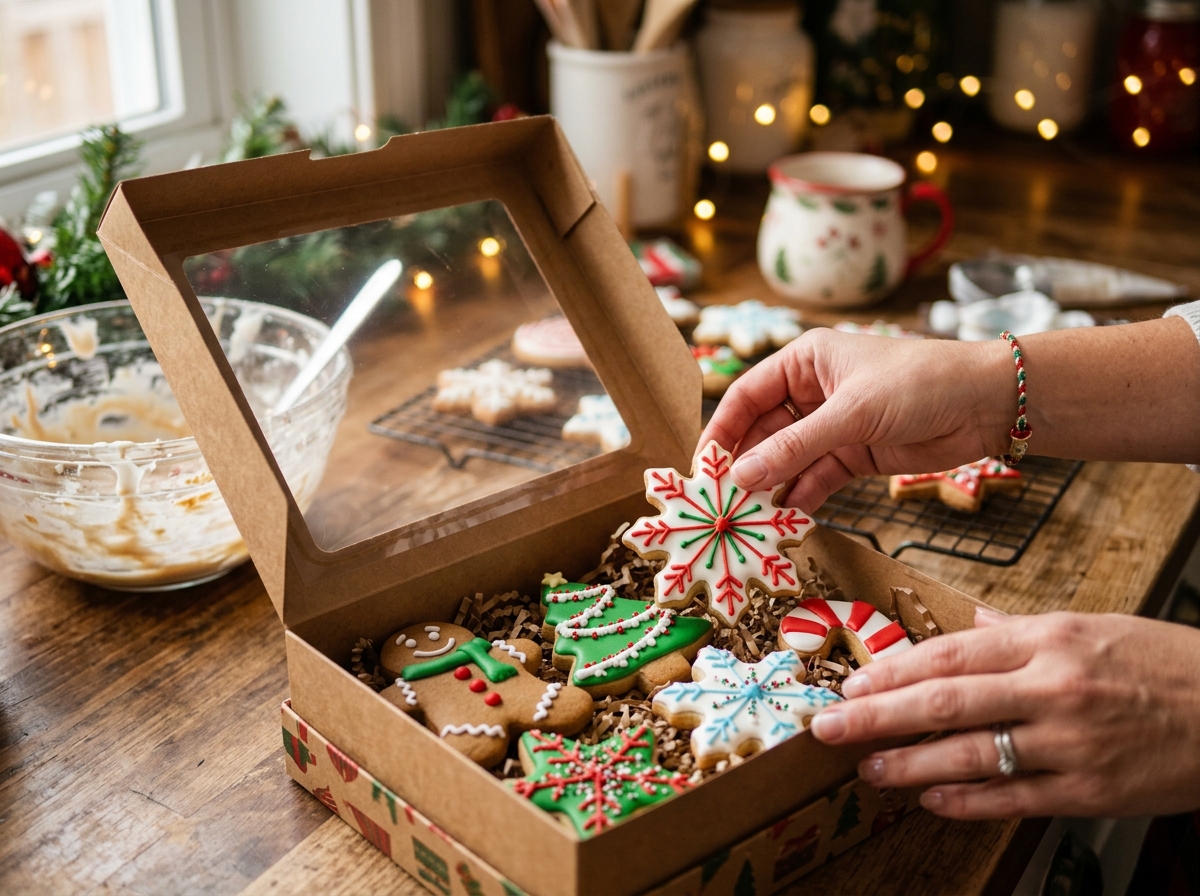
Home bakers typically prioritize cost-effectiveness and visual appeal for these events, while small bakeries face the additional challenge of maintaining brand consistency and meeting higher volume demands. Both audiences benefit from understanding the three primary packaging categories: window boxes that display decorative work, cellophane bags offering flexibility and value, and kraft paper options that communicate eco-conscious values.
The FDA regulates all food contact materials, ensuring packaging meets safety standards for direct contact with baked goods. This federal oversight means reputable packaging suppliers use approved materials, but understanding basic food-safety principles helps you evaluate options and store cookies properly.
Cookie exchange events peak sharply in December, with ordering timelines becoming critical for bakeries serving this seasonal market. Planning your packaging purchases 8-10 weeks ahead of your event date prevents stock shortages and rushed decisions.
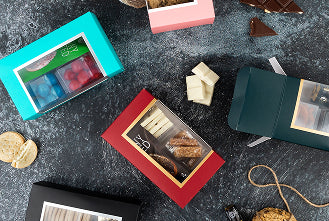
Window cookie boxes combine the structural protection of paperboard with transparent panels that display your decorative work. These boxes excel when presentation drives value—decorated sugar cookies with royal icing, intricate gingerbread designs, or beautifully piped butter cookies all benefit from visibility before the recipient opens the package.
The tall paper boxes with window in white measuring 8x5.5x2.5 inches provide an ideal format for standard cookie exchange portions. This dimension accommodates 6-12 medium cookies arranged in a single layer, preventing stacking that could damage delicate icing or decorations. The window panel runs across the top surface, giving recipients an immediate view of the cookie assortment inside.
Window boxes typically arrive as flat-pack units requiring assembly. For home bakers preparing a dozen boxes for a single event, assembly time remains minimal—approximately 20-30 seconds per box once you establish a rhythm. Small bakeries processing hundreds of units during peak season should factor assembly labor into their production timeline, allocating roughly 45-60 minutes per 100 boxes for staff unfamiliar with the fold pattern.
Our detailed comparison of window cookie boxes examines various size options and their ideal cookie applications, helping you match box dimensions to your specific recipes.
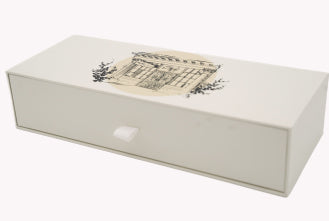
Color selection influences perceived value and seasonal appropriateness. White boxes project clean elegance and work across all holiday themes. The blue gift boxes with window at 9x5x2.5 inches offer a festive alternative that stands out in a sea of traditional red and green packaging, while the cream-colored window boxes in the same 9x5x2.5 dimension provide vintage charm that complements rustic or farmhouse-style cookie presentations.
Window boxes command a higher per-unit cost than cellophane bags but deliver superior structural protection and premium presentation. For decorated cookies where appearance drives perceived value, this investment typically proves worthwhile. Bakeries can expect customers to associate window-boxed cookies with higher quality, supporting premium pricing strategies during the competitive holiday season.
Cellophane bags represent the most cost-effective cookie exchange packaging option, offering transparency, flexibility, and the lowest per-unit price point. These clear bags work particularly well for casual exchanges, large-volume bakery orders, and situations where recipients will repackage cookies immediately upon returning home.
The material itself—oriented polypropylene (OPP) in most modern "cellophane" bags—provides adequate moisture barrier properties for short-term cookie storage (3-7 days). Unlike true cellophane, which is plant-based but less common today, OPP bags resist tearing and maintain clarity without becoming brittle in cold temperatures. This matters for cookie exchanges where participants may leave packages in cars during winter events.
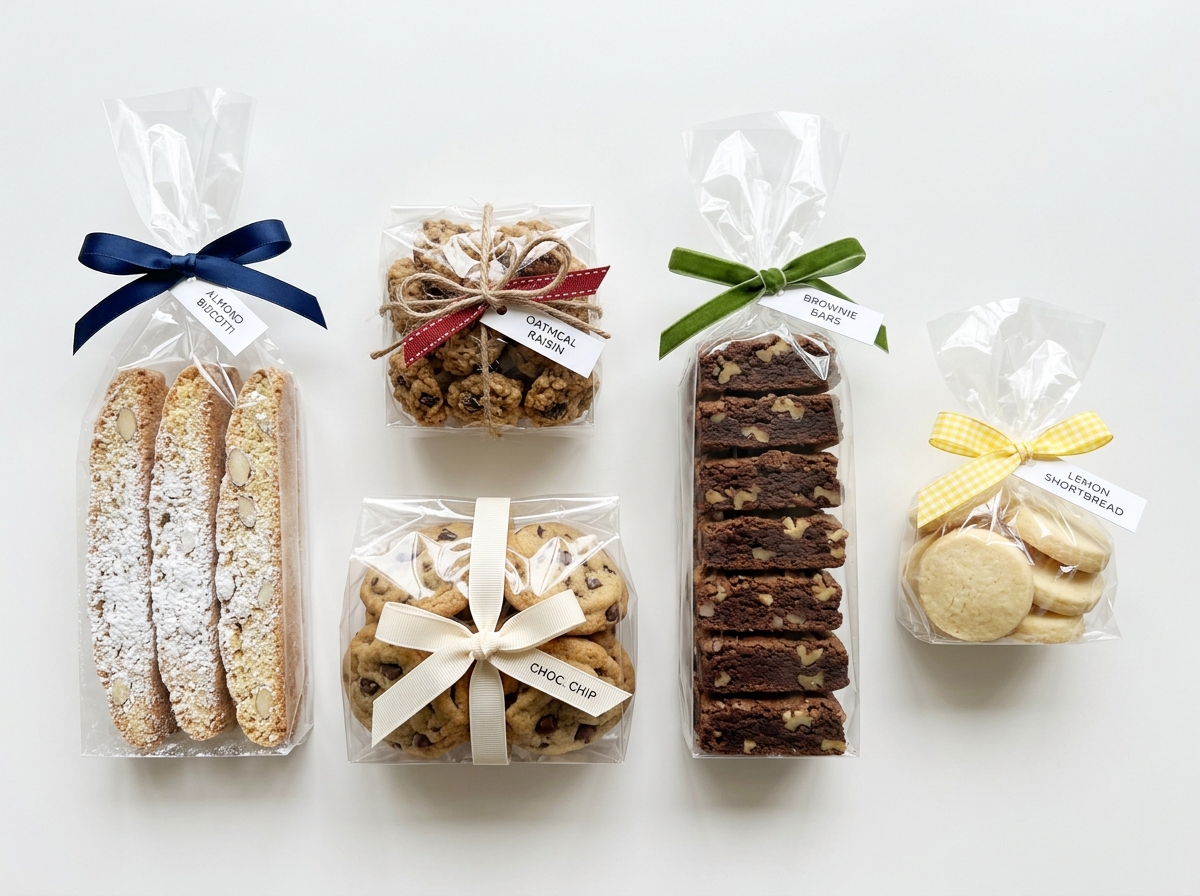
Size selection depends entirely on cookie dimensions and quantity. The 3.75x6.25-inch cellophane bags accommodate 3-5 standard round cookies (2.5-3 inches diameter) or 6-8 smaller cookies like mini gingerbread men. For larger cookies or bar-style treats, the 11x17-inch cellophane bags provide ample room without excessive material waste.
Long, narrow cookies like biscotti or pirouette-style treats require specialized dimensions. The 2x10-inch cellophane bags prevent breakage by supporting the full length of the cookie without forcing it to angle inside the package.
Our comprehensive comparison of cellophane bags and bakery boxes breaks down cost-per-unit calculations, assembly time differences, and ideal use cases for each format.
Presentation enhancement for cellophane bags comes primarily through closure methods and added embellishments. Simple twist-ties provide functional closure but minimal visual appeal. Satin ribbon tied in bows elevates the presentation significantly while adding only 15-20 cents per package. Printed labels or tags communicate cookie flavors, allergen information, or personalized messages—a detail covered extensively in our DIY cookie packaging guide.
For bakeries managing high-volume holiday orders, cellophane bags streamline production workflows. Staff can fill bags assembly-line style, achieving packaging speeds of 80-100 units per hour compared to 40-60 units per hour for box assembly and filling. This efficiency advantage matters when processing hundreds of cookie orders during the compressed December timeline.
Kraft paper cookie boxes answer growing consumer demand for sustainable packaging while maintaining the structural benefits of traditional bakery boxes. The natural brown material communicates environmental consciousness—a value that resonates particularly with younger gift recipients and aligns with broader Flexible Packaging Association industry trends toward recyclable materials.
The unbleached kraft material offers inherent grease resistance superior to standard white paperboard, though not approaching the performance of specialty-coated boxes. For most cookie applications—sugar cookies, shortbread, gingerbread—standard kraft provides adequate protection for 5-7 days of storage. Extremely buttery cookies or those with oil-based ingredients may eventually show some spotting on the exterior, which many consumers accept as evidence of authentic, high-quality ingredients rather than a packaging failure.
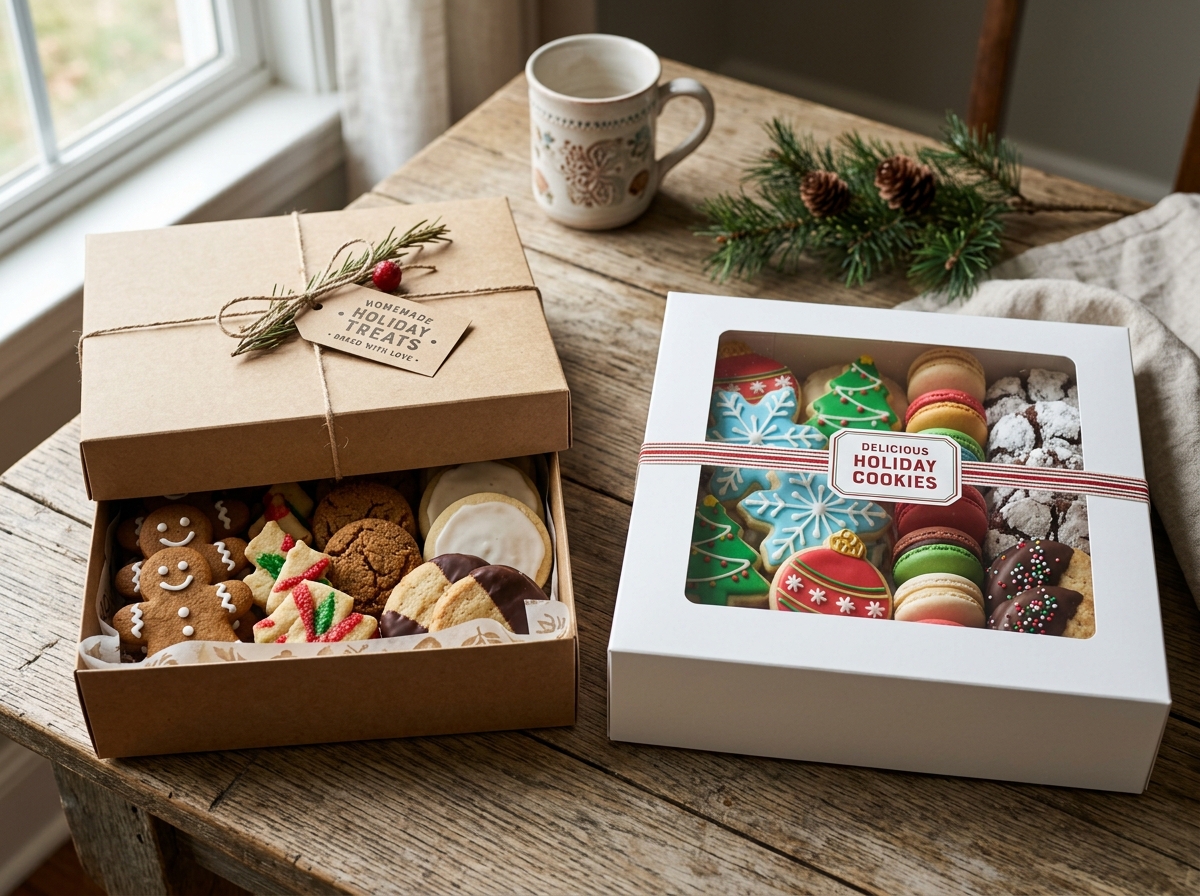
Kraft boxes without windows require different presentation strategies than their windowed counterparts. The opaque material shifts focus to exterior decoration—custom stamps, printed labels, or hand-lettered tags become the primary visual communication. This works well for rustic or artisanal brand positioning but may not suit bakeries emphasizing decorative cookie artistry that benefits from visibility.
Our dedicated kraft cookie boxes guide explores sourcing options, certification standards like FSC (Forest Stewardship Council), and consumer perception research around sustainable packaging choices.
Environmental claims require careful communication. Kraft paper is recyclable in most municipal systems, but only if it remains free from excessive grease contamination and doesn't include plastic windows or laminated coatings. Bakeries marketing kraft packaging as "eco-friendly" should provide accurate disposal instructions to help customers complete the sustainability loop through proper recycling.
Price positioning for kraft boxes typically falls between basic cellophane bags and premium window boxes. The material cost runs slightly lower than bleached paperboard, but the "natural" aesthetic often supports pricing comparable to white boxes. Bakeries can leverage this perception to maintain margins while appealing to environmentally conscious customers.
Proper size matching prevents both cookie damage from cramped packaging and wasted material from oversized containers. Cookie exchanges typically involve portions of 6-12 cookies per recipient, but the physical dimensions vary dramatically based on cookie style.
Standard drop cookies (chocolate chip, oatmeal raisin, peanut butter) measure 2.5-3.5 inches in diameter and roughly 0.5 inches thick. A 6-count portion requires minimum internal dimensions of 6x4x2 inches when arranged in two rows of three. The 8x5.5x2.5-inch boxes provide comfortable clearance for this arrangement without excessive void space that allows cookies to shift during transport.
Decorated sugar cookies cut into shapes present more complex spatial requirements. A 4-inch gingerbread man needs packaging at least 5 inches in the longest dimension to prevent contact with box edges that could smudge icing. Star-shaped cookies, snowflakes, and other irregular forms often pack most efficiently in square boxes rather than rectangular formats, minimizing wasted corner space.
Bar cookies and brownies cut into 2x2-inch squares stack efficiently in deeper boxes. A 6-count portion fits well in 4x4x3-inch dimensions, while 12-count portions require stepping up to 6x6x3-inch or 8x4x3-inch formats depending on your preferred arrangement.
Our detailed cookie box sizing guide includes printable templates and dimension charts for 15 common cookie types, helping you select optimal packaging without trial-and-error purchasing.
Thickness considerations affect both box depth and cellophane bag width. Thin, crisp cookies like pizzelles or lace cookies need minimal depth (1.5-2 inches) but benefit from rigid boxes that prevent crushing. Thick, soft cookies like frosted sugar cookies or sandwich cookies require 2.5-3 inches of depth and gentle handling during packaging to avoid compression that mars their appearance.
Specialty cookies demand specialized solutions. Biscotti and other long, narrow treats work best in the 3x10-inch cellophane bags that support their full length. Delicate lace cookies or brandy snaps need rigid boxes with minimal internal movement—consider adding crumpled tissue paper or shredded paper fill to immobilize contents.
All packaging materials that contact food must meet federal safety standards, but understanding the specific properties that affect cookie quality helps you evaluate options and set proper customer expectations.
Grease resistance in paper-based packaging traditionally came from fluorinated compounds (PFAS), but recent FDA actions have eliminated these materials from the market. Modern food-safe cookie boxes use alternative coatings—typically starch-based or polymer treatments—that provide adequate grease resistance for bakery applications without raising health concerns.
For most cookie types, standard paperboard without additional grease-proofing performs adequately for the 3-7 day timeframe typical of cookie exchange scenarios. Extremely buttery shortbread or cookies made with significant amounts of coconut oil may eventually show some oil migration to the box exterior, particularly if stored in warm environments. This represents a cosmetic rather than safety concern, though it may affect gift presentation if boxes sit for extended periods before the exchange event.
Cellophane bags (OPP material) provide complete grease barriers, preventing any oil migration regardless of cookie composition. This makes them the preferred choice for high-fat cookies or situations where packaging must maintain pristine appearance over longer storage periods.
Our food-safe cookie packaging guide examines material certifications, proper storage conditions, and strategies for maintaining cookie freshness across different packaging formats.
Direct food contact requires materials free from harmful chemicals that could migrate into baked goods. Reputable packaging suppliers provide materials that comply with FDA food contact regulations, but bakeries should verify this when sourcing from new vendors. Look for explicit "food safe" or "FDA compliant" language in product descriptions, and request documentation if supplying to commercial customers who may audit your ingredient and material sourcing.
Moisture barrier properties vary significantly across packaging types. OPP cellophane bags offer moderate moisture barriers suitable for cookies with low moisture content (crisp cookies, biscotti, shortbread). Soft cookies with higher moisture levels may experience texture changes in cellophane after 4-5 days as moisture equilibrates between the cookie and the package environment. Paperboard boxes provide minimal moisture barriers, making them best suited for cookies consumed within 3-5 days of packaging.
Holiday cookie packaging faces compressed seasonal demand that creates supply challenges for late-ordering buyers. Understanding optimal ordering windows prevents stock-outs and rush shipping charges that erode profit margins.
Small bakeries serving the cookie exchange market should place packaging orders 8-10 weeks before their peak fulfillment period. For December cookie exchanges (typically occurring the first three weeks of December), this means ordering in early October. September orders provide even greater security, particularly for customized packaging with printed branding or specialty sizes that may require longer production runs.
Home bakers planning single events have more flexibility but should still order 4-6 weeks ahead to ensure availability of preferred styles and quantities. Standard window boxes and cellophane bags typically remain in stock through November, but specialty colors or larger quantity packs may sell out as the season progresses.
Our comprehensive baker's timeline for ordering cookie packaging breaks down month-by-month planning steps, helping you coordinate packaging purchases with ingredient sourcing, recipe testing, and event scheduling.
Minimum order quantities (MOQs) vary significantly by supplier and product type. Standard packaging from wholesale suppliers typically requires purchasing in case quantities—often 50-100 units for boxes, 100-200 units for cellophane bags. This works well for bakeries processing multiple orders but may exceed home baker needs for single events.
Retail packaging suppliers offer smaller quantities at higher per-unit costs, making them suitable for home bakers or bakeries testing new formats before committing to larger purchases. A case-by-case cost comparison often reveals that purchasing one case from a wholesale supplier costs less than buying 25-30 units at retail, even if you don't immediately need the full quantity.
Lead times extend during peak season. Standard in-stock items that ship within 2-3 business days in August may require 7-10 business days in November as suppliers manage high order volumes. Custom printing or specialty orders can extend to 3-4 weeks during peak periods, making early ordering even more critical for bakeries relying on branded packaging.
Cost-per-unit calculations determine packaging feasibility for different business models and event scales. Understanding true costs—including assembly labor, storage space, and material waste—helps you select the most economical option for your specific situation.
Cellophane bags represent the lowest material cost, typically ranging from $0.08-0.25 per bag depending on size and purchase quantity. A home baker packaging 60 cookies (5 dozen) for a 12-person exchange would spend approximately $10-15 on bags alone, before adding ribbons or labels. Small bakeries purchasing 500-count cases access lower per-unit pricing, bringing costs down to $0.06-0.12 per bag.
Window boxes cost more per unit—generally $0.40-0.85 depending on size and quality—but deliver significantly higher perceived value. The same 60-cookie scenario would cost $24-51 in packaging materials, a meaningful difference for home bakers on tight budgets. However, bakeries can often price cookies in premium boxes 25-40% higher than bag-packaged equivalents, more than offsetting the packaging cost difference.
Assembly labor shifts the equation for high-volume operations. Cellophane bags require minimal assembly (simply opening and filling), allowing one worker to package 80-100 portions per hour. Window boxes require folding and tab insertion before filling, reducing throughput to 40-60 portions per hour. For a bakery processing 500 cookie orders in December, this represents 5-6 additional labor hours for box assembly compared to bags—a cost that may exceed the material price difference.
Storage space considerations favor flat-pack boxes and bags equally, as both store efficiently before assembly. However, pre-assembled boxes (sometimes preferred by bakeries wanting to streamline production) consume significantly more warehouse space, potentially requiring off-site storage during peak season.
Our wholesale buying guide for small bakeries includes detailed cost calculators, MOQ comparisons across major suppliers, and break-even analysis tools for different packaging strategies.
Material waste factors into environmental and economic calculations. Cellophane bags generate minimal waste when sized properly—unused bags simply return to inventory. Boxes ordered in incorrect sizes or excessive quantities represent sunk costs, as most suppliers don't accept returns on food-contact packaging once shipped. Conservative initial orders with planned reorders reduce waste risk while maintaining adequate inventory.
Packaging serves as the first impression of your baking skill, making presentation techniques critical for cookie exchange success. Strategic embellishments transform basic packaging into gift-worthy presentations without requiring significant additional cost or time.
Ribbon selection impacts both visual appeal and functional closure. Satin ribbon in 3/8-inch or 5/8-inch widths provides elegant bows that stay tied during transport. Coordinate ribbon color with cookie theme—traditional red and green for Christmas cookies, silver or gold for New Year's treats, or match your decorated icing colors for cohesive presentation. Budget 18-24 inches of ribbon per package to allow for generous bows with tails.
Labels communicate essential information while adding professional polish. Include cookie name, key ingredients (especially important for allergen transparency), and your name or bakery brand. Pre-designed holiday label templates available through office supply stores or online printable resources save design time while maintaining polished appearance. Our DIY packaging ideas guide provides downloadable templates and step-by-step embellishment tutorials.
Tissue paper adds protective cushioning while creating visual interest. A single sheet of coordinating tissue paper placed between cookie layers prevents sticking and provides subtle color that shows through clear packaging. Crumpled tissue paper as void fill immobilizes cookies inside boxes, preventing shift damage during transport.
Stacking arrangements inside boxes affect both capacity and visual impact. Single-layer arrangements showcase individual cookies beautifully and prevent weight-related damage to bottom cookies, but limit quantity per box. Double-layer arrangements with tissue paper separation allow greater quantity in the same box footprint while maintaining protection. For decorated cookies with dimensional icing, single-layer arrangement remains essential to prevent smudging.
Custom stamps or stickers add personal branding without custom printing costs. A simple "Made with Love" stamp or holiday-themed sticker on kraft boxes creates handmade charm. Small bakeries can invest in custom stamps featuring their logo for under $30, then apply them to standard boxes for branded appearance at fraction of custom printing costs.
Cookie exchange events create different packaging needs for hosts and guests, requiring strategic planning to ensure smooth execution and satisfied participants.
Guests bringing cookies to exchange need packaging that facilitates easy distribution. Individual portions pre-packaged in cellophane bags or small boxes allow quick redistribution without hosts needing to repackage contributions. A guest bringing 5 dozen cookies to a 12-person exchange should arrive with 12 pre-packaged portions of 5 cookies each, making distribution as simple as handing one package to each participant.
Hosts coordinating the exchange need take-home containers for participants to collect their assorted cookies. Larger boxes or bags accommodate the variety each guest receives—typically one portion from each attending baker. For a 12-person exchange, each participant leaves with 11 different cookie types (one from each other baker), requiring containers sized for 55-60 cookies total. The large clear frosted gift bags measuring 9.75x11.75x4.5 inches provide ample capacity for this assortment while maintaining visibility of the cookie variety inside.
Our complete host and guest packaging guide includes planning checklists, quantity calculators, and coordination strategies for smooth exchange events.
Display during the exchange event adds to the festive atmosphere. Hosts can provide serving platters or tiered stands where guests arrange their contributions before distribution. This creates photo opportunities and allows participants to admire decorative work before cookies are packaged for take-home. Consider having extra small plates or napkins available for sampling—cookie exchanges often include tasting before the final distribution.
Transport considerations differ for hosts and guests. Guests need packaging that protects cookies during initial transport to the venue, then allows easy removal for display and distribution. Boxes with removable lids work better than sealed bags for this purpose. Hosts need durable take-home containers that withstand the return journey with full cookie assortments—sturdy handles or reinforced construction prevent bag failures that would devastate participants after a successful exchange.
Cookie exchange packaging costs vary by format and quantity. For cellophane bags, expect $0.08-0.25 per portion, meaning a 12-person exchange costs $1-3 total for a guest bringing one cookie type. Window boxes run $0.40-0.85 per portion, or $5-10 for the same exchange. Hosts providing take-home containers should budget $1-2 per guest for large bags or boxes that hold the full assortment. Ribbons, labels, and embellishments add $0.15-0.50 per package depending on elaborateness.
For standard 3-inch round cookies, a 9x5x2.5-inch box accommodates 12 cookies in two layers with tissue paper separation. Single-layer presentation requires 10x8x2-inch dimensions for the same quantity. Bar cookies measuring 2x2 inches fit efficiently in 6x6x3-inch boxes for 12-count portions. Cookie thickness affects depth requirements—add 0.5-1 inch for frosted or decorated cookies to prevent lid contact with icing.
Cellophane bags work best for casual exchanges, budget-conscious bakers, and cookies without elaborate decoration. They cost less, require minimal assembly, and allow easy distribution. Window boxes suit decorated cookies where presentation drives value, formal exchanges, or bakery sales where premium packaging supports higher pricing. Consider hybrid approaches—cellophane for transport, then transfer to boxes for final presentation—if budget allows.
Small bakeries should order cookie exchange packaging 8-10 weeks before peak December demand, placing orders in early October. September orders provide additional security for custom printing or specialty items. Standard stock items remain available through November for smaller quantities, but case-lot pricing and full selection favor early ordering. Lead times extend from 2-3 days to 7-10 days during November-December peak season.
Modern cellophane bags made from oriented polypropylene (OPP) are food-safe and FDA-compliant for direct cookie contact. They provide adequate moisture and grease barriers for most cookie types stored 3-7 days. Verify "food safe" designation when purchasing, and avoid industrial or craft cellophane not rated for food contact. OPP bags outperform true cellophane for cookie applications due to better moisture resistance and durability in cold temperatures.
The right cookie exchange packaging protects your baking investment while creating memorable presentations that honor the tradition of sharing homemade treats. Whether you're selecting clear boxes for showcasing decorated cookies or planning shipping solutions for distant exchange participants, matching packaging format to your specific needs ensures your cookies arrive in perfect condition. Start with our seasonal design ideas to plan packaging that makes your holiday baking shine.