Cart
0
You may also like

Book a call with our development team to get started.



Apply online and access wholesale pricing.

Choosing the right cookie box sizes can make the difference between a polished presentation and a disappointing unboxing. Whether you're preparing gift boxes for a holiday cookie exchange, packaging retail orders for your bakery, or assembling party favors, understanding how cookie dimensions translate to box capacity saves time, material waste, and customer frustration. This guide walks you through standard cookie diameters, the box dimensions that accommodate them, and how to plan packaging for 4-count, 6-count, and 12-count quantities.
For comprehensive strategies on cookie exchange packaging, including presentation techniques and material selection, our pillar guide covers everything from bags to boxes. Here, we focus specifically on the numbers: matching cookie size to box dimensions.
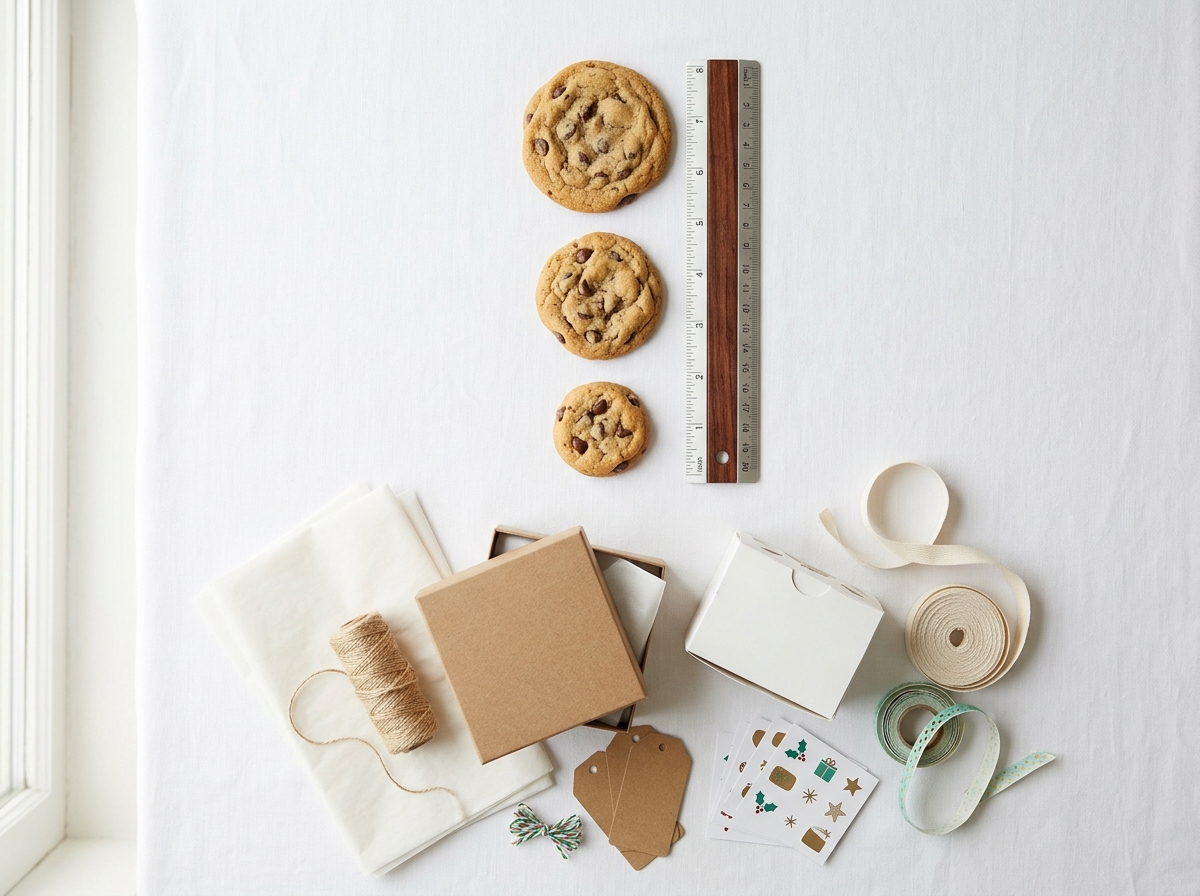
Before selecting cookie box sizes, you need to know the diameter of your baked goods. Most homemade and bakery cookies fall into three size categories, each requiring different clearance in packaging.
Standard cookies—the kind you'd find at a cookie exchange or home bakery—typically measure 2.5 to 3 inches in diameter after baking. Mini cookies range from 1 to 2 inches, while large bakery-style cookies span 4 to 6 inches. Cookie scoop size directly affects final diameter: a #40 scoop (1.5 tablespoons of dough) produces a cookie roughly 2 inches across, while a #20 scoop yields a 4-inch cookie.
Cookies also vary in thickness. Drop cookies like chocolate chip or oatmeal raisin typically stand 0.5 to 0.75 inches tall. Decorated sugar cookies, especially those with royal icing, may reach 1 inch in height once frosting is applied. Sandwich cookies or filled varieties can exceed 1.25 inches. Box depth must account for the tallest point, including any toppers or decorative elements.
Small boxes work best for individual gifts, party favors, or sampler sets. A 4 x 4 x 2-inch box comfortably fits one to two standard 2.5-inch cookies. For a 4-count arrangement of 2-inch cookies, a 5 x 5 x 2-inch box provides adequate spacing without excess movement during transport.
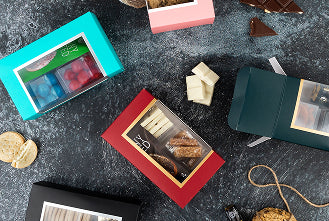
If you're packaging decorated or frosted cookies, increase the depth. A box measuring 6 x 6 x 2.5 inches accommodates four 2.5-inch cookies with modest icing detail. For thicker royal icing or stacked designs, opt for 3-inch depth to prevent smudging. Window cookie boxes in these dimensions let recipients see the design without opening the package—a practical choice for decorated sugar cookies or holiday cutouts.
Small tall paper boxes with windows measuring 6.75 x 3.5 x 2 inches offer an alternative footprint for narrow cookie shapes like biscotti or rectangular shortbread bars. The vertical orientation reduces counter space while maintaining visibility.
Six cookies represent a common exchange quantity—enough for variety without overwhelming the recipient. For 2.5-inch cookies arranged in two rows of three, a 7 x 5 x 2.5-inch box provides a snug fit. This dimension minimizes shifting while keeping the overall package compact.
Larger 3-inch cookies need more real estate. An 8 x 6 x 3-inch box handles six cookies with slight spacing between each piece. If your cookies include dimensional toppings—chocolate chips, nuts, or candy pieces—the extra depth prevents crushing. For frosted cookies, particularly those with piped borders or flooded icing, a 3.5-inch depth adds insurance against surface damage.
Medium boxes also suit mixed-size assortments. You can fit four 3-inch cookies plus two smaller 2-inch varieties in an 8 x 8 x 2.5-inch square box by arranging the larger cookies in corners and filling the center with smaller pieces. This layout works well for cookie exchange hosts offering multiple recipes in a single package.
When choosing between boxes and bags for this quantity, consider your presentation goals. Cellophane bags vs. bakery boxes each offer distinct advantages: bags allow stacking flexibility and take up less storage space, while boxes protect delicate decorations and maintain a more structured appearance.
A dozen cookies is the standard quantity for exchanges, retail bakery sales, and party platters. Box dimensions for 12-count packaging depend heavily on cookie diameter and arrangement strategy.
For standard 2.5-inch cookies, a 10 x 7 x 3.5-inch box accommodates a 3 x 4 grid layout. This is the most common dimension for half-dozen donut boxes, which share similar footprint requirements with cookies. If you're working with 3-inch cookies, step up to a 12 x 10 x 4-inch box—the same size used for full dozen donuts. This provides adequate clearance for each cookie without crowding.
Large bakery-style cookies (4 inches or more) don't fit traditional 12-count layouts. Instead, use a 14 x 10 x 4-inch box and arrange cookies in a 2 x 6 or 3 x 4 configuration, depending on exact diameter. You may need to reduce the count to 9 or 10 cookies to maintain spacing and prevent edge damage.
For decorated cookies, especially custom designs for events, consider individual compartments. Insert dividers or use a tall windowed gift box measuring 8 x 5.5 x 2.5 inches for smaller batch presentations, then scale up to larger formats with custom inserts as needed. Dividers prevent icing transfer between cookies and maintain the integrity of detailed designs during transport.
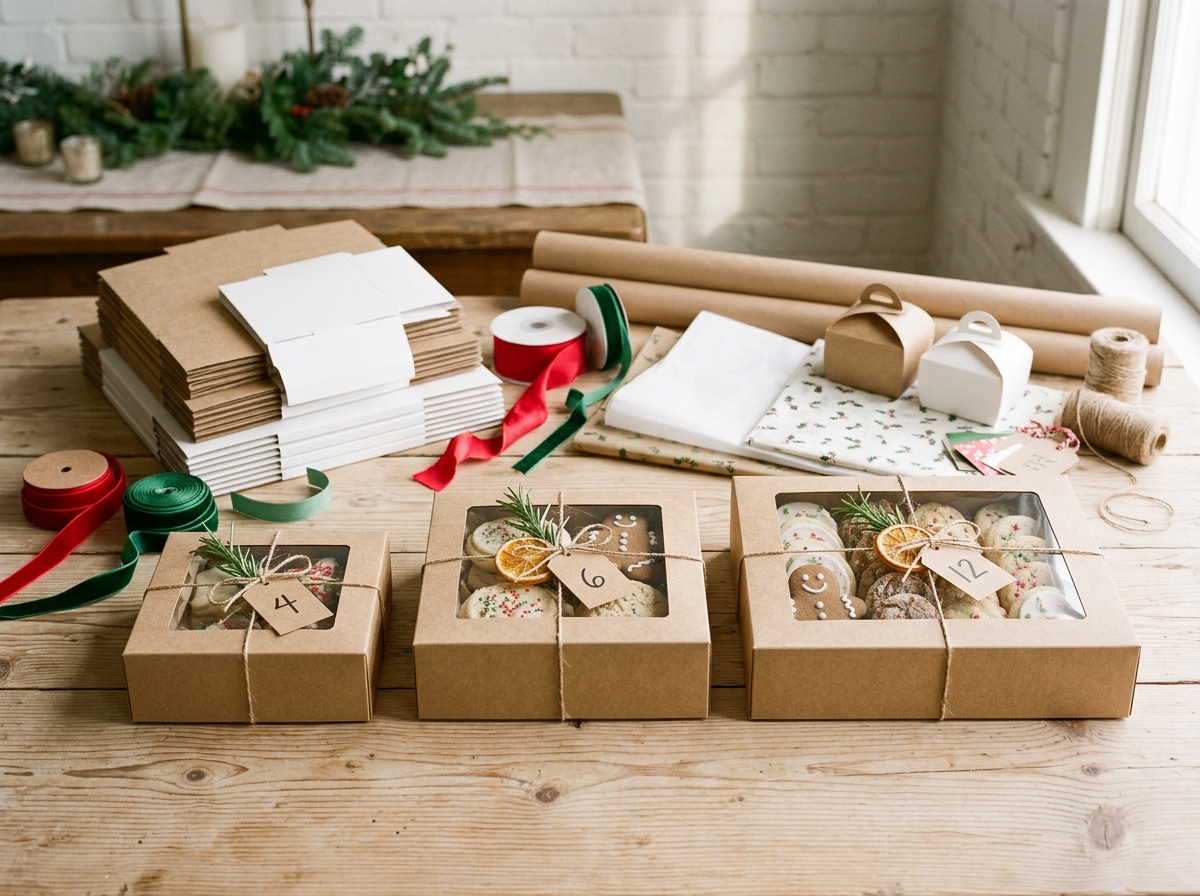
Use this chart to select appropriate box dimensions based on cookie diameter and desired quantity. Measurements reflect interior dimensions; exterior sizes may vary slightly depending on box construction and material thickness.
4-count: 4 x 4 x 2 inches
6-count: 5 x 5 x 2 inches
12-count: 7 x 5 x 2.5 inches
4-count: 6 x 6 x 2.5 inches
6-count: 8 x 6 x 3 inches
12-count: 10 x 7 x 3.5 inches (2.5-inch cookies) or 12 x 10 x 4 inches (3-inch cookies)
4-count: 10 x 10 x 3 inches
6-count: 12 x 10 x 4 inches
9–10 count: 14 x 10 x 4 inches
These dimensions assume flat or lightly decorated cookies. Add 0.5 to 1 inch of depth for dimensional toppings, thick icing, or stacked varieties.
Cookie thickness varies more than diameter, and underestimating depth is the most common packaging mistake. A plain chocolate chip cookie may be 0.5 inches tall, but add royal icing and the same cookie reaches 1 inch or more.
Flooded icing—the technique where a thin layer of icing covers the entire cookie surface—adds approximately 0.25 inches of height. Piped borders or details add another 0.25 to 0.5 inches. Three-dimensional elements like rosettes, ruffles, or stacked layers can push total height to 1.5 inches. Measure your tallest cookie, then add at least 0.5 inches of clearance to prevent lid contact.
For extremely delicate designs, consider using large cellophane bags measuring 11 x 17 inches instead of rigid boxes. Slide a cardboard base inside the bag, arrange cookies flat, and seal with a ribbon. This method eliminates top-down pressure while maintaining visibility. It's particularly effective for cookie exchange guests who need to transport multiple varieties without crushing intricate work.
Not every cookie presentation requires a structured box. Cellophane bags offer flexibility in sizing and cost less per unit, making them ideal for high-volume packaging or casual gifting scenarios.
For 4-count cookie packaging, a cellophane bag measuring 3.75 x 6.25 inches holds standard cookies in a vertical stack. Tie with ribbon or twist-tie at the top, leaving minimal excess material. This size works well for party favors or individual exchange portions.
Six-count packaging fits comfortably in a 2 x 10-inch cellophane bag if cookies are arranged in a single row. For wider layouts, step up to an 11 x 17-inch bag that accommodates two rows of three cookies with room for a decorative insert or recipe card.
According to the Flexible Packaging Association, cellophane and other flexible packaging materials continue to gain market share in bakery applications due to their lighter weight and reduced material costs compared to rigid paperboard. For bakers managing tight margins or shipping costs, bags can reduce per-unit packaging expenses by 30 to 50 percent compared to structured boxes.
Bags do have limitations. They don't protect cookies from top-down pressure, so avoid them for frosted or delicate varieties unless you're hand-delivering. They also lack the premium presentation of a windowed box, which may matter for retail sales or formal gifting occasions.
Cookie exchanges typically involve multiple participants each bringing a set quantity to swap. Standard exchange formats include 4 dozen total cookies (4 cookies per participant for 12 people), 6 dozen (6 per participant for 12 people), or 8 dozen for larger groups.
If you're hosting, communicate packaging expectations in advance. Specify whether participants should bring cookies pre-packaged in individual portions or in bulk for the host to divide. Pre-portioned packaging—such as 4 or 6 cookies per box—simplifies distribution but requires more advance preparation. Bulk packaging in a single large box or tray allows the host to create custom assortments but adds time to the event.
For hosts assembling take-home packages, having multiple cookie box sizes on hand streamlines the process. Stock 6 x 6 x 2.5-inch boxes for 4-count portions, 8 x 6 x 3-inch boxes for 6-count, and a few 12 x 10 x 4-inch boxes for larger assortments or oversized cookies. This variety lets you adapt to the actual cookie sizes participants bring rather than forcing everything into a single box dimension. Our guide on how to package cookies for a cookie exchange party covers host and guest responsibilities in detail, including timeline planning and presentation strategies.
Timing matters, too. When to order cookie packaging depends on your event date and whether you're sourcing from a local supplier or ordering online. For holiday exchanges in December, place orders by early November to avoid stock shortages and shipping delays. Standard lead times for wholesale bakery boxes range from 1 to 3 weeks, longer for custom printing or specialty sizes.
Retail bakeries face different constraints than home bakers. You're balancing material costs, shelf space, branding opportunities, and customer expectations. Standardizing on two or three cookie box sizes rather than maintaining inventory for every possible dimension reduces complexity and improves purchasing power.
A common retail approach uses a small box (6 x 6 x 2.5 inches) for 4-count individual purchases, a medium box (8 x 8 x 3 inches) for half-dozen mixed assortments, and a large box (12 x 10 x 4 inches) for full dozen orders. This three-tier system covers most customer needs while keeping SKU count manageable.
Window boxes command a price premium—typically 15 to 25 percent more than solid boxes—but they increase impulse purchases by making the product visible. For decorated cookies or signature items, the visibility justifies the cost. For plain drop cookies or items sold primarily by the dozen, solid boxes with a small label or sticker may suffice.
If your bakery offers cookies in multiple sizes, consider using box dimensions as a size cue. Reserve your largest boxes for premium or oversized cookies, reinforcing the value proposition visually. Customers perceive larger packaging as more generous, even when cookie count remains constant.
Cookie box sizes aren't just about length, width, and height—material thickness affects both durability and cost. Most bakery boxes use SBS (solid bleached sulfate) paperboard ranging from 12-point to 18-point thickness. Point refers to thousandths of an inch; 12-point board is 0.012 inches thick.
Smaller boxes (under 6 x 6 inches) function adequately with 12-point board. The shorter spans and lighter loads don't require heavy reinforcement. Medium boxes (6 x 6 to 10 x 10 inches) benefit from 14-point or 16-point board, especially if stacked or shipped. Large boxes (over 10 x 10 inches) should use 16-point or 18-point board to prevent sagging and maintain structure when fully loaded.
Kraft paperboard offers a lighter-weight, eco-friendly alternative to SBS. It's typically 10 to 15 percent less expensive and appeals to customers seeking sustainable packaging. However, kraft board is slightly less rigid than SBS at equivalent thickness, so you may need to step up one point size to achieve the same structural performance.
For more on material selection and how kraft compares to other bakery packaging substrates, see our comparison of pie box sizes, which explores similar dimensional and material considerations for different baked goods.
For 2.5-inch cookies, use a 10 x 7 x 3.5-inch box. If your cookies measure 3 inches in diameter, step up to a 12 x 10 x 4-inch box. These dimensions accommodate a standard grid layout (3 x 4 or 4 x 3) with minimal shifting. Add 0.5 to 1 inch of depth if cookies are frosted or have dimensional toppings.
Yes, as long as the diameter and thickness fall within the box's capacity. A 6 x 6 x 2.5-inch box works for four 2.5-inch chocolate chip cookies, sugar cookies, or oatmeal raisin cookies. However, if one variety is significantly thicker—such as a sandwich cookie or heavily frosted cutout—you may need a deeper box to prevent lid contact and icing damage.
Allow at least 0.25 inches of clearance for plain cookies and 0.5 inches for frosted varieties. This buffer prevents smudging during transport and accommodates slight variations in cookie thickness. For delicate royal icing or three-dimensional decorations, increase clearance to 0.75 inches or use a cellophane bag instead of a rigid box.
It depends on your priorities. Cellophane bags cost less, take up less storage space, and allow flexible portioning. Boxes offer better protection for frosted cookies, maintain a more polished presentation, and stack more securely for transport. For casual exchanges or drop cookies, bags work well. For decorated cookies or formal gifting, boxes are the safer choice.
Choose boxes that fit snugly inside a corrugated shipping box with 1 to 2 inches of padding on all sides. A 6 x 6 x 2.5-inch cookie box fits well in an 8 x 8 x 4-inch corrugated mailer. For 12-count orders, a 12 x 10 x 4-inch bakery box nests inside a 14 x 12 x 6-inch shipping box. Fill void space with crinkle paper or bubble wrap to prevent shifting. Avoid overpacking, which can crush cookies, or underpacking, which allows excessive movement.
Matching cookie box sizes to your baked goods isn't complicated, but it does require measuring your cookies and understanding how diameter, thickness, and quantity interact with box dimensions. Start by measuring your largest and tallest cookie, then reference the size chart above to identify the appropriate box. When in doubt, size up—a slightly oversized box is easier to fill with tissue or crinkle paper than trying to force cookies into a box that's too small.
Whether you're preparing for a holiday cookie exchange, packaging retail orders, or assembling party favors, having the right dimensions on hand saves time and reduces waste. Stock a small, medium, and large option to cover most scenarios, and consider both rigid boxes and cellophane bags to give yourself flexibility across different cookie types and presentation contexts.