Cart
0
You may also like


Book a call with our development team to get started.



Apply online and access wholesale pricing.

When a customer invests in custom-decorated sugar cookies—whether for a wedding, corporate event, or holiday gift—the packaging must do more than protect. It must showcase. Clear cookie boxes solve a problem that opaque containers cannot: they let the artistry speak before the box is even opened. For bakers selling intricate royal icing designs or custom logos, transparency isn't just aesthetic—it's a sales tool that increases perceived value and justifies premium pricing.
This guide covers the mechanics of clear cookie boxes: which materials offer true crush protection, how to match box depth to icing height, and why rigid PET construction outperforms folding cartons when presentation and durability both matter. Whether you're packaging a dozen monogrammed cookies for a bridal shower or shipping corporate logo cookies across state lines, the right clear box protects your work and amplifies its impact.
Research on packaging psychology reveals that transparent packaging consistently elicits higher purchase intention across food categories. The mechanism is straightforward: when buyers can see the product before purchase, they assess quality directly rather than inferring it from branding alone. For decorated cookies, this visibility is particularly powerful. A customer scrolling through an online bakery can immediately evaluate the precision of your piping, the vibrancy of your flood icing, and the complexity of your stencil work—all before adding to cart.
This effect extends beyond digital storefronts. At farmers markets, cookie exchange parties, and retail counters, clear boxes allow decorated cookies to function as their own advertisement. The packaging recedes; the product commands attention. Transparent packaging lowers consumer guard by showing just enough to build trust, a dynamic that matters when customers are choosing between a $30 box of custom cookies and a $12 grocery-store alternative.
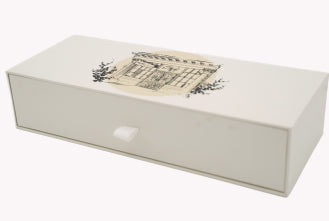
For bakers, this transparency also reduces the need for elaborate outer packaging or printed graphics. A well-designed cookie—whether a watercolor floral or a photorealistic company logo—doesn't require additional decoration. The structured white gift box with window becomes the frame, not the focal point.
Not all clear boxes are structurally equivalent. The two dominant materials—PET (polyethylene terephthalate) and acetate (cellulose acetate)—differ in rigidity, food safety certification, and crush resistance. For decorated cookies with dimensional icing, these differences are not trivial.
PET maintains full compliance with NSF, FDA, and EU food-contact standards, a baseline requirement for any packaging in direct contact with baked goods. PET is recognized by the #1 resin code and offers superior clarity compared to polypropylene or polystyrene alternatives. The material's inherent stiffness—measured by intrinsic viscosity—allows thinner walls without sacrificing structural integrity, which translates to lighter shipping weights and lower per-unit costs at scale.
Acetate, while also food-safe when sourced from reputable suppliers, tends to be softer and more prone to creasing under pressure. For cookies traveling through shipping carriers or stacked in delivery vehicles, this flexibility becomes a liability. A 20-mil PET box will maintain its shape under 15-20 pounds of stacking weight; a comparable acetate box may buckle at half that threshold.
Rigid PET boxes are thermoformed or injection-molded, not folded from flat stock. This construction eliminates seams along the vertical edges—the most common failure point when boxes are handled roughly. For bakers fulfilling wholesale orders or shipping direct-to-consumer, the added cost of rigid PET (typically 15-25% more than acetate per unit) is offset by reduced breakage claims and the ability to ship without secondary outer cartons in many cases.
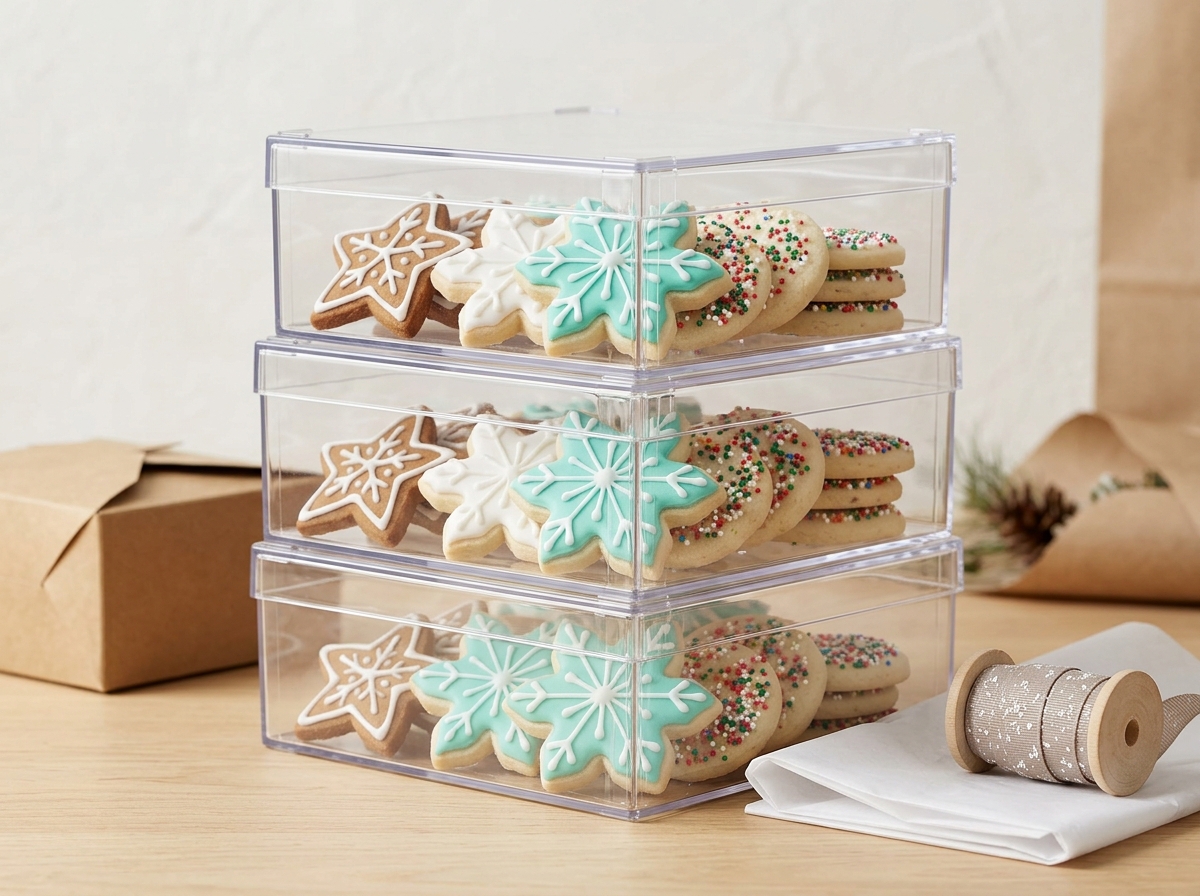
Royal icing adds vertical dimension that standard bakery boxes don't anticipate. A flooded sugar cookie with wet-on-wet detail or dimensional buttercream borders can measure 3/8" to 5/8" thick—double the profile of an unfrosted shortbread. If the box lid contacts the icing surface, you'll see smudging, color transfer, and flattened piping. The solution is not simply choosing a deeper box; it's matching interior clearance to the tallest element of your design.
Most clear cookie boxes are available in three depth profiles: shallow (1.5"-2"), standard (2"-2.5"), and deep (2.5"-3.5"). A shallow box works for cookies with thin royal icing washes or airbrushed designs where the icing sits flush with the cookie surface. Standard depth accommodates most hand-piped borders, flooded sections, and simple dimensional details. Deep boxes are necessary for cookies with stacked elements, 3D buttercream flowers, or thick fondant appliqués.
To measure correctly, place your tallest decorated cookie on a flat surface and use a ruler to measure from the base to the highest point of icing, then add 1/4" clearance. This buffer accounts for minor settling during transport and prevents the lid from resting directly on the icing. For cookie box sizing across different quantities, the same clearance rule applies whether you're packaging 4 cookies or 12.
Base dimensions matter equally. A 4" x 4" box fits one large (3.5"-4") decorated cookie with minimal movement. A 6" x 6" box holds four 2.5" cookies in a grid or six smaller (2") cookies with tissue paper stabilization. For bakers offering tiered pricing based on cookie count, standardizing on two or three box sizes simplifies inventory without forcing awkward product fits.
Clear boxes provide visibility, but they don't inherently provide cushioning. When shipping decorated cookies—especially those with royal icing that remains brittle for 24-48 hours post-decoration—crush protection requires a multi-layer approach.
Start with the box itself. Rigid PET boxes with ribbed or corrugated sidewalls distribute pressure more effectively than smooth-walled designs. Some manufacturers offer "double-wall" PET construction, where two thin layers are bonded with an air gap between them. This adds negligible weight but doubles the crush resistance, making it viable to ship clear boxes inside poly mailers rather than corrugated shippers for orders under 6 cookies.
Inside the box, use food-safe tissue paper or crinkle paper to prevent cookies from sliding. The goal is not to pack tightly—compression will damage icing—but to eliminate lateral movement. A single sheet of white tissue paper folded once and placed between cookie layers works for most applications. Avoid cotton batting or shredded paper, which can leave fibers on icing surfaces.
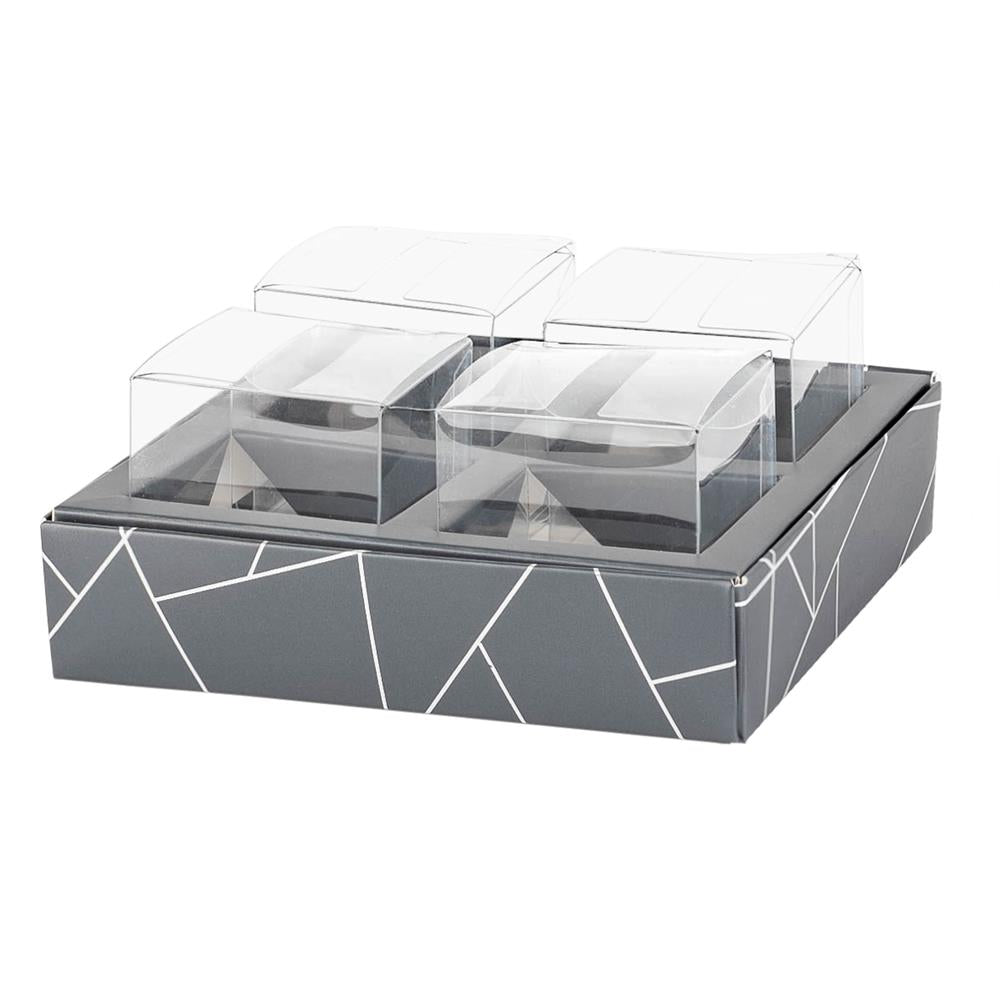
For wholesale or corporate orders where presentation is critical, consider nesting the clear PET box inside a gray windowed gift box. The outer box provides crush protection and a premium unboxing experience, while the inner clear box keeps cookies visible through the window. This two-box system is common in high-end cookie gifting and adds roughly $0.75-$1.25 per unit to packaging cost.
When shipping via carriers, always use a corrugated outer box rated for the total package weight plus 20%. Mark packages "FRAGILE" and "THIS SIDE UP" even though carriers don't guarantee orientation. For orders over $50, require signature confirmation to reduce porch-theft claims.
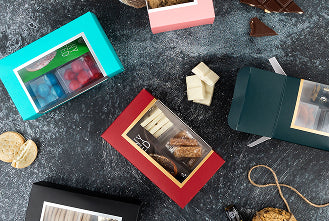
Both clear boxes and window cookie boxes offer visibility, but they serve different use cases. Window boxes—typically kraft or white paperboard with a cellophane or PET window panel—provide partial visibility while offering better printability for branding. Clear boxes offer 360-degree visibility but limited surface area for labels or graphics.
Choose clear boxes when the cookie design itself is the brand. This applies to custom logo cookies for corporate clients, photorealistic portrait cookies, or intricate hand-painted designs where any obstruction diminishes impact. Clear boxes also suit minimalist bakery branding, where the aesthetic is clean and the packaging is meant to disappear.
Choose window boxes when you need to communicate information—ingredients, allergen warnings, bakery name, or care instructions—directly on the packaging. Window boxes also perform better in retail environments where shelf presence matters. A kraft box with a window and a printed logo will stand out on a crowded farmers market table more effectively than a fully clear box, which can visually blend with adjacent products.
For bakers offering both retail and custom order fulfillment, maintaining inventory of both formats makes sense. Use window boxes for walk-in sales and farmers markets; reserve clear boxes for custom orders, weddings, and corporate gifting where the customer has already committed to the purchase and presentation is the priority.
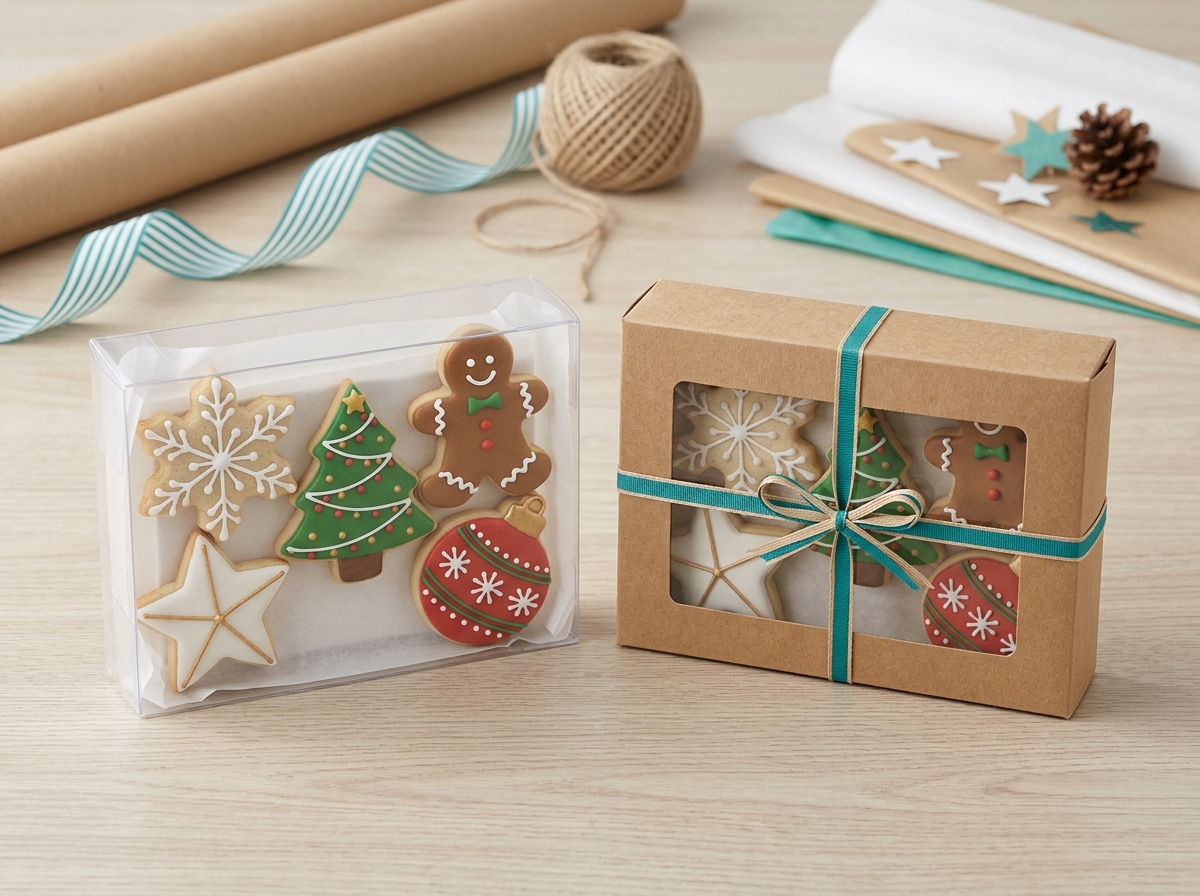
Clear packaging presents a labeling challenge: there's limited opaque surface area for stickers or printing. Most bakers solve this with a combination of lid labels and belly bands.
Lid labels—typically 2" x 3" or smaller—adhere to the top of the box and include the bakery logo, a "handmade" or "made with love" tagline, and space for a handwritten note or order number. Use weatherproof label stock if boxes will be refrigerated, as condensation will cause standard paper labels to peel. Clear labels with white or metallic ink maintain visibility without obscuring the cookies.
Belly bands—paper strips that wrap around the box perimeter—offer more branding real estate and can be printed with ingredient lists, care instructions, or a QR code linking to your website. A 1.5"-2" band placed at the box's midpoint doesn't obstruct the top or bottom view of the cookies but provides enough space for regulatory compliance (required in some jurisdictions for packaged food sold at retail).
For high-volume operations, consider investing in custom-printed PET boxes. Minimum order quantities typically start at 1,000-2,500 units, with per-unit costs dropping 30-40% compared to off-the-shelf boxes plus aftermarket labels. Lead times run 6-10 weeks, so this strategy works best for bakers with consistent monthly volume and established branding.
Clear boxes and cellophane bags both offer transparency, but their structural differences dictate when each is appropriate. Cellophane bags—whether true cellophane or food-safe polypropylene—are flexible, lightweight, and inexpensive (often $0.10-$0.25 per bag). They work well for single cookies, cookie favors, or casual gifting where the recipient will consume the cookies within 24-48 hours.
Clear boxes, by contrast, provide rigid protection and are better suited for cookies that will be displayed, transported over distance, or stored for several days. A cellophane bag cannot prevent a decorated cookie from being crushed if placed in a tote bag or shipping box without additional support. A rigid PET box can.
For bakers, the decision often comes down to price point and occasion. Cellophane bags suit $3-$5 single-cookie favors at baby showers or birthday parties. Clear boxes suit $25-$50 boxed sets for weddings, corporate gifts, or holiday assortments. Some bakers use a hybrid approach: individually bag each cookie in a small cellophane sleeve, then arrange the sleeved cookies inside a clear box. This adds a layer of protection and makes it easier for recipients to remove and serve cookies without handling them directly.
Clear PET boxes are inert and do not leach chemicals into food products when used as intended. PET complies with stringent EU and FDA food contact regulations, eliminating the risk of chemical leaching. However, PET is not a moisture barrier. Unlike wax-coated paperboard or foil-lined bags, PET boxes allow air exchange, which means decorated cookies will stale at the same rate as they would in any non-sealed container.
For cookies with royal icing, this is generally acceptable. Royal icing forms a hard, shelf-stable crust that protects the underlying cookie from moisture loss for 3-5 days at room temperature. Buttercream-decorated cookies, which remain soft and are more prone to drying, benefit from a secondary wrap—either shrink-wrapping the entire clear box or placing a sheet of food-grade cellophane inside the box before closing the lid.
Refrigeration is rarely necessary for decorated sugar cookies unless they contain perishable fillings (cream cheese frosting, custard, fresh fruit). If refrigeration is required, condensation becomes a concern. PET boxes will fog on the exterior when removed from cold storage, temporarily obscuring visibility. To minimize this, allow boxed cookies to come to room temperature gradually—leave them in the closed box for 20-30 minutes before opening or displaying.
For food-safe cookie packaging, always source boxes from suppliers who provide material certifications. Avoid boxes marketed as "craft" or "display only" unless they explicitly state food-contact compliance. The cost difference is minimal, but the liability difference is not.
Clear PET cookie boxes typically cost $0.40-$1.50 per unit depending on size, wall thickness, and order volume. A 4" x 4" x 2" rigid PET box runs $0.50-$0.75 in quantities of 50-100. A 6" x 6" x 2.5" box runs $0.80-$1.20 in similar quantities. Deeper boxes (3"+ interior height) and larger footprints (8" x 8"+) push costs above $1.50 per unit.
Most wholesalers offer tiered pricing with breaks at 50, 100, 250, and 500 units. For bakers just starting with clear packaging, buying 50-100 units allows testing without overcommitting to inventory. As order volume grows, shifting to 250-unit purchases typically reduces per-unit cost by 15-20%.
Lead times for stock clear boxes are usually 3-7 business days. Custom-printed PET boxes require 6-10 weeks and minimum orders of 1,000-2,500 units, making them viable only for established bakeries with consistent monthly volume. For bakers in between—producing 50-150 decorated cookie orders per month—stock boxes with custom labels or belly bands offer the best balance of branding and flexibility.
When comparing suppliers, evaluate not just price but also material certification, return policies, and shipping costs. A box that costs $0.60 but arrives with cracks or doesn't include FDA-compliance documentation is not a savings. Reputable packaging suppliers will provide material data sheets (MDS) or certificates of compliance upon request.
Decorated cookie orders spike around holidays—Christmas, Valentine's Day, Easter, graduations, and wedding season (May-October). For bakers, this creates an inventory challenge: do you stock up on clear boxes year-round, or order in batches aligned with your busy seasons?
Most small bakeries use a hybrid approach. Maintain a baseline stock of one or two versatile sizes (e.g., 4" x 4" x 2" and 6" x 6" x 2.5") year-round for custom orders and walk-in sales. Then, 8-10 weeks before major holidays, place larger orders for specialty sizes or seasonal designs. This approach minimizes cash tied up in packaging inventory while ensuring you're not scrambling to source boxes during peak demand.
For bakers who take custom orders with 2-3 weeks' lead time, ordering cookie packaging should happen as soon as the order is confirmed. This buffer accounts for supplier lead times, shipping delays, and the occasional need to reorder if the first batch doesn't meet expectations. Waiting until the week before an order is due leaves no margin for error.
Storage is straightforward: keep clear boxes in a dry, temperature-controlled space away from direct sunlight. PET can become brittle if exposed to prolonged UV light, and humidity can cause cardboard inserts (if included) to warp. Flat-stacked boxes take up minimal space—100 small boxes typically stack to 8-10 inches in height.
Ensure the box interior height exceeds the tallest icing element by at least 1/4 inch. Allow royal icing to dry completely—at least 6-8 hours, ideally overnight—before boxing. If you must box cookies sooner, place a small square of parchment paper over each cookie to prevent lid contact, though this reduces the visual impact of clear packaging. For cookies with extremely dimensional icing, consider using a deeper box or a two-piece clamshell design where the lid doesn't compress downward.
Yes, most clear cookie boxes are made from PET plastic, which is widely recyclable and marked with the #1 resin code. However, recyclability depends on local municipal programs—not all curbside pickup accepts rigid PET containers. Advise customers to check local guidelines or return boxes to retail drop-off locations that accept #1 plastics. Some bakeries include a small note inside the box explaining how to recycle it, which reinforces eco-conscious branding.
Place the clear PET box inside a corrugated shipping box with at least 2 inches of cushioning material (bubble wrap, air pillows, or crinkle paper) on all sides. Choose a corrugated box rated for the total package weight plus 20% to account for rough handling. Mark the package "FRAGILE" and "PERISHABLE FOOD" even though these labels don't guarantee special treatment—they do increase the likelihood of careful handling. For high-value orders, use a double-box method: nest the clear box inside a smaller corrugated box, then place that inside the shipping box.
Yes, but buttercream requires more care than royal icing because it remains soft and is prone to smudging. Chill buttercream-decorated cookies for 15-20 minutes before boxing to firm up the frosting. Use a deeper box to prevent lid contact, and consider placing a sheet of food-grade acetate or parchment between the cookies and the lid. For extended storage or shipping, wrap the entire closed box in plastic wrap to create a moisture seal—buttercream can dry out in non-airtight containers.
Absolutely. Clear PET boxes are inert and do not interact with gluten-free or vegan ingredients. However, if you're packaging allergen-free cookies, ensure the boxes themselves are sourced from a supplier who can confirm they're manufactured in a facility free from cross-contamination. For regulatory compliance, include a label on the box that lists all ingredients and clearly identifies the product as gluten-free, vegan, or allergen-free as applicable. This is especially important if selling at farmers markets or retail locations where customers may have dietary restrictions.
Clear cookie boxes do more than protect—they elevate. When a customer can see the precision of your piping, the vibrancy of your colors, and the care in your design before they even open the box, the packaging has already done its job. For bakers investing time in custom royal icing work, choosing rigid PET boxes with proper sizing and crush protection ensures that artistry arrives intact and makes the impression it deserves.