Cart
0
You may also like


Book a call with our development team to get started.



Apply online and access wholesale pricing.

When a customer keeps your packaging long after Valentine's Day ends, you've created more than a sale—you've built a touchpoint that extends your brand presence for months. Reusable valentine boxes with removable sleeves solve a problem that both small bakeries and eco-conscious consumers care about: how to deliver seasonal appeal without creating single-use waste.
The design is straightforward. A neutral kraft or white base box holds the product. A decorative sleeve—printed with hearts, florals, or Valentine messaging—slides over the box to deliver holiday impact. After February 14, the recipient removes the sleeve and repurposes the box for storage, gifting, or organizing. The base box becomes a keepsake; the sleeve can be recycled or saved for next year.
This approach aligns with a broader shift in consumer expectations. Shorr found that 62% of U.S. consumers consciously purchased products with sustainable packaging in the past six months, up from 54% in 2025, and 93% are more likely to buy from brands offering sustainable options. For small bakeries and chocolatiers, valentine's day candy packaging that customers actually want to keep creates a competitive advantage without requiring a complete packaging overhaul.
Sleeve-and-tray construction separates the seasonal from the structural. The inner tray or box is designed to be timeless—clean lines, neutral colors, sturdy enough for repeated use. The outer sleeve carries the Valentine branding. This modularity gives bakeries flexibility: order a large run of base boxes once, then print smaller batches of seasonal sleeves as needed.
From a production standpoint, the sleeve is less expensive to customize than a fully printed rigid box. You can test multiple designs—one sleeve for classic red-and-pink Valentine themes, another for Galentine's Day with softer pastels—without committing to separate box inventory. The base box remains consistent across all variants.
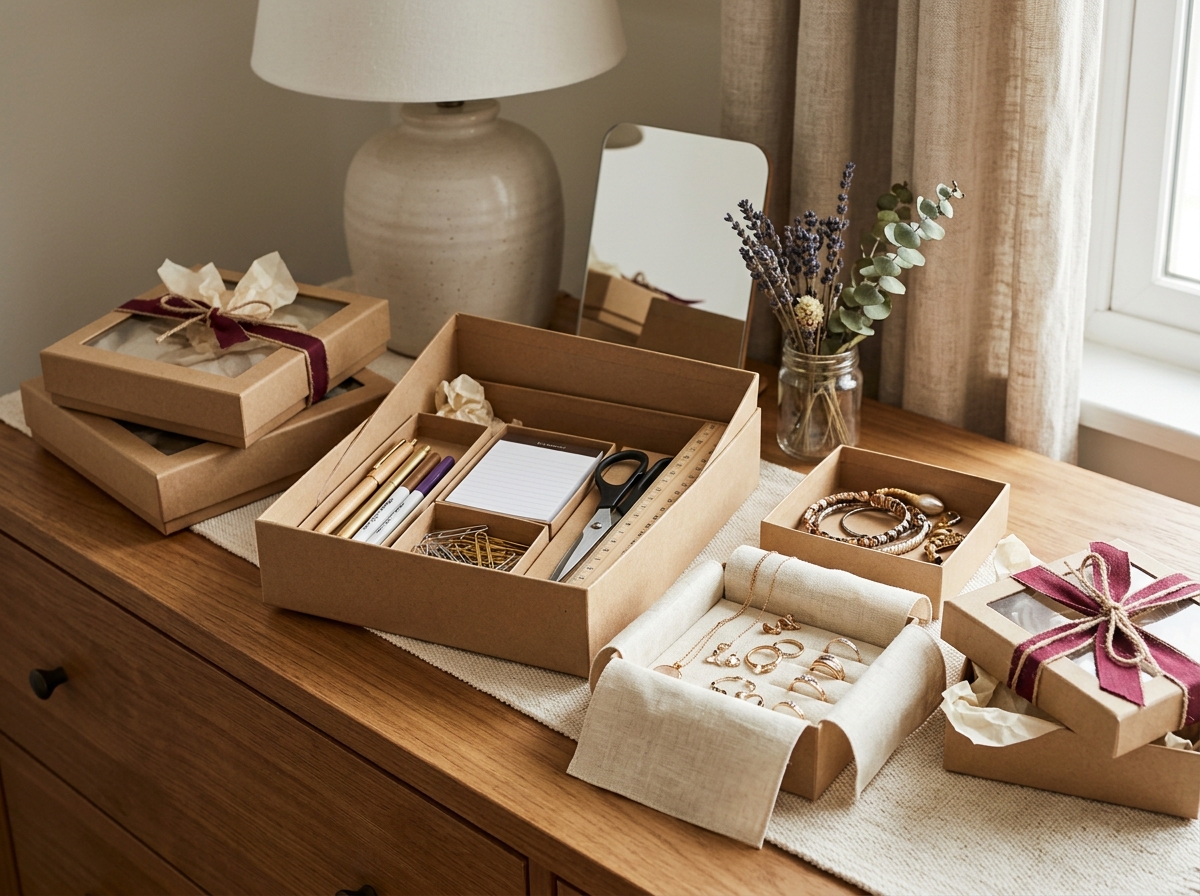
Customers notice the difference. A box that feels substantial, with a removable decorative layer, signals thoughtfulness. It tells the recipient that the contents—and the presentation—were chosen with care. When that same box later holds jewelry, office supplies, or next month's homemade cookies, your brand stays visible on a shelf or dresser.
For bakeries concerned about lead times and MOQ planning, sleeve boxes offer a practical advantage. Base boxes can be ordered in bulk and stored year-round. Sleeves, which are lighter and take up less space, can be printed closer to the holiday with shorter lead times. This reduces the risk of over-ordering seasonal inventory that becomes obsolete after February 14.
The most common base materials for reusable valentine boxes are kraft paperboard, white cardboard, and rigid chipboard. Kraft delivers an organic, artisan aesthetic that pairs well with bakery branding. White cardboard offers a clean, modern look that works across multiple product categories. Rigid chipboard—thicker and more durable—positions the box as a true keepsake rather than disposable packaging.
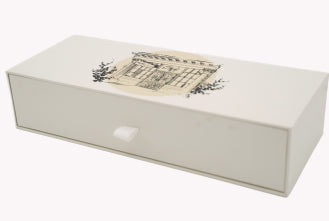
Construction style matters for reuse. Tuck-top boxes are easy to open and close repeatedly, making them ideal for storage after the holiday. Two-piece lid-and-base boxes (also called setup boxes) feel more premium but require more storage space. Sleeve-and-tray designs, where the tray slides out of the sleeve, offer the best balance: the tray is simple and reusable, while the sleeve adds structure during gifting.
Wall thickness affects durability. A 24-point paperboard box will hold up to repeated handling and stacking. Thinner 18-point stock is fine for single-use or lightweight contents like cookies, but it won't feel substantial enough for customers to repurpose. If your goal is true reusability, invest in heavier stock for the base box. The sleeve can be lighter—14 to 18 points—since it's primarily decorative.
Finishes on the base box should be minimal. Uncoated kraft or a light matte coating allows the natural texture to show through. Avoid glossy finishes on the base; they look more disposable and don't age as well with repeated use. Save the gloss, foil stamping, or spot UV for the removable sleeve, where the seasonal design justifies the embellishment.
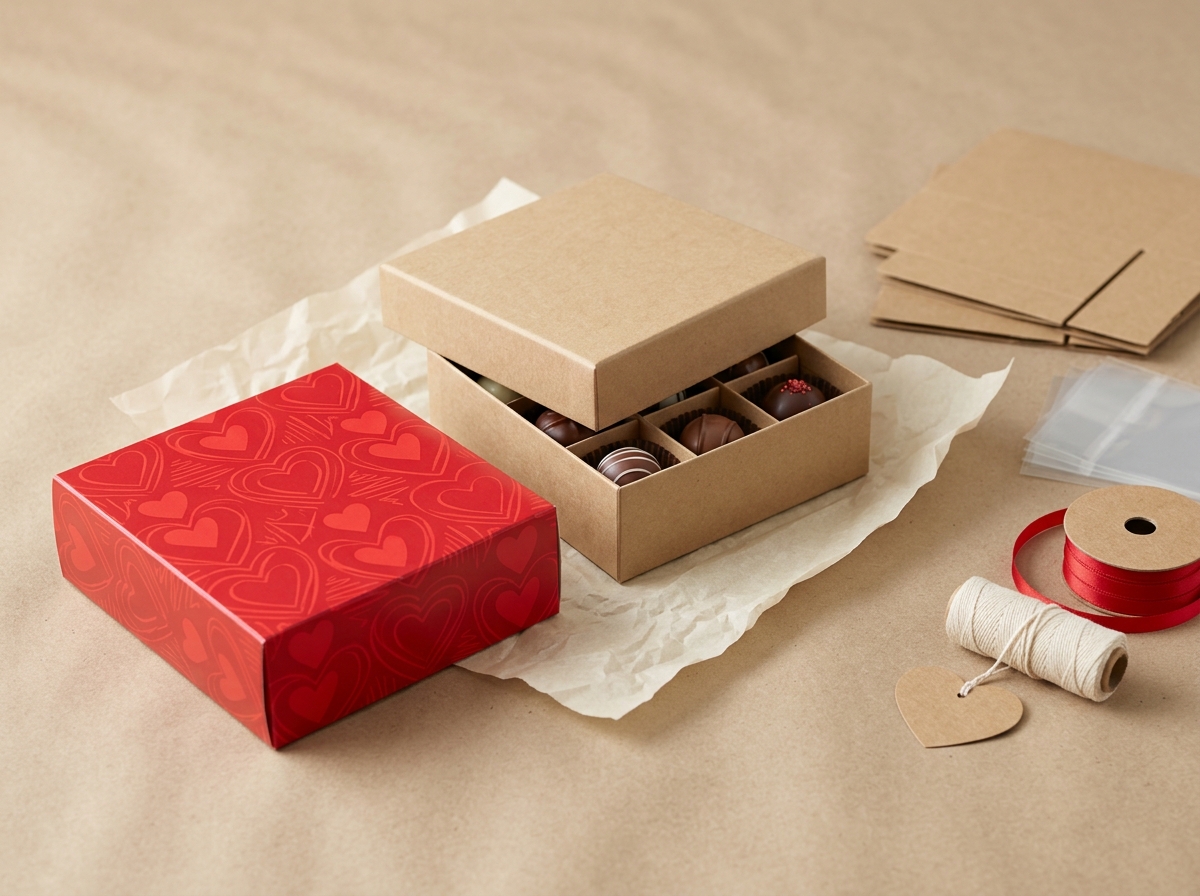
The sleeve is where you deliver Valentine's Day. This is the layer customers see first, so it needs to communicate the occasion immediately. Classic red and pink remain the most recognizable Valentine palette, but softer tones—blush, terracotta, sage green—appeal to customers looking for something less traditional.
Typography and graphics should be bold enough to read at a distance. If your boxes sit on a retail shelf or farmers market table, the sleeve needs to catch attention from several feet away. Heart motifs, floral illustrations, and hand-lettered scripts are perennial favorites. Avoid overly intricate designs that require close inspection; simplicity scales better across different box sizes.
Consider whether the sleeve will be saved or recycled. Some customers keep decorative sleeves to reuse the following year, especially if the design is generic enough ("Be Mine" works every February). Others will recycle the sleeve immediately after opening. If you want to encourage saving, print care instructions or a small note on the inside of the sleeve: "Save this sleeve for next year's gifts."
Printing methods affect both cost and environmental impact. Digital printing works well for short runs and allows for easy design variations, but it may not be as vibrant on uncoated stock. Offset printing delivers richer color saturation and is more cost-effective at higher quantities, typically above 500 units. Soy-based or water-based inks are increasingly standard for eco-conscious brands and don't compromise print quality.
Structural details like thumb notches or pull tabs make sleeve removal intuitive. A small die-cut notch at the base of the sleeve gives customers an easy grip point. Without it, removing a snug sleeve can feel awkward and may damage the box. This is a small design detail that significantly improves the user experience.
Kraft paperboard is the default choice for bakeries emphasizing natural, handmade, or sustainable positioning. The brown tone pairs well with twine, wax seals, and minimalist branding. It also photographs beautifully, which matters if your customers share unboxing moments on social media. Kraft is forgiving—minor scuffs or handling marks blend into the texture rather than standing out as flaws.
White cardboard feels cleaner and more formal. It works well for chocolatiers and confectioners with a modern or upscale brand identity. White also provides better contrast if you plan to add branded stickers, stamps, or labels directly to the base box. However, white shows wear more easily than kraft, so it's best suited for products that will be gifted soon after purchase rather than stored long-term by the retailer.
Some bakeries split the difference with natural white or cream-colored stock. This gives a softer look than bright white while still offering more contrast than kraft. It's a good middle ground if your brand palette includes pastels or metallics that don't pop as well against brown kraft.
Color consistency matters if you're ordering base boxes and sleeves from different suppliers or at different times. Kraft can vary slightly in tone depending on the mill and batch. If color matching is critical, request samples from your supplier and specify the exact stock you want to use for future orders. For white boxes, ask whether the stock is clay-coated (brighter, smoother) or uncoated (more textured, slightly off-white).
Box dimensions should accommodate your product with minimal wasted space. A box that's too large requires excessive filler, which adds cost and undermines the sustainable positioning. A box that's too tight risks crushing delicate items or making the sleeve difficult to remove.
For truffles and bonbons, a 4x4x2-inch box holds roughly six to eight pieces, depending on size. A 6x6x2-inch format works for a dozen truffles or a small assortment. If you're packaging chocolate-covered strawberries or other tall items, consider a 5x5x3-inch or 6x6x3-inch box to provide vertical clearance. For more guidance on sizing, see our clear window candy boxes sizing guide.
Cookies and baked goods require slightly different proportions. A 7x5x2.5-inch box fits a half-dozen decorated cookies laid flat. For stacked cookies or brownies, a 6x6x3-inch cube provides enough height without looking oversized. If you're offering assorted baked goods, a 8x6x2.5-inch rectangular box gives you flexibility to arrange items in a single layer.
The sleeve adds roughly 1/8 to 1/4 inch to each dimension, depending on the paperboard thickness and how snugly it fits. When specifying box sizes, confirm whether the dimensions refer to the inner tray or the outer sleeve. A "4x4x2-inch sleeve box" might mean the tray is 4x4x2 and the sleeve is slightly larger, or it might mean the assembled unit measures 4x4x2. Clarify with your supplier to avoid ordering boxes that don't fit your product.
Weight capacity is another consideration. A 24-point kraft box can typically hold up to two pounds without structural issues, assuming the contents are evenly distributed. Heavier items like dense brownies or large chocolate bars may require reinforced corners or a thicker base. Test your packaging with the actual product before committing to a large order.
Calling a box "reusable" isn't enough—you need to show customers how to reuse it. A small printed card inside the box, or a line of copy on the sleeve, can make the difference between a box that gets tossed and one that gets kept. Suggestions like "Remove the sleeve and use this box for jewelry, office supplies, or next month's baked goods" give customers a concrete mental image of the box's second life.
Certifications add credibility to sustainability claims. FSC (Forest Stewardship Council) certification indicates that the paperboard comes from responsibly managed forests. If your supplier offers FSC-certified stock, include the logo on your packaging or marketing materials. According to Innova Market Insights, consumers globally trust third-party certifications and are willing to pay more for verified packaging claims.
Recyclability information should be clear and specific. A phrase like "Box and sleeve are 100% recyclable—remove any tape or labels before recycling" helps customers dispose of the packaging correctly. If your area has curbside recycling that accepts paperboard, mention it. If not, note that the materials can be composted in a backyard bin (assuming no plastic coatings).
Some bakeries include a small incentive for customers who return the base box. A "bring back this box for 10% off your next order" program encourages reuse and drives repeat business. You can sanitize returned boxes and resell them at a discount as "gently used" packaging, or simply accept them as a goodwill gesture that reinforces your sustainability commitment.
Transparency about materials builds trust. If your boxes are made from 100% post-consumer recycled content, say so. If they're made from virgin fiber but are FSC-certified, explain what that means. Avoid vague terms like "eco-friendly" or "green" without specifics—these can come across as greenwashing, especially to informed consumers who are skeptical of unverified claims.
Sleeve boxes typically cost 15 to 30% more than a single-piece folding carton, but less than a fully printed rigid box. The cost breakdown depends on quantities, customization, and whether you're ordering the base boxes and sleeves together or separately.
For a small bakery ordering 250 units, expect to pay roughly $1.50 to $3.00 per assembled sleeve box, depending on size and printing complexity. At 500 units, the per-unit cost drops to $1.00 to $2.00. At 1,000 units or more, you can often negotiate closer to $0.75 to $1.50 per box. These figures assume offset printing on the sleeve and unprinted or minimally printed base boxes.
If you order base boxes in bulk (e.g., 1,000 units) and sleeves in smaller batches (e.g., 250 units per design), you'll pay a premium on the sleeve printing but save overall by reducing waste. This approach works well if you're testing multiple designs or serving different customer segments. The base box inventory can be shared across all variants.
Setup fees for printing typically range from $100 to $300 per design, covering plate-making and press setup. Digital printing eliminates setup fees but has a higher per-unit cost, making it economical only for very short runs (under 100 units). For most small bakeries, offset printing becomes cost-effective around 250 to 500 units.
Don't forget to factor in storage costs. Sleeve boxes ship and store flat, which is more space-efficient than pre-assembled rigid boxes. A pallet of 1,000 flat sleeve boxes occupies roughly the same space as 300 to 400 assembled rigid boxes. If storage space is limited, this can be a deciding factor.
Sleeve boxes occupy a middle ground between budget-friendly folding cartons and premium rigid boxes. Understanding where they fit in the format hierarchy helps you choose the right packaging for your product and price point.
Folding cartons—like standard tuck-top gift boxes—are the most economical option. They ship flat, assemble quickly, and can be printed with full-color graphics. However, they don't offer the same reusability as a two-piece sleeve box. Once a folding carton is opened, it often can't be closed securely again, limiting its second life.
Rigid boxes (also called setup boxes) deliver the highest perceived value. They arrive pre-assembled, with thick walls and a magnetic or lift-off lid. Customers almost always keep rigid boxes, making them ideal for luxury chocolates or high-ticket items. The trade-off is cost—rigid boxes typically run two to four times the price of sleeve boxes—and storage space, since they don't ship flat.
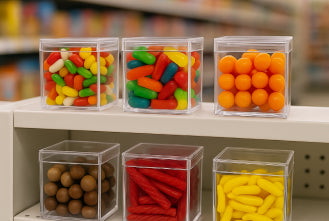
Clear acrylic or PET boxes, like our clear acrylic boxes, offer excellent product visibility and are inherently reusable. They work well for colorful candies or visually striking baked goods. However, they lack the warmth and tactile appeal of paperboard, and they don't accept printing, so branding must be done via labels or inserts. For a deeper dive into format trade-offs, see heart-shaped candy boxes vs. clear acrylic.
Cellophane bags and wraps are the most budget-friendly and versatile. They're not reusable in the traditional sense, but they can be composted or recycled in some municipalities. Pairing a cellophane wrap with a reusable ribbon or tag creates a gift-ready presentation at a fraction of the cost of a box. The downside is durability—cellophane doesn't protect contents as well during shipping or handling.
Most packaging suppliers offer sleeve boxes as a semi-custom or fully custom option. Semi-custom means you choose from a library of standard sizes and add your own printing to the sleeve. Fully custom allows you to specify exact dimensions, materials, and structural features, but it requires higher minimums and longer lead times.
Minimum order quantities (MOQs) vary widely. Domestic suppliers often have MOQs of 250 to 500 units for semi-custom sleeve boxes. Overseas manufacturers may require 1,000 to 3,000 units but offer lower per-unit costs. For small bakeries just starting out, domestic suppliers with lower MOQs provide more flexibility, even if the per-unit cost is higher.
Lead times for custom sleeve boxes typically run six to eight weeks for overseas production, including shipping. Domestic suppliers can often turn around orders in three to four weeks. If you're ordering for Valentine's Day, place your order by early December at the latest to account for production delays and shipping. For more on timing, see when to order Valentine's Day packaging.
Request samples before committing to a large order. A digital mockup or PDF proof shows you the design, but it doesn't convey the weight, texture, or fit of the actual box. Physical samples reveal whether the sleeve slides on and off smoothly, whether the base box feels sturdy enough for reuse, and whether the colors match your brand standards.
When evaluating suppliers, ask about their sustainability practices. Do they offer FSC-certified stock? Can they print with soy-based or water-based inks? Do they have a waste-reduction program? Suppliers who prioritize sustainability are more likely to deliver packaging that aligns with your brand values and resonates with eco-conscious customers.
The base box and sleeve offer two distinct branding surfaces. The sleeve is temporary and seasonal, so it's the right place for bold Valentine graphics, promotional messaging, or limited-edition designs. The base box is permanent, so branding should be subtle and timeless.
On the base box, consider a small logo stamp, a debossed brand name, or a simple one-color print. This keeps the box versatile—customers can reuse it for any occasion without feeling like they're repurposing Valentine packaging. A discreet logo on the inside lid is another option; it's visible when the box is open but doesn't dominate the exterior.
On the sleeve, you have more freedom. Full-color printing, metallic foils, embossing, and spot UV are all fair game. The sleeve is what customers see first, so it should communicate your brand identity and the Valentine theme clearly. If you're selling through retail partners, the sleeve is also where you'll include barcodes, ingredient lists, and any required labeling.
QR codes are an emerging branding tool. A QR code printed on the inside of the sleeve can link to a recipe, a video about your sourcing practices, or a landing page with reuse ideas. This adds value without cluttering the exterior design. According to packaging trend reports, digital interaction through QR codes and NFC tags is becoming a standard feature in premium gift packaging.
Personalization is another option. Variable data printing allows you to print individual names, messages, or designs on each sleeve without significantly increasing costs. This works well for corporate gifting or custom orders. For example, a bakery fulfilling a bulk Valentine order for a company could print each employee's name on the sleeve, turning a generic gift into a personalized one.
Small bakeries use removable sleeve boxes to differentiate their Valentine offerings from grocery store competition. A chocolatier might package single-origin truffles in kraft boxes with letterpress-printed sleeves that emphasize the artisan process. Customers can keep the boxes to store loose tea, spices, or small kitchen items, so the brand name stays visible in their homes for months.
A cookie decorator could offer "build your own" Valentine boxes where customers choose six cookies from a menu. The base box stays the same neutral kraft, while the sleeve design changes with the customer's theme choice—classic hearts, floral, or humorous. This lets the bakery manage inventory efficiently while still offering customization.
Subscription box services can also use sleeve boxes for their flexibility. A monthly dessert subscription might use the same base box year-round, swapping in seasonal sleeves for Valentine's Day, Easter, and Christmas. This reduces per-box costs and simplifies logistics, since the base box can be ordered in bulk and stored long-term.
Corporate gifting is another strong use case. A company ordering 200 Valentine gift boxes for clients can specify a neutral base box with the corporate logo and a Valentine-themed sleeve. After the holiday, recipients can remove the sleeve and continue using the branded box, extending the company's visibility. For more on this application, see corporate gift box ideas.
Farmers market vendors appreciate the portability and ease of assembly. Sleeve boxes ship flat and take up minimal space in a vehicle. Vendors can assemble boxes on-site as needed, and the neutral base box allows them to use the same inventory for multiple products or seasons by swapping sleeves.
For orders of 250 to 500 units, expect to pay $1.50 to $3.00 per box, depending on size, materials, and printing complexity. Costs decrease at higher volumes—orders of 1,000 units or more typically run $0.75 to $1.50 per box. Ordering base boxes in bulk and sleeves in smaller batches can reduce overall costs while allowing you to test multiple designs. Setup fees for custom printing add $100 to $300 per design.
A 4x4x2-inch box holds six to eight truffles, while a 6x6x2-inch format accommodates a dozen pieces or a small assortment. For chocolate-covered strawberries or taller items, consider a 5x5x3-inch or 6x6x3-inch box. The sleeve adds about 1/8 to 1/4 inch to each dimension, so confirm whether your supplier's dimensions refer to the inner tray or the outer sleeve to ensure proper fit.
Yes, if the base box is made from durable materials like 24-point kraft or rigid chipboard and designed with a neutral aesthetic. Customers commonly repurpose these boxes for jewelry storage, office supplies, gift-giving, or organizing small household items. Including a printed card with reuse suggestions increases the likelihood that customers will keep the box rather than discard it.
Sleeve boxes can be more sustainable if the base box is reused and the sleeve is recycled. Look for FSC-certified paperboard, soy-based inks, and minimal coatings to maximize recyclability. The modular design also reduces waste by allowing you to order neutral base boxes in bulk and print seasonal sleeves in smaller quantities, minimizing leftover inventory after the holiday. Clear disposal instructions on the packaging help customers recycle correctly.
A sleeve box consists of an inner tray and an outer sleeve that slides on and off. The sleeve is typically decorative and removable, while the tray is functional and reusable. A two-piece rigid box has a separate lid and base, both made from thick chipboard, and is pre-assembled. Rigid boxes feel more premium and are more expensive, while sleeve boxes offer better cost efficiency and flexibility for seasonal designs.
Domestic suppliers typically require three to four weeks for production and delivery, while overseas manufacturers need six to eight weeks. To account for potential delays and allow time for quality checks, place your order by early December if you're targeting Valentine's Day. If you're ordering base boxes and sleeves separately, you can order base boxes earlier and sleeves closer to the holiday to reduce storage time.