Cart
0
You may also like

Book a call with our development team to get started.



Apply online and access wholesale pricing.

When you're packaging Valentine chocolates for retail or gifting, the box size matters as much as what's inside. Clear window candy boxes let customers see your work before they buy, but only if the fit is right. A truffle rattling around in an oversized cavity looks unfinished; a box that's too shallow crushes delicate ganache. This guide walks through the standard dimensions and cavity counts you'll encounter when sourcing Valentine's Day candy packaging, so you can match your product to the right format on the first order.
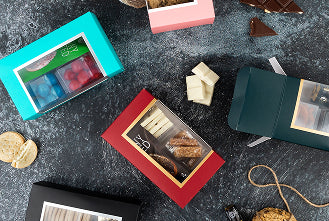
Clear window formats dominate Valentine displays because they solve the trust problem: shoppers want proof that your $18 truffle assortment contains actual truffles, not air. The window—whether acetate, PET, or soft-fold acrylic—turns packaging into a preview. But that transparency only works when the candy fits the cavity. Too much empty space reads as skimpy; too little clearance smudges the coating during assembly.
Cavity dimensions determine whether your candy sits securely or shifts during transport. Most clear acrylic boxes are designed around standard truffle sizes—typically 1 inch square or 1.25 inches for larger European-style pieces. If your product falls outside those norms, you'll need to adjust your search or your recipe.
The outer box dimensions tell you shelf footprint and stackability, but the cavity measurements tell you what actually fits. A box listed as 4" × 13/16" × 5 7/16" might hold 12 square chocolates in 1" × 7/16" × 1" cavities. That 7/16-inch depth works for flat-bottomed truffles or bark, but a tall bonbon with a peaked top will hit the lid.
Commercial packaging suppliers list cavity counts (2-piece, 4-piece, 6-piece, 12-piece) as the primary spec, but the individual cavity dimensions are what you measure your product against. Standard truffle cavities range from 1 inch to 1.25 inches square, with depths between 7/16 inch and 1 inch depending on the box style.
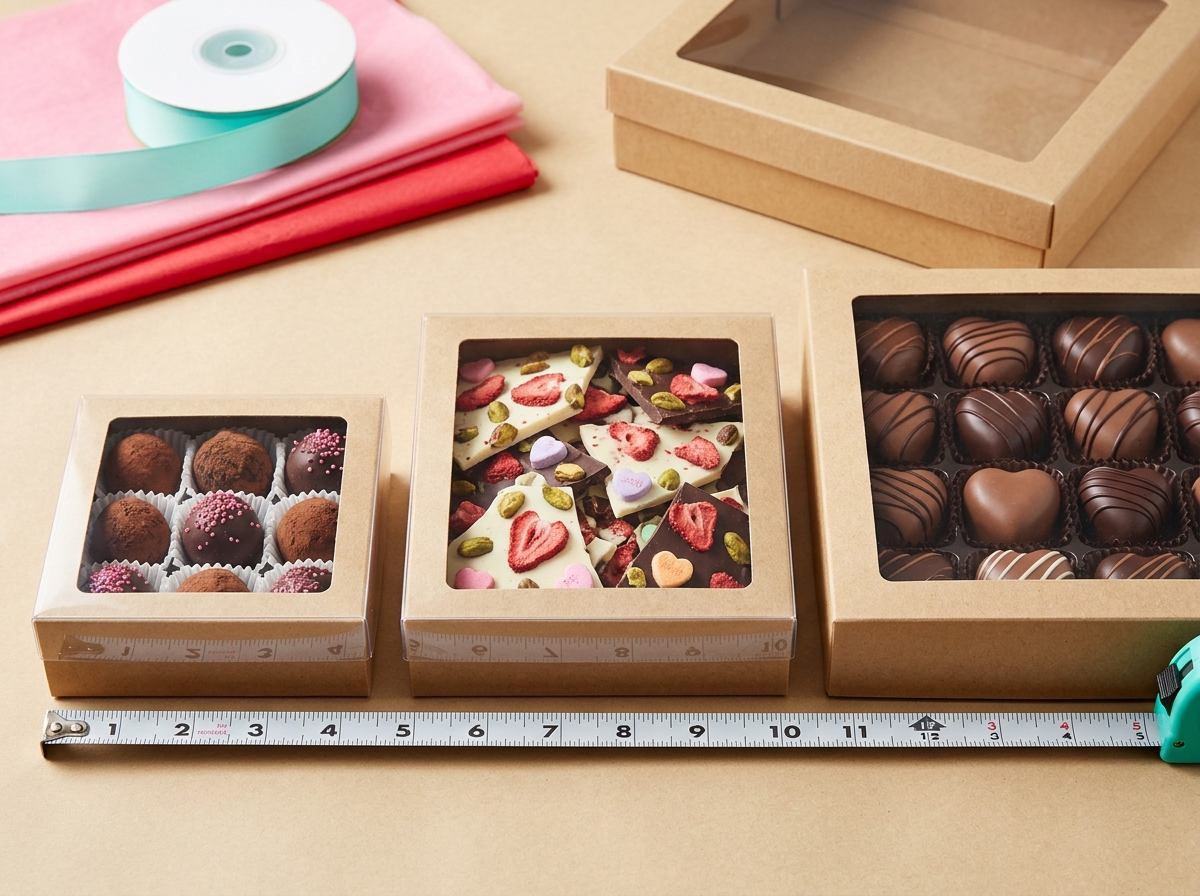
Truffles are the easiest category to package because the industry has settled on a few standard sizes. Most round or square truffles measure between 1 inch and 1.25 inches in diameter, which means you're shopping for boxes with cavities in that range.
A 2-piece truffle box typically measures around 2 3/4" × 1 3/8" × 1 3/8" externally, with two square cavities. This format is popular for impulse buys at checkout counters or as add-ons to larger gifts. The small footprint keeps costs low, but it limits your storytelling—there's not much room for variety in a two-count.
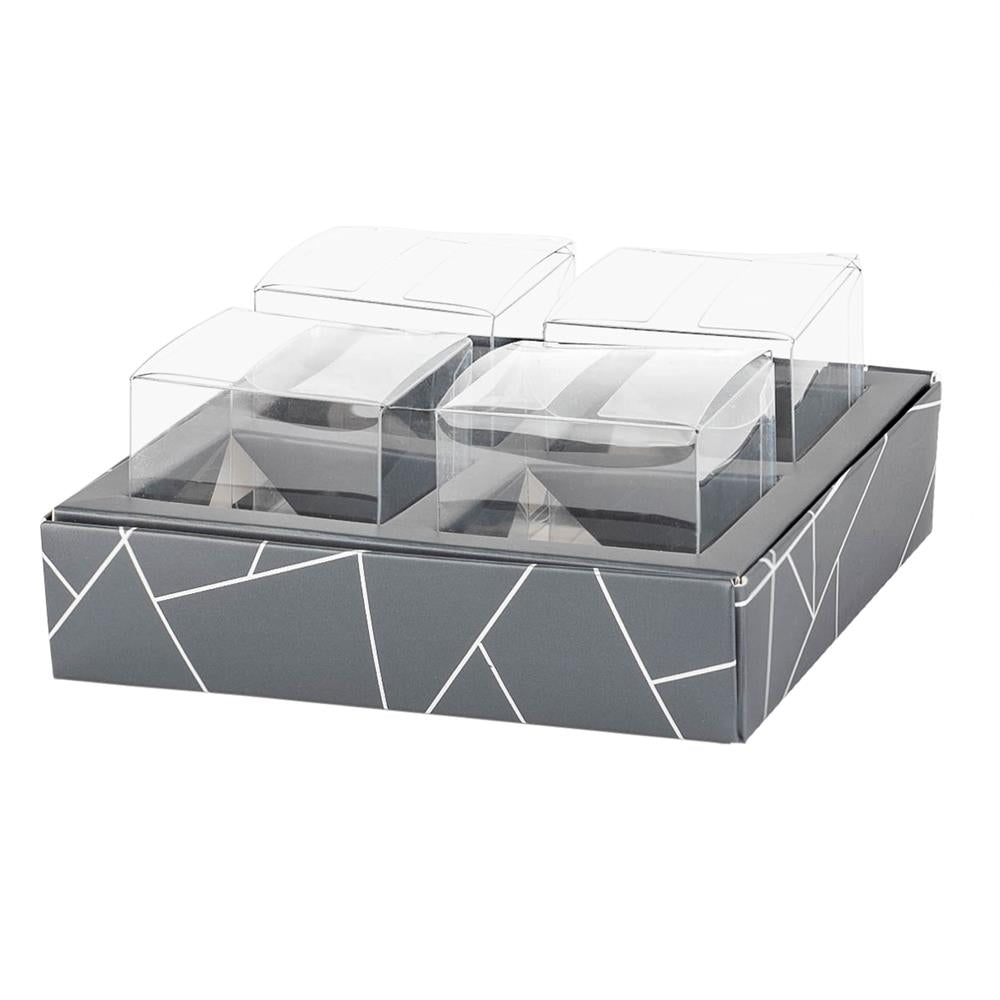
Four-piece boxes are the sweet spot for samplers. Common dimensions include 2 3/4" × 2 3/4" × 1 3/8" or 3.5" × 3.5" × 1.25", with four square cavities arranged in a grid. This format gives you enough space to show range—dark, milk, white, and a flavored ganache—without overwhelming the buyer. Cavity depth in these boxes usually runs 7/16 inch to 1 inch, which accommodates most hand-rolled truffles.
Six-piece formats often use a 2 × 3 grid in a rectangular footprint, such as 2 3/4" × 4 1/8" × 1 3/8". This shape fits well in gift bags and stacks efficiently for retail display. Eight-piece boxes extend the rectangle further, typically measuring 2 3/4" × 5 1/2" × 1 3/8".
Twelve-piece boxes are the standard Valentine gift size. You'll see outer dimensions around 4" × 13/16" × 5 7/16" or 6.5" × 8.75" × 1", depending on whether the box uses a shallow tray or a deeper rigid base. These boxes often include a separate thermoformed tray with 12 cavities, each measuring 1" × 7/16" × 1". The tray keeps pieces from touching and protects delicate coatings.
Before you order, measure your finished truffle at its widest point and tallest point. Add 1/8 inch to each dimension for clearance—this prevents smudging when you place the candy in the cavity and allows for minor variations in hand-rolled sizes. If your truffle measures 1 1/8 inches wide and 3/4 inch tall, you need a cavity at least 1 1/4 inches wide and 7/8 inch deep.
Round truffles fit into square cavities as long as the diagonal of the truffle is smaller than the cavity width. A 1-inch round truffle has a diagonal of about 1.4 inches, so it needs at least a 1.5-inch square cavity to sit flat without wedging.
Bark and brittle are harder to standardize because you control the break size. Unlike truffles, which you mold or roll to a target dimension, bark is snapped into irregular shards. This makes cavity-style boxes less practical—you'll want a flat tray or an open interior instead.
Shallow rectangular boxes work best for bark. A common size is 4 1/2" × 1/2" × 5 7/8", which gives you a long, narrow profile that shows off the bark's texture through the window. The shallow depth (1/2 inch) keeps the bark from shifting but doesn't provide much stacking height, so this format is best for thin bark or brittle.
For thicker bark—like a layered dark-and-white chocolate bark with toppings—you'll need a box with at least 1 inch of interior depth. A 3 1/2" × 1 3/4" × 6 1/2" box provides enough vertical clearance for chunky bark without looking oversized.
If you're packaging bark as a gift assortment with multiple flavors, consider a box with a single large cavity or no cavity tray at all. Clear soft tall gift boxes let you layer bark pieces with parchment dividers, creating a more artisanal presentation than a rigid tray.
Most bakers break bark into 2- to 3-inch pieces for easy eating. If you're using a 6-inch box, break your bark into pieces no longer than 5 1/2 inches to allow clearance on all sides. Irregular shapes are fine—in fact, they signal handmade quality—but extreme length or width will force you into a larger, more expensive box format.
Weight is another consideration. Bark is denser than truffles, so a 12-piece bark assortment might weigh twice as much as a 12-piece truffle box. Make sure your box material can handle the load. Thin acetate windows can bow under weight; look for boxes with PET windows or rigid acrylic construction if you're packaging more than 8 ounces of bark.
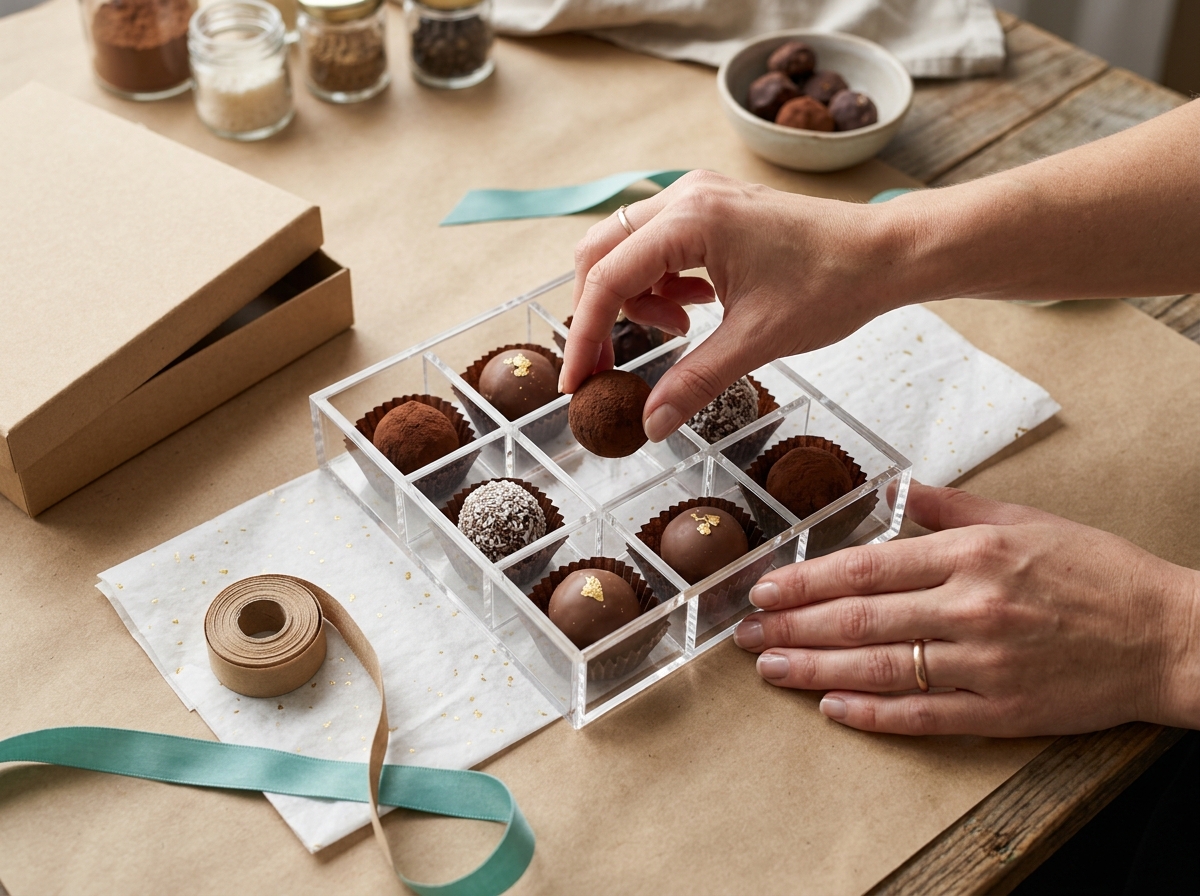
Filled chocolates—bonbons with liquid centers, caramels, nut clusters—introduce height and shape variables that truffles don't. A caramel might be only 3/4 inch wide but 1 1/4 inches tall if it's hand-cut and dipped. A nut cluster could be 1 1/2 inches in diameter with irregular edges.
For tall filled chocolates, prioritize cavity depth over width. A box with 1-inch-deep cavities will accommodate most bonbons, but check the interior height after the lid closes. Some boxes list external depth but lose 1/8 to 1/4 inch to the lid and base thickness, leaving less room than you expect.
Assortments that mix shapes—rounds, squares, rectangles—need either flexible cavities or a flat tray. Flexible thermoformed trays with slightly oversized cavities (1 1/4" × 1 1/4") can hold a 1-inch square and a 1-inch round in adjacent spots without looking mismatched. Rigid cavity trays with tight tolerances will highlight size differences and make mixed assortments look uneven.
If you're packaging a Valentine assortment with heart-shaped chocolates, you'll need a box that either has heart-shaped cavities or enough clearance in square cavities to accommodate the heart's widest point. A 1 1/4-inch heart fits into a 1 3/8-inch square cavity, but a 1 1/2-inch heart needs at least a 1 5/8-inch cavity. For more on format decisions, see Heart-Shaped Candy Boxes vs. Clear Acrylic: Which Format Sells Better for Valentine Chocolates?.
The window material affects clarity, durability, and food safety. Most clear window candy boxes use one of three materials: PET (polyethylene terephthalate), acetate, or acrylic.
PET is the most common for thermoformed cavity trays and attached window sheets. It's food-safe, recyclable, and holds its shape well. PET windows are typically 12 mil thick, which provides good clarity without excessive weight. Boxes with PET windows can withstand temperatures up to 149°F, which matters if you're shipping chocolates in warm months or storing them near heat sources.
Acetate windows are thinner and more flexible, often used in kraft or paperboard boxes where the window is glued to the inside of a die-cut opening. Acetate is less rigid than PET, so it can bow slightly if the box is overpacked or stacked under weight. It's still food-safe and works well for lightweight candies like bark or small truffles.
Acrylic (lucite) is the premium option, used in rigid two-piece boxes where the entire lid or base is clear. Acrylic is thicker and more scratch-resistant than PET or acetate, and it gives a high-end jewelry-box feel. It's heavier and more expensive, so it's typically reserved for luxury Valentine assortments or corporate gifts. According to research from PMMI, material choice increasingly reflects sustainability pressures as well as cost and performance trade-offs.
All three materials are FDA-approved for direct food contact, but you should still check the supplier's documentation. Some decorative acrylic boxes are marketed for general storage and may not carry food-contact certifications. If you're placing unwrapped chocolates directly into the cavity, confirm that the tray material is food-safe and won't transfer odors or chemicals.
Even with food-safe materials, it's good practice to line cavities with small paper cups or foil liners if your chocolates have soft coatings or high oil content. This prevents sticking and makes the box easier to clean if a customer wants to reuse it.
Cavity count drives both cost and perceived value. A 12-piece box signals a full gift; a 2-piece box reads as a sampler or impulse add-on. Your target price point should guide your cavity count, not the other way around.
If you're selling a $15 Valentine assortment, a 6-piece box gives you a per-piece cost of $2.50 before packaging. Add $1 to $2 for the box, and you're at $16 to $17 retail. A 12-piece box at the same per-piece cost would retail around $32 to $34, which might be too high for your market. Alternatively, you could reduce the size or complexity of each piece to fit 12 into a $15 price point, but that might compromise quality.
Portion size also matters for gifting context. A 2-piece box works as a "just because" gesture or a dinner party favor. A 4- or 6-piece box is appropriate for coworkers, teachers, or casual friends. A 12-piece box is the traditional romantic Valentine gift. If you're targeting multiple segments, offer at least two sizes—a small sampler and a full gift box.
Clear window candy boxes are widely stocked by wholesale suppliers, but popular sizes and styles sell out in the weeks leading up to Valentine's Day. If you're ordering standard sizes (4-piece, 6-piece, 12-piece), plan to place your order by late December or early January to ensure availability.
Minimum order quantities (MOQs) for stock boxes typically range from 25 to 100 units per size. Custom sizes or printed boxes carry higher MOQs—often 500 to 1,000 units—and require 4 to 8 weeks of lead time. If you're a small bakery or chocolatier producing fewer than 100 units, stick with stock sizes and add custom labels or ribbon to differentiate your brand. For more on planning your order schedule, see When to Order Valentine's Day Packaging: Lead Times and MOQ Planning for Small Bakeries.
If you're testing a new product or size for the first time, order samples before committing to a full case. Most suppliers sell sample quantities (1 to 5 units) at a higher per-unit price, but the cost is negligible compared to the risk of ordering 100 boxes that don't fit your product.
Clear window boxes are only as good as the presentation inside. Because the contents are visible, every detail matters—smudged chocolate, crooked placement, or empty cavities all detract from the perceived value.
When filling cavity trays, place each piece in the center of its cavity. Offset or tilted pieces look careless, even if the chocolate itself is perfect. If you're using a thermoformed tray, press the candy gently into the cavity so it sits flush with the tray surface. If it sits too high, the lid may not close properly; if it sinks too low, it looks small.
For boxes without cavity trays, use clear cellophane wrap or parchment dividers to separate pieces and prevent them from sliding. A single sheet of parchment between layers adds a professional touch and protects delicate coatings.
Close the box carefully to avoid smudging the window. Fingerprints on the inside of the window are nearly impossible to remove once the box is sealed, so handle the lid by the edges. If you're adding a ribbon or seal, place it after the box is fully assembled and inspected.
The most common mistake is ordering based on external dimensions without checking cavity size. A box that's 6 inches long might have only 5 inches of usable interior space once you account for walls and lid overlap. Always ask for cavity dimensions, not just box dimensions.
Another frequent error is underestimating the height requirement for filled or topped chocolates. A truffle with a decorative swirl or a bonbon with a tall ganache dome needs more vertical clearance than a flat-topped piece. Measure your tallest piece and add 1/8 inch for clearance.
Overpacking is also a problem. If a box is designed for 12 pieces and you try to fit 14, the lid won't close properly or the pieces will press against each other and smudge. Stick to the intended cavity count unless you're using a flat tray where spacing is flexible.
Finally, don't assume that all "clear" boxes are the same. Frosted acrylic, tinted PET, and crystal-clear acetate all have different levels of transparency. If you want maximum visibility, specify crystal-clear or high-clarity PET. Frosted finishes soften the look but reduce product visibility, which can be a disadvantage if your chocolates are your best marketing tool.
For 1-inch square or round truffles, look for boxes with cavity dimensions of at least 1 1/8" × 1 1/8" to allow clearance. A 4-piece box typically measures 2 3/4" × 2 3/4" × 1 3/8" externally with four 1-inch cavities. A 12-piece box will measure around 4" × 5 7/16" with 1" × 1" cavities arranged in a grid. Measure your truffle at its widest point and add 1/8 inch for safe clearance.
It depends on the box format. Cavity-style boxes designed for truffles won't work well for irregular bark pieces, which need a flat tray or open interior. If you want to package both in the same box style, choose a shallow rectangular box without cavities—around 4 1/2" × 1/2" × 5 7/8"—and break your bark into pieces that fit the interior length. For truffles, you can place them directly on the flat base with small paper cups to keep them separated.
Check the product description or packaging for FDA food-contact compliance. Most boxes made from PET, acetate, or food-grade acrylic are safe for direct contact with chocolates. If the supplier doesn't list food-safety certifications, ask before ordering. Decorative storage boxes that aren't marketed for food use may not meet FDA standards, even if they look identical to food-safe versions.
PET (polyethylene terephthalate) is a rigid, recyclable plastic commonly used for thermoformed trays and window sheets. It's thicker (typically 12 mil) and holds its shape well under weight. Acetate is thinner and more flexible, often used in paperboard boxes where the window is glued over a die-cut opening. PET offers better clarity and durability; acetate is lighter and less expensive. Both are food-safe when sourced from reputable suppliers.
For stock sizes, order by late December or early January to ensure availability. Popular sizes like 6-piece and 12-piece boxes sell out quickly in the weeks before Valentine's Day. If you're ordering custom or printed boxes, allow 4 to 8 weeks of lead time and expect MOQs of 500 to 1,000 units. Ordering samples first is a good practice if you're trying a new size or supplier for the first time.
Sizing clear window candy boxes correctly comes down to three measurements: cavity width, cavity depth, and total count. Measure your finished product, add clearance, and match it to a standard box format before you order. The transparency that makes these boxes appealing also exposes poor fit, so take the time to get the dimensions right. Your chocolates will look better, ship more securely, and justify the premium price that Valentine packaging commands.