Cart
0
You may also like

Book a call with our development team to get started.



Apply online and access wholesale pricing.

Thanksgiving drives the highest seasonal demand for pie packaging in the bakery industry. Between mid-September and late November, bakeries and caterers face a compressed ordering window where the right packaging decisions directly impact product quality, display appeal, and operational efficiency. Choosing thanksgiving pie boxes requires balancing dimensional accuracy, material performance during refrigerated transport, food-safety compliance, and wholesale pricing structures that align with your production volume.
This guide addresses the specific packaging challenges bakeries and caterers encounter during Thanksgiving: selecting between 9-inch and 10-inch boxes for standard versus deep-dish pies, comparing kraft and SBS paperboard for moisture-heavy fillings during multi-day transport, understanding window material options that prevent condensation, navigating minimum order quantities for small versus large operations, and timing orders to meet the November 19-26 delivery peak.
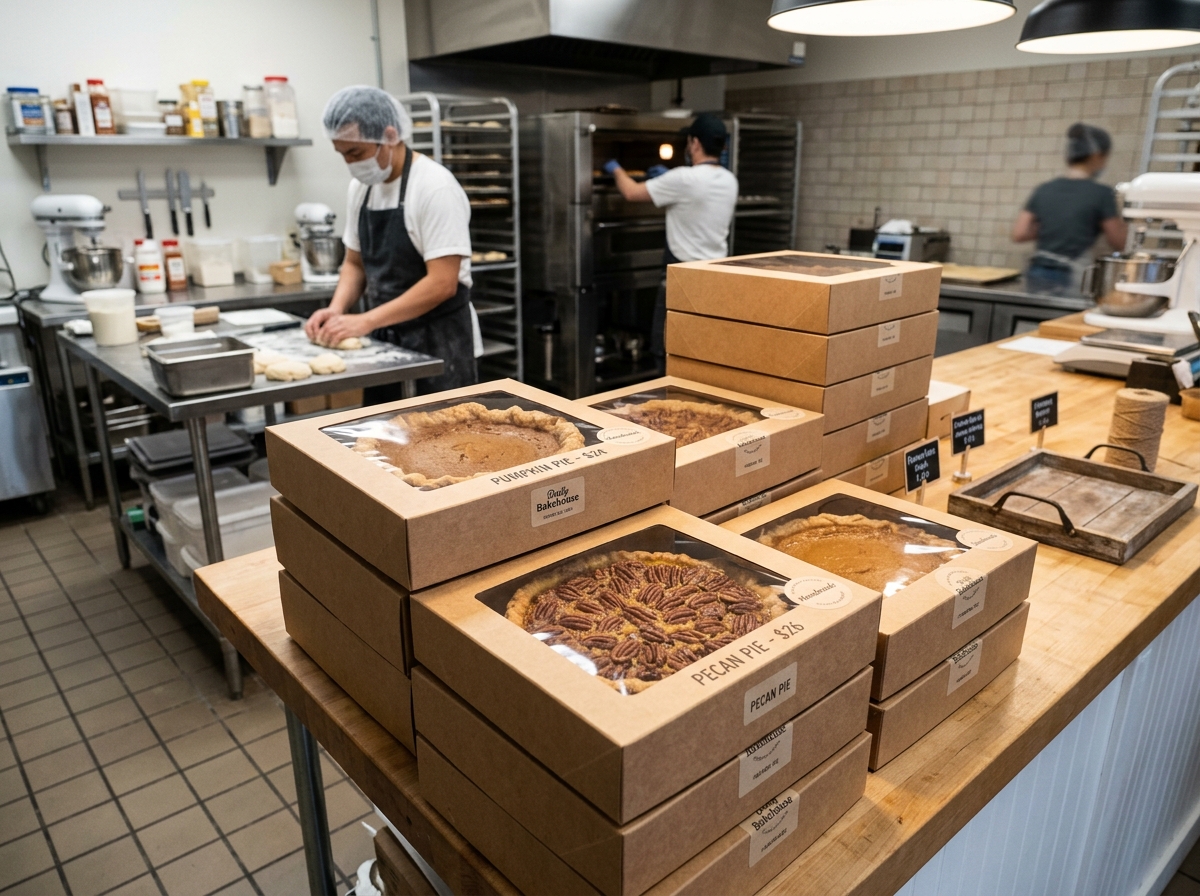
Thanksgiving pie sales represent a concentrated revenue opportunity that requires packaging infrastructure different from routine bakery operations. The holiday creates simultaneous demand from wholesale accounts, in-store retail customers, catering orders, and farmers market vendors—each channel with distinct packaging requirements.
For B2B bakeries supplying grocery stores and restaurants, pie boxes must support stacking during delivery, maintain structural integrity under refrigeration, and provide clear product visibility for impulse purchases. Caterers need secure closures that prevent filling displacement during meal-kit assembly and transport. Home bakers selling at seasonal markets require smaller quantities with presentation features that justify premium pricing.
Material selection affects product quality during the 2-3 day window between baking and Thanksgiving consumption. Pumpkin and pecan pies contain high moisture and oil content that can compromise paperboard strength. SBS paperboard has a low moisture absorption rate, which helps preserve quality during transport and storage, while kraft options offer natural grease resistance at lower cost. The wrong material choice leads to box failure, damaged crusts, and customer complaints during your busiest week.
Window placement drives purchasing decisions at retail. Pies are visual products—lattice crusts, meringue peaks, and decorative edges communicate craftsmanship. Boxes without windows require trust; boxes with windows convert browsers to buyers. But window material matters: acetate panels fog under refrigeration, while PET maintains clarity across temperature changes.
Timing is non-negotiable. Production runs 8–12 weeks, and holiday seasonal custom printing demand spikes hard in October. Bakeries ordering in late October for Thanksgiving delivery face stockouts or premium rush fees. Understanding lead times relative to your production calendar prevents last-minute scrambling.
Pie box sizing follows a counterintuitive convention: if you have a 9" pie, you should allow room on all sides to account for crust and pie plate overflow—the 10" size would be a good choice. The box dimension refers to interior footprint, but pie plates have lips and crimped edges that extend beyond the filling diameter.
A standard 9-inch pie—measured by the top diameter of the filling—typically sits in a 9.5-inch plate with a 0.75-inch rim. When you account for decorative crust edges and any lattice overhang, the actual footprint approaches 10 inches. Forcing this into a 9×9-inch box compresses the crust, damages presentation, and makes removal difficult for customers.
The industry-standard dimensions are 9×9×2.5 inches for smaller pies and tarts, and 10×10×2.5 inches for full-size traditional pies. The 9-inch box accommodates pot pies, quiches, and single-serving dessert pies where the plate diameter genuinely measures 8-8.5 inches. The 10-inch box is the workhorse for Thanksgiving: it fits standard pumpkin, pecan, apple, and sweet potato pies baked in 9-inch plates.
Deep-dish pies require dimensional adjustments in both footprint and height. A deep-dish pie plate measures 9.5-10 inches in diameter but holds 50-75% more filling than standard depth. These pies need 10×10-inch or even 10.5×10.5-inch boxes to prevent edge contact. For more detailed guidance on matching box dimensions to pie styles, see our comprehensive sizing guide.
Bakeries producing both standard and deep-dish varieties face an inventory decision: stock two box sizes or compromise with one. Stocking both optimizes fit and presentation but increases minimum order quantities and storage space. Using 10-inch boxes for all pies simplifies logistics but leaves smaller pies sliding during transport. The decision depends on your product mix—if 80% of Thanksgiving orders are standard 9-inch pies, dedicated sizing makes sense.
The standard 2.5-inch height works for most traditional pies: single-crust pumpkin, pecan with modest filling, and fruit pies with flat or slightly domed tops. This height provides approximately 0.5 inches of clearance above a standard pie, enough to prevent top crust contact during normal handling.
Meringue-topped pies break this standard. A proper meringue rises 2-3 inches above the pie plate rim, with peaks that add another 0.5 inches. Total height from plate bottom to meringue tip often reaches 3.5-4 inches. A 2.5-inch box crushes the meringue on contact. Meringue pies require 3-inch or even 4-inch box heights, which are less common in standard wholesale catalogs.
Lattice-top fruit pies present a similar challenge when bakers create tall, woven patterns. A traditional flat lattice fits standard height, but dimensional lattice work—where strips are folded or braided to create texture—can add an inch of clearance requirement. Dutch apple pies with streusel toppings also need extra vertical space, as the crumb topping mounds above the crust edge.
Cream pies and custard pies with whipped cream garnish need height assessment on a per-recipe basis. If whipped cream is piped at service rather than pre-applied, standard height works. If pies are packaged with decorative cream borders or rosettes, measure the tallest point and add 0.5 inches for safe clearance.
The operational trade-off is inventory complexity versus product protection. Stocking 2.5-inch and 3-inch heights doubles your SKU count and splits minimum order quantities. Some bakeries solve this by limiting Thanksgiving meringue production or offering meringue as an at-home topping kit. Others absorb the cost of specialized boxes for signature items that command premium pricing.
Paperboard choice affects structural performance during the specific conditions Thanksgiving pies encounter: refrigerated storage for 24-72 hours, transport in vehicles with temperature fluctuations, and display in grocery store bakery cases with variable humidity.
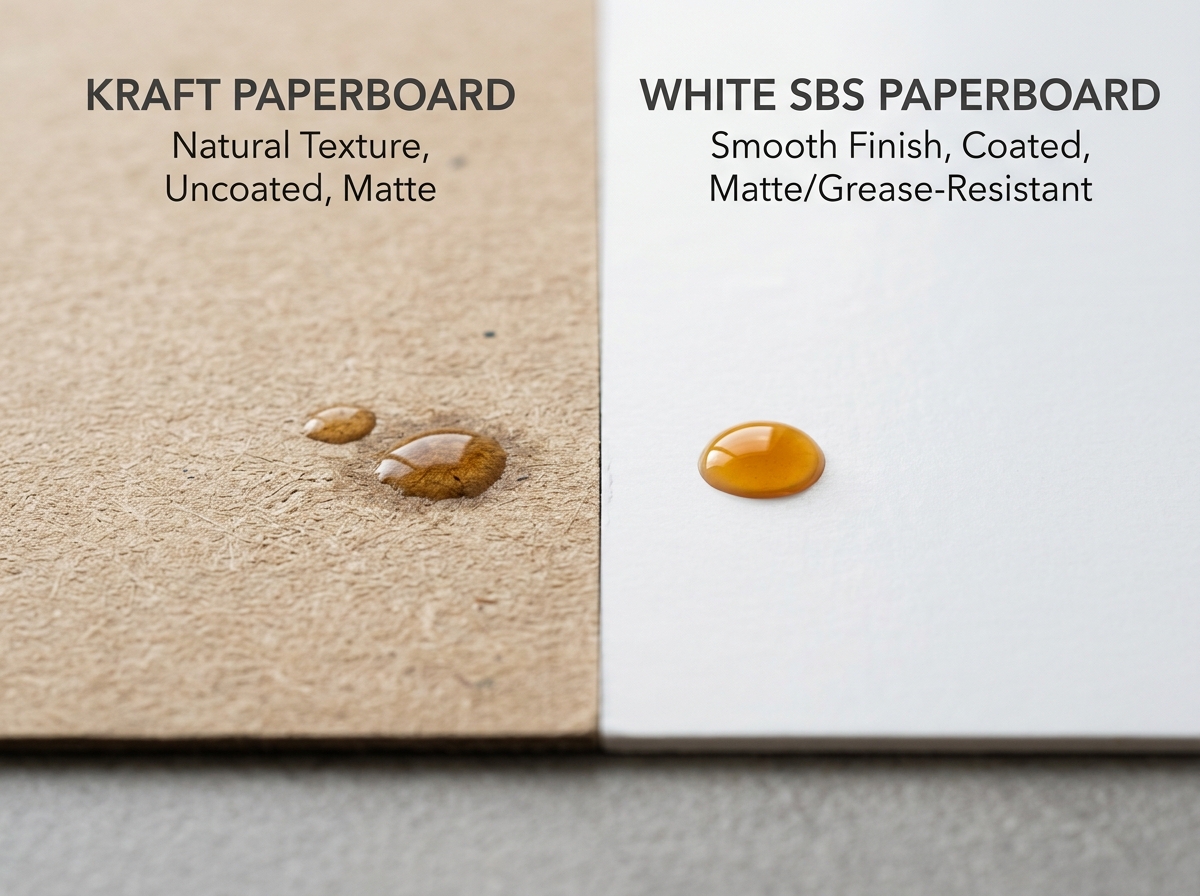
Kraft paperboard—technically Solid Unbleached Sulfate (SUS)—uses unbleached wood fibers that retain natural lignin content. This gives kraft inherent grease resistance and structural strength. SUS is naturally resistant to moisture, and when enhanced with some coatings, it's the perfect packaging for fridge and freezer products. The brown color reads as rustic and artisanal, aligning with farm-to-table and organic positioning. Kraft costs 15-25% less than SBS at comparable weights, making it the default choice for high-volume operations focused on cost control.
SBS (Solid Bleached Sulfate) paperboard uses bleached virgin fibers that create a bright white surface. The smoothness of SBS paperboard allows for high-quality printing, and its rigidity provides excellent protection. For bakeries investing in custom printing or brand differentiation, SBS delivers superior color accuracy and fine detail reproduction. The white surface also creates a cleaner, more premium perception for upscale retail environments.
Moisture performance differs in practical application. Pumpkin pie filling contains 60-70% water by weight, and pecan filling includes corn syrup and eggs that create condensation during cooling. SBS paperboard has a low moisture absorption rate, which helps to preserve the quality of your products during transport and storage. Kraft performs well with grease but can soften when exposed to sustained moisture contact, particularly along the box bottom where condensation pools.
Both materials require grease-resistant coatings for direct food contact with high-fat pies. Uncoated paperboard absorbs butter and oil from crust edges, creating visible staining and structural weakening. A clay coating or food-safe wax treatment prevents absorption. When comparing supplier quotes, confirm that grease-resistant treatment is included—it's standard for SBS but sometimes optional for kraft, creating a hidden cost difference.
For a detailed material comparison with performance data across different pie types and storage conditions, see our kraft versus SBS analysis.
Window placement transforms a pie box from transport container to display case. The window serves two functions: it allows customers to verify pie quality before purchase, and it creates visual appeal that drives impulse buying in retail settings. But window material choice affects clarity, durability, and food safety compliance.
Acetate film is the traditional window material. It's a cellulose-based plastic that's clear, lightweight, and bonds well to paperboard during manufacturing. Acetate costs less than alternatives and is readily available in standard box production. The limitation is moisture sensitivity: acetate fogs when exposed to temperature changes, particularly when a refrigerated pie is moved to room temperature. The fog clears as temperatures equalize, but during peak retail hours when cases are opened frequently, acetate windows remain cloudy.
PET (polyethylene terephthalate) film offers superior clarity across temperature ranges. Window patches must use FDA-approved PET film for food contact applications. PET resists fogging, maintains transparency under refrigeration, and provides better impact resistance during stacking and transport. The material costs 20-30% more than acetate, which suppliers typically pass through in per-unit pricing.
Window size and placement follow design conventions that balance visibility with structural integrity. The most common configuration is a centered rectangular window that reveals 60-70% of the pie top, leaving 1.5-2 inches of paperboard around the perimeter for stacking strength. Some designs use circular windows that echo the pie shape, though these require custom die-cutting that increases setup costs.
Bakeries must weigh the display advantage against the cost premium. For wholesale accounts where pies are delivered to restaurant kitchens, windows add expense without value—the pie is removed from the box immediately. For retail bakery counters and farmers markets, windows are essential sales tools. For catering meal kits, windows provide quality assurance that reduces customer service inquiries.
One practical consideration is condensation management. Even PET windows can't prevent moisture from accumulating inside the box—they simply remain clear while it happens. Pies packaged hot will generate significant condensation that drips onto the crust surface. Best practice is cooling pies to room temperature before boxing, or using vented boxes that allow steam escape during the first hour of cooling. For detailed window selection guidance and display strategies, review our window material comparison.
Food packaging compliance is not optional—it's a legal requirement that affects material selection, supplier vetting, and documentation. FDA-approved materials use food-safe packaging materials that do not leach harmful substances. The FDA doesn't approve individual packages, but it regulates the materials, coatings, inks, and adhesives used in food contact packaging.
Paperboard boxes require three compliance layers. First, the base paperboard must be manufactured from food-grade virgin pulp or approved recycled content. Paperboard must be free from unsafe coatings and chemical contamination risks—recycled paper must be controlled for mineral oils and contamination risk. Second, any coating applied for grease or moisture resistance must meet FDA food contact substance regulations. Third, printing inks and adhesives must be formulated for indirect food contact, meaning they're on the exterior surface but could transfer through the paperboard.
Grease-resistant coatings are essential for pie boxes because butter, shortening, and oil from crusts migrate through uncoated paperboard. Bakery packaging must use food-safe paperboard with grease-resistant coatings, and window patches must use FDA-approved PET film. The coating creates a barrier that prevents oil absorption and visible staining. Common food-safe coatings include clay-based treatments, wax emulsions, and fluorine-free water-resistant alternatives.
Supplier documentation is your compliance proof. Reputable packaging suppliers provide Certificates of Compliance (COC) that certify materials meet FDA food contact requirements. This document should specify the paperboard grade, coating type, and any testing performed. If a supplier cannot provide a COC upon request, find a different supplier—you're assuming liability for any contamination or compliance failure.
Allergen labeling is separate from packaging compliance but equally important. The packaging itself must be allergen-free, but bakeries are responsible for labeling the pie with ingredient and allergen information. The box should provide space for labels or stickers that include required disclosures. For comprehensive food safety requirements and compliance documentation, see our FDA compliance guide.
Wholesale pricing follows volume tiers that reward bulk ordering but create barriers for small bakeries. Understanding minimum order quantities (MOQ) and price breaks helps you balance cash flow against per-unit cost savings.
Standard wholesale pie boxes—stock designs without custom printing—typically have MOQs of 100-200 units per case. At this entry level, expect to pay $0.75-$1.25 per box for 10×10×2.5-inch kraft boxes with windows, and $0.95-$1.50 for comparable SBS boxes. These prices assume plain white or kraft exteriors with no custom printing.
The first significant price break occurs at 500-1,000 units, where per-unit costs drop 15-25%. A bakery ordering 1,000 kraft pie boxes might pay $0.60-$0.85 per unit versus $1.00 for a 200-unit order. This volume threshold aligns with mid-sized bakeries producing 200-400 pies per week during Thanksgiving season, allowing them to order once for the entire holiday window.
Pay close attention to the supplier's minimum order quantity—for small and medium-sized bakeries, excessively high MOQs may result in overstock and restricted cash flow. Large bakeries and regional chains access the next tier at 5,000-10,000 units, where prices can drop to $0.40-$0.60 per box. But ordering 10,000 boxes requires significant storage space and capital investment that many operations can't absorb.
Custom printing adds both cost and MOQ requirements. Basic one-color logo printing typically requires 1,000-unit minimums and adds $0.15-$0.30 per box. Full-color custom designs require 2,500-5,000 unit minimums and add $0.30-$0.50 per box, plus one-time setup fees of $150-$400 for design and printing plates.
Small bakeries and cottage food operators face a strategic choice: accept higher per-unit costs for stock boxes, or collaborate with other local bakeries to split custom orders and reach volume thresholds. Some packaging suppliers now offer low-MOQ custom programs starting at 250-500 units, specifically targeting the artisan bakery market. These programs cost more per unit than traditional wholesale but less than retail packaging supply stores.
For detailed MOQ guidance, volume pricing tiers, and strategies for small bakeries, see our wholesale pricing and MOQ guide. If you're ready to order, browse our selection of kraft gift boxes suitable for smaller pie packaging needs.
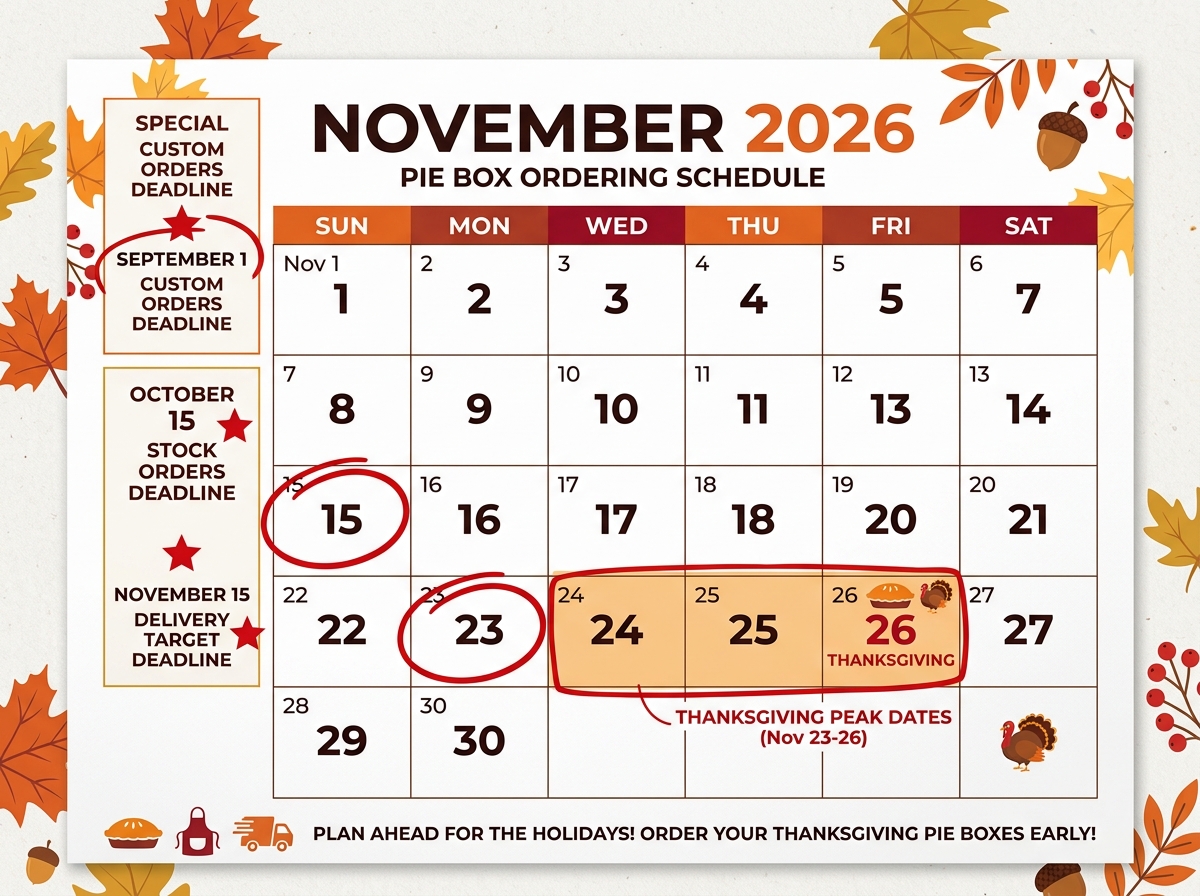
Thanksgiving packaging operates on a compressed seasonal calendar where late orders face stockouts or premium rush fees. The ordering window opens in early September and effectively closes in mid-October for standard wholesale delivery.
Stock pie boxes—standard sizes in kraft or white with generic windows—have the shortest lead times. Suppliers maintain inventory of common configurations and can ship within 5-10 business days. For bakeries ordering standard boxes in September or early October, delivery by late October is reliable. But as October progresses, stock inventory depletes and lead times extend to 3-4 weeks.
Custom printed boxes require 8-12 weeks from design approval to delivery. This timeline includes artwork finalization (1-2 weeks), printing plate production (1-2 weeks), production runs (3-4 weeks), and shipping (1-2 weeks). Bakeries wanting custom boxes for Thanksgiving must finalize orders by mid-September at the latest. Orders placed in October won't arrive until late November or early December—after the holiday has passed.
The Thanksgiving delivery peak runs November 19-26, with November 23-24 representing the highest volume days. Bakeries need packaging in-house by November 15 to support pre-holiday production. Working backward, this means ordering stock boxes by October 15 and custom boxes by September 1.
Rush production is available from some suppliers but carries 25-50% cost premiums and requires minimum order quantities that may be higher than standard programs. Rush service typically compresses timelines by 2-3 weeks, not by half—a 10-week custom order might be rushed to 7-8 weeks, but not to 5 weeks.
Bakeries operating on tight timelines should consider split ordering: place a bulk order for stock boxes as backup, then add custom boxes if they arrive in time. The stock boxes ensure you can fulfill orders regardless of custom production delays. Any unused stock boxes can be held for other holidays or used for non-seasonal pies throughout the year.
For detailed lead time planning and a week-by-week ordering calendar, see our Thanksgiving ordering timeline guide.
Packaging is a brand touchpoint that communicates quality, values, and attention to detail. Even stock boxes offer presentation opportunities through labels, stickers, ribbon ties, and insert cards.
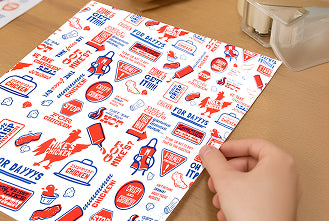
Custom labels are the most accessible branding tool for bakeries not ready for custom box printing. Design and print labels in-house or through a local print shop, then apply them to stock boxes. A 2×3-inch label on the box top can include your logo, pie variety, ingredients, and a "Happy Thanksgiving" message. Labels cost $0.05-$0.15 per unit at modest volumes and require no minimum order quantities beyond what your printer specifies.
Ribbon ties add a gift-worthy touch that elevates perceived value. A 12-inch length of grosgrain or satin ribbon in fall colors (burgundy, gold, burnt orange) costs $0.08-$0.15 per box and takes 10-15 seconds to tie. This simple addition transforms a commodity pie box into gift packaging that customers feel confident bringing to a host. For bakeries selling at premium price points or targeting gift-giving customers, ribbon ties justify a $2-3 price increase.
Insert cards serve multiple purposes: they provide baking or serving instructions, list ingredients and allergens, tell your bakery's story, or include a discount code for future orders. A simple 3×5-inch card printed on cardstock costs $0.10-$0.20 per unit and creates a professional impression that generic packaging lacks. The card also provides space for required food labeling information without adhering stickers directly to the box.
Window boxes inherently support presentation by showcasing the pie itself. Invest in pie finishing details that photograph well through the window: decorative crust edges, leaf cutouts for fruit pies, pecan halves arranged in concentric circles, or a light dusting of cinnamon on pumpkin pies. The packaging window is only valuable if the product inside merits display.
Seasonal design elements can be added to stock boxes through stamps or stencils. A "Baked Fresh for Thanksgiving" stamp in food-safe ink costs $15-30 and can be applied to hundreds of boxes. Stenciled designs using edible luster dust or cocoa powder on the box interior create a subtle branded pattern visible through the window.
For comprehensive presentation ideas and seasonal branding strategies, see our presentation and gift packaging guide. Enhance your pie presentation with our clear acrylic serving trays for upscale catering displays.
Pie boxes ship flat-packed to minimize freight costs and storage space. A case of 100 flat boxes occupies approximately 2 cubic feet; the same boxes assembled would require 15-20 cubic feet. For bakeries ordering 500-1,000 boxes for Thanksgiving, flat storage is essential.
Box assembly follows a standard folding sequence: fold the base panel, tuck side tabs into slots, fold the lid panel, and secure the locking tab. Most pie boxes use a tuck-top design where a tab on the lid panel inserts into a slot on the front panel. This design requires no tape or adhesive and can be assembled in 8-12 seconds once staff develop muscle memory.
Pre-assembly timing affects workflow efficiency. Assembling all boxes in advance creates clutter and reduces available work surface in the production area. Assembling boxes on-demand during packaging creates bottlenecks during peak production hours. The optimal approach is batch assembly: assemble 50-100 boxes at a time during slower periods, stack them carefully to prevent crushing, and position them within arm's reach of the packaging station.
Stacking assembled boxes requires attention to weight distribution. Empty boxes can be stacked 15-20 high if weight is distributed evenly. Stacking higher risks crushing the bottom boxes. Use flat surfaces like sheet pans or cardboard flats between every 10 boxes to distribute weight and maintain box shape.
Flat-packed box storage should keep boxes dry and away from temperature extremes. Paperboard absorbs moisture from humid environments, which weakens fold lines and makes assembly difficult. Store boxes in climate-controlled areas, not in walk-in coolers or near steam equipment. If you must store boxes in a basement or garage, elevate them on pallets or shelving to prevent ground moisture absorption.
Quality control during assembly catches defects before they affect production. Check a sample box from each case for proper fold lines, intact windows, and secure locking tabs. Occasionally a manufacturing defect affects an entire case—discovering this during peak production is costly. For detailed assembly techniques and high-volume workflow strategies, see our assembly and storage efficiency guide.
A standard 9-inch pie requires a 10×10-inch box to accommodate the pie plate rim and decorative crust edges. The 9-inch measurement refers to the filling diameter, but the actual plate and crust extend to approximately 9.5-10 inches. Using a 9×9-inch box compresses the crust and makes removal difficult. For standard-height pies, choose a 10×10×2.5-inch box. For meringue-topped or lattice pies, select a 10×10×3-inch or taller box to prevent top contact.
Order stock pie boxes by October 15 for reliable delivery by mid-November. Custom printed boxes require 8-12 weeks lead time, meaning orders must be finalized by mid-September for Thanksgiving delivery. Suppliers experience high demand in October, and late orders face extended lead times or stockouts. Plan to have all packaging in-house by November 15 to support pre-holiday production that peaks November 19-26.
Kraft paperboard offers natural grease resistance, lower cost, and a rustic appearance, while SBS paperboard provides superior moisture resistance, better printing quality, and a premium white finish. Kraft costs 15-25% less and performs well for high-volume operations, but SBS maintains structural integrity better under refrigerated conditions with moisture-heavy pies like pumpkin and pecan. Both materials require food-safe grease-resistant coatings for direct pie contact.
Stock pie boxes have minimum order quantities of 100-200 units per case, with significant price breaks at 500-1,000 units and again at 5,000+ units. Custom printed boxes typically require 1,000-2,500 unit minimums for basic designs and 2,500-5,000 units for full-color printing. Small bakeries can access low-MOQ custom programs starting at 250-500 units from suppliers targeting artisan operations, though per-unit costs are higher than traditional wholesale.
Yes, window boxes cost 20-35% more than solid boxes due to the additional material, die-cutting, and assembly required. A stock kraft box might cost $0.75 per unit, while the same box with a PET window costs $0.95-$1.10. The cost premium is justified for retail and farmers market sales where product visibility drives purchasing decisions, but may not be worthwhile for wholesale delivery to restaurants or catering operations where pies are removed from boxes immediately.
For additional guidance on packaging pies for delivery and preventing damage during transport, see our delivery packaging guide. Bakeries prioritizing sustainability should review our eco-friendly packaging options. Cottage food businesses and farmers market vendors can find portable solutions in our cottage food packaging guide.
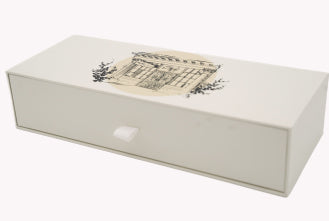
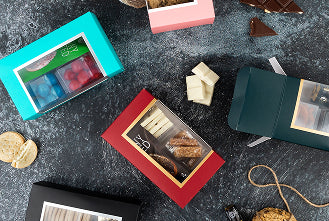
Thanksgiving pie packaging is a seasonal investment that affects product quality, brand perception, and operational efficiency during your highest-revenue week. Selecting the right box size, material, and supplier—and ordering early enough to avoid rush fees—ensures your pies arrive at customer tables in perfect condition. Complement your pie packaging with our white gift boxes for smaller dessert items, or explore our windowed gift boxes for elegant presentation options that extend beyond the holiday season.