Cart
0
You may also like

Book a call with our development team to get started.



Apply online and access wholesale pricing.

For small bakeries and cottage food businesses, understanding wholesale pie box pricing can mean the difference between profitable holiday production and razor-thin margins. Most suppliers set minimum order quantities between 50 and 100 units for custom-printed boxes, though plain stock boxes often carry lower minimums or none at all. The cost per unit drops significantly as order volume increases—typically 10 to 20 percent at each major tier—but only if you can manage the storage and cash flow requirements that come with bulk purchasing.
This guide breaks down the MOQ landscape for Thanksgiving pie boxes and year-round pie packaging, comparing pricing structures across order volumes and helping you calculate the true cost of your packaging investment.
Minimum order quantity, or MOQ, represents the smallest number of units a supplier will sell in a single transaction. For wholesale pie boxes, this threshold exists because suppliers need to cover fixed costs—plate setup for custom printing, machine calibration, and order processing—that remain constant whether they produce 50 boxes or 500.
According to industry standards documented by the Fibre Box Association, corrugated and paperboard packaging suppliers typically structure MOQs around production efficiency rather than arbitrary unit counts. A 50-unit minimum often represents a single production run for small-format boxes, while 100-unit minimums align with case pack configurations that optimize pallet loading and shipping.
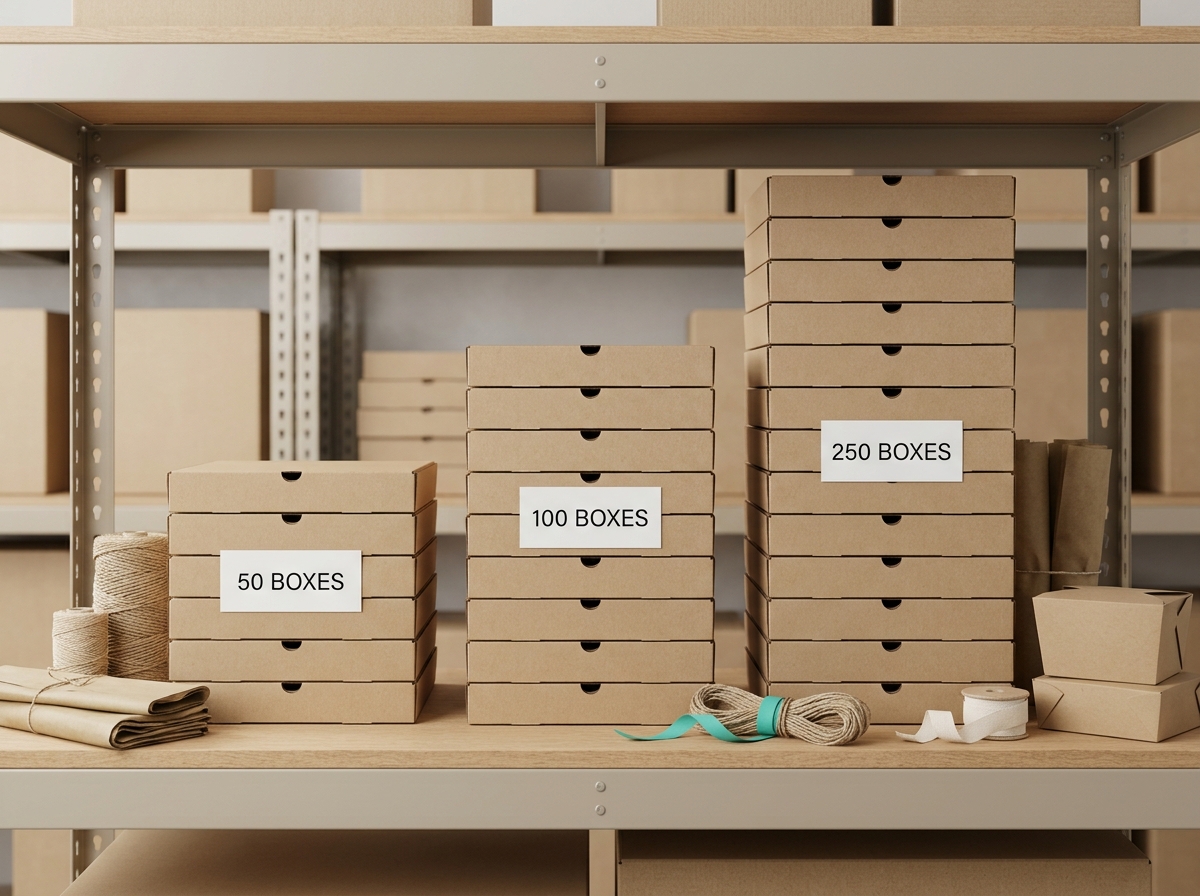
For pie boxes specifically, MOQs vary by customization level. Plain kraft or white SBS boxes with no printing frequently have no minimum or minimums as low as 25 units. Once you add custom printing—your bakery logo, seasonal graphics, or product information—most suppliers require 50 to 100 units to justify the setup costs. Window boxes with acetate or PET panels fall somewhere in the middle, with typical minimums around 50 units for stock window configurations.
Small bakeries face a strategic decision: order the minimum to test packaging or reduce storage burden, or commit to higher volumes to unlock better per-unit pricing. The answer depends on your production calendar, available storage space, and whether you're ordering for a single seasonal peak or year-round use.
The MOQ for wholesale pie boxes scales with the complexity of the packaging. Stock boxes—standard sizes in kraft or white paperboard with no customization—represent the lowest barrier to entry. Many suppliers offer these with no minimum order requirement, allowing bakeries to purchase exactly the quantity they need. This flexibility works well for cottage bakers testing new pie flavors or small operations with limited storage.
Semi-custom boxes, which include standard sizes with added features like windows or simple one-color printing, typically require 50 to 100 units. This tier covers most bakery needs for branded packaging without the cost commitment of fully custom work. If you're ordering pie boxes with windows, expect minimums in this range unless you're selecting from pre-configured stock window options.
Fully custom boxes—unique sizes, multi-color printing, specialty finishes, or structural modifications—push minimums to 100 units or higher. Some suppliers require 250 units for complex custom work, particularly if the box dimensions fall outside their standard die inventory. This level makes sense for established bakeries with consistent high-volume production or those building a strong brand identity through distinctive packaging.
The material choice also influences MOQ. Kraft paperboard boxes generally carry lower minimums than coated SBS (solid bleached sulfate) because kraft runs on more versatile equipment with faster changeovers. If you're comparing kraft vs. SBS paperboard for pie packaging, factor the MOQ difference into your total cost analysis—a lower per-unit price on SBS means little if the higher minimum forces you to tie up capital in excess inventory.
Volume pricing for wholesale pie boxes follows a tiered discount structure where the per-unit cost decreases as order quantity increases. This pricing model reflects the economics of packaging production: setup costs remain fixed, so spreading them across more units reduces the burden on each box.
A typical tiered pricing structure for 9-inch pie boxes might look like this: 50 to 99 units at full wholesale price, 100 to 249 units at 10 percent off, 250 to 499 units at 15 percent off, and 500-plus units at 20 percent off. The exact percentages vary by supplier, material, and customization level, but the pattern holds consistent—each major quantity break delivers a meaningful price reduction.
These tiers aren't arbitrary. They align with production and shipping realities. A 100-unit order often represents a full case pack, which reduces handling costs for the supplier and simplifies inventory management for you. A 250-unit order typically fills a pallet layer, improving shipping efficiency. Orders of 500 or more units may trigger dedicated production runs where your boxes move through the manufacturing process without competing for press time with other jobs.
Small bakeries should calculate the effective savings against the costs that bulk ordering creates. If moving from 100 units to 250 units saves you 5 percent per box but requires renting additional storage space or delays other equipment purchases, the nominal savings evaporate. The right tier is the one where the discount meaningfully improves your margin without creating operational strain.
Some suppliers offer all-units discounting, where the reduced price applies to every box in the order once you cross a threshold. Others use incremental discounting, where only the units above each threshold receive the lower price. Clarify which model your supplier uses before comparing quotes—the difference can shift your actual cost by several percentage points on large orders.
The quoted price per box represents only part of your total packaging cost. Small bakeries need to account for storage, cash flow timing, shipping, and potential waste to understand the real expense of wholesale pie boxes.
Storage costs accumulate quickly when you order in bulk. A case of 100 pie boxes occupies roughly 3 to 4 cubic feet of space, depending on the box dimensions and how they're packed. If you're ordering 250 units to capture a volume discount, you need 8 to 10 cubic feet of dry, climate-controlled storage. For bakeries operating out of commercial kitchens or shared spaces where storage costs $2 to $5 per square foot per month, that storage expense can negate 2 to 3 percent of your packaging savings over a six-month period.
Cash flow timing matters more for small operations than for established bakeries with credit lines. Ordering 500 boxes at once to maximize discounts ties up capital that might deliver better returns elsewhere—ingredients for a new product line, marketing for the holiday season, or a piece of equipment that increases production capacity. Calculate your opportunity cost: if that capital would otherwise earn a return (through sales, reduced labor costs, or avoided financing charges), factor that into your true packaging cost.
Shipping fees often scale non-linearly with order size. A 50-unit order might ship via standard ground for $15 to $25. A 100-unit order could jump to $40 to $60 if it crosses a weight threshold or requires a larger truck. But a 250-unit order that fills a pallet may actually cost less per unit to ship because it qualifies for LTL (less-than-truckload) freight rates. Ask suppliers for shipping quotes at each tier—the shipping cost structure can flip the economics of your order size decision.
Waste and obsolescence represent hidden costs that grow with order size. If you order 500 boxes with seasonal Thanksgiving graphics, any boxes remaining after the holiday become dead inventory unless you run a spring pie promotion. Plain boxes carry less obsolescence risk, but custom-printed boxes require careful demand forecasting. A 10 percent obsolescence rate on a bulk order can eliminate the entire volume discount you thought you were capturing.
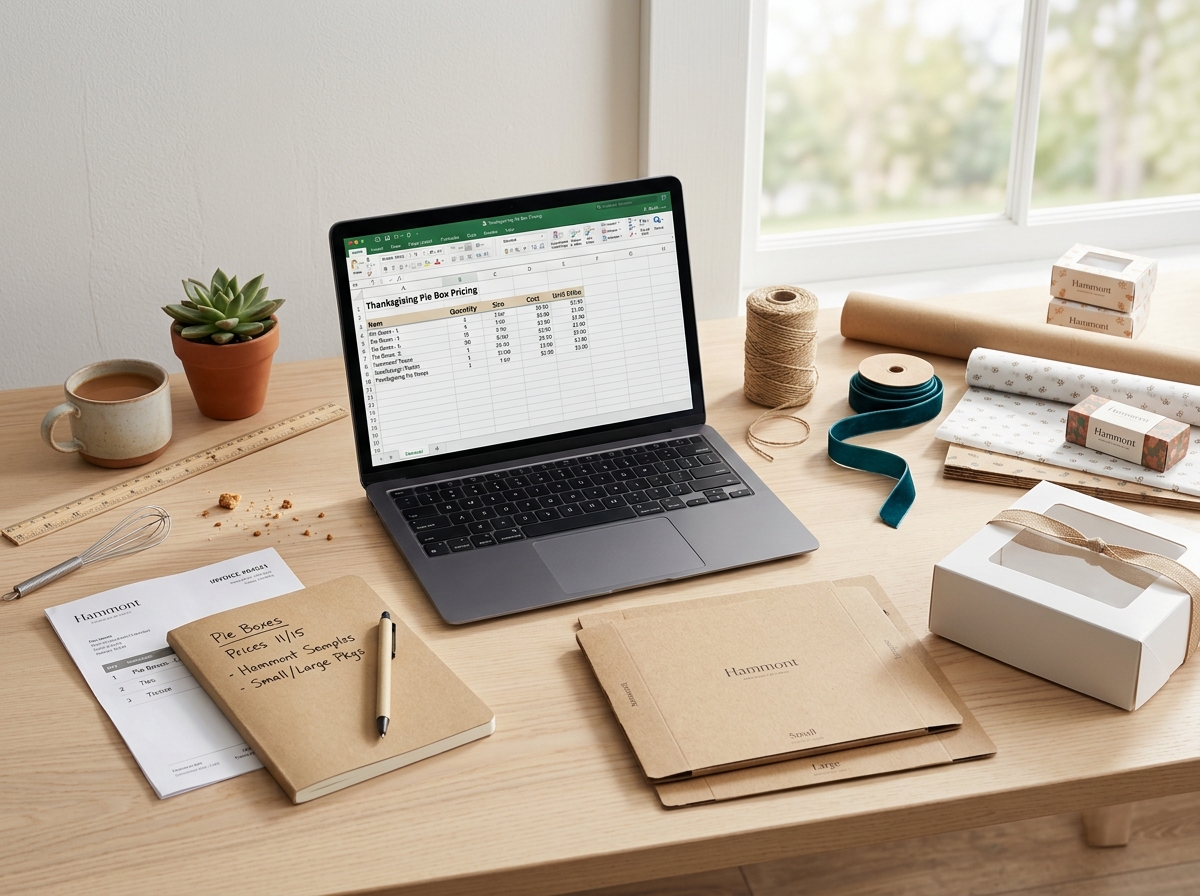
Seasonal bakeries face different MOQ decisions than year-round operations. If Thanksgiving and Christmas represent 70 percent of your annual pie sales, ordering a full year's supply of boxes in October makes little sense—you'll capture the volume discount but pay for storage you don't need and risk obsolescence if your sales forecast misses.
For seasonal production, consider ordering at the tier that covers your peak plus a small buffer. If you project 180 pies for Thanksgiving, ordering 200 boxes lands you in the 100 to 249 tier at most suppliers while leaving margin for forecast error. This approach balances cost efficiency with operational flexibility. Understanding when to order Thanksgiving pie boxes helps you time these purchases to avoid rush fees while maintaining reasonable inventory levels.
Year-round bakeries can leverage higher-volume tiers more effectively because inventory turns faster. If you sell 50 pies per month consistently, a 500-unit order represents a 10-month supply—manageable storage commitment with meaningful cost savings. The key is matching your order frequency to your storage capacity and cash flow cycle. Ordering quarterly at the 100 to 150 unit level might deliver better total economics than ordering annually at 500-plus units if storage costs are high or if you're using seasonal variations of the same base box design.
Split ordering offers a middle path: commit to a higher volume to lock in tier pricing, but request staggered delivery. Some suppliers will hold inventory and ship in batches—100 units now, 100 units in two months, final 100 units in four months—for a small warehousing fee. This strategy captures bulk pricing without overwhelming your storage or cash flow, though not all suppliers offer it and those that do may charge 3 to 5 percent of the order value for the service.
Published MOQs and pricing tiers aren't always final. Small bakeries with clear growth trajectories or unique requirements can often negotiate more favorable terms, particularly when building long-term supplier relationships.
Start negotiations by demonstrating future value. If you're ordering 100 units now but project 500 units within six months as your wholesale accounts expand, share that roadmap with your supplier. Many will reduce the current MOQ or offer better pricing on the initial order in exchange for a commitment to future volume. This works best when you can show concrete evidence—signed wholesale contracts, retail partnership letters, or historical sales growth.
Consolidating your packaging purchases with a single supplier strengthens your negotiating position. If you're buying pie boxes, cookie boxes, and bakery tissue from the same vendor, your combined annual spend may qualify you for pricing tiers normally reserved for larger individual orders. Suppliers value account consolidation because it reduces their customer acquisition costs and increases order predictability.
Timing your orders strategically can unlock flexibility. Suppliers face seasonal demand fluctuations just like bakeries do. Ordering pie boxes in June or July—well ahead of the fall rush—may get you reduced MOQs or better pricing because the supplier's production schedule has capacity. Conversely, ordering in late September when every bakery is scrambling for Thanksgiving packaging gives you zero negotiating leverage.
Consider joining a purchasing cooperative or informal buying group with other small bakeries in your region. Pooling orders lets you hit higher volume tiers while each business orders only what they need. This requires coordination and trust—someone needs to manage the consolidated order and distribution—but the savings can be substantial. A group of four bakeries each needing 100 boxes can order as a single 400-unit purchase, often dropping per-unit costs by 15 to 20 percent.
Ordering at higher volume tiers only makes financial sense if you can store the inventory properly and manage it efficiently. Pie boxes, like all paperboard packaging, require dry storage away from moisture, temperature extremes, and crushing weight.
Calculate your storage footprint before committing to bulk orders. Standard 9-inch pie boxes typically ship in bundles of 25 or 50 units, with bundles stacking 4 to 6 high depending on the box gauge. A 250-unit order might arrive on a partial pallet measuring 40 by 48 inches and standing 36 inches tall—roughly 10 square feet of floor space. If your bakery storage area costs $3 per square foot per month, that's $30 monthly in storage expense, or $180 over six months. Factor this into your cost-per-box calculation.
Humidity control matters more than most bakeries realize. Paperboard absorbs moisture from the air, which reduces stacking strength and can cause boxes to warp or develop mold in extreme cases. Store boxes in climate-controlled space with relative humidity below 60 percent. If your only storage option is an unheated garage or outdoor shed, order smaller quantities more frequently rather than risking quality degradation on bulk inventory.
Implement FIFO (first-in, first-out) rotation even for packaging supplies. While boxes don't expire like ingredients, older inventory can accumulate dust, suffer minor crushing from prolonged stacking, or become obsolete if you update your branding. Mark each delivery with the receipt date and pull from the oldest stock first.
If storage constraints limit your bulk ordering capability, consider whether investing in shelving or reorganizing your current space would pay for itself through volume discounts. A $200 wire shelving unit that lets you store 500 boxes instead of 100 might enable tier pricing that saves you $50 per order—a payback period of four orders, or roughly one year for most seasonal bakeries.
The decision between stock boxes and custom-printed packaging hinges on more than aesthetics—it's fundamentally an MOQ and pricing question that affects both upfront cost and long-term brand value.
Stock boxes with no customization typically offer the lowest MOQs and per-unit costs. A plain kraft 9-inch pie box might cost $0.60 to $0.85 per unit with no minimum order, available for immediate shipment. You can order exactly the quantity you need for this weekend's farmers market without tying up capital or storage space. The tradeoff is zero brand differentiation—your pies leave in the same packaging as every other bakery using that supplier.
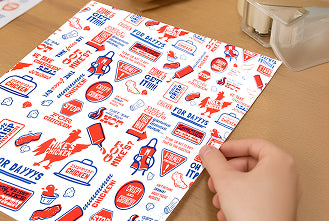
Adding a custom sticker or stamp to stock boxes creates a middle ground. You still benefit from low MOQs and stock pricing on the boxes themselves, then add branding through separately-ordered stickers or a rubber stamp. A custom sticker might add $0.10 to $0.25 per box depending on size and quantity, with sticker MOQs often starting at 250 to 500 units. This approach lets you test brand messaging without committing to printed box minimums, though it adds a labor step to your packaging process.
Custom-printed boxes deliver the strongest brand presence but require higher MOQs—typically 50 to 100 units for single-color printing, 100 to 250 units for full-color work. Per-unit costs start around $0.90 to $1.40 for simple one-color designs and climb to $1.50 to $2.50 for full-color printing with custom sizing. The economics improve dramatically at higher volumes: a 500-unit order might drop per-unit cost to $0.70 to $1.20 even for full-color work, making custom printing cheaper than stock boxes plus stickers at scale.
Calculate your breakeven point between stock-plus-stickers and custom printing. If stock boxes cost $0.70, stickers cost $0.15, and labor to apply stickers costs $0.05 per box (at $15/hour with 12 boxes per hour), your total is $0.90 per box. If custom printing costs $1.40 at 100 units but drops to $0.85 at 500 units, you break even somewhere around 300 units depending on your specific quotes. Below that threshold, stock boxes make economic sense; above it, custom printing delivers better unit economics plus time savings.
Deciding whether to order at the minimum or jump to a higher tier requires analyzing more than just the per-box price difference. Small bakeries should evaluate several factors simultaneously to find the optimal order quantity.
Start with demand certainty. If you have confirmed wholesale orders or catering contracts that specify exact quantities, ordering to cover that demand plus a 10 to 15 percent buffer makes sense even if it means jumping to a higher tier. Confirmed demand eliminates obsolescence risk and justifies the storage and cash flow commitment. Speculative demand—"I think I'll sell this many pies"—requires more conservative order sizing unless your forecast track record is strong.
Assess your storage cost as a percentage of the discount. If moving from 100 to 250 units saves you $0.12 per box (a $30 total saving) but requires storage that costs $25 over the holding period, you net only $5—probably not worth the operational complexity. But if that same tier jump saves you $0.25 per box ($62.50 total) against $15 in storage costs, the $47.50 net savings might justify the larger order.
Consider your reorder frequency and lead times. If your supplier offers 5-day turnaround on stock boxes, ordering at the minimum and reordering frequently carries little risk. But if lead times stretch to 3 or 4 weeks during peak season, ordering at a higher tier to ensure supply continuity becomes strategic insurance, not just a pricing decision. Knowing the lead times for bakery packaging helps you balance order size against supply chain risk.
Factor in your growth trajectory. If you're expanding wholesale accounts or adding retail locations, ordering at the next tier up might be forward-looking rather than excessive. You'll use the inventory within your growth timeline and avoid reordering at a busier operational moment. This works best when growth is contracted or highly probable, not merely aspirational.
Evaluate whether the discount enables new opportunities. Sometimes a lower per-unit cost on packaging makes a product line newly profitable or competitive. If reducing your pie box cost from $1.20 to $0.95 lets you win a wholesale contract that requires a specific margin, ordering at that higher tier becomes a business development investment, not just a procurement decision.
Most packaging suppliers require 50 to 100 units for custom-printed pie boxes with your bakery logo or branding. Simple one-color designs often start at 50 units, while full-color printing typically requires 100 to 250 units to justify the setup costs. Plain stock boxes usually have no minimum or minimums as low as 25 units, making them accessible for cottage bakers and small operations testing new packaging.
Wholesale pie box pricing varies by material, size, and customization, but typical ranges are $0.60 to $0.85 per unit for plain stock boxes, $0.90 to $1.40 for simple custom printing at 100 units, and $0.70 to $1.20 for full-color custom work at 500-plus units. Volume discounts typically reduce per-unit cost by 10 to 20 percent at each major tier—100 units, 250 units, 500 units—with the steepest discounts appearing at 500-plus unit orders.
Order at a higher tier when you have confirmed demand, adequate storage, and sufficient cash flow to support the larger purchase. Calculate your total cost including storage fees and opportunity cost of tied-up capital, not just the per-box savings. For seasonal bakeries with limited storage, ordering at or near the minimum often makes more sense than chasing volume discounts that create operational strain. Year-round operations with consistent demand can leverage higher tiers more effectively.
Small bakeries can negotiate lower MOQs by demonstrating future order volume, consolidating multiple packaging purchases with one supplier, ordering during the supplier's slow season, or joining purchasing cooperatives with other local bakeries. Suppliers value long-term relationships and predictable order patterns, so sharing your growth roadmap and committing to future volume often unlocks flexibility on initial orders even if your current needs are modest.
A 250-unit order of standard 9-inch pie boxes typically requires 8 to 10 cubic feet of storage space, or roughly 10 square feet of floor space when stacked to a safe height. Boxes must be stored in dry, climate-controlled conditions with humidity below 60 percent to prevent warping or moisture damage. Calculate whether your available storage can accommodate bulk orders before committing to higher volume tiers—storage costs can negate 2 to 5 percent of your volume discount over a six-month holding period.
Wholesale pie box MOQs and volume pricing create a strategic puzzle for small bakeries: order too little and you pay premium per-unit costs; order too much and you tie up capital and storage space that could deliver value elsewhere. The right answer depends on your production volume, storage capacity, cash flow position, and demand certainty.
Start by mapping your actual pie production—confirmed orders, historical sales patterns, and realistic growth projections. Match that demand to supplier MOQs and pricing tiers, then calculate total cost including storage and cash flow opportunity cost. For most seasonal bakeries, ordering at or slightly above the minimum makes sense until demand patterns stabilize. Year-round operations with consistent volume can capture meaningful savings by committing to higher tiers, particularly when ordering plain boxes that carry no obsolescence risk.
Remember that the lowest per-box price doesn't always translate to the best business decision. A slightly higher per-unit cost on a right-sized order often delivers better total economics than a deeply discounted bulk purchase that strains your operations. Focus on optimizing your total packaging spend as a percentage of revenue, not just minimizing the line-item cost of each box.
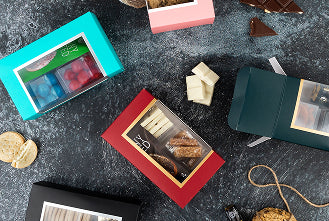
Whether you're selecting kraft gift boxes for small bakery items or need clear serving trays with lids for display purposes, understanding MOQ economics helps you make packaging decisions that support profitability rather than undermine it. The goal is packaging that protects your product, represents your brand, and fits your operational and financial constraints—not just the lowest possible price per box.