Cart
0
You may also like


Book a call with our development team to get started.



Apply online and access wholesale pricing.

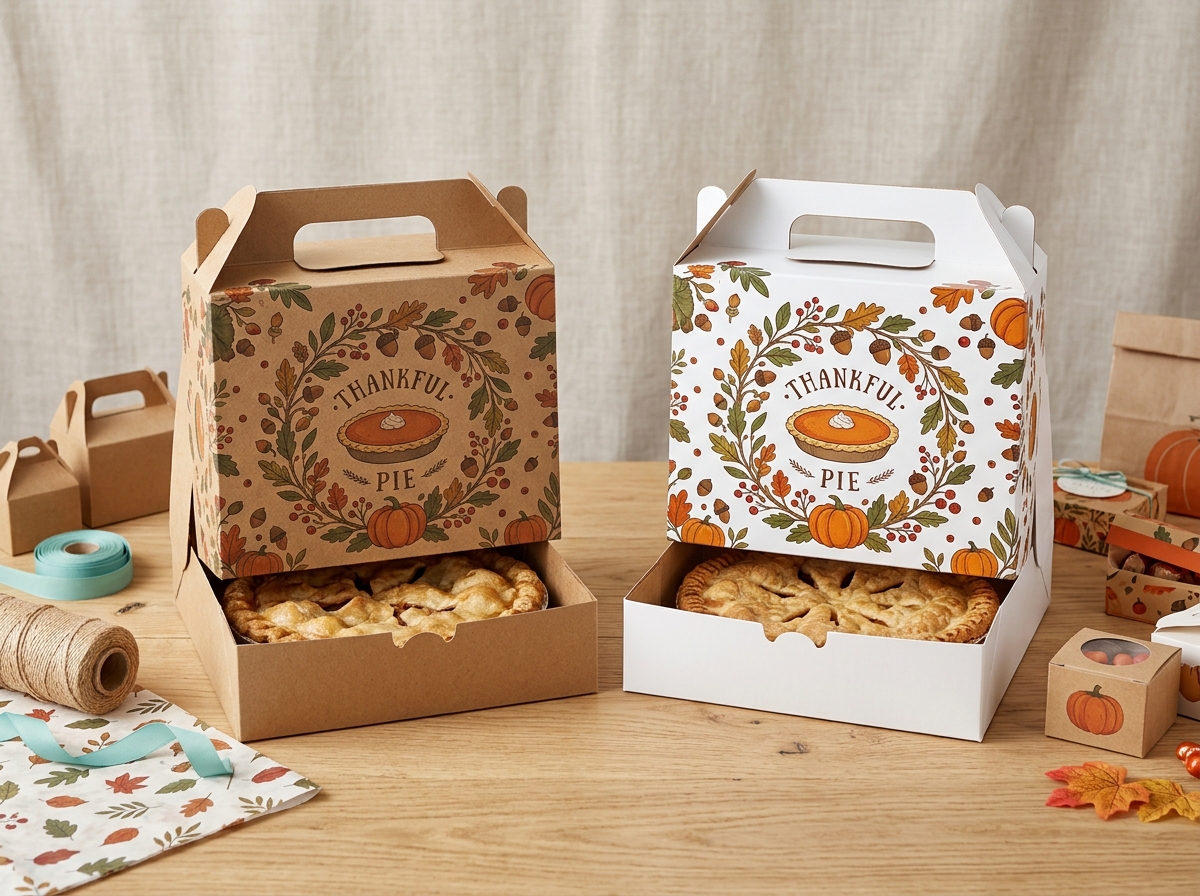
When sourcing packaging for Thanksgiving pies, the choice between kraft pie boxes vs SBS (Solid Bleached Sulfate) paperboard determines not only shelf appeal but also grease resistance, structural integrity, and alignment with your brand's sustainability messaging. Kraft paperboard offers an earthy, artisan aesthetic with strong environmental credentials, while SBS delivers a premium white surface ideal for vibrant graphics and superior barrier performance. Both materials meet FDA food-contact requirements under 21 CFR 176, but their functional differences matter when you're packaging moisture-heavy pumpkin or pecan pies for retail sale or catering delivery.
This guide breaks down the material science, performance characteristics, and practical trade-offs between kraft and SBS paperboard. Whether you're a small-batch bakery prioritizing eco-friendly messaging or a high-volume caterer needing reliable grease barriers, understanding these two substrates will help you select thanksgiving pie boxes that protect your product and reinforce your brand positioning.
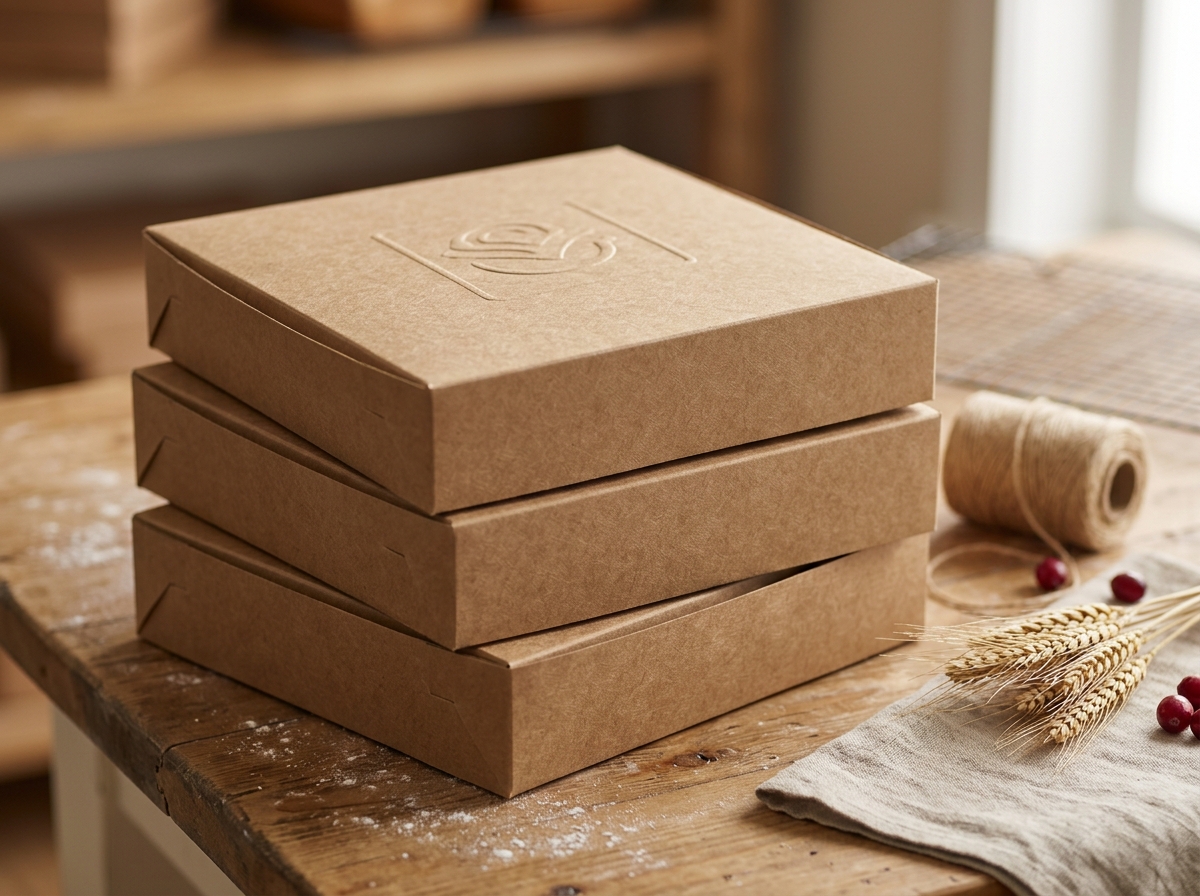
Kraft paperboard is produced through the kraft pulping process, which transforms wood into pulp using heat and a chemical solution of sodium hydroxide and sodium sulfide. This process removes lignin while preserving strong cellulose fibers, resulting in a naturally brown substrate with exceptional tear resistance. Kraft paperboard contains a mixture of virgin paper pulp and recycled paper pulp with no chemical additives, which explains both its characteristic color and its environmental appeal.
The absence of bleaching agents means kraft retains more of the wood's natural strength and requires less chemical processing than white paperboard. Many kraft substrates incorporate up to 100% recycled content, making them particularly attractive to bakeries marketing sustainability credentials. The unbleached fibers create a warm, organic appearance that communicates artisan quality—an aesthetic advantage for farm-to-table bakeries, specialty pie shops, and brands emphasizing handmade production.
For Thanksgiving pie packaging, kraft paperboard typically ranges from 12 to 18 point caliper. Thinner stocks work for single-serve portions or lightweight fruit pies; heavier gauges provide the structural support needed for full-size 9-inch or 10-inch pies with custard or cream fillings. The natural brown surface accepts water-based inks and simple one- or two-color designs, though saturated colors may appear muted without a white undercoat.
Solid Bleached Sulfate (SBS) paperboard is manufactured from 100% virgin wood pulp, which undergoes rigorous chemical treatment to remove lignin and other impurities. The fibers are then bleached to achieve a bright white surface, creating an ideal canvas for high-resolution printing. SBS is typically coated on one side (C1S) or both sides (C2S), with coatings applied to improve ink receptivity and provide resistance against environmental factors, crucial for achieving high-quality print results.
The all-virgin fiber construction gives SBS significantly greater stiffness per unit weight than recycled-content boards of equivalent thickness, which is why it's preferred for carton structures that require precise folding and reliable stacking strength. For bakeries shipping pies or displaying them in refrigerated cases, this rigidity prevents box collapse and maintains a premium shelf presence.
SBS paperboard offers excellent brightness and smoothness, making it suitable for premium packaging and high-quality print applications, often used in pharmaceutical, cosmetics, and food packaging due to its strong visual appeal and cleanliness. The bright white surface allows full-color process printing, metallic inks, and intricate branding elements that would be impossible on kraft's brown substrate. Bakeries competing in upscale markets or corporate gifting channels often choose SBS to convey a polished, professional image.
Both kraft and SBS paperboard must comply with FDA safety standards for coatings and adhesives applied to paper used to package or serve food. The regulatory framework focuses on food contact substances (FCS)—any component that may migrate into food during storage, transport, or service. Components of food packaging material used in compliance with regulations in 21 CFR 174-179 need no further FDA review, meaning bakeries can confidently specify either material as long as the supplier provides documentation.
Kraft paperboard's simpler composition—unbleached fibers with minimal chemical processing—often makes compliance straightforward. However, any coatings applied for grease resistance must still meet FDA standards. Materials commonly used in sustainable packaging such as bagasse, PLA, bamboo fiber, and recycled paperboard can qualify as food-safe, but only after meeting specific FDA standards that evaluate purity, composition, and performance under defined temperature and moisture conditions.
SBS paperboard benefits from FDA approval for direct food contact, making it a reliable choice for pies with moist fillings or butter-rich crusts. The clay coatings typically applied to SBS serve dual purposes: they create a smooth printing surface and act as a functional barrier. When selecting pie boxes, request a Certificate of Compliance (COC) from your supplier to verify that the specific substrate and any barrier treatments meet 21 CFR Part 176 requirements for paper and paperboard components.
Thanksgiving pies present a challenging packaging scenario: butter-laden crusts, custard fillings, and fruit compotes all generate grease and moisture that can compromise box integrity. Uncoated kraft paperboard has little or no oil, grease, or moisture resistance, which limits its use for high-fat pies unless a barrier coating is applied. Aqueous coatings, wax linings, or clay treatments can enhance kraft's barrier properties, though these additions may affect recyclability.
SBS paperboard, particularly grades engineered for food service, offers good moisture and grease resistance that can prevent contamination and spoilage of the product. Specialized SBS substrates like EnShield incorporate oil and grease resistance properties that enable replacement of rigid plastic, poly-extruded paper, and fluorocarbon-treated packaging. For bakeries shipping pies overnight or holding them in refrigerated display cases for several days, this barrier performance prevents oil staining and structural failure.
The practical difference becomes clear when packaging pecan pie versus fruit pie. Pecan pies, with their corn-syrup-and-butter filling, generate significant grease that will migrate through uncoated kraft within hours. SBS with an appropriate barrier coating maintains box integrity and prevents the greasy feel that signals poor quality to customers. Fruit pies with less fat content may perform adequately in coated kraft, offering a sustainability story without sacrificing function.
When evaluating grease resistance, consider the entire customer journey. A pie boxed at 8 a.m. for a noon pickup requires less barrier performance than one shipped cross-country or displayed in a bakery case for 48 hours. Match the substrate to the use case rather than over-engineering for scenarios that won't occur.
The bright white surface of SBS paperboard provides a neutral canvas for full-color lithography, flexographic printing, and digital processes. SBS C2S offers enhanced printability and moisture resistance, with vibrant color reproduction and crisp text display that makes it an excellent material for high-end packaging. Bakeries using photography, gradient backgrounds, or Pantone-matched brand colors will see the most accurate reproduction on SBS.
Kraft paperboard's natural brown tone creates design constraints but also opportunities. The earthy aesthetic communicates authenticity, sustainability, and artisan production without any printing at all. Simple one-color designs using white or dark ink stand out against the brown background, creating a rustic charm that resonates with farm-to-table positioning. However, saturated colors printed on kraft material come out muted in tone, and it is recommended to print a layer of white before applying an additional layer of color to ensure color fidelity.
For Thanksgiving pie packaging, consider how much your brand relies on visual complexity. A minimalist bakery with a hand-stamped logo may find kraft's simplicity reinforces brand identity, while a bakery competing in upscale grocery chains may need SBS's print quality to stand out among premium competitors. The substrate choice becomes part of your brand language, not just a functional decision.
Specialty finishes also perform differently on each substrate. Matte and gloss aqueous coatings, soft-touch laminates, and foil stamping all achieve their intended effect more reliably on SBS's smooth, white surface. Kraft accepts embossing and simple foil accents, but the brown background limits metallic impact. If your Thanksgiving packaging strategy includes limited-edition boxes with special finishes, SBS provides more design flexibility.
Natural brown kraft paperboard is 100% recyclable and eco-friendly, making it the perfect choice for brands looking to create sustainable custom packaging. The unbleached production process requires fewer chemicals, and many kraft grades incorporate post-consumer recycled content. The kraft process is better for the environment, as it requires fewer chemicals, which can be recovered and reused without affecting the quality of the output.
SBS paperboard, despite being made from virgin fibers, is also recyclable and biodegradable, which can reduce the environmental impact of packaging. The key difference lies in the upstream production: kraft's lower chemical load and potential for recycled content give it an advantage in life-cycle assessments, while SBS's virgin fiber composition ensures consistent quality and performance. Bakeries with explicit sustainability commitments may prefer kraft for its lower environmental footprint, especially when marketed to eco-conscious consumers.
However, recyclability depends on coatings and adhesives, not just the base substrate. In order for kraft paper to be 100% degradable or compostable, you must ensure that it is uncoated with any finishes. Laminated or wax-coated boxes—whether kraft or SBS—complicate recycling and extend degradation time. If environmental messaging is central to your brand, work with suppliers who can document both the substrate's recycled content and the recyclability of the finished box, including any barrier treatments.
For Thanksgiving pie packaging, the environmental story matters to a growing segment of consumers. A kraft box with a simple "100% recyclable" callout can differentiate your product in a crowded holiday market. SBS boxes can still claim recyclability, but the messaging lacks the immediate visual cue that kraft's brown color provides. Consider whether your customer base values the sustainability signal enough to offset any print-quality trade-offs.
Kraft paperboard typically costs less per unit than SBS, both because of the simpler manufacturing process and the potential use of recycled content. For small bakeries ordering a few hundred boxes for Thanksgiving, this price difference can be meaningful. However, the cost equation shifts when you factor in printing: kraft's limited color reproduction may require simpler designs, reducing setup costs, while SBS's premium printability may justify higher per-unit costs through stronger shelf appeal.
Minimum order quantities (MOQs) vary by supplier and customization level. Stock sizes in kraft or SBS with no custom printing may be available in quantities as low as 50 to 100 units. Custom-printed boxes typically require MOQs of 500 to 1,000 units, with lower minimums available from digital printing suppliers at a higher per-unit cost. For bakeries planning Thanksgiving production, lead times and order windows matter as much as per-box pricing.
When comparing quotes, evaluate total cost of ownership: substrate price, printing setup, shipping weight (SBS's stiffness may allow lighter caliper at equivalent strength), and potential waste from over-ordering. A slightly more expensive kraft box that aligns with your brand positioning may deliver better return on investment than a cheaper SBS option that doesn't resonate with your target customer.
Pie packaging must support weight without collapsing, protect delicate meringue or lattice-top crusts, and maintain shape during transport. SBS's all-virgin-fiber construction makes it significantly stiffer per unit weight than recycled-content boards of equivalent thickness, preferred for carton structures that require precise folding and reliable stacking strength. This stiffness advantage matters when bakeries stack boxed pies in delivery vans or refrigerated cases.
Kraft paperboard compensates for lower stiffness through heavier caliper. A 16-point kraft box may perform comparably to a 14-point SBS box for the same pie size, though at a slight weight penalty. For standard 9-inch pies weighing 2 to 3 pounds, either material works well in appropriate caliper. Deep-dish pies, extra-large 10-inch or 12-inch sizes, or pies with heavy ceramic dishes require the added rigidity of heavier-gauge SBS or reinforced kraft constructions.
Closure mechanisms also interact with substrate choice. Tuck-top closures rely on the paperboard's memory and stiffness to stay closed; SBS's crisp folding characteristics make it ideal for this style. Lock-corner boxes, which interlock flaps for added strength, work well in kraft despite its softer hand. For Thanksgiving orders, consider whether your pies will be stacked, how customers will carry them, and whether the box needs to double as a serving presentation piece—all factors that influence substrate selection.
The kraft vs SBS decision ultimately aligns with your brand positioning, customer expectations, and operational constraints. Kraft paperboard suits bakeries emphasizing sustainability, artisan production, and approachable pricing. The natural brown aesthetic signals handmade quality and environmental responsibility, resonating with customers who value authenticity over polish. Small-batch pie makers, farmers' market vendors, and community bakeries often find kraft's simplicity matches their brand identity.
SBS paperboard serves bakeries competing in premium markets, corporate gifting channels, or upscale retail environments. The bright white surface and superior print quality communicate professionalism and attention to detail, justifying higher price points. Bakeries offering custom-designed holiday packaging, limited-edition flavors, or pies positioned as luxury gifts benefit from SBS's design flexibility and structural performance.
Many bakeries use both materials strategically: kraft for everyday retail pies and community orders, SBS for corporate Thanksgiving gifts and special-occasion packaging. This tiered approach lets you match packaging investment to product margin while maintaining brand consistency across different customer segments. Consider creating a structured kraft gift box program for standard pies and reserving custom SBS boxes for premium offerings.
When finalizing your Thanksgiving packaging plan, order samples of both materials in your preferred sizes. Test them with actual pies, including the fillings and crusts you'll be producing. Evaluate how each substrate handles grease, whether the closure stays secure during transport, and how the printed design looks in your bakery's lighting. The material that performs best under real-world conditions—not just on a spec sheet—is the right choice for your operation.
Kraft pie boxes typically cost 15 to 30 percent less than comparable SBS boxes, depending on size, caliper, and order quantity. Stock kraft boxes in standard 9-inch or 10-inch sizes may run $0.40 to $0.75 per unit in quantities of 250 to 500, while equivalent SBS boxes range from $0.60 to $1.00. Custom printing adds $0.20 to $0.50 per box for either material, with setup fees amortized across the order quantity. For precise pricing, request quotes from multiple suppliers and compare total delivered cost rather than per-unit price alone.
Uncoated kraft paperboard has minimal grease resistance and will absorb oils from butter-rich crusts and fatty fillings within a few hours. For pecan pies, pumpkin pies with butter-heavy crusts, or any pie that generates significant grease, specify kraft boxes with an aqueous or clay barrier coating. These treatments provide adequate short-term grease resistance for same-day pickup or next-day delivery. For longer storage or display periods, SBS with engineered grease-resistant coatings offers more reliable barrier performance and prevents oil staining that compromises perceived quality.
Yes, both kraft and SBS paperboard are recyclable in most municipal curbside programs, provided they are free from excessive food contamination and non-paper coatings. Kraft's unbleached composition and potential recycled content often make it slightly easier to process, but the practical difference is minimal for clean boxes. Avoid wax coatings, polyethylene lamination, or heavy foil stamping if recyclability is a priority. Communicate recycling instructions to customers—many assume brown kraft is compostable (it may be, if uncoated) but don't realize white SBS is also recyclable. Clear labeling helps customers dispose of packaging correctly.
SBS paperboard delivers superior print quality for full-color designs, photography, and complex graphics due to its bright white surface and smooth coating. Colors reproduce accurately, and fine details remain crisp. Kraft paperboard works best for simple one- or two-color designs, hand-stamped logos, or minimalist branding that leverages the natural brown aesthetic. If your Thanksgiving packaging includes detailed illustrations, gradient backgrounds, or brand colors that must match precisely, SBS is the better choice. If your design relies on rustic charm and environmental messaging, kraft's limitations become strengths.
For a standard 9-inch pie weighing 2 to 3 pounds, 14-point to 16-point SBS or 16-point to 18-point kraft provides adequate structural support. SBS's greater stiffness per unit weight allows the lighter caliper range, while kraft's softer hand requires slightly heavier stock for comparable rigidity. Deep-dish pies, pies in ceramic dishes, or boxes that will be stacked during transport benefit from 18-point to 20-point substrates. Request samples from your supplier and test them with your actual products to verify that the caliper you select maintains shape and protects the pie during your specific distribution and display conditions.
Selecting between kraft pie boxes vs SBS paperboard requires balancing functional performance, brand alignment, and budget constraints. Kraft offers sustainability credentials and artisan appeal at a lower cost, while SBS delivers premium print quality and superior grease resistance for upscale positioning. Both materials meet FDA food-contact standards and provide reliable protection when specified correctly for your pie types and distribution channels. By understanding the material science, testing samples under real-world conditions, and matching substrate choice to your brand positioning, you can create Thanksgiving pie packaging that protects your product, reinforces your identity, and meets customer expectations. Whether you choose kraft's earthy simplicity or SBS's polished professionalism, the right material becomes an extension of your bakery's commitment to quality.