Cart
0
You may also like

Book a call with our development team to get started.



Apply online and access wholesale pricing.

If you're planning Thanksgiving pie production, your packaging order should already be confirmed. For bakeries and caterers expecting high-volume holiday demand, the ordering window for Thanksgiving pie boxes typically opens in early September and closes by early October. Stock packaging may still be available through late October, but custom or bulk orders require six to eight weeks of lead time before the November 19–26 consumer peak.
The difference between ordering in September versus scrambling in November isn't just cost—it's whether you have the right boxes when production ramps up. This guide breaks down lead times for stock versus custom packaging, minimum order quantity considerations, rush fees, and how to plan inventory for one of the year's most concentrated production windows.
Lead times vary significantly based on whether you're ordering stock packaging or requesting custom printing. Standard production for custom bakery packaging typically takes 8 to 12 business days after artwork approval, but that timeline assumes normal production schedules—not the compressed window before a major holiday.
During the Thanksgiving season, lead times become tighter and production schedules fill quickly across the packaging industry. Most packaging suppliers recommend placing orders by early October to guarantee delivery before production begins in mid-November. For bakeries ordering kraft gift boxes or other stock items, the window extends slightly later, but custom-printed boxes with seasonal graphics require significantly more advance notice.
The six-to-eight-week guideline accounts for more than manufacturing time. It includes artwork approval cycles, proof revisions, production setup, quality checks, and freight transit. Bakeries that wait until October to finalize designs often face a choice between paying rush fees or accepting generic packaging.
Stock packaging offers the shortest path to delivery. Plain kraft boxes, white bakery boxes, and standard windowed pie carriers typically ship within three to five business days because they're manufactured in advance and held in distributor warehouses. For bakeries that brand their packaging with stickers, stamps, or belly bands, stock boxes ordered in late September or early October still arrive in time for mid-November production.
Custom-printed packaging follows a different calendar. The optimal ordering window for Thanksgiving packaging opens in July and August, giving adequate production time before September and October when orders surge. Bakeries requesting full-color printing, custom die-cuts, or specialty finishes should plan for 15 to 20 business days from artwork approval to delivery, and that timeline compresses as October progresses.
The production process for custom boxes includes several stages that can't be rushed without additional cost. Design files must be reviewed for print readiness, color proofs approved, printing plates created, and the actual print run scheduled among competing orders. Quality control checks add another day or two before boxes are packed and shipped. When you order stock white gift boxes, these steps are eliminated entirely.
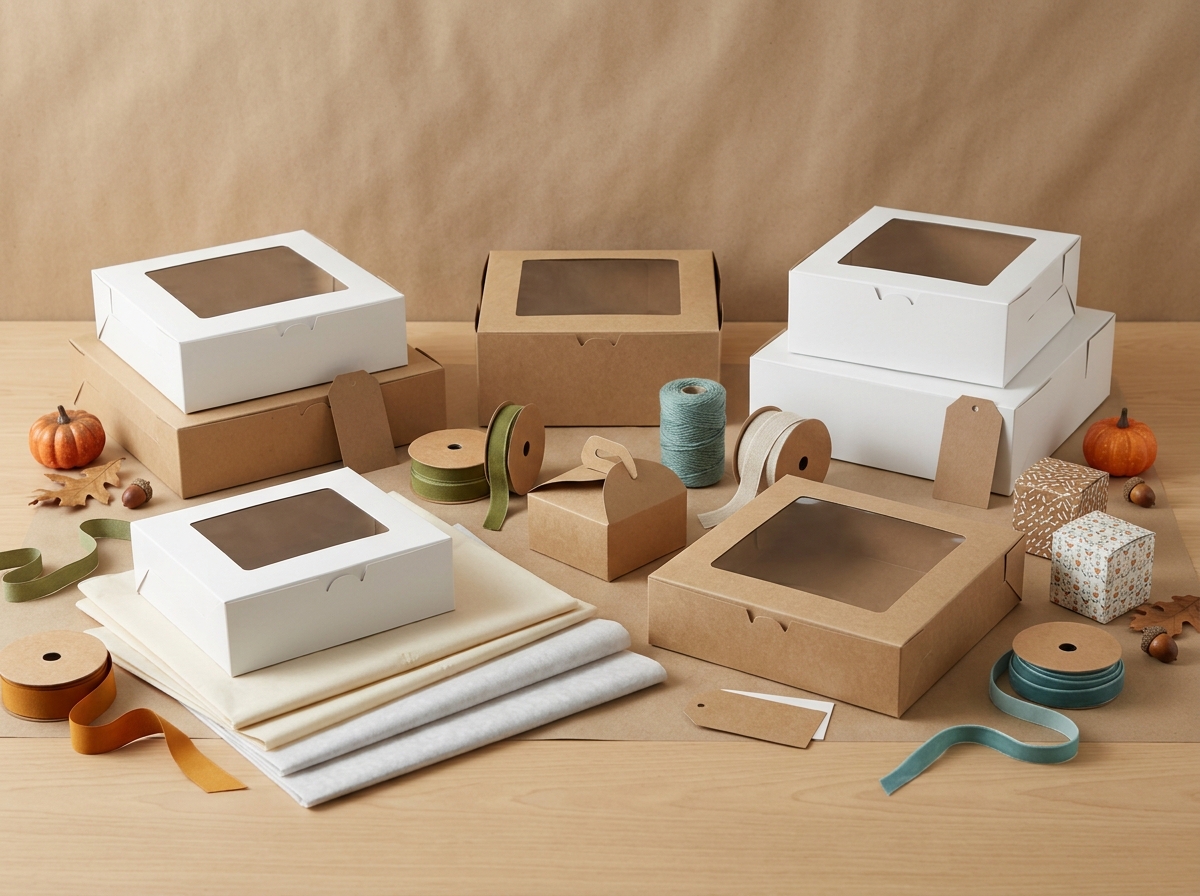
Minimum order quantities directly affect both cost and lead time. Stock packaging typically carries lower MOQs—often as few as 50 to 100 units—because the supplier has already absorbed the setup cost. Custom packaging, by contrast, requires dedicated production runs that justify the expense of creating new printing plates and configuring machinery.
For custom Thanksgiving pie boxes, minimum order is 50 units at some suppliers, though many require 250 to 500 units for full-color printing. Bakeries planning to produce fewer than 100 pies often find that stock boxes with aftermarket branding deliver better economics than a custom print run.
MOQs also influence how early you need to order. A 1,000-unit custom order competes for press time with other large jobs, meaning it must be scheduled weeks in advance. A 100-unit stock order can be pulled, packed, and shipped the same week. Bakeries projecting 200 to 300 Thanksgiving pies should decide by mid-September whether custom branding justifies the higher MOQ and longer lead time, or whether stock boxes meet their needs.
The economics shift further when you consider storage. Ordering 500 custom boxes in August means warehousing them for two to three months before Thanksgiving production begins. Smaller operations without dedicated storage space may prefer to order stock boxes in two or three smaller batches—100 units in late September, another 100 in mid-October—to avoid tying up cash and floor space.
Rush fees appear when standard lead times no longer align with your delivery date. Most packaging suppliers define "rush" as any order requiring delivery in fewer than 10 business days, and the premium ranges from 15% to 50% of the base order cost depending on how compressed the timeline becomes.
Planning ahead can help minimize expedited freight charges, rush production fees, and costly last-minute adjustments. A bakery that finalizes its Thanksgiving menu in early September and places its packaging order immediately pays standard pricing. The same bakery waiting until late October faces either rush fees or the risk that the supplier can't accommodate the timeline at all.
Expedited freight adds another layer of cost. Standard ground shipping from most packaging suppliers takes five to seven business days. If you need boxes in three days, you're paying for faster trucking or air freight, which can double the shipping cost on a bulky, low-density product like folded pie boxes. For a 500-unit order, that might mean an extra $150 to $300 in freight alone.
Some suppliers offer tiered rush options: a 10% upcharge for two-week delivery, 25% for one week, 40% for three days. Bakeries that miss the standard ordering window should request a detailed quote that breaks out the rush production fee separately from expedited shipping, so they understand exactly where the premium is applied. In some cases, ordering stock boxes with next-day shipping costs less than paying for rushed custom printing.
Thanksgiving pie production concentrates into a narrow window. Consumer orders peak in the week before the holiday, with most bakeries scheduling pickup on November 26 or 27. That means production runs from November 19 through November 25, and packaging must be on-site before the first pie comes out of the oven.
Effective inventory planning starts with a production forecast. Review last year's Thanksgiving orders, adjust for growth or menu changes, and add a 10% to 15% buffer for walk-in demand. If you sold 250 pies last Thanksgiving and you're adding a new flavor this year, plan for 275 to 290 units of packaging. Ordering exactly 250 boxes leaves no room for the inevitable last-minute corporate order or the customer who decides they want two pies instead of one.
Storage logistics matter as much as order timing. Pie boxes are bulky, and 500 units can occupy 20 to 30 cubic feet of shelf space depending on size. Bakeries with limited storage should coordinate delivery dates carefully—receiving boxes in early November rather than mid-October frees up space for flour, sugar, and other ingredients during the busy fall season. Some suppliers offer staggered delivery at no additional cost if you're ordering in volume.
For bakeries managing warehouse storage for seasonal packaging, the Thanksgiving window overlaps with early holiday gift orders. Coordinating pie box delivery with your broader seasonal packaging plan prevents bottlenecks in receiving and helps you allocate storage space efficiently across multiple product lines.
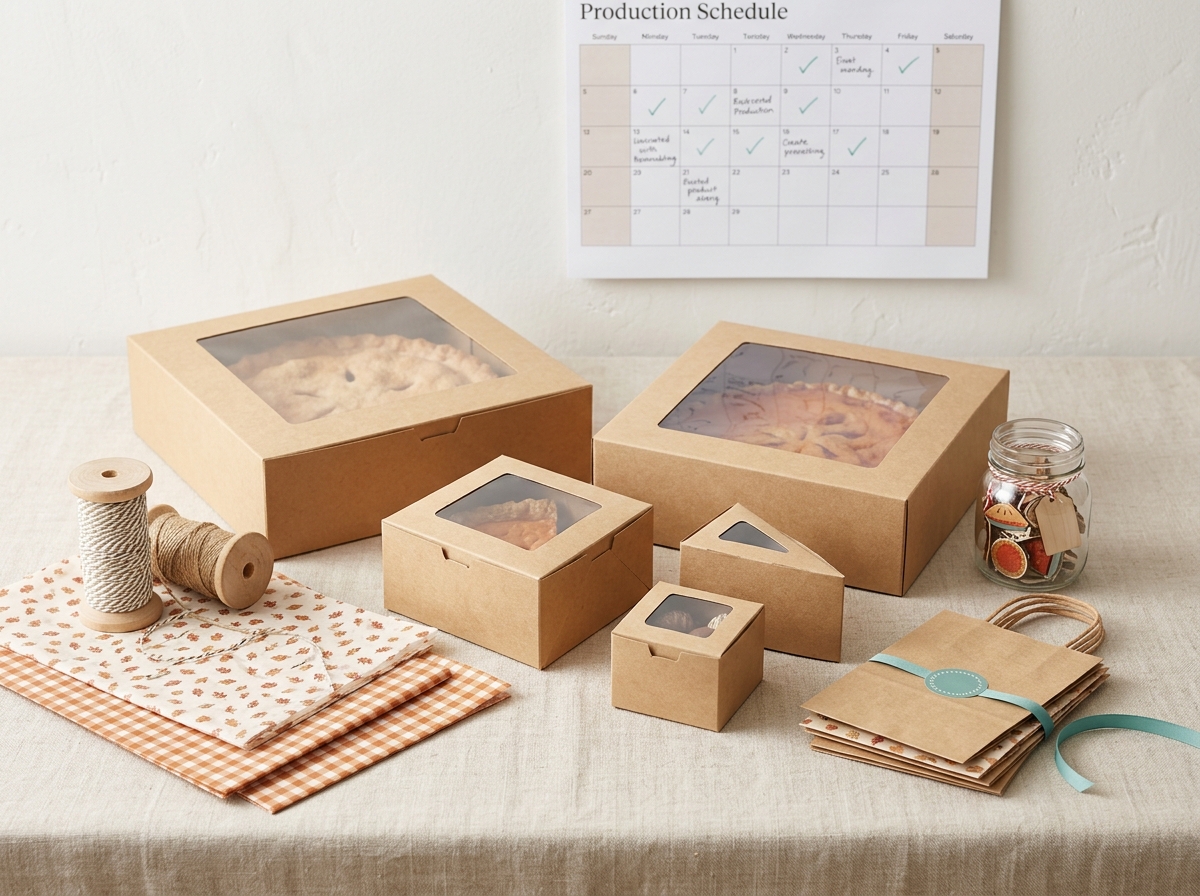
Your packaging order deadline works backward from your production schedule. If you're baking pies on November 22, boxes need to be on-site by November 21 at the latest—preferably earlier to allow time for quality checks and to ensure you have enough inventory if orders exceed projections.
Most bakeries begin accepting Thanksgiving pre-orders in late October, with order cutoffs falling between November 15 and November 20. Bakeries require 72 hours lead time for standard orders, with longer times for complex items; holiday events need 14 days. That two-week customer order window means your packaging must arrive before November 5 if you're opening pre-orders on November 1.
Production schedules also dictate packaging variety. Bakeries offering three pie sizes—8-inch, 9-inch, and 10-inch—need three box sizes, and each must be in stock before production begins. Ordering all three sizes from the same supplier in a single purchase order simplifies logistics and often unlocks volume discounts, but it also means the entire order is subject to the longest lead time in the batch. If 9-inch boxes are stock items but 10-inch boxes require custom production, the whole shipment waits for the custom run to complete.
Coordinating packaging delivery with ingredient orders and labor scheduling creates a smoother production flow. Boxes arriving two weeks early sit in storage; boxes arriving two days late halt production. The ideal delivery window is five to seven days before your first scheduled bake, giving you time to inspect the shipment, confirm quantities, and resolve any issues before you're under deadline pressure.
Freight transit times vary by region, and bakeries on the West Coast or in rural areas should add extra days to their ordering timeline. A packaging supplier shipping from the Midwest reaches most East Coast destinations in three to four business days via standard ground freight, but the same shipment takes six to seven days to reach the Pacific Northwest.
Seasonal shipping volume also affects delivery reliability. The weeks leading up to Thanksgiving overlap with early holiday e-commerce shipments, and freight carriers experience higher volumes and occasional delays. Bakeries ordering in early October avoid the worst of this congestion; those ordering in late October compete for truck space with Black Friday inventory shipments.
Weather adds another variable in November. Early winter storms in the Midwest and Northeast can delay freight by one to three days, and carriers typically don't guarantee delivery dates during severe weather events. Bakeries in snow-prone regions should build an extra two to three days into their lead time calculations, or choose expedited shipping to reduce exposure to weather delays.
Some packaging suppliers offer regional warehousing or drop-ship arrangements that shorten delivery windows. A supplier with a West Coast distribution center can deliver to California bakeries in two days instead of six, effectively extending the safe ordering window by nearly a week. When comparing suppliers, ask where inventory is held and what the realistic ground-shipping timeline is to your specific ZIP code.
Ordering early doesn't just guarantee availability—it often unlocks better pricing. Suppliers offer early-order discounts in July and August to level-load their production schedules, and bakeries that commit inventory dollars in the summer can save 10% to 15% compared to October pricing.
Volume discounts apply across most packaging categories. Ordering 500 boxes costs less per unit than ordering 250, and ordering 1,000 boxes drops the unit cost further. Bakeries projecting 300 to 400 Thanksgiving pies should calculate whether rounding up to a 500-unit order—and accepting the storage cost—delivers a lower total cost than ordering exactly what they need.
Standardizing box sizes across multiple products also improves economics. A bakery offering 9-inch pies, 9-inch quiches, and 9-inch tarts can use the same box for all three, consolidating orders and hitting higher volume tiers. Using versatile cube gift boxes for smaller items like pie slices or mini desserts further simplifies inventory and reduces the number of SKUs you need to manage.
Freight costs drop on a per-unit basis as order size increases. Shipping 100 boxes might cost $40, or $0.40 per box; shipping 500 boxes might cost $120, or $0.24 per box. Bakeries ordering for both Thanksgiving and the December holiday season can combine shipments to reduce freight expense, provided they have the storage capacity to receive everything at once.
Menu decisions drive packaging specs, and late menu changes create ordering delays. A bakery that finalizes its Thanksgiving lineup in early September can order packaging immediately. A bakery still debating whether to offer 8-inch or 9-inch pies in late September faces a choice: order both sizes and risk excess inventory, or delay the packaging order and accept shorter lead times.
The most efficient approach is to finalize your Thanksgiving menu by Labor Day. That gives you the first two weeks of September to source samples, confirm box sizes, and place orders while lead times are still comfortable. Bakeries that treat menu planning and packaging procurement as a single integrated process avoid the bottleneck of waiting for one to finish before starting the other.
Custom printing timelines make menu finalization even more critical. If your pie boxes feature printed nutritional information, ingredient lists, or reheating instructions, any menu change requires new artwork, new proofs, and potentially a new print run. Stock boxes with applied labels offer more flexibility—you can print new labels in-house or through a local print shop in a matter of days if a menu item changes after your initial packaging order.
For bakeries offering both retail and wholesale Thanksgiving products, packaging requirements multiply. Retail pies sold directly to consumers need attractive, branded boxes; wholesale pies delivered to restaurants or corporate clients may require plain, cost-effective packaging. Ordering both types simultaneously from the same supplier simplifies logistics and often qualifies for combined volume discounts.
For stock packaging, late October is typically the cutoff for reliable delivery before Thanksgiving production begins. Custom-printed boxes require orders by early October to avoid rush fees. If you're ordering in November, expect to pay expedited production and shipping charges, and confirm that your supplier can accommodate the compressed timeline before placing the order.
Stock pie boxes ship within three to five business days because they're pre-manufactured and warehoused. Custom boxes require 15 to 20 business days from artwork approval, covering design review, printing plate creation, production runs, and quality checks. During peak season, custom lead times can extend to four weeks or more as suppliers manage competing orders.
Higher MOQs require earlier ordering because they tie up more production capacity. A 500-unit custom order must be scheduled weeks in advance, while a 100-unit stock order can ship within days. If your projected volume sits near an MOQ threshold, ordering early gives you time to adjust quantities up or down based on pre-order trends without missing delivery deadlines.
Rush fees make sense when the cost is lower than lost revenue from not having packaging. If paying a 25% rush premium on a $200 box order lets you fulfill $2,000 in pie sales, the math works. But if stock boxes with sticker branding cost less than rushed custom printing and still meet your brand standards, the stock option is smarter. Always request a detailed quote that separates rush production fees from expedited freight.
Most bakeries order 10% to 15% above their projected Thanksgiving volume to cover walk-in demand, last-minute orders, and damaged boxes. If you expect to produce 200 pies, order 220 to 230 boxes. The cost of a small surplus is lower than the cost of running out of packaging mid-production or turning away customers because you can't package their order.
Planning when to order Thanksgiving pie boxes comes down to understanding your production timeline, choosing between stock and custom packaging, and building in enough lead time to avoid rush fees. Bakeries that finalize menus by early September, place packaging orders by early October, and coordinate delivery with production schedules enter the holiday season with the right boxes on hand—and the capacity to focus on baking rather than scrambling for last-minute packaging solutions.