Cart
0
You may also like


Book a call with our development team to get started.



Apply online and access wholesale pricing.

When your Black Friday packaging order arrives on three pallets instead of one, where does it go? For retailers managing high-volume fulfillment operations, packaging storage planning black friday isn't an afterthought—it's a logistical requirement. Between late September and mid-November, warehouses receive their largest packaging shipments of the year. Without a clear plan for where those boxes, bags, and cellophane rolls will live until they're needed, you risk blocked aisles, disrupted workflows, and delays during the busiest shopping week of the year.
This guide covers the operational side of Black Friday packaging: how to allocate storage space, stack materials safely, and coordinate delivery timing so your warehouse stays functional through peak season.
Most retailers order 30–50% more packaging for Black Friday than they use during a typical month. That volume doesn't arrive gradually—it often comes in one or two bulk shipments timed to your supplier's production schedule. If your warehouse operates near capacity during normal operations, a sudden influx of palletized gift boxes and rolls of cellophane can quickly consume the space you need for active picking, staging, and receiving.
A flexible warehouse storage strategy includes buffer capacity to manage inventory swings, which becomes especially important during seasonal peaks when volumes rise and operational agility is critical to maintaining service levels. The challenge isn't just finding room—it's ensuring that packaging materials remain accessible when your team needs them, without forcing pickers to navigate around unstable stacks or blocking access to fast-moving inventory.
Poor storage planning creates predictable problems: damaged packaging from improper stacking, extended pick times when materials are buried behind other pallets, and safety hazards when aisles become impassable. The solution starts with understanding how much space your packaging order will actually consume and reserving that space before the delivery truck arrives.
Before you can allocate storage, you need to know how much floor space your packaging will occupy. Start with your order quantities and the dimensions of the packaging you've purchased. A case of 18 kraft gift boxes occupies different cubic footage than a 100-foot roll of cellophane, and your supplier's pallet configuration determines how those cases stack.
Most wholesale packaging ships on standard 40" × 48" pallets. A single pallet of folded gift boxes can hold anywhere from 200 to 1,000 units depending on box size and case pack. If you've ordered 5,000 boxes, expect 5–8 pallets. Add another 2–3 pallets for tissue paper, ribbon, or cellophane bags, and you're looking at 10–12 pallet positions before accounting for stacking height.
Effective warehouse capacity planning requires balancing current storage needs with future growth projections while optimizing space utilization and operational efficiency. When calculating your footprint, factor in:
If your Black Friday packaging stock includes multiple SKUs—different box sizes, bag styles, or specialty items—group similar items together and label each pallet clearly. This prevents your team from unwrapping every pallet to find the right size during a fulfillment rush.
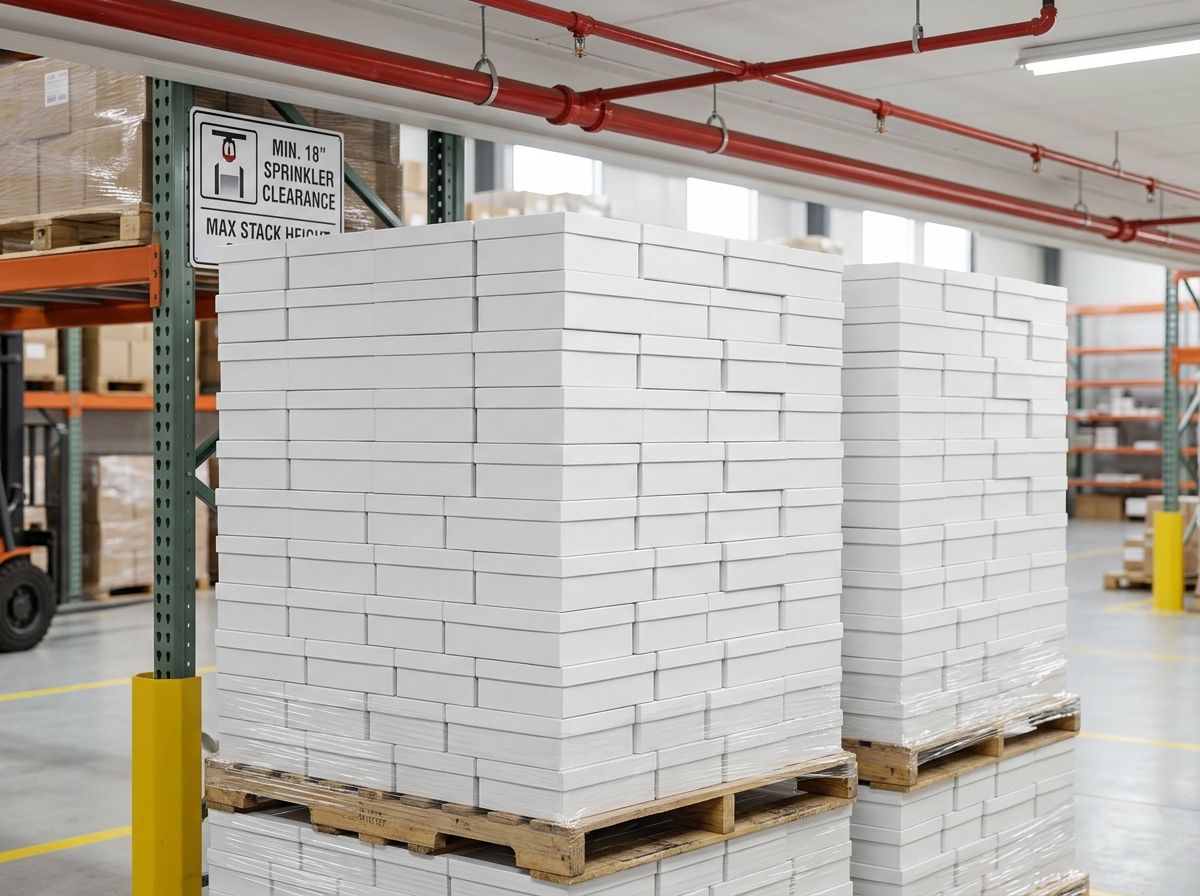
Vertical stacking multiplies your storage capacity, but only if it's done correctly. OSHA standard 1910.176(b) states that storage of material shall not create a hazard, and that bags, containers, bundles, etc., stored in tiers shall be stacked, blocked, interlocked, and limited in height so that they are stable and secure against sliding or collapse. For packaging materials, this means paying attention to weight distribution, box strength, and clearance from overhead systems.
Lightweight packaging—tissue paper, cellophane bags, folded gift boxes—can typically stack three to four pallets high if the bottom pallet is in good condition and the load is evenly distributed. Heavier items like rigid gift boxes or cases of clear acrylic boxes should stay at two pallets high to prevent crushing the bottom layer.
Interlock stacking arranges boxes in alternating layers, creating a more secure hold. It works well for mixed-size packages and offers better stability, though it can slightly reduce the number of boxes you can stack per pallet. This method is particularly useful for packaging materials that will remain in storage for several weeks, as it reduces the risk of shifting during normal warehouse traffic.
Height limits aren't arbitrary. Standard 1910.159(c)(10) requires that the minimum vertical clearance between sprinklers and the material below shall be 18 inches. Measure from your warehouse floor to the lowest sprinkler head, subtract 18 inches, and that's your maximum stack height. Mark this clearly in your storage zone so temporary staff don't accidentally violate the clearance during peak season.
Additional stacking guidelines that apply to packaging storage:
If your packaging includes items with different weights—such as heavy rolls of cellophane alongside lightweight paper bags—store heavier items on lower pallets and lighter materials on upper tiers. This lowers the center of gravity and reduces the chance of collapse.
Not all warehouse space is equally suited for packaging storage. Strategic zoning ensures different types of goods are where they should be, reducing unnecessary handling time and minimizing the risk of errors in warehouse operations. For Black Friday packaging, the goal is to position materials close to your packing stations without interfering with receiving, shipping, or active inventory picking.
Most warehouses benefit from a three-zone approach for seasonal packaging:
Active Fulfillment Zone: This is the area immediately adjacent to your packing stations. Reserve this space for the packaging you'll use first—typically your highest-volume items like standard gift boxes, tissue paper, and cellophane bags. Keep quantities limited to one or two days' worth of stock to prevent clutter, and replenish from overflow storage as needed.
Short-Term Holding: Position this zone within forklift range of your packing area but outside the main traffic flow. This is where you'll store the bulk of your Black Friday packaging—enough to last one to two weeks. Organize by SKU and clearly label each pallet with contents and quantity to speed up replenishment.
Overflow Storage: If you've ordered packaging for the entire holiday season, designate a separate area for materials you won't need until late November or December. This can be in a less accessible part of the warehouse, stacked higher, or even in a separate storage facility if space is tight. The key is to move these pallets out of the way until active storage runs low.
When mapping your zones, consider the flow of materials. Packaging should move in one direction: from receiving to overflow, overflow to short-term holding, short-term holding to active fulfillment, and finally to the packing station. Avoid layouts that require forklifts to cross active picking aisles or double back through shipping lanes.

Even with space allocated, receiving 10 pallets of packaging on the same day your regular inventory shipment arrives creates chaos. Staggered delivery scheduling spreads the load and gives your team time to properly inspect, count, and position materials before the next truck backs up to the dock.
When you place your Black Friday packaging order, ask your supplier if they can split the shipment into two or three deliveries. For example, receive gift boxes and tissue paper in early October, cellophane and bags in mid-October, and specialty items like ribbon or custom boxes in late October. This approach has several advantages:
If your supplier can't split shipments, coordinate delivery timing with your other vendors. Schedule packaging deliveries for slower days—typically mid-week—and avoid the same day as large inventory drops or outbound shipments. Communicate your preferred delivery windows clearly and confirm them in writing at least two weeks before the scheduled date.
For retailers with limited receiving capacity, consider scheduling packaging deliveries for early morning or late afternoon when dock doors are less congested. Some suppliers offer appointment-based delivery windows; use them if available.
Packaging is designed to protect your products, but it's also vulnerable to damage during storage. Crushed boxes, torn bags, and moisture-damaged tissue paper can't be used for customer orders, which means waste and potential stockouts during peak demand.
Most folded gift boxes and paper bags ship in cases wrapped with stretch film or shrink wrap. Leave this protective layer intact until you move materials to your active fulfillment zone. The film prevents dust accumulation, moisture intrusion, and accidental tearing during handling.
For items stored on upper tiers, use corner protectors or edge guards to prevent strapping from cutting into boxes. This is especially important for rigid boxes or items with printed surfaces, where damage affects both function and appearance.
Temperature and humidity matter more than many retailers realize. Kraft paper, tissue, and cellophane all absorb moisture. If your warehouse experiences high humidity or temperature swings, store packaging away from exterior walls and loading dock doors. Consider using cellophane rolls within climate-controlled zones if possible, as extreme cold can make film brittle and prone to tearing.
Inspect stored packaging weekly during the lead-up to Black Friday. Look for:
If you identify damaged packaging, move it to a quarantine area and assess whether it's still usable. Minor box crushing may not affect function, but torn bags or moisture-damaged tissue should be replaced before they reach your packing stations.
The best storage plan fails if your packing team runs out of boxes mid-shift. Prioritizing replenishment reduces short picks and overflow in the receiving area. Instead of leaving new product at the receiving door, find times for your operation to fit replenishment in throughout the day. For Black Friday operations, this means establishing clear triggers for when materials move from storage to active fulfillment.
Set minimum stock levels for each packaging SKU at the packing station. For high-volume items like standard gift boxes or tissue paper, this might be 100 units; for specialty items used less frequently, 25 units may suffice. When quantities drop to this threshold, replenishment should be automatic—not dependent on packers noticing they're running low.
Assign replenishment responsibility to a specific role or shift. In high-volume operations, this might be a dedicated material handler who monitors stock levels and moves pallets from short-term holding to active zones. In smaller warehouses, this can be part of a shift supervisor's duties, scheduled during predictable slow periods like early morning or after the main shipping cutoff.
Use visual cues to simplify replenishment. Mark active fulfillment zones with floor tape showing exactly where each packaging SKU belongs. Label shelves or pallet positions with SKU numbers and photos of the packaging. This allows anyone on your team—including temporary holiday staff—to restock correctly without detailed training.
During Black Friday week, increase replenishment frequency. Stock levels that normally last a full shift may be depleted in two hours during peak order volume. Schedule replenishment checks every two hours, and position backup stock as close to packing stations as safety and space constraints allow.
Your Black Friday packaging arrives during the same weeks that you're receiving holiday inventory. Competing for the same dock doors, forklifts, and floor space requires coordination between your receiving and warehouse teams.
Create a receiving calendar that shows all scheduled deliveries—both inventory and packaging—for September through November. Share this with your entire operations team so everyone knows when space will be tight and when resources need to be prioritized. Update the calendar weekly as delivery dates shift or new orders are added.
Prioritize packaging deliveries for immediate put-away. Unlike inventory that may sit in receiving for quality checks or allocation, packaging can usually be moved to its designated storage zone as soon as it's counted and inspected. This clears dock space faster and reduces congestion.
If your warehouse uses a warehouse management system (WMS), create separate location codes for packaging storage zones. This allows you to track packaging separately from sellable inventory, prevents accidental allocation of packaging to customer orders, and provides visibility into what's in storage versus what's been moved to active fulfillment.
For warehouses without a WMS, maintain a simple spreadsheet that tracks packaging receipts, storage locations, and replenishment to active zones. Include columns for SKU, quantity received, pallet count, storage zone, date moved to active fulfillment, and remaining quantity. Update this daily during peak season.
Many retailers hire seasonal warehouse staff to handle Black Friday volume. These workers need to understand your storage protocols—not just where packaging lives, but why it's organized that way and what happens if stacking or replenishment is done incorrectly.
Create a one-page visual guide that shows:
Walk new staff through the storage zones during onboarding. Show them what a properly stacked pallet looks like versus one that's leaning or unstable. Explain why packaging can't be stored in shipping lanes or in front of emergency exits. Make safety and organization part of the culture, not just a rulebook.
Assign experienced staff to supervise temporary workers during the first week. Watch for common mistakes like overstacking, mixing SKUs on the same pallet, or placing packaging in the wrong zone. Correct these immediately—bad habits formed in October become bigger problems in November.
Plan for 20–30% more floor space than your packaging order's cubic footage suggests. This accounts for aisle clearance, stacking inefficiencies, and the need to keep different SKUs separated for easy access. A typical retail operation ordering 5,000–10,000 units of packaging should reserve 200–400 square feet of floor space, depending on stacking height and pallet configuration. Calculate your needs by multiplying pallet count by 16 square feet per pallet (accounting for aisle access), then add buffer space for replenishment staging.
Maximum stacking height depends on three factors: pallet condition, load weight, and sprinkler clearance. For lightweight folded gift boxes on good-condition pallets, three to four pallets high is typically safe if you maintain 18 inches clearance below sprinkler heads as required by OSHA standard 1910.159(c)(10). Heavier rigid boxes or items with uneven weight distribution should stay at two pallets high. Always inspect pallet condition before stacking and use interlocking patterns to prevent shifting.
Multiple deliveries spread across three to four weeks reduce receiving congestion and give you flexibility to adjust storage as you see how quickly materials are consumed. Request split shipments when ordering, with the first delivery arriving six to eight weeks before Black Friday and subsequent shipments timed to your replenishment needs. This approach works best for retailers with limited receiving capacity or warehouses operating near full occupancy during Q4.
Keep manufacturer packaging (stretch wrap or shrink film) intact until materials move to active fulfillment. Store packaging away from exterior walls and loading docks to avoid moisture and temperature fluctuations. Use corner protectors on upper-tier pallets to prevent strapping damage. Inspect stored packaging weekly for leaning stacks, torn cases, or moisture stains. Position packaging away from high-traffic areas where forklifts or pallet jacks might accidentally strike stacks.
Each pallet should be labeled with SKU or product description, quantity, date received, and designated storage zone. For mixed pallets, list all SKUs and quantities. Include a "use by" date if packaging has time-sensitive promotional printing. Use large, clear labels positioned on at least two sides of each pallet so they're visible from aisles. Consider color-coding labels by packaging type (boxes, bags, tissue, cellophane) to speed visual identification during replenishment.
Effective packaging storage planning black friday transforms a potential bottleneck into a managed process. By calculating space requirements early, following safe stacking protocols, and coordinating delivery timing with your broader warehouse operations, you ensure that packaging materials are available when your team needs them—without disrupting the workflows that keep orders moving. The warehouses that navigate Black Friday most successfully are the ones that treat packaging as a critical operational input, not an afterthought that arrives on a pallet and gets stashed wherever there's room.