Cart
0
You may also like


Book a call with our development team to get started.



Apply online and access wholesale pricing.

Black Friday 2026 falls on November 27, and the retailers who secure their black friday packaging inventory today will be the ones fulfilling orders smoothly while competitors scramble for alternatives. With lead times extending to four to six weeks or more once peak season demand increases and many manufacturers closing their calendars for bespoke production by mid-October, the ordering window for reliable Black Friday packaging closes faster than most operators expect. This guide provides the lead time benchmarks, stock calculation frameworks, and supplier selection criteria you need to avoid costly stockouts during the November 27-30 peak period.
UK consumers are forecast to spend £6.4 billion during Black Friday 2026, with 80 percent of purchases expected online. That volume creates intense pressure on packaging stock, warehouse operations, and fulfillment speed. Retailers who wait until peak season to discover packaging shortfalls face delays, compromised customer experience, and lost revenue. The solution is a structured approach to lead time planning, volume forecasting, and supplier coordination—starting now.
Black Friday is no longer a single-day event. Order volumes can increase by up to 70 percent above the annual average for larger online retailers during Black Friday week alone. That surge compresses fulfillment timelines, increases packaging consumption, and exposes any weakness in your supply chain planning. The packaging you select today will determine whether your warehouse can maintain speed during the busiest trading period of the year.
The shift to e-commerce has fundamentally changed Black Friday packaging requirements. Where brick-and-mortar retail once dominated, online fulfillment now demands packaging that protects products during transit, presents well on doorsteps, and supports brand equity during deep-discount periods. Retailers need solutions that balance cost efficiency with customer experience—a structured kraft gift box that arrives intact and looks intentional, not an over-taped mailer that screams "discount bin."
According to McKinsey, advanced planning systems offer proactive strategies for anticipating challenges as well as customer needs, providing visibility that was impossible in the past. Retailers who treat packaging as a strategic input—not a last-minute consumable—build resilience into their operations and protect customer lifetime value during the period when first impressions matter most.

Standard packaging lead times collapse during peak season. What might be a 10- to 14-day turnaround in June becomes four to six weeks—or longer—by September. The reason is straightforward: every retailer preparing for Black Friday is placing orders at the same time, and manufacturers allocate capacity on a first-come basis. Retailers who order in early September secure their inventory. Those who wait until October are choosing from what's left.
The 8- to 12-week ordering window is not arbitrary. It accounts for production scheduling, material procurement, quality control, and freight transit. The time it takes to design, approve, produce and deliver packaging influences cash flow, inventory planning and speed to market. For Black Friday, that window opens today—September 4—and closes in early October for custom or high-volume orders. Stock items with shorter lead times remain available longer, but popular sizes and formats sell out as demand peaks.
Retailers who plan to use specific lead time strategies can navigate this compressed timeline more effectively. The key is to separate stock planning into tiers: core packaging that must arrive by mid-October, secondary formats that can arrive by early November, and contingency stock that provides a buffer against unexpected volume spikes. This tiered approach reduces risk and ensures that your highest-priority SKUs are never at risk of stockout.
By mid-October, many manufacturers have closed their calendars for bespoke production. After this point, packaging becomes a compromise based on availability rather than a strategic choice aligned with your brand and operational needs. Retailers who miss the cutoff are left with stock items in limited sizes, generic designs, or premium-priced rush orders that erode already-thin Black Friday margins.
The mid-October cutoff is not a supplier inconvenience—it reflects the operational reality of high-volume manufacturing during peak season. Production lines are booked weeks in advance, raw materials are allocated to confirmed orders, and freight capacity is reserved for scheduled shipments. Courier capacity is tightening, surcharges are being applied and operational pressure is rising across the supply chain, with material availability now limited and lead times extending. Retailers who understand this timeline and act accordingly gain a decisive advantage.
For businesses that rely on custom printed packaging or specific color palettes, the cutoff is even earlier. Custom printing requires artwork approval, plate creation, and production test runs—all of which add time. If your brand identity depends on specific packaging, the ordering window is 10 to 14 weeks, not 8 to 12. Stock items like white cube tuck-top boxes or black cube gift boxes remain available closer to the peak, but they still require advance ordering to secure volume.
Accurate stock planning starts with demand forecasting. Retailers need to estimate total order volume for the Black Friday period, then translate that into packaging units by SKU. The most common mistake is underestimating the surge—assuming Black Friday will be 20 percent above average when historical data shows 50 to 70 percent increases. Most retailers aim for a service level between 90 percent and 95 percent, which means planning for the upper end of the demand range, not the average.
The basic calculation framework is straightforward. Start with last year's Black Friday order volume. Apply a growth rate based on your year-over-year trend. Add a safety stock buffer to account for demand variability and lead time uncertainty. Greasley's method is a formula used to calculate safety stock levels that considers both demand fluctuations and lead time variability and is regarded as one of the most accurate ways of calculating safety stock levels, useful for companies that experience high demand variability. For retailers without historical Black Friday data, industry benchmarks suggest planning for 1.5 to 2 times your average weekly volume per day during the peak period.
Safety stock is not optional during Black Friday. Safety stock is the buffer inventory you maintain beyond expected demand to protect against variability in both supply and demand, and properly calculated safety stock is a strategic asset that protects your business from unpredictable supply chain disruptions and maintains service levels during unexpected demand spikes. A 15 to 25 percent safety stock buffer is standard for peak season, with higher buffers for fast-moving SKUs and lower buffers for slower categories. Retailers who want detailed stock calculation methods can apply these frameworks to their specific product mix and order history.
One often-overlooked factor is packaging format efficiency. A retailer selling jewelry needs different packaging density than a retailer selling apparel. Calculate units per case, cases per pallet, and pallet capacity in your warehouse. This ensures that the packaging you order not only meets demand but also fits within your storage footprint and handling capacity.
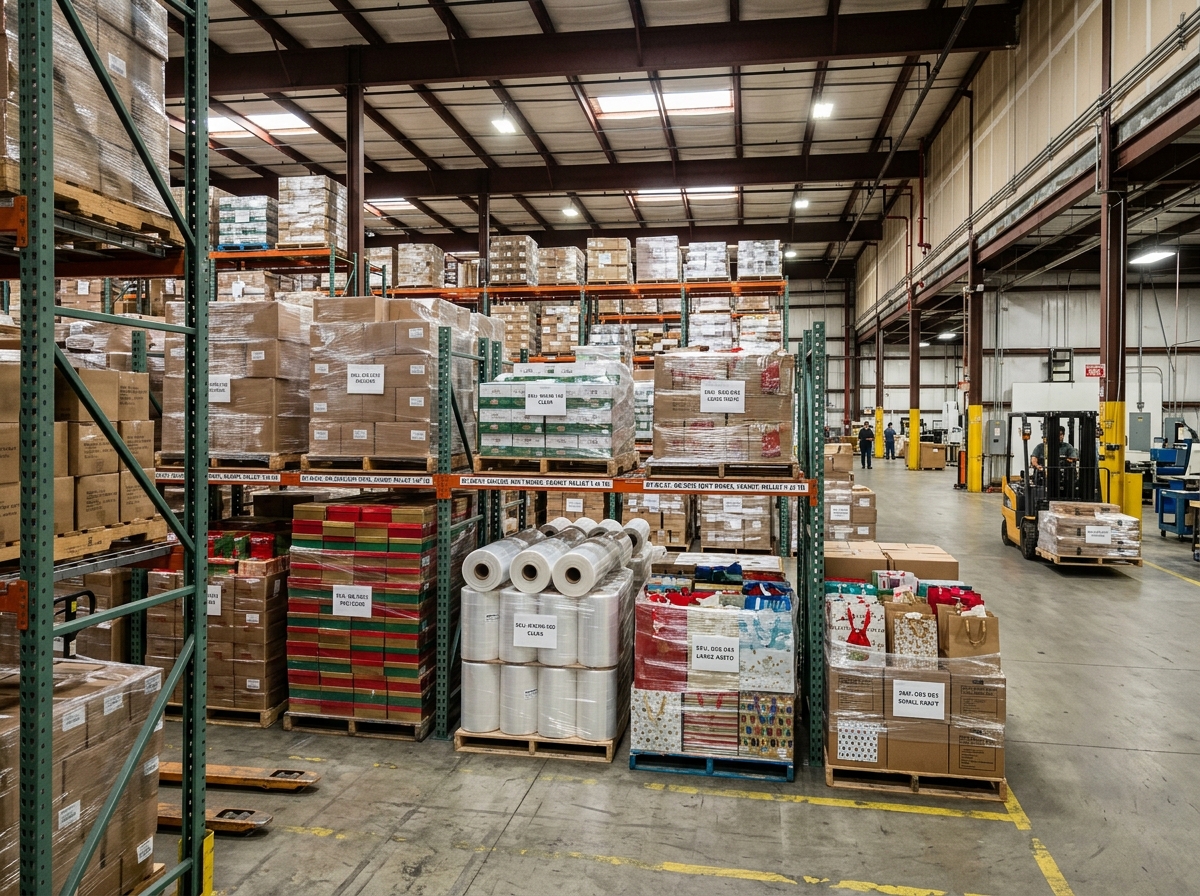
Minimum order quantities (MOQs) create a trade-off between unit cost and capital commitment. Bulk orders unlock tiered pricing—often 15 to 30 percent lower per unit—but require upfront investment and warehouse storage capacity. For Black Friday, the question is not whether to order in bulk, but how to structure bulk orders to maximize cost efficiency without over-committing capital to slow-moving SKUs.
Most packaging suppliers tier pricing at specific volume thresholds: 500 units, 1,000 units, 2,500 units, and 5,000 units are common break points. Retailers should calculate the cost per unit at each tier, then compare that to projected consumption. If you expect to use 1,200 units during Black Friday and the 1,000-unit tier offers a 20 percent discount while the 2,500-unit tier offers 28 percent, the decision depends on whether the incremental savings justify the excess inventory and storage cost.
For retailers managing multiple SKUs, the optimal strategy is to concentrate bulk orders on your highest-volume packaging formats and order smaller quantities of secondary or specialty items. A compact kraft gift box that you use across multiple product categories justifies a 5,000-unit order. A specialty format used only for limited-edition items does not. Retailers seeking detailed MOQ and pricing strategies can apply this tiering logic to their full packaging portfolio.
Another consideration is supplier flexibility. Some suppliers offer mixed-SKU pallets that allow you to hit MOQ thresholds while diversifying your inventory. This is particularly valuable for retailers who need multiple sizes or colors but cannot commit to full-case quantities of each. Ask suppliers whether they offer assortment packs or mixed pallets—it can reduce your per-unit cost without forcing you into single-SKU bulk orders.
Black Friday packaging must balance two competing priorities: warehouse speed and customer presentation. Fast-assembly formats like tuck-top boxes and cellophane bags reduce packing time per order, which matters when your team is processing 70 percent more volume than usual. Premium formats like rigid boxes and custom inserts enhance unboxing experience but add seconds—or minutes—to each order. The right choice depends on your product category, average order value, and customer expectations.
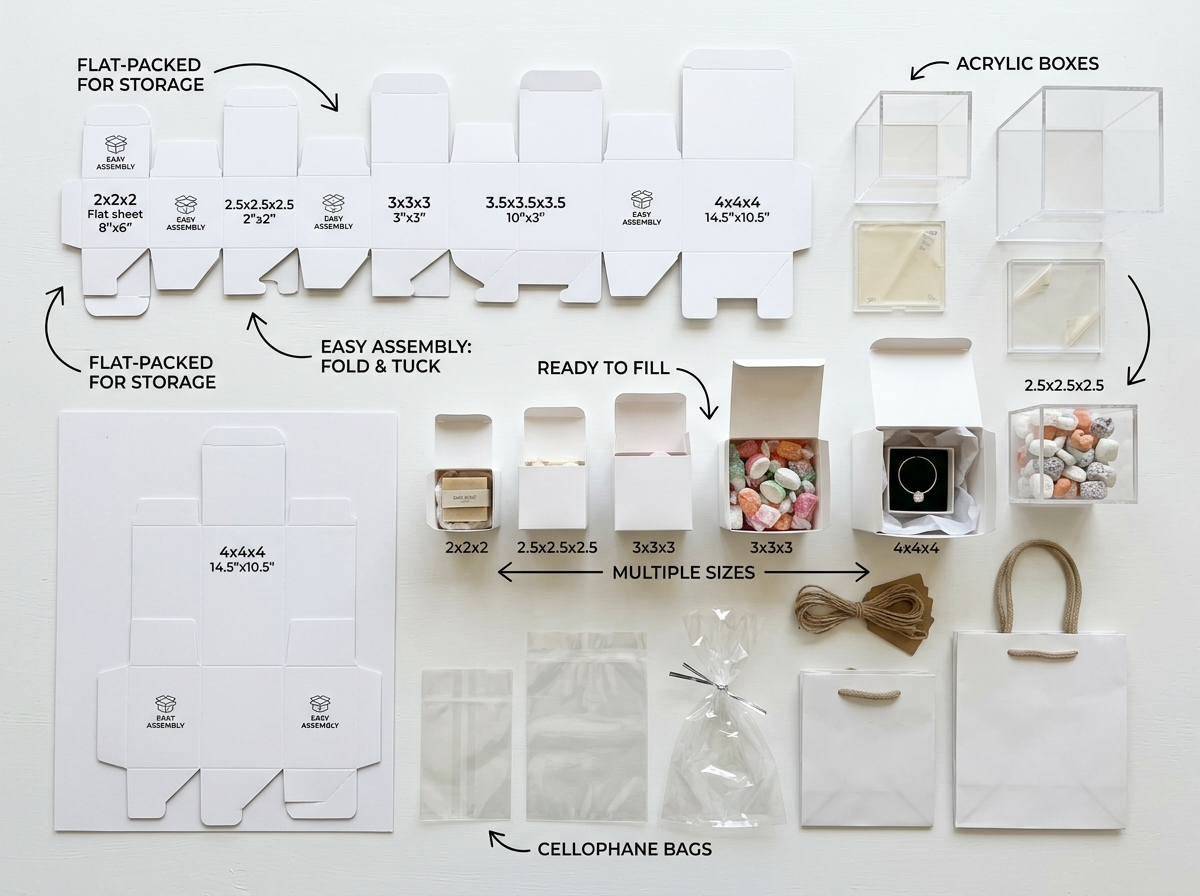
For high-volume, moderate-value orders, speed wins. Tuck-top boxes assemble in seconds, require no tape, and stack efficiently in warehouse storage. Cellophane wrap and clear bags provide product visibility and fast sealing. These formats are ideal for apparel, accessories, and non-fragile goods where the primary packaging goal is protection and efficiency. Retailers focused on assembly speed and throughput should prioritize these formats for their core SKUs.
For higher-value or gift-oriented orders, presentation justifies the extra time. Rigid gift boxes, clear acrylic boxes, and custom inserts signal quality and care. These formats work well for jewelry, premium cosmetics, and gift sets where the unboxing experience directly influences customer satisfaction and repeat purchase intent. The key is to segment your packaging strategy by product category and order value, not apply a single format across your entire catalog.
One hybrid approach is to use fast-assembly packaging as your base format and add premium touches selectively. A kraft tuck-top box with a branded sticker or ribbon delivers most of the presentation value at a fraction of the time and cost of a fully custom solution. This approach scales during peak season and allows your warehouse team to maintain speed without sacrificing brand identity.
Bulk packaging orders create warehouse storage challenges that retailers often underestimate. A pallet of 5,000 gift boxes occupies significant floor space, and that space must be allocated weeks before Black Friday begins. Retailers who fail to plan storage capacity find themselves with packaging deliveries that have nowhere to go—or worse, packaging stored in locations that slow down order fulfillment when speed matters most.
The first step is to calculate cubic footage per SKU. Packaging suppliers can provide pallet dimensions and case counts. Multiply cases by cubic feet per case, then compare that to your available storage capacity. If your warehouse has 10,000 cubic feet of available space and your Black Friday packaging requires 3,500 cubic feet, you have adequate capacity. If it requires 12,000 cubic feet, you need to either reduce order quantities, negotiate staggered deliveries, or secure additional storage.
Staggered deliveries are a practical solution for retailers with limited storage. Order your full Black Friday inventory in September, but schedule deliveries in two or three waves: early October for core SKUs, late October for secondary formats, and early November for contingency stock. This spreads the storage burden across multiple weeks and ensures that your warehouse is not overwhelmed by a single massive delivery. Suppliers are often willing to accommodate staggered deliveries if you communicate your needs during the ordering process. Retailers managing complex storage logistics can explore detailed warehouse planning frameworks.
Another consideration is packaging placement within your warehouse. Store high-volume SKUs in easily accessible locations near packing stations. Store secondary or specialty formats in overflow areas. This reduces travel time during order fulfillment and prevents bottlenecks when your team is processing peak volume. The difference between a well-organized packaging layout and a poorly organized one is measured in seconds per order—and those seconds add up to hours during Black Friday week.
Black Friday creates increased demand across supply chains, making reliable stock availability and dependable lead times particularly important. The supplier you choose today will determine whether your packaging arrives on time, meets quality standards, and supports your fulfillment operations during the most critical trading period of the year. Supplier selection is not about finding the lowest per-unit price—it is about finding the partner who can deliver reliability when you need it most.
The first criterion is lead time consistency. Ask potential suppliers for their on-time delivery rate during peak season. A supplier who delivers 98 percent of orders on time during normal periods but drops to 85 percent during peak season is a risk. A supplier who maintains 95 percent on-time delivery year-round is a partner. Request references from other retailers who have worked with the supplier during Black Friday. Their experience is the best predictor of your experience.
The second criterion is stock availability. Suppliers who manufacture domestically or maintain significant inventory buffers are better positioned to meet peak season demand than suppliers who rely on long international supply chains. Working with a UK packaging manufacturer can help businesses build greater resilience into their packaging supply while reducing reliance on long international supply chains. This does not mean that international suppliers are inherently unreliable, but it does mean that lead times are longer and more vulnerable to disruption. Evaluate your risk tolerance and choose accordingly.
The third criterion is communication and responsiveness. Suppliers who respond quickly to inquiries, provide clear lead time estimates, and proactively communicate delays are easier to work with during peak season. Suppliers who are slow to respond or vague about timelines create uncertainty that compounds during the compressed Black Friday planning cycle. Test responsiveness during the quoting process—it is a reliable indicator of how the supplier will perform under pressure.
Bulk packaging pricing is structured in tiers, and understanding those tiers allows retailers to optimize cost without over-ordering. The cost per unit drops significantly at specific volume thresholds, but the savings plateau beyond a certain point. The goal is to identify the threshold where incremental savings no longer justify incremental investment—and to structure your orders accordingly.
A typical tiered pricing structure might look like this: 500 units at $1.20 each, 1,000 units at $0.95 each, 2,500 units at $0.82 each, and 5,000 units at $0.78 each. The largest per-unit savings occurs between 500 and 1,000 units (a 21 percent reduction). The savings between 2,500 and 5,000 units is only 5 percent. For a retailer who expects to use 1,800 units during Black Friday, ordering 2,500 units makes sense. Ordering 5,000 units does not—the incremental savings is too small to justify doubling your inventory commitment.
Another cost consideration is freight. Bulk orders often qualify for full-truckload (FTL) or full-container-load (FCL) shipping, which is significantly cheaper per unit than less-than-truckload (LTL) or parcel shipping. If your order is close to a freight threshold—say, 22 pallets when FTL pricing kicks in at 24 pallets—it may be worth adding two more pallets of packaging to unlock the freight savings. Calculate total landed cost (product cost plus freight) rather than product cost alone. Retailers exploring detailed cost optimization strategies can apply this logic across their full supplier portfolio.
Finally, consider payment terms. Suppliers often offer early-payment discounts or extended payment terms for large orders. A 2 percent discount for payment within 10 days may not sound significant, but on a $10,000 packaging order, that is $200 in savings. Extended payment terms improve cash flow, which matters when you are investing in inventory weeks before revenue arrives. Negotiate payment terms during the quoting process—it is a simple way to improve your Black Friday economics.
Even the best-planned Black Friday packaging strategy needs contingency plans. Supplier delays, demand spikes, and operational disruptions happen, and retailers who lack backup plans face stockouts during the peak period. Contingency planning is not pessimism—it is operational discipline that protects revenue and customer experience when things do not go as planned.
The first layer of contingency planning is safety stock. As discussed earlier, a 15 to 25 percent buffer above projected demand provides protection against moderate demand spikes or minor supplier delays. Safety stock should be calculated by SKU, with higher buffers for fast-moving items and lower buffers for slower categories. Without safety stock, companies would not be able to fulfill orders once regular inventory was depleted, leading to lost sales. Retailers who want to refine their safety stock approach can explore detailed calculation methods.
The second layer is backup suppliers. Identify at least one alternative supplier for your core packaging SKUs. This does not mean placing orders with multiple suppliers for the same item—it means knowing who you can call if your primary supplier experiences a delay. Pre-qualify backup suppliers by requesting quotes, lead time estimates, and sample products. Store this information in a supplier database so that you can act quickly if needed. The time to identify backup suppliers is September, not mid-November when your primary supplier calls to say your order is delayed.
The third layer is format flexibility. If your primary packaging format becomes unavailable, can you substitute a similar format without disrupting your fulfillment operations? A retailer who relies exclusively on 3x3x3 kraft boxes may find that 4x4x4 white boxes are available and functionally equivalent. Build flexibility into your packaging specifications so that you have options if your first choice is unavailable. Retailers focused on comprehensive contingency strategies can develop multi-layered backup plans that protect against a range of disruptions.
Warehouse efficiency during Black Friday depends on packaging that assembles quickly and requires minimal training. Every second spent assembling a box, sealing a bag, or applying tape is a second not spent picking, packing, or shipping the next order. Fast-assembly packaging formats reduce labor cost, increase throughput, and prevent bottlenecks during the peak period when your warehouse is processing 70 percent more volume than usual.
Tuck-top boxes are the gold standard for fast assembly. They ship flat, pop open in seconds, and require no tape or adhesive. A warehouse worker can assemble, pack, and close a tuck-top box in under 30 seconds—compared to 60 to 90 seconds for a traditional folding carton with tape. Over the course of a 1,000-order day, that time savings translates to hours of additional capacity. Kraft tuck-top boxes and white tuck-top boxes are available in multiple sizes to fit a range of product dimensions.
Cellophane bags and clear gift bags offer similar speed advantages. They require no assembly—just insert the product, fold the top, and seal with tape or a twist tie. For non-fragile items like apparel, accessories, or packaged goods, cellophane bags provide product visibility and fast throughput. They also store efficiently, occupying minimal warehouse space compared to rigid boxes. Retailers shipping high volumes of lightweight products should prioritize bag formats for their core SKUs. Detailed guidance on assembly time optimization can help retailers benchmark their current processes and identify improvement opportunities.
Another fast-assembly option is pre-assembled rigid boxes with separate lids. Clear acrylic boxes arrive ready to use—no folding, no taping, no assembly. They add presentation value without adding labor time. The trade-off is cost and storage space: pre-assembled boxes are more expensive per unit and occupy more cubic footage in your warehouse. For high-value products or gift-oriented orders, the trade-off is worth it. For high-volume, moderate-value orders, tuck-top boxes and cellophane bags are the better choice.
Retailers should place Black Friday packaging orders 8 to 12 weeks before November 27 to secure reliable delivery. For 2026, that means ordering between early September and early October. Custom or high-volume orders require the longer end of that window, while stock items in standard sizes can be ordered closer to mid-October. Lead times extend significantly once peak season demand increases, and many manufacturers close their production calendars for bespoke work by mid-October. Ordering early ensures you have first access to capacity and avoid the compromises that come with late ordering.
Start with your projected Black Friday order volume based on last year's data and your year-over-year growth rate. Multiply by the number of packaging units per order (accounting for multi-item orders). Add a 15 to 25 percent safety stock buffer to cover demand variability and lead time uncertainty. Most retailers plan for order volumes 50 to 70 percent above their average weekly volume during the Black Friday peak period. Use historical data when available, and apply industry benchmarks when launching new products or entering new categories. Safety stock formulas that account for both demand and lead time variability provide the most accurate results.
Minimum order quantities vary by supplier and product type, but common thresholds are 500, 1,000, 2,500, and 5,000 units. Bulk orders unlock tiered pricing discounts of 15 to 30 percent compared to smaller quantities. The key is to match your MOQ commitment to your projected consumption—ordering 5,000 units to save 5 percent per unit makes sense only if you will use most of that inventory during the Black Friday period. Retailers managing multiple SKUs should concentrate bulk orders on high-volume formats and order smaller quantities of specialty items to balance cost savings with inventory risk.
Tuck-top boxes, cellophane bags, and clear gift bags are the fastest formats for high-volume fulfillment. Tuck-top boxes assemble in seconds without tape or adhesive, reducing packing time by 50 percent or more compared to traditional folding cartons. Cellophane bags require no assembly—just insert the product and seal. These formats are ideal for apparel, accessories, and non-fragile goods where speed and efficiency are the primary packaging goals. Pre-assembled rigid boxes and clear acrylic boxes offer faster throughput than custom folding cartons but are more expensive and occupy more storage space.
Calculate cubic footage per SKU by multiplying cases by cubic feet per case, then compare to available warehouse capacity. If storage is limited, negotiate staggered deliveries with your supplier—schedule core SKUs for early October, secondary formats for late October, and contingency stock for early November. Store high-volume packaging near packing stations to reduce travel time during fulfillment. Use vertical storage and pallet racking to maximize floor space. Retailers with severe space constraints can explore third-party warehousing for overflow inventory, though this adds cost and logistics complexity. The key is to plan storage allocation during the ordering process, not after pallets arrive.
Black Friday packaging is not a last-minute decision. It is a strategic input that determines whether your fulfillment operations can meet demand, maintain speed, and deliver the customer experience that drives repeat purchases. Retailers who order early, calculate stock accurately, and build contingency plans into their supply chain will navigate the November 27-30 peak with confidence. Those who wait will be choosing from what is left—and hoping it is enough.
Hammont's gift boxes, gift bags, cellophane bags, and bakery boxes support high-volume packaging across product categories, with in-stock availability designed to meet the compressed timelines and warehouse efficiency requirements of Black Friday fulfillment. Secure your inventory today, and focus on what matters most: fulfilling orders and serving customers during the busiest week of the year.