Cart
0
You may also like

Book a call with our development team to get started.



Apply online and access wholesale pricing.

When 202.9 million consumers shop during the Thanksgiving through Cyber Monday weekend, retailers need packaging that moves as fast as their orders. Gift boxes bulk Black Friday operations demand formats that assemble in seconds, store flat until needed, and present products in gift-ready condition straight from the shipping carton. This isn't about premium unboxing theater—it's about operational throughput when holiday retail sales exceed $1 trillion and every minute of packing-station time counts.
The right Black Friday packaging strategy balances presentation with speed. Gift boxes that require tape, ribbon, or multi-step assembly create bottlenecks during peak. Boxes that arrive pre-assembled consume three to four times the warehouse cubic footage of flat-pack alternatives. For retailers processing hundreds or thousands of daily orders between November 27 and December 2, these constraints translate directly into labor costs, storage fees, and missed shipping cutoffs.
Most Black Friday orders ship as gifts, yet many retailers still pack products into plain corrugated mailers and hope customers will re-wrap them. That approach wastes the presentation opportunity and adds an extra step for the recipient. Gift boxes designed for e-commerce fulfillment eliminate both problems: the box protects the product during transit and arrives ready to place under a tree or hand to a recipient.
The operational advantage becomes clear during peak season. A cube kraft gift box with a tuck-top closure assembles in under five seconds—no tape, no inserts, no ribbon required. Workers grab a flat blank, fold the base, tuck the top, drop in the product, and move to the next order. Compare that to traditional gift wrapping, which requires store personnel to measure and cut paper from a roll, wrap the item, and seal with adhesive tape—a process that creates significant labor expense.

Dual-purpose packaging also reduces SKU complexity. Instead of stocking both shipping cartons and gift boxes, retailers maintain one inventory that serves both functions. A 3×3×3 kraft box holds jewelry, candles, or small electronics; ships via USPS, UPS, or regional carriers; and presents well enough that most customers skip additional wrapping. For operations running tight margins on Black Friday promotions, eliminating redundant packaging SKUs frees up working capital and simplifies reorder planning.
Warehouse space becomes premium real estate in October and November. Retailers are stocking holiday inventory, seasonal staff need staging areas, and packaging must fit into whatever cubic footage remains. Pre-assembled gift boxes consume 70-80% more space than flat-pack equivalents, which matters when you're ordering 500 or 1,000 units to cover peak volume.
Flat-pack gift boxes ship and store as collapsed blanks. A case of 18 cube boxes measuring 3×3×3 inches assembled occupies roughly 12×9×4 inches in flat form—compact enough to stack vertically on standard industrial shelving. Retailers can store a full Black Friday supply in a fraction of the floor space that pre-assembled boxes would require, leaving room for product inventory and packing materials.
This density advantage extends to inbound freight costs. Shipping 1,000 flat boxes costs significantly less than shipping 1,000 assembled boxes because carriers charge by dimensional weight. The more air you ship, the higher the freight bill. During September through November peak ordering season when production schedules fill up and freight carriers prioritize high-volume accounts, every cubic inch of truck space matters. Flat packaging reduces both the number of pallets and the total freight cost, which directly improves your per-order packaging expense.
Black Friday fulfillment is a volume game. Retailers processing 500+ orders per day need packaging that doesn't slow down packers or require training. Tuck-top cube boxes, snap-base rectangles, and auto-lock bottom designs all assemble without tools, tape, or guesswork. Workers can learn the fold sequence in under a minute, and experienced packers hit 12-15 boxes per minute during sustained runs.
Tuck-top closures are the workhorse format for gift box bulk Black Friday operations. The box blank folds into a cube or rectangle, and four flaps tuck into slots at the top to secure the contents. No adhesive means no tape dispensers to refill, no jammed applicators, and no sticky residue on products. The closure is strong enough to survive parcel shipping but easy enough for recipients to open without tools. A 4×4×4 white gift box handles items up to 12 ounces comfortably and ships First Class or Priority Mail without additional outer packaging in most cases.
Snap-base designs add a locking bottom for heavier products. The base panels interlock without glue or tape, creating a rigid platform that supports up to two pounds depending on box dimensions and paperboard weight. These work well for cosmetics sets, gourmet food boxes, or bundled products where the gift box must bear the full weight during handling and transit. Assembly still takes under 10 seconds per unit, which keeps packing-station throughput high even when processing mixed-SKU orders.
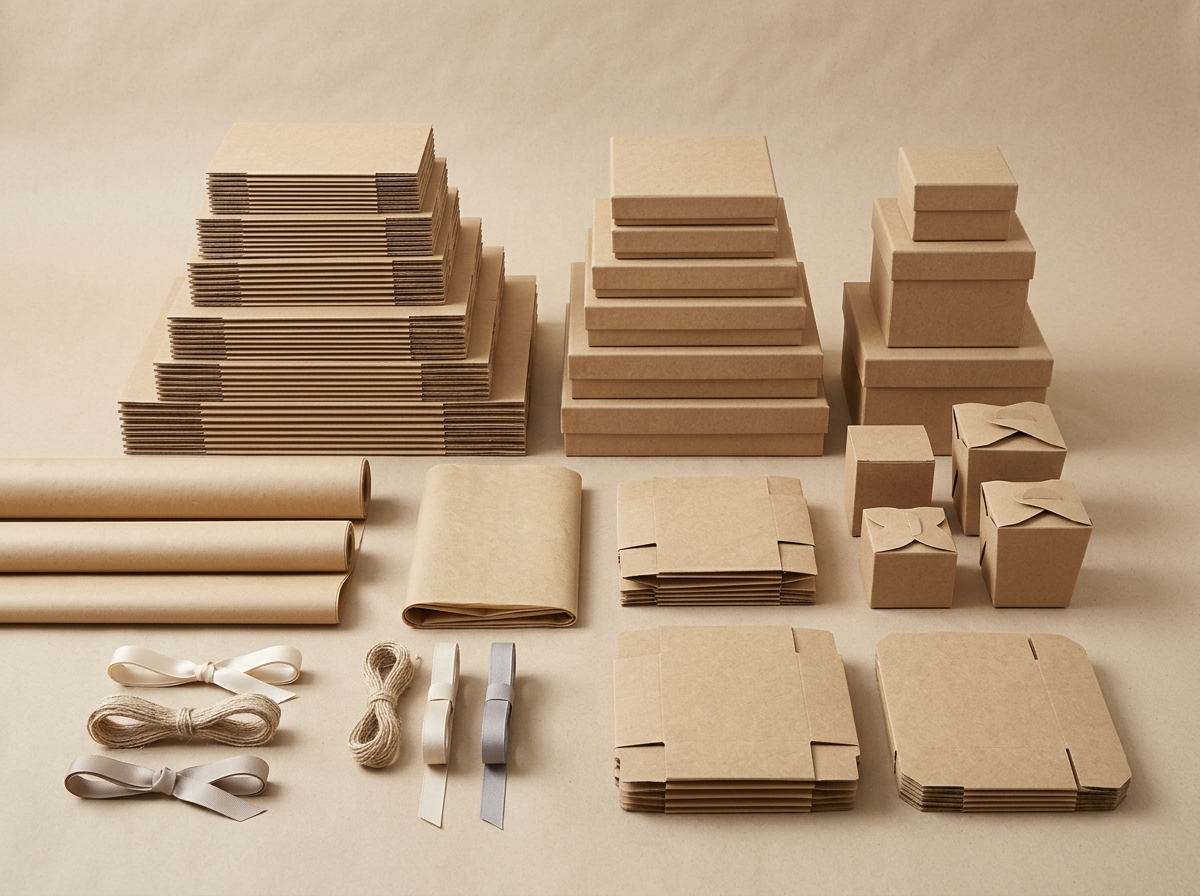
Retailers selling diverse product lines face a packaging paradox: every product size seems to need its own box, but stocking 15 different gift box SKUs creates inventory chaos during peak season. The solution is aggressive size standardization around three to five core dimensions that cover 80-90% of your order volume.
A typical standardization strategy includes a small cube (2×2×2 or 3×3×3) for jewelry, cosmetics samples, and small accessories; a medium cube or rectangle (4×4×4 or 5×5×3) for candles, mugs, and mid-size gifts; and a large rectangle (8×8×4 or 10×6×4) for apparel, gift sets, and bundled items. These dimensions nest efficiently for storage, ship economically across carrier rate tables, and present well across product categories.
Standardization also simplifies reorder planning. Instead of forecasting demand for a dozen SKUs, you're managing three. If your 3×3×3 kraft boxes run low mid-peak, you can expedite a single reorder rather than coordinating multiple shipments. This focus reduces the risk of stockouts on critical sizes and minimizes the capital tied up in slow-moving packaging inventory. When you're calculating packaging stock for Black Friday order volume, fewer SKUs with higher unit counts beat a sprawling catalog with shallow inventory on each size.
Color and finish standardization matters too. Kraft, white, and black cover most branding and aesthetic needs without requiring custom printing. Kraft boxes read as eco-friendly and artisanal; white boxes feel clean and premium; black boxes signal luxury. Retailers can differentiate product lines or price tiers using box color alone, avoiding the lead times and minimum order quantities that custom printing requires. A black cube gift box elevates perceived value for higher-margin items without adding per-unit cost or complexity to the packing process.
Black Friday customers expect their orders to arrive ready to give. That doesn't mean elaborate ribbons or custom tissue—it means the packaging itself looks intentional and finished. A clean kraft or white box with a tuck-top closure signals thoughtfulness without requiring additional materials or labor.
The presentation threshold for gift-ready packaging is surprisingly low. Customers accept plain boxes as long as they're clean, structurally sound, and appropriately sized for the contents. Overpacking a small item in a large box reads as wasteful; underpacking a fragile item in a flimsy box reads as careless. When the box fits the product and closes securely, most recipients perceive it as gift packaging even without decorative elements.
Retailers who want to add branding or seasonal messaging without custom printing can use stickers, stamps, or printed inserts. A kraft box with a circular logo sticker on the lid delivers brand recognition at a fraction of the cost and lead time of custom-printed boxes. Stamps work well for text-based messages like "Happy Holidays" or "Thank You." Both options allow you to order stock boxes in bulk and customize them in-house as orders ship, which preserves flexibility if your product mix or branding changes mid-season.
Not every gift box survives parcel shipping. Boxes designed for hand-to-hand gift giving often lack the structural integrity to handle conveyor belts, sorting machines, and stacked pallets. For Black Friday fulfillment, gift boxes must meet minimum performance standards or they'll arrive crushed, torn, or opened.
Paperboard weight is the primary structural variable. Gift boxes rated at 18-point or higher caliper handle most e-commerce applications. Lighter stocks (12-14 point) work for hand delivery or low-value items where cosmetic damage is acceptable, but they won't survive rough handling. Heavier stocks (24-point or corrugated) add cost and bulk without meaningful performance gains for most retail products under two pounds.
Edge crush test (ECT) ratings apply to corrugated boxes but not to solid paperboard gift boxes, which rely on caliper and fold geometry for strength. Cube boxes with interlocking bases distribute weight more evenly than flat-bottom rectangles, making them more resistant to crushing when stacked. Tuck-top closures hold securely under normal handling but can pop open if the box is dropped or compressed; for high-value or fragile items, a small piece of clear tape on the closure adds insurance without compromising presentation.
Parcel carriers don't distinguish between gift boxes and corrugated mailers in their handling protocols. Your packaging must survive the same treatment regardless of how it looks. Test shipments during your pre-peak planning phase reveal whether your chosen gift boxes need reinforcement, outer mailers, or different sizes. A box that arrives intact 95% of the time still generates returns, complaints, and replacement costs on the 5% that don't—acceptable for low-volume operations but unsustainable when you're shipping thousands of units per week.
Stock gift boxes in standard sizes ship faster than custom orders, but "fast" is relative during peak season. Standard boxes need 2-4 weeks, custom orders 8-12 weeks from order placement to warehouse delivery. For Black Friday fulfillment, that means stock orders must be placed by early October at the latest, and custom orders by late August if you're targeting November 27-30 peak.
The ordering window tightens further when you account for freight transit and warehouse receiving. A packaging order that ships from the supplier on October 15 might not arrive at your fulfillment center until October 25 or later, depending on origin, destination, and carrier schedules. If your peak season starts November 22 (the week before Thanksgiving), you have less than four weeks to unpack, stage, and integrate the packaging into your fulfillment workflow. Any delays—production backlog, freight congestion, receiving bottlenecks—compress that window further.
Retailers who order Black Friday packaging by September gain buffer time to handle surprises. If the initial shipment is short, damaged, or wrong, there's time to reorder. If your sales forecast changes, you can adjust quantities on follow-up orders. If a new product launch requires a different box size, you can add it without expediting freight. That flexibility disappears once October arrives, when suppliers are managing peak demand and carriers are prioritizing contracted volume over spot shipments.
Ordering too few gift boxes creates mid-peak stockouts; ordering too many ties up working capital and leaves you with surplus inventory in January. The right quantity balances historical order data, growth projections, and safety stock for demand spikes.
Start with last year's Black Friday order volume by product category. If you shipped 800 orders between November 22 and November 30 last year, and 60% of those orders used gift boxes, you consumed roughly 480 boxes during peak. Apply your growth rate—if you're projecting 20% year-over-year growth, plan for 576 boxes this year. Add 15-20% safety stock to cover forecast errors, late orders that ship in early December, and any promotional extensions, bringing your total to roughly 675-700 units.
Break that total into size categories based on your product mix. If 40% of your orders are small items (jewelry, cosmetics, accessories), 40% are medium items (candles, mugs, small apparel), and 20% are large items (gift sets, bundled products), allocate your 700 units accordingly: 280 small boxes, 280 medium boxes, 140 large boxes. This distribution assumes you're standardizing sizes as discussed earlier; if you're carrying more SKUs, the math gets more complex but the principle remains the same.
Don't forget non-peak usage. Gift boxes ordered for Black Friday also serve December holiday orders, corporate gifting, and regular e-commerce fulfillment through year-end. If you typically ship 50 gift box orders per week outside of peak season, and you have eight weeks from December 1 through January 31, that's another 400 units. Your total order should cover peak demand plus two months of baseline volume, or roughly 1,100 units in this example.
Stock gift boxes in standard sizes should be ordered by early October to ensure delivery before peak season begins in late November. Custom orders require 8-12 weeks, which means placing orders by late August or early September. Ordering earlier provides buffer time for production delays, freight congestion, and any necessary reorders if the initial shipment has issues.
Gift boxes prioritize presentation and can often serve as both product packaging and shipping containers, eliminating the need for customers to re-wrap items. They typically use heavier paperboard (18-point or higher) with clean finishes in kraft, white, or black. Shipping boxes prioritize protection and cost efficiency, using corrugated cardboard with minimal aesthetic consideration. For Black Friday, dual-purpose gift boxes reduce SKU complexity and meet customer expectations for gift-ready delivery.
Yes, when properly sized and constructed. Gift boxes with 18-point or heavier paperboard and secure tuck-top closures handle standard parcel shipping for most products under two pounds. Cube formats with interlocking bases perform better than flat-bottom rectangles under stacking pressure. For high-value or fragile items, adding a small piece of clear tape to the closure provides extra security. Always run test shipments during your planning phase to verify performance with your specific products and carrier mix.
Flat-pack gift boxes occupy roughly 20-30% of the space that pre-assembled boxes require. A case of 18 cube boxes (3×3×3 assembled) stores in approximately 12×9×4 inches when flat, meaning 1,000 units would require about 56 cases occupying roughly 28 cubic feet on standard industrial shelving. This is a rough estimate—actual dimensions vary by box size and manufacturer packaging. The key advantage is vertical stacking efficiency, which allows you to store peak-season inventory without dedicating significant floor space.
Most retailers find that two colors—typically kraft and white—cover 90% of their needs without creating excess inventory complexity. Kraft works for artisanal, eco-friendly, or casual gift presentation; white suits premium, clean, or formal aesthetics. Adding black as a third option allows you to differentiate luxury or high-margin items. Stocking more than three colors increases the risk of having the wrong color in stock when demand spikes, and the presentation difference rarely justifies the inventory complexity during high-volume Black Friday fulfillment.
Gift boxes bulk Black Friday fulfillment requires balancing speed, storage, and presentation. Tuck-top formats that assemble in seconds keep packing stations moving during peak volume. Flat-pack storage maximizes warehouse efficiency when space is premium. Size standardization reduces SKU complexity and simplifies reorder planning. And gift-ready presentation eliminates wrapping steps while meeting customer expectations for holiday orders. Retailers who order by early October, standardize on three to five core sizes, and choose dual-purpose boxes that ship and present well position themselves to handle peak season volume without bottlenecks, stockouts, or excess inventory carrying into January.