Cart
0
You may also like


Book a call with our development team to get started.



Apply online and access wholesale pricing.

Every package you ship is a marketing opportunity. The box arrives, your customer opens it, and in that moment—before they've even touched the product—you have a chance to earn their next order. Packaging inserts for small business turn that unboxing moment into a retention tool. A discount code, a handwritten note, or a care instruction card costs pennies to produce but can influence whether a buyer returns in 30 days or never comes back.
Research shows that 47% of consumers cite a coupon, discount, or credit toward a future purchase as the single factor most likely to drive a repeat purchase from an unboxing experience, followed by free samples. Unlike email campaigns that sit unopened or social ads that scroll past, an insert is physical, immediate, and arrives at the exact moment your customer is most engaged with your brand. This guide walks through the types of packaging inserts that move metrics, how to measure their impact, and where they fit inside your custom packaging ideas for small businesses strategy.
The unboxing experience has a 100% open rate. Every customer who receives a package opens it, which makes it one of the most valuable touchpoints in the entire commerce relationship. According to research, 52% of online shoppers are likely to make repeat purchases if they receive products in premium packaging, and inserts are a low-cost way to elevate that perception without redesigning your entire box.
Packaging inserts work because they arrive at a high-intent moment. Your customer has already paid, the product is in their hands, and they're forming an opinion about your brand. An insert that offers value—whether it's a discount, useful information, or a simple thank-you—shapes that opinion in your favor. It's retention marketing disguised as generosity, and the brands that execute it well see measurable lift in repeat purchase rate within 60 to 90 days.
The psychology is straightforward: customers who feel valued are more likely to return. A thoughtful insert signals that there are real people behind the brand, which matters especially for small businesses competing against faceless e-commerce giants. The key is choosing inserts that align with your product, your margin, and your customer lifecycle stage.
Not all inserts deliver the same return. Some drive immediate repeat orders; others build long-term loyalty or reduce support tickets. Here are the formats that consistently perform, organized by business goal.
Discount inserts are the most direct path to a second order. A printed card with a unique code—10% off, free shipping over a threshold, or a dollar amount off the next purchase—gives customers a tangible reason to come back. The offer should be time-bound (30 to 60 days) to create urgency and trackable so you can measure redemption rate in your analytics.
Placement matters. Put the discount card on top of the tissue paper or taped to the inside lid so it's the first thing customers see. If it's buried under packing material, redemption drops. Print the code large enough to read without squinting, and include a short URL or QR code that takes them directly to your shop—no hunting through your homepage.
For small bakeries or food brands, consider pairing discount codes with a structured kraft gift box that customers can reuse, reinforcing the value of ordering again.
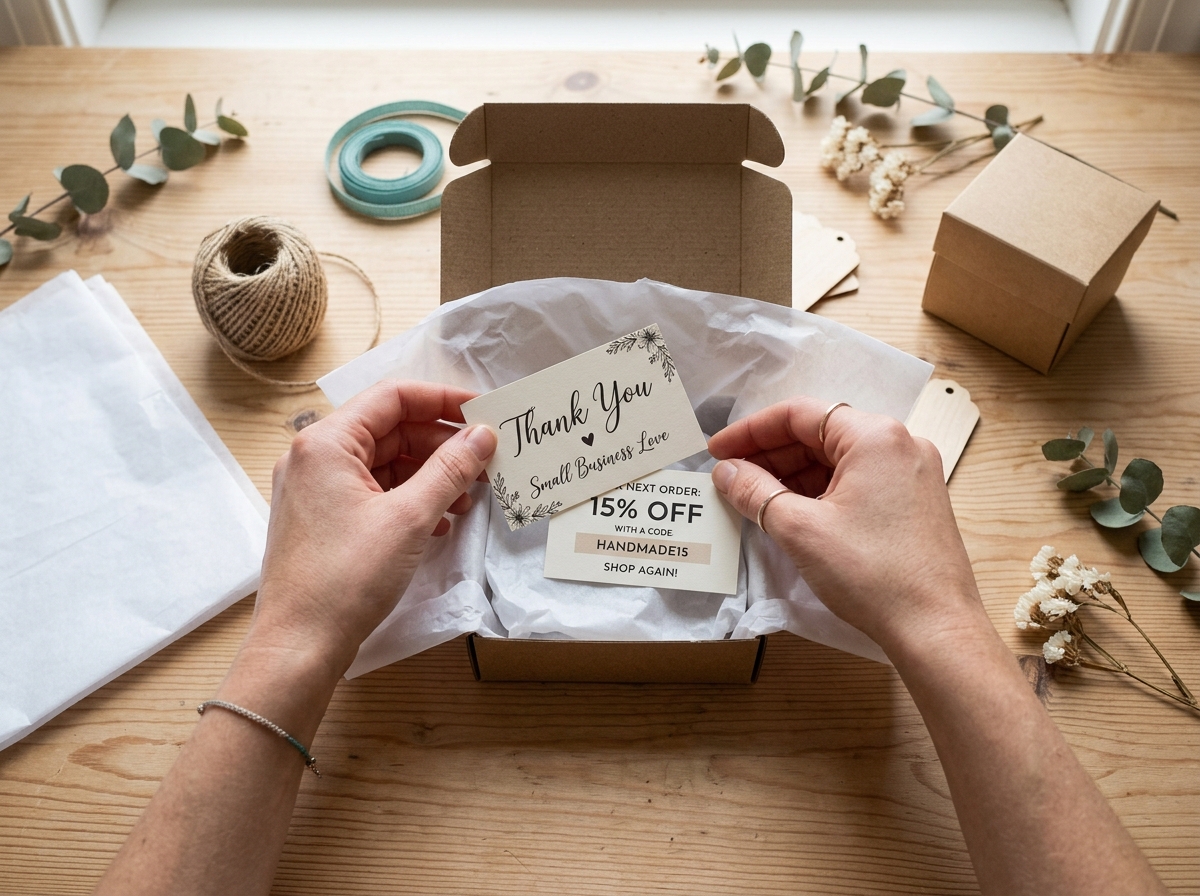
A simple thank-you note is one of the most effective inserts despite being incredibly low-cost. The key is making it feel conversational rather than corporate. A line like "You could've ordered from anywhere—thank you for choosing us" reads more human than a generic "Thank you for your purchase." For very small brands, handwritten notes on blank cards create an emotional pause during unboxing that customers remember and mention in reviews.
If handwriting doesn't scale, print thank-you cards with a signature or a photo of your team. The goal is to remind customers that real people packed their order. This human element becomes a differentiator in crowded categories where most competitors ship in anonymous poly mailers.
Care instruction inserts reduce returns, extend product life, and cut down on support emails. If your product requires assembly, special storage, or maintenance, a one-page card with clear steps prevents confusion and buyer's remorse. For example, a small candle brand might include a card explaining proper wick trimming; a jewelry maker might include tarnish-prevention tips.
These inserts also position your brand as an expert. When you proactively answer common questions, customers trust that you know your product and care about their experience. That trust translates to repeat purchases because they're more likely to come back to a brand that made their first order easy.
If you're shipping fragile items like baked goods, choosing the right packaging material is the first line of defense, but a care card that explains how to store or serve the product adds a second layer of customer satisfaction.
Including a sample of a complementary product introduces customers to your broader catalog without asking them to commit to a full purchase. A skincare brand might tuck a sample packet of a new serum into every moisturizer order; a spice company might include a single-use pouch of a seasonal blend. The sample should be relevant to what they bought—random samples feel like you're clearing inventory.
Cross-sell inserts work similarly but use a printed card instead of a physical product. A card that says "Customers who bought this also love…" with a photo and a discount code for the suggested item can drive incremental revenue. Track which products you're cross-selling and measure conversion to identify your highest-performing pairings.
A card that asks customers to share their unboxing on Instagram or leave a review on your site turns satisfied buyers into brand advocates. The ask should be simple and specific: "Tag us @yourbrand for a chance to be featured" or "Leave a review and we'll send you a thank-you discount." Incentivizing the action increases follow-through.
Social proof drives new customer acquisition, and user-generated content is more trusted than brand messaging. If you're running a DTC brand, unboxing photos and testimonials become free marketing assets you can repurpose in ads and on your homepage. Just make sure the card includes your handle and a reason to post—customers need a nudge.
Packaging inserts are only worth the investment if you track their impact. The primary metric is repeat purchase rate (RPR): the percentage of customers who place a second order within a defined window, typically 60 to 90 days. For most e-commerce businesses, a healthy repeat purchase rate sits somewhere in the 20–40% range. If yours is below that, inserts are worth testing alongside other retention levers.
To isolate the effect of an insert, run a cohort comparison. Ship half your orders with the insert and half without, then compare RPR between the two groups after 90 days. This gives you directional evidence of whether the insert is working. Track redemption rate for discount codes by using unique codes for each batch or campaign—this tells you not just whether customers are returning, but whether they're using the specific incentive you provided.
Qualitative signals matter too. After adding inserts, monitor customer reviews to see if they mention the packaging experience. Check your brand name on Instagram and TikTok for organic unboxing content. Look at your Net Promoter Score (NPS) to see if it ticks up. These soft signals often move together when an insert strategy is landing, even if the lift in RPR takes a full quarter to show up in your data.
If you're also investing in designing an unboxing experience that builds loyalty, inserts should be one component of a broader retention system that includes packaging aesthetics, product quality, and post-purchase email flows.
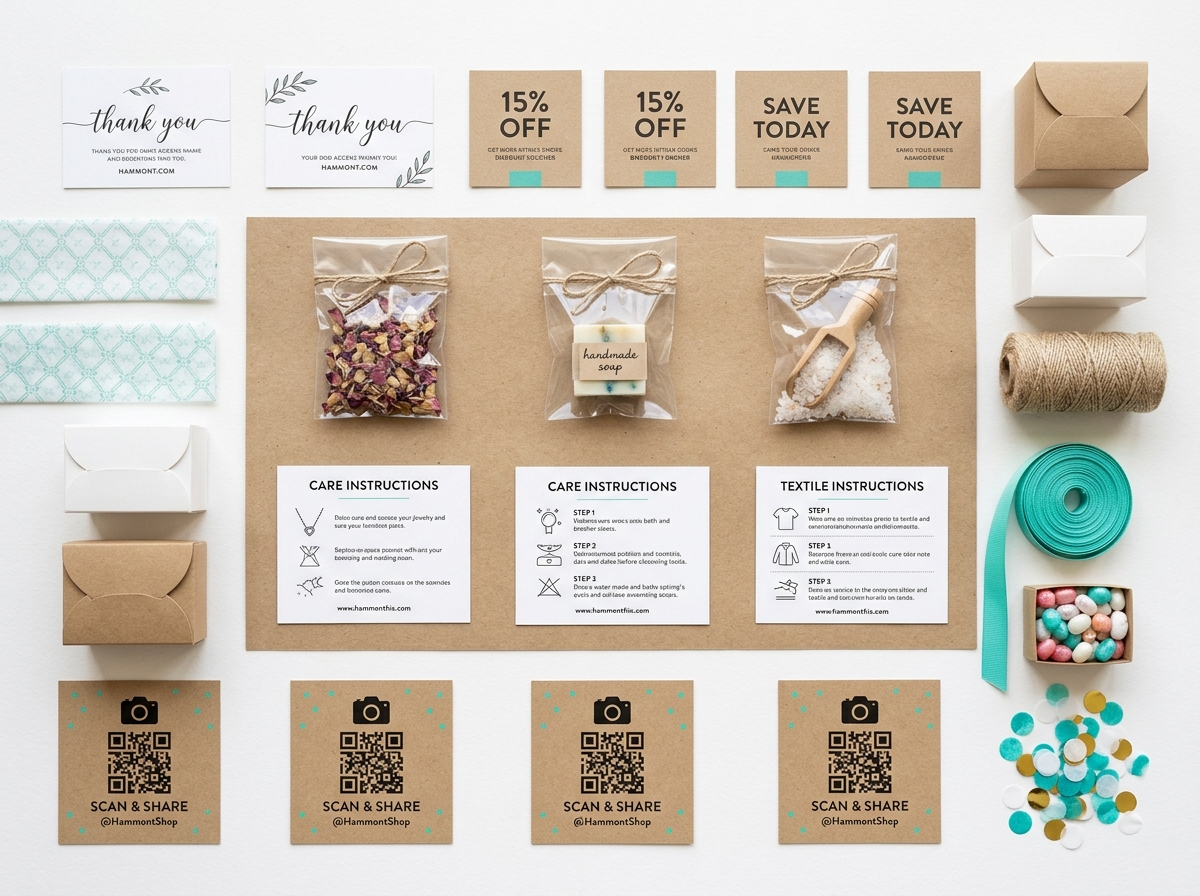
Packaging inserts don't require a large budget, but they do require planning. Printed cards typically cost $0.05 to $0.25 per unit depending on size, paper stock, and print run. Thank-you cards on standard cardstock are cheapest; multi-page booklets or coated stock cost more. For very small runs (under 500 units), print-on-demand services keep upfront costs low, but per-unit price drops significantly once you hit 1,000 or 2,500 units.
If you're adding physical samples, factor in the cost of the sample itself plus any additional packaging (small cellophane bags, sample jars, or pouches). Samples make sense when your margin supports it and when the goal is to upsell a higher-ticket product. If your average order value is under $30, a discount code insert typically delivers better ROI than a physical sample.
Storage and fulfillment are the hidden costs. Inserts add a step to your packing process, so make sure your team or 3PL can handle the extra touch without slowing down ship times. Pre-sort inserts by product type or order value if you're personalizing them—this prevents mistakes and keeps your workflow efficient.
For brands working within tight minimum order quantity constraints, start with a single insert type (discount code or thank-you card) and test it on 100 to 200 orders before scaling. Measure redemption and RPR lift, then decide whether to expand to additional insert types or increase print runs.
Not every insert fits every business. A discount code makes sense for consumables and repeat-purchase categories like skincare, coffee, or pet supplies. A care instruction card is essential for complex or delicate products. A social media card works best for visually appealing products that photograph well.
Match the insert to your customer lifecycle stage. First-time buyers benefit from thank-you notes and care instructions that reduce friction and build trust. Repeat customers respond better to loyalty rewards, exclusive previews, or referral incentives. If you're shipping branded packaging on a budget, inserts are one of the highest-leverage ways to add perceived value without redesigning your entire box.
Consider your product's price point and margin. High-ticket items ($100+) can support more elaborate inserts—a multi-page welcome booklet, a premium thank-you card, or a branded gift. Low-margin products need to keep insert costs under $0.10 per order, which usually means a single printed card on standard stock.
For seasonal businesses, time your inserts to the calendar. A holiday bakery might include a "Save 15% on Valentine's orders" card in December shipments. A gift box brand could include a referral card in Q4 that incentivizes customers to share your products as gifts. Align the offer with when customers are most likely to need your product again.
The most common mistake is burying the insert under packing material. If customers don't see it, it doesn't exist. Place inserts on top of tissue paper, taped to the inside of the box lid, or tucked into a visible pocket. The second mistake is using generic, corporate language that feels like it came from a template. Customers can tell when a message is automated. Write like you're talking to a friend, not reading from a script.
Another mistake is offering a discount so small it doesn't motivate action. A 5% code on a $20 product saves the customer one dollar—not enough to overcome inertia. Aim for 10% to 15% off or free shipping, which are meaningful enough to drive a click. Time-bound the offer (30 to 60 days) so it doesn't sit in a drawer forever.
Don't ask for too much at once. A card that requests a review, a social post, and a referral overwhelms the customer and reduces completion rate on all three. Pick one primary call to action per insert. If you want reviews, make that the focus. If you want social shares, design the card around that single ask.
Finally, don't launch inserts without a way to track them. Use unique discount codes, trackable URLs, or QR codes that tie back to your analytics. If you can't measure it, you can't optimize it. After a few hundred orders, look at redemption rate and RPR lift. If an insert shows no movement, cut it and test something new rather than letting it linger out of habit.
Packaging inserts work best as part of a cohesive unboxing experience, not as a standalone tactic. If your outer box is plain and your product arrives in a poly bag, a fancy insert won't compensate for the lack of brand presence. Start with the fundamentals: a box that protects the product, tissue paper or filler that looks intentional, and a consistent color palette or logo placement.
Once those basics are in place, inserts amplify the experience. They add a personal touch that turns a functional delivery into a branded moment. For small businesses, this is especially important because your packaging is often the first physical interaction a customer has with your brand. Make it count.
If you're exploring eco-friendly packaging options, choose inserts printed on recycled cardstock or seed paper that customers can plant. Sustainability-minded buyers notice these details and are more likely to return to brands that align with their values. Just make sure the eco-friendly choice doesn't compromise readability or durability—a card that arrives smudged or torn undermines the message.
For brands that ship in cube kraft gift boxes or other reusable packaging, inserts can reinforce the value of keeping the box. A care card that says "This box is perfect for storing jewelry, office supplies, or small gifts" reminds customers that your packaging has a second life, which increases perceived value and brand recall.
The brands that get the most out of packaging inserts are the ones that treat them as an ongoing experiment, not a set-it-and-forget-it tactic. Start with two tests: a thank-you card versus no card, measuring repeat purchase rate over 60 days; and a 10% discount code versus free shipping, measuring which drives a faster second order. Run each test on at least 100 orders per variant to get statistically meaningful data.
Once you identify a winning format, test variations. Try different discount percentages, different expiration windows, or different placements inside the box. A/B test your copy—does "Thank you for supporting our small business" outperform "You're awesome"? Does a QR code get more scans than a typed URL? Small changes can yield double-digit lifts in redemption.
Track your results in a simple spreadsheet: insert type, cost per unit, redemption rate, and 90-day RPR for each cohort. Over time, you'll see patterns. Maybe discount codes work better for products under $50, while thank-you cards perform better for high-ticket items. Maybe first-time buyers respond to care instructions, while repeat customers prefer loyalty rewards. Use that data to personalize inserts by customer segment.
If you're managing multiple product lines or selling through different channels, segment your insert strategy accordingly. A wholesale account ordering in bulk doesn't need a discount code, but they might appreciate a line sheet insert showcasing your full catalog. A DTC customer ordering a single item benefits from a personal note and a repeat-purchase incentive.
Different business models require different insert approaches. For consumable products—coffee, skincare, supplements—discount codes with a 30-day expiration create urgency and align with natural replenishment cycles. Include a reminder of when the customer will likely run out: "Your next order is on us—use code RESTOCK15 before you run out."
For one-time or infrequent purchases—jewelry, home decor, gifts—focus on referral inserts. A card that says "Give a friend 20% off and you'll get 20% off your next order" turns satisfied customers into acquisition channels. Track referral redemptions to measure how much new revenue the insert generates.
For subscription or membership businesses, inserts can reinforce the value of staying subscribed. Include a roadmap of upcoming products, a note from the founder, or a loyalty milestone card ("You're in month 6—here's what's coming next"). These inserts reduce churn by reminding customers why they signed up in the first place.
For service-based businesses that ship physical goods—meal kits, craft kits, educational materials—care instructions and usage tips are essential. A recipe card, a step-by-step assembly guide, or a troubleshooting FAQ reduces support tickets and increases the likelihood that customers complete the experience and reorder.
Printed inserts typically cost between $0.05 and $0.25 per unit depending on size, paper stock, and quantity. Standard thank-you cards on uncoated cardstock are cheapest, while multi-page booklets or premium finishes cost more. Print runs of 1,000 units or more reduce per-unit cost significantly. For very small batches under 500 units, print-on-demand services keep upfront investment low but increase per-piece pricing.
Discount codes and promotional offers are the most direct drivers of repeat purchases. Research shows that 47% of consumers cite a coupon or discount as the top factor influencing a second order. Time-bound offers (30 to 60 days) with clear value (10% to 15% off or free shipping) perform best. Thank-you cards and product samples also contribute to loyalty but typically require a longer timeline to show measurable lift in repeat purchase rate.
Place inserts on top of tissue paper or tape them to the inside lid of the box so they're the first thing customers see when they open the package. If inserts are buried under packing material or placed at the bottom of the box, redemption rates drop significantly. Visibility is critical—customers won't act on an insert they don't notice.
Track repeat purchase rate (RPR) for customers who received an insert versus those who didn't, measured over 60 to 90 days. For discount codes, track redemption rate using unique codes tied to each batch or campaign. Also monitor qualitative signals like customer reviews mentioning the insert, social media posts featuring your unboxing experience, and Net Promoter Score (NPS) shifts. Run cohort tests to isolate the impact of the insert from other variables.
Yes. Start with a single insert type—a thank-you card or discount code printed on standard cardstock—and test it on 100 to 200 orders. Measure redemption and repeat purchase lift before scaling. Even a simple printed card at $0.05 per unit can deliver ROI if it drives a second order. Avoid elaborate multi-page inserts or physical samples until you've proven the concept with a low-cost test.
Packaging inserts for small business are one of the highest-leverage retention tactics available. They cost pennies per order, arrive at a high-intent moment, and create a tangible reason for customers to come back. Whether you're including a discount code, a thank-you note, or a product care card, the goal is the same: turn a one-time buyer into a repeat customer.
Start with the insert type that aligns with your product, your margin, and your customer lifecycle. Test it on a small batch, measure the results, and iterate. Over time, you'll identify the formats and offers that move your repeat purchase rate, and you'll build a packaging experience that does more than protect your product—it grows your business.
Ready to elevate your packaging? Explore Hammont's selection of compact gift boxes designed to hold your products and inserts in one cohesive, brand-building package.