Cart
0
You may also like

Book a call with our development team to get started.



Apply online and access wholesale pricing.

Small businesses producing under 500 units per month face a common dilemma: how to create memorable branded packaging without committing to the high minimum order quantities that custom printing requires. While competitors showcase expensive flexographic printing and full-color litho labels, many overlook the budget branded packaging ideas that deliver professional results at a fraction of the cost. Sticker seals, rubber stamps, and printed inserts allow you to brand plain stock packaging with flexibility, lower upfront investment, and the ability to test designs before scaling.
This guide covers three core tactics—custom stickers, rubber stamps, and thank-you card inserts—that work for bakeries shipping 50 orders a week, candle makers fulfilling 200 monthly subscriptions, or any product-based business operating below traditional custom-printing minimums. These methods integrate seamlessly with stock kraft boxes, cellophane bags, and plain mailers, transforming them into cohesive brand touchpoints without the waste or expense of pre-printed packaging.
Traditional custom packaging typically requires minimum orders of 1,000 to 5,000 units. For a business shipping 300 orders per month, that represents three to seventeen months of inventory—a significant cash flow burden and a design commitment that leaves no room for iteration. Consistent branding can elevate revenue by up to 33%, but only when that branding accurately reflects your current market position and visual identity.
Budget branded packaging ideas solve this by decoupling the base packaging from the branding layer. You purchase plain kraft gift boxes or stock cellophane bags in quantities that match your actual throughput, then apply branding elements as needed. This approach offers three strategic advantages: you can update designs quarterly without discarding obsolete inventory, test seasonal variations on small runs, and maintain tighter cash flow by ordering packaging materials just-in-time rather than warehousing months of pre-printed boxes.
Businesses operating at this scale also benefit from the handcrafted aesthetic that stickers and stamps provide. 72% of buyers say packaging design influences purchase decisions, and for artisan or small-batch brands, a hand-stamped logo or custom sticker seal signals authenticity rather than mass production. This perception aligns with customer expectations in categories like handmade goods, specialty food, and craft beverages, where the packaging itself becomes part of the product narrative.
For a detailed comparison of when to use stock packaging versus custom printing, see our guide on understanding MOQ for small business packaging.
Sticker seals are adhesive labels—typically circular, ranging from 1.5 to 2 inches in diameter—that close tissue paper folds, secure mailer flaps, or add a branded accent to plain boxes. They serve dual functions: physical closure and visual branding. A well-designed sticker seal transforms a generic kraft mailer into a branded experience the moment it arrives.
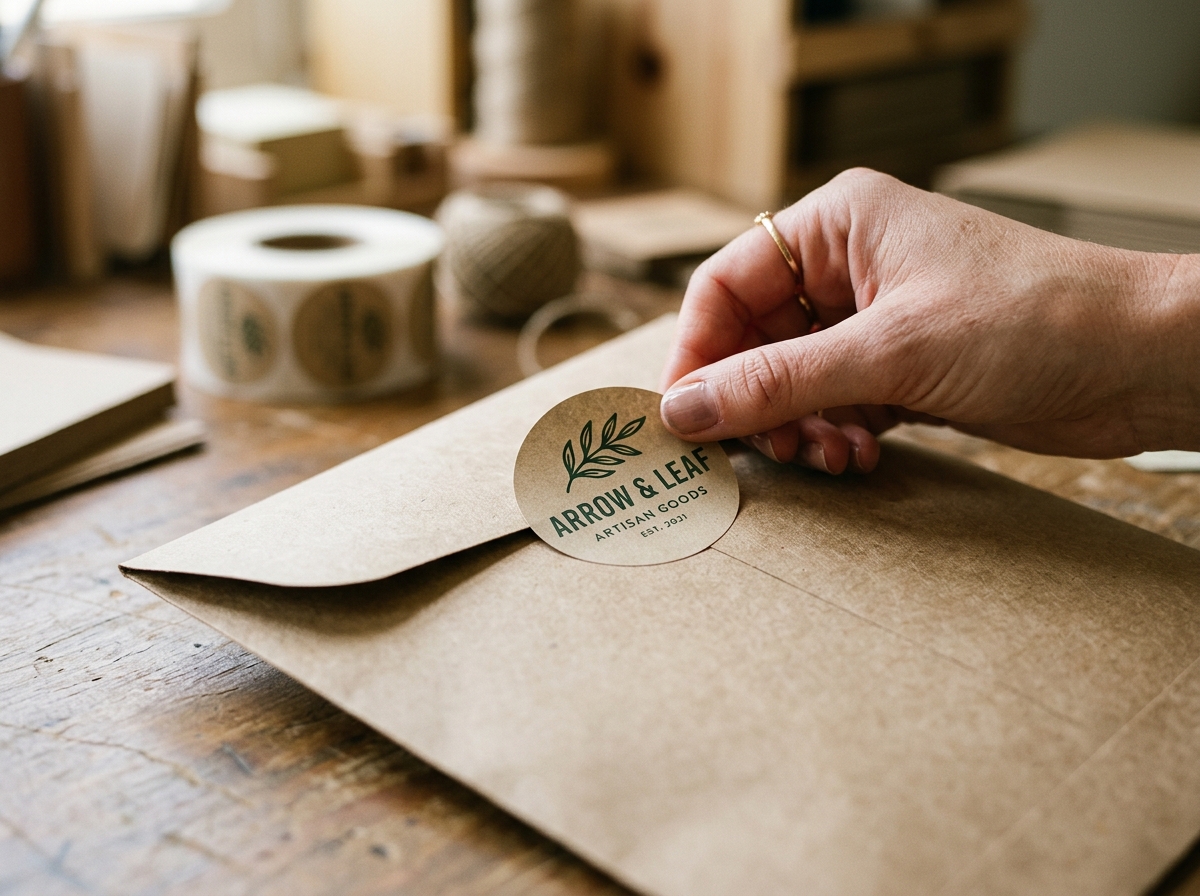
Most print-on-demand sticker vendors offer minimums as low as 50 to 100 units, with per-unit costs dropping significantly at 250 and 500 quantities. Paper stock stickers (uncoated or kraft finish) work well for standard postal conditions and support sustainability narratives, while vinyl stickers provide moisture resistance for products that may encounter condensation or outdoor storage. For businesses using resealable treat bags, a vinyl sticker provides tamper-evidence and reinforces closure security during transit.
Design considerations for effective sticker seals include high contrast (your logo should read clearly at arm's length), appropriate sizing (a 38mm circle seals most tissue folds cleanly without excess), and a clear brand mark rather than detailed imagery. Stickers also offer the flexibility to rotate designs seasonally—holiday editions, limited-run collaborations, or product-specific variants—without the financial penalty of obsolete packaging stock.
Practical applications extend beyond mailer closures. Sticker seals work as product labels on clear acrylic boxes, closure reinforcement on cellophane bags, and decorative accents on plain gift boxes. For businesses that ship in poly mailers or need moisture-resistant labels, vinyl stickers outperform paper in durability while maintaining a professional appearance.
Rubber stamps offer the lowest per-impression cost of any branding method once you exceed approximately 200 monthly units. A custom logo stamp typically costs between $30 and $80 depending on size, and delivers thousands of impressions before requiring re-inking. For businesses stamping 50 boxes per week, the per-unit branding cost drops below two cents within the first month.
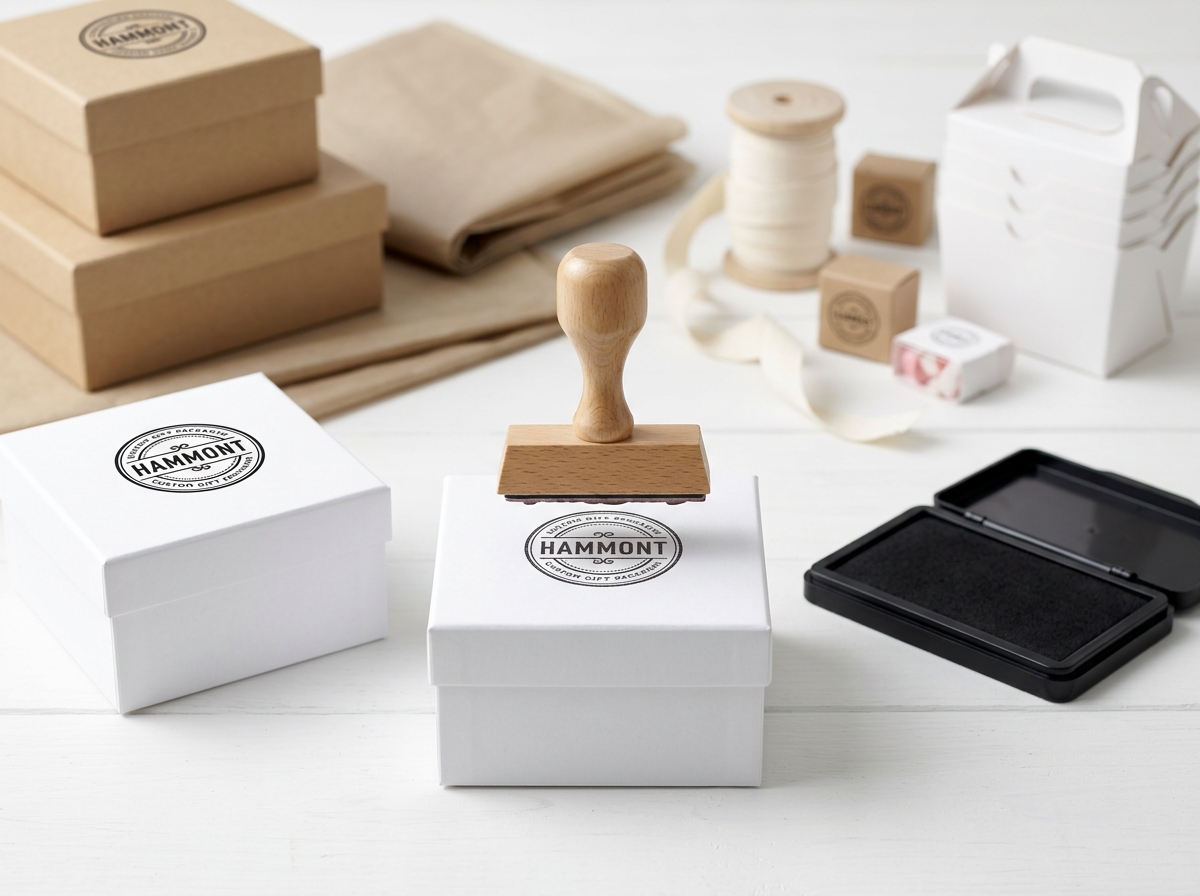
Stamp types fall into three categories. Traditional wood-handle stamps require a separate ink pad but allow easy color switching and create an artisanal aesthetic. Self-inking stamps streamline high-volume workflows by automatically re-inking after each impression, ideal for businesses processing daily order batches. Pre-inked stamps use a gel reservoir and produce the crispest impressions, suitable for detailed logos or fine text, with some models rated for 50,000 impressions before re-inking.
Stamp size should match your packaging dimensions. For standard kraft mailers and small gift boxes, a 2-inch square or circular stamp provides adequate visibility without overwhelming the surface. Larger formats (up to 4 inches) work for paper shopping bags or the broad sides of shipping boxes, though stamps above 4 inches require more stamping skill to achieve even ink coverage.
Stamps excel on porous surfaces: kraft paper, uncoated cardstock, wood, and natural fabric. For glossy or coated surfaces, specialty ink pads prevent smudging. Water-based inks suit most paper applications and clean easily, while pigment inks offer fade resistance for products with longer shelf exposure. Stamps integrate naturally into packing workflows—station the stamp and ink pad at your packing table, and each box receives its brand mark as part of the standard fulfillment process.
Businesses concerned about consistency should note that stamping technique improves rapidly with practice. Apply even pressure, avoid rocking the stamp, and test on scrap material until the impression is clean. For detailed guidance on pairing stamps with different packaging materials, see our post on choosing the right packaging material for your product.
Printed inserts—thank-you cards, product care instructions, or branded postcards—add a branded touchpoint inside the package where customers engage with your product for the first time. Unlike exterior branding, inserts are protected from shipping damage and arrive pristine, making them ideal for conveying brand story, care instructions, or calls-to-action like social media follows or referral codes.
Thank-you cards remain the most common insert format. A simple 4x6-inch card printed with your logo, a short message, and social handles costs approximately $0.15 to $0.30 per unit at quantities of 250 to 500. This cost is often justified by the brand recall it generates—handwritten or printed thank-you notes create a perception of care that differentiates small businesses from large-scale competitors.
Product care cards serve functional and branding purposes simultaneously. A candle business includes burn instructions and safety warnings; a jewelry maker provides metal care tips and storage recommendations. These cards reduce customer service inquiries while reinforcing brand professionalism. Include your logo, website, and a single clear call-to-action (e.g., "Tag us @yourbrand for a chance to be featured").
Postcards with discount codes incentivize repeat purchases and provide trackable marketing ROI. A postcard offering 15% off the next order, coded uniquely to the insert channel, allows you to measure the direct revenue impact of your packaging investment. This tactic works particularly well for consumable products with natural repurchase cycles—coffee, skincare, snacks—where the postcard arrives just as the customer nears product depletion.
Insert design should prioritize readability and a single focal point. Avoid cramming multiple messages onto one card; instead, use front and back strategically. Front: brand mark and primary message. Back: secondary details like website, contact, or product care. Print on uncoated or lightly textured cardstock for a premium feel that aligns with the handcrafted aesthetic most small businesses cultivate.
The most effective budget branded packaging ideas layer multiple low-cost elements to create a cohesive unboxing experience. A typical system might include: a plain kraft box or mailer (stock inventory), a rubber-stamped logo on the exterior, a custom sticker seal closing the flap, and a printed thank-you card inside. Each element costs pennies, but together they deliver a branded experience that rivals custom-printed packaging at a fraction of the investment.
This layered approach also accommodates product variety without requiring separate packaging SKUs. A bakery shipping cookies, brownies, and cakes uses the same base boxes and stamps, but varies sticker colors or insert messaging by product type. Seasonal variations require only new sticker designs or updated thank-you cards, not entirely new packaging inventory.
Operationally, this system integrates into existing packing workflows with minimal friction. Stage your packing station with pre-stamped boxes (stamp a week's worth during downtime), rolls of sticker seals within arm's reach, and stacks of thank-you cards ready to drop into each package. The incremental time per order is typically under 30 seconds, a negligible addition to fulfillment labor.
For businesses exploring sustainable options alongside budget constraints, see our guide on eco-friendly packaging that doesn't break the budget, which covers recyclable sticker stocks and FSC-certified paper options compatible with these branding methods.
A direct cost comparison illustrates why budget branded packaging ideas make sense for businesses under 500 units per month. Custom-printed boxes typically require a 1,000-unit minimum with setup fees ranging from $150 to $400, resulting in an all-in cost of $1.50 to $3.00 per box depending on size and print complexity. For a business shipping 200 units monthly, that represents five months of inventory and $3,000 to $6,000 in upfront capital.
By contrast, a budget branding system costs approximately $0.40 to $0.75 per package: $0.25 for a plain kraft box, $0.10 for a sticker seal (at 500 quantity), $0.02 for a stamp impression, and $0.20 for a printed insert. The initial investment is a $50 rubber stamp and $75 for 500 stickers and inserts—$125 total, recovered within the first 50 to 100 shipments. This approach preserves cash flow, reduces waste from design changes, and allows testing of multiple branding concepts before committing to large print runs.
The cost advantage compounds when factoring in design iteration. A sticker design that underperforms can be replaced after 250 units; a custom-printed box that misses the mark leaves you with 750 units of obsolete inventory. For early-stage businesses still refining their visual identity, this flexibility is often more valuable than the marginal aesthetic improvement custom printing provides.
Effective budget branded packaging ideas rely on strong design execution within the constraints of each medium. For sticker seals, prioritize a single brand mark—your logo or wordmark—with high contrast and minimal detail. Intricate illustrations or fine text become illegible at small sizes; a bold, clean mark reads instantly and reproduces reliably across print vendors.
Rubber stamp designs should account for the medium's limitations. Avoid large solid areas (they print unevenly) and extremely fine lines (they fill in with ink over repeated use). Designs with open space and moderate line weight produce the most consistent impressions. Vector artwork is ideal; if providing raster files, use high resolution (300 DPI minimum) and pure black-and-white without gradients.
Printed inserts benefit from generous margins and a clear visual hierarchy. Place your logo in the top third, your primary message in the center, and secondary details (website, social handles) at the bottom. Use a single typeface family in two weights (regular and bold) rather than mixing multiple fonts, which dilutes brand cohesion. If including a call-to-action, make it specific and trackable: "Use code THANKYOU15 for 15% off your next order" performs better than generic "Visit our website."
Color choices should align with your broader brand palette but also consider cost. Full-color printing costs more than one- or two-color printing; a well-designed two-color insert (brand color plus black) often delivers stronger brand recognition than a poorly executed full-color design. Sticker seals in a single brand color with white or kraft background maintain visual impact while controlling costs.
Sticker vendors vary widely in minimum order quantities, turnaround times, and material options. Print-on-demand services like Sticker Mule or Moo offer low minimums (50 to 100 units) with fast turnaround but higher per-unit costs. Trade printers offer better pricing at 250 to 500 quantities with longer lead times (7 to 10 business days). Order a sample pack from multiple vendors to compare material quality, adhesive strength, and color accuracy before committing to production quantities.
Rubber stamp suppliers include both online platforms and local print shops. Online vendors typically offer lower prices and faster production (2 to 5 business days), while local shops provide in-person design consultation and same-day pickup. Ensure your vendor uses photopolymer or laser-engraved dies for sharpness and longevity; avoid vendors using outdated rubber-molding processes that produce softer, less detailed impressions.
For printed inserts, digital printing services like Vistaprint, GotPrint, or local quick-print shops handle small quantities economically. Request uncoated or lightly textured cardstock (14pt to 16pt) for a premium feel. Order 250 units initially to test messaging and design, then scale to 500 or 1,000 once the design is proven. Always request a printed proof before full production—colors and sizing can vary significantly from screen to print.
Budget branding elements work best when integrated into a standardized packing workflow. Designate a clean, flat surface for stamping and pre-stamp a batch of boxes or mailers during low-traffic periods—early mornings or between order waves. This batch approach is faster than stamping individual boxes during order fulfillment and produces more consistent results.
Store sticker seals on rolls or sheets within easy reach of your packing station. Peel-and-stick application takes seconds per package; position the seal to close the mailer flap or tissue fold while displaying your logo prominently. For high-volume operations, consider a label dispenser that advances the roll automatically, reducing application time.
Printed inserts should be pre-folded (if applicable) and staged in stacks at the packing station. Include the insert as the final step before sealing the package, ensuring it sits atop the product where customers see it immediately upon opening. If using discount codes or time-sensitive messaging, rotate insert batches quarterly to keep offers current.
Train any team members involved in packing on the brand standards for each element: stamp placement, sticker alignment, and insert inclusion. Consistency across orders reinforces brand professionalism; inconsistent application—stamps at varying angles, stickers askew—undermines the quality perception you're working to build.
Budget branded packaging ideas are not a permanent solution; they're a bridge strategy that preserves capital and flexibility while your business scales. The inflection point for transitioning to custom-printed packaging typically occurs around 500 to 750 units per month, where the labor cost of applying stickers and stamps begins to exceed the per-unit savings compared to pre-printed boxes.
Other indicators include: consistent design (no changes for six-plus months), stable product mix (same packaging across most SKUs), and available capital (custom printing requires larger upfront investment but lower marginal cost). At this stage, the brand recognition and operational efficiency of custom printing justify the commitment. However, many businesses continue using inserts and sticker accents even after adopting custom boxes, layering these elements for seasonal promotions or limited editions.
Before making the transition, audit your current branding system's performance. Track customer feedback on unboxing experience, measure social media mentions and tags, and calculate the fully loaded cost per package including labor. If your current system delivers strong brand engagement and your labor cost remains under $0.50 per package, there may be no urgency to switch. Custom printing is a tool, not a milestone; adopt it when the economics and operational benefits align with your business stage.
Custom sticker seals typically cost $0.25 to $0.50 per unit at 100-quantity minimums, dropping to $0.10 to $0.20 per unit at 500 quantities. Paper stock stickers are less expensive than vinyl, and single-color designs cost less than full-color. Most vendors offer 1.5-inch to 2-inch circular seals as standard sizes with no die-cut fees. For the best pricing, order 250 to 500 units and choose paper stock unless your packaging requires moisture resistance.
Rubber stamps work best on porous surfaces like kraft paper, uncoated cardstock, and natural fabrics. Glossy or coated surfaces require specialty ink pads formulated for non-porous materials—look for solvent-based or pigment inks labeled for plastic, metal, or coated paper. These inks take longer to dry (30 to 60 seconds) but prevent smudging. Test on a sample of your actual packaging material before stamping production orders, as ink adhesion varies by surface finish and coating type.
Effective thank-you cards include four elements: your logo or brand mark, a brief thank-you message (one to two sentences), a single call-to-action (follow on Instagram, use a discount code, leave a review), and your website or primary contact method. Avoid cramming multiple messages onto one card—prioritize the one action most valuable to your business. If including a discount code, make it memorable and trackable (e.g., THANKYOU15) so you can measure the insert's ROI through repeat purchase attribution.
For small businesses and artisan brands, budget branding methods like stamps and stickers often enhance brand perception rather than diminish it. The handcrafted aesthetic signals authenticity and small-batch production, which aligns with customer expectations in categories like handmade goods, specialty food, and craft products. Custom printing becomes important when scaling to retail distribution or when competing in categories where polished, mass-produced packaging is the norm. For direct-to-consumer businesses under 500 units monthly, thoughtfully executed budget branding delivers comparable brand impact at a fraction of the cost.
Custom rubber stamps have no minimum order quantity—you purchase a single stamp tool that produces thousands of impressions. A basic logo stamp costs $30 to $80 depending on size and type (wood handle, self-inking, or pre-inked). The stamp itself is a one-time investment; ongoing costs include only ink pad refills or re-inking fluid, typically $5 to $15 per refill. This makes stamps the most economical branding method for businesses producing more than 200 units per month, where the per-impression cost drops below $0.02 within the first month of use.