Cart
0
You may also like

Book a call with our development team to get started.


Apply online and access wholesale pricing.

When you're opening a coffee shop or launching a roasting operation, one of the first roadblocks you'll encounter is the coffee packaging minimum order quantity. Most suppliers won't sell you 50 bags to test your brand—they require hundreds or thousands of units per order. For new owners working with tight budgets and uncertain demand, this requirement can feel like a barrier to entry. Understanding how minimum order quantities work, why they exist, and how to navigate them strategically will help you make smarter purchasing decisions without tying up all your capital in packaging inventory.
The coffee packaging minimum order quantity typically ranges from 500 to 10,000 units, depending on the supplier, printing method, and level of customization. Some suppliers require as few as 100 bags, while others mandate 10,000 or more. This wide range exists because production, transportation, handling, and administration costs eat into profit margins considerably more for small orders, so manufacturers set MOQs that guarantee income will exceed associated costs. If you're planning your first packaging order, you need to know where your business falls on this spectrum and what options exist at each tier.
Before you can evaluate suppliers or commit to an order, you need to understand the fundamentals of custom packaging for coffee shops and how MOQs fit into your broader branding and operations strategy. This guide breaks down the cost implications, supplier tiers, inventory management strategies, and practical workarounds that help new coffee shop owners launch without overcommitting to packaging they may not need.
Minimum order quantities are defined as the fewest number of units of a product that can be purchased at any one time, and are typically set by suppliers or manufacturers to ensure profit on all orders. For coffee packaging specifically, MOQs are particularly prevalent for customized products because they usually demand specially designed equipment, such as custom print rollers. Every custom order requires setup work—die-line creation, printing plate preparation, machine calibration, and material sourcing—and these costs are fixed regardless of order size.
If a supplier produces only 100 bags with your custom design, the setup costs make each bag extremely expensive. By requiring a minimum of 500, 1,000, or more units, the supplier spreads those fixed costs across a larger run, bringing the per-unit price down to a sustainable level. This is why you'll often see dramatically lower pricing when you move from 500 units to 2,000 units—the setup cost stays the same, but it's divided among more bags.
Raw material purchasing also drives MOQ requirements. Paper, barrier films, valves, zippers, and inks are purchased in bulk from upstream suppliers. A packaging manufacturer who opens a new roll of film or drum of ink to fulfill a small order may not be able to use the remainder efficiently, which creates waste and drives up costs. Higher MOQs help manufacturers use materials more completely and predictably.
Not all suppliers operate at the same scale, and the coffee packaging minimum order quantity you'll encounter depends on the type of supplier and printing method they use. Here's what the landscape looks like in 2026:
100–500 units (micro-roaster tier): A small number of suppliers cater specifically to micro-roasters and startups. These companies use digital printing technology, which eliminates the need for expensive printing plates and allows for shorter runs. Digital printing offers low order minimums starting as low as 2,000 pieces per SKU at some suppliers, though a few specialty providers go lower. Expect to pay a premium per unit at this tier—often $0.50 to $1.50 per bag depending on size and features—but the trade-off is flexibility and lower upfront cash outlay.
500–2,000 units (startup tier): This is the sweet spot for new coffee shops testing custom branding for the first time. Many mid-sized packaging suppliers offer digital printing with MOQs in this range. Some suppliers accommodate brands of any size with a minimum order quantity of 500 units. At this tier, you'll typically pay $0.30 to $0.70 per bag, depending on material, valve type, and print complexity. This range allows you to test a design, gauge customer response, and avoid warehousing thousands of bags before you've proven demand.
2,000–5,000 units (established roaster tier): Once you've validated your brand and have consistent sales volume, you'll likely move into this range to capture better pricing. Digital printing remains an option here, but some suppliers begin offering rotogravure (cylinder-based) printing at the higher end of this tier. Per-unit costs drop to $0.20 to $0.40, and lead times may extend to 6–8 weeks instead of the 3–5 weeks typical for digital runs.
10,000+ units (wholesale and high-volume tier): Some suppliers offer rotogravure-printed coffee bags using copper cylinder plates at just 10,000 pieces minimum. At this scale, you're committing significant capital—often $2,000 to $4,000 or more per order—but per-unit costs can fall below $0.20. This tier makes sense only when you have predictable, high-volume sales and sufficient warehouse space to store several months' worth of packaging.
Understanding where you fall on this spectrum helps you identify which suppliers to approach and what kind of pricing to expect. If you're a new shop roasting 50 pounds per week, a 10,000-unit MOQ is a mismatch. Conversely, if you're roasting 500 pounds per week and selling through multiple wholesale accounts, a 500-unit order will have you reordering every few weeks, which eats into operational efficiency.
The printing technology a supplier uses has a direct impact on the coffee packaging minimum order quantity they can offer. There are two dominant methods in the coffee packaging industry: digital printing and rotogravure (offset) printing.
Digital printing uses inkjet or toner-based systems similar to a large-format office printer. There are no printing plates or cylinders to create, which means setup costs are minimal. This allows suppliers to offer lower MOQs—sometimes as low as 100–500 units—and faster turnaround times. The trade-off is a higher per-unit cost and, in some cases, slightly less vibrant color reproduction compared to rotogravure. Digital printing is ideal for startups, seasonal blends, or limited-edition releases where you need flexibility more than rock-bottom pricing.
Rotogravure (offset) printing uses engraved metal cylinders that transfer ink onto the packaging film. The cylinders are custom-made for each design and can cost $500 to $2,000 or more depending on the number of colors and complexity. Once the cylinders are made, the per-unit cost drops significantly because the press can run thousands of bags per hour with minimal waste. However, the high setup cost means suppliers require larger MOQs—typically 5,000 to 10,000 units—to make the economics work. Rotogravure delivers superior print quality, more consistent color matching, and better durability, making it the preferred choice for established brands with predictable volume.
When evaluating suppliers, ask which printing method they use and how it affects both MOQ and per-unit pricing. If you're ordering resealable zipper bags for retail coffee, digital may be the right fit for your first few orders, even if the per-bag cost is higher. Once you've proven demand and refined your design, you can transition to rotogravure for longer runs.
The coffee packaging minimum order quantity directly determines your upfront investment and per-unit cost. Here's a realistic breakdown based on 2026 supplier pricing for stand-up pouches with one-way valves and custom printing:
500-unit order (digital printing): Expect to pay $250 to $750 total, or $0.50 to $1.50 per bag. This tier is accessible for most startups, but the per-unit cost is high enough that your packaging may represent 10–15% of your retail price if you're selling 12 oz bags at $15–$18.
1,000-unit order (digital printing): Total cost typically ranges from $400 to $1,000, or $0.40 to $1.00 per bag. The per-unit cost drops slightly, and you've doubled your inventory without doubling your spend. This is often the best entry point for new roasters who have validated initial demand.
2,500-unit order (digital or rotogravure): Total cost ranges from $750 to $1,500, or $0.30 to $0.60 per bag. At this volume, some suppliers offer rotogravure as an option, which may bring the per-unit cost down further if you're willing to commit to the design for multiple reorders.
5,000-unit order (rotogravure): Total cost ranges from $1,200 to $2,500, or $0.24 to $0.50 per bag. You're now in the territory where packaging becomes a line item in your working capital plan, but the per-unit savings start to add up if you're moving volume.
10,000-unit order (rotogravure): Total cost ranges from $2,000 to $4,000, or $0.20 to $0.40 per bag. This is a significant cash commitment, and you'll need at least 100–200 square feet of warehouse space to store the inventory. Only commit to this tier if you have consistent monthly sales that will move through the inventory in 3–6 months.
These figures assume a standard 12 oz or 16 oz stand-up pouch with a one-way degassing valve, zipper closure, and 4-color printing. Add-ons like foil lining, matte finishes, or shaped windows will increase costs. Always request a detailed quote that breaks out setup fees, per-unit costs, and shipping so you can compare suppliers accurately.
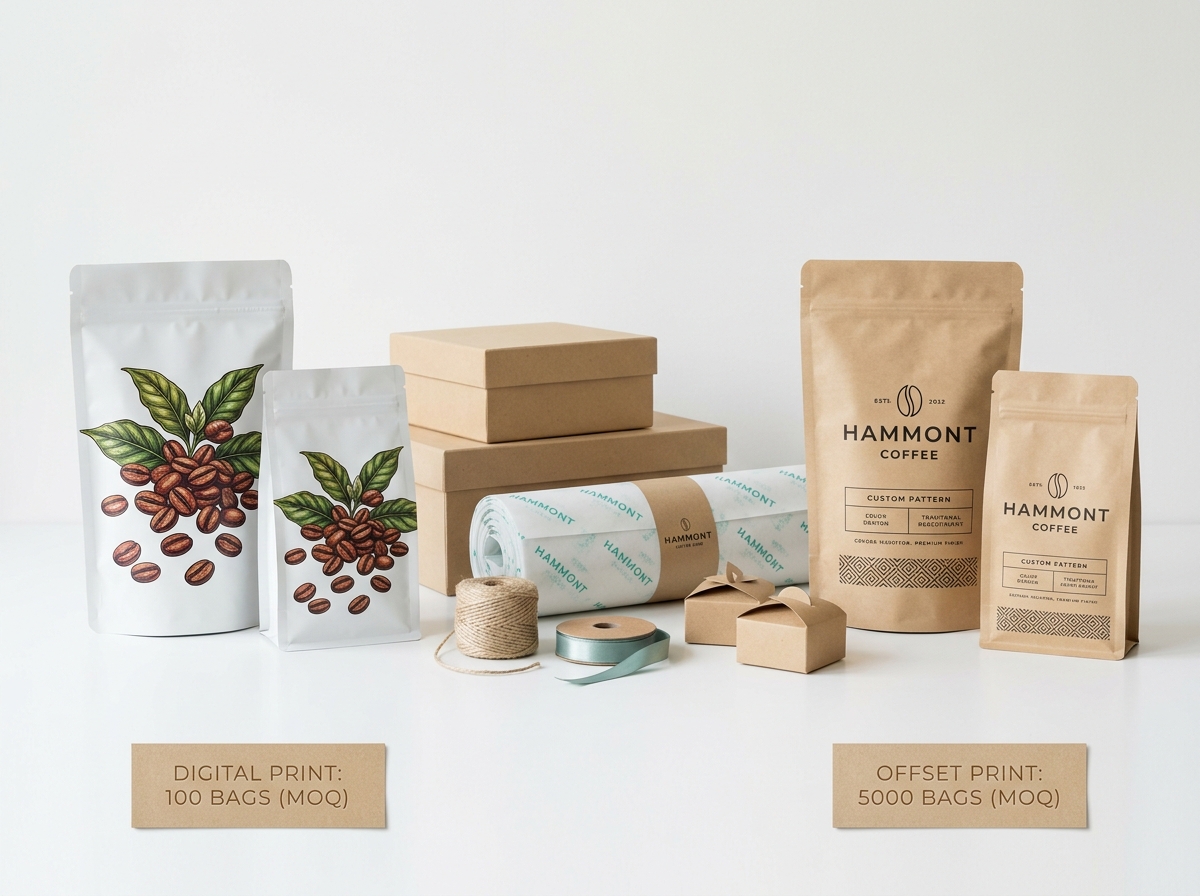
If the coffee packaging minimum order quantity from your preferred supplier exceeds your immediate needs, you're not stuck. Here are six practical strategies new coffee shop owners use to manage inventory without overcommitting capital:
1. Start with stock (unprinted) bags and add labels. Many suppliers offer plain kraft or white stand-up pouches with valves at much lower MOQs—sometimes as few as 50 or 100 units. You can order these in small quantities and apply custom labels printed through a local print shop or online label supplier. This approach gives you full branding control without the 500+ unit commitment. Once you've validated demand and locked in your design, transition to fully printed bags for a more polished look and better per-unit economics.
2. Split an order across multiple SKUs. If you're launching with three or four different coffee blends, ask your supplier if they'll allow you to split the MOQ across multiple designs. For example, a 2,000-unit MOQ might be fulfilled as 500 units each of four different bag designs. This works best with digital printing, where there's no penalty for changing the artwork between runs. Some suppliers charge a small setup fee per SKU, but it's often worth it to avoid being stuck with 2,000 bags of a single blend.
3. Order in stages with a committed production schedule. Some suppliers will reduce the per-order MOQ if you commit to a multi-order contract. For example, you might agree to order 1,000 units per quarter for a year, giving the supplier predictable volume while allowing you to manage cash flow and storage in smaller increments. This works best with suppliers who have excess capacity and are willing to negotiate for long-term relationships.
4. Partner with another local roaster. If you know other coffee shops or roasters in your area who are also navigating MOQ challenges, consider pooling an order. You'll need to coordinate on a supplier and printing method, but you can split the setup costs and each take a portion of the run. This strategy requires trust and clear communication, but it's a proven way to access rotogravure pricing and quality at lower individual volumes. Using clear acrylic display boxes can help you showcase samples when coordinating with partners.
5. Use the first order as a test and plan for iteration. Accept that your first packaging order may not be perfect. Order the minimum quantity your budget allows, get it into customers' hands, and gather feedback. You may discover that your valve placement is off, your bag size is too small, or your color palette doesn't pop on the shelf. Treat the first MOQ as a learning investment, not a final commitment. When you reorder, you'll have real-world data to inform your design and quantity decisions.
6. Negotiate payment terms. Some suppliers offer net-30 or net-60 payment terms for established customers or larger orders. If you're ordering 2,500 or 5,000 units, ask if you can defer payment until after the bags are delivered. This gives you 30–60 days to start selling product and generating revenue before the packaging invoice is due, which eases the cash flow burden.
The right supplier for your coffee shop depends on where you are in your growth trajectory and how much capital you have available. Here's how to evaluate suppliers based on the coffee packaging minimum order quantity they require:
Pre-launch or testing phase (0–50 lbs per week): Look for suppliers offering digital printing with MOQs of 500 units or less. Prioritize flexibility and speed over per-unit cost. You need to get branded bags in customers' hands quickly to validate your concept. Ask about sample packs, rush production, and the ability to make design changes between orders. Don't commit to rotogravure or high-volume contracts at this stage.
Early growth phase (50–200 lbs per week): You're ready for MOQs in the 1,000–2,500 range. At this stage, you should have enough sales data to forecast 2–3 months of packaging needs with reasonable confidence. Look for suppliers who offer both digital and rotogravure options so you can transition to offset printing when your volume justifies it. Evaluate lead times carefully—if you're reordering every 6–8 weeks, a 7-week lead time creates logistical challenges.
Established operation (200+ lbs per week): You're likely ready for rotogravure printing and MOQs of 5,000–10,000 units. At this volume, the per-unit savings from offset printing add up quickly, and you have the cash flow and storage capacity to handle larger orders. Focus on suppliers who offer consistent quality, reliable lead times, and account management support. You should also evaluate custom coffee bags for retail to ensure your packaging aligns with your distribution strategy.
When vetting suppliers, ask these specific questions: What is your standard MOQ for digital printing? For rotogravure? Do you offer sample packs or pre-production proofs? What are your lead times from order to delivery? Can I split an MOQ across multiple SKUs? What payment terms do you offer? Do you have a minimum reorder quantity, or can I adjust quantities on subsequent orders?
The answers to these questions will help you identify which suppliers are set up to support your business at its current stage and which ones you should revisit as you scale.
Once you understand the coffee packaging minimum order quantity landscape, you need a framework for planning your first order. Here's a step-by-step approach that balances cost, risk, and operational needs:
Step 1: Forecast your usage. Estimate how many bags you'll use per week based on your current or projected sales. If you're roasting 100 lbs per week and selling primarily in 12 oz bags, that's roughly 130 bags per week, or 520 bags per month. Build in a 20% buffer for growth, sampling, and waste, bringing you to roughly 625 bags per month.
Step 2: Determine your storage capacity. A case of 500 stand-up pouches typically occupies 2–3 cubic feet. If you're ordering 2,000 bags, you'll need 8–12 cubic feet of dry, climate-controlled storage. Make sure you have the physical space before committing to a large order. Bags stored in damp or fluctuating conditions can develop issues with valve adhesion or zipper function.
Step 3: Set a budget. Decide how much capital you're willing to allocate to packaging inventory. If your budget is $500, you're limited to 500–1,000 units depending on supplier pricing. If you have $2,000 available, you can access better per-unit pricing at the 2,500–5,000 unit tier. Don't stretch your budget to hit a lower per-unit cost if it means you can't cover other operating expenses.
Step 4: Request quotes from 3–5 suppliers. Provide each supplier with your bag specifications (size, material, valve type, zipper, print colors) and ask for pricing at multiple quantity tiers—typically 500, 1,000, 2,500, and 5,000 units. Compare not just the per-unit cost, but also setup fees, shipping, lead time, and payment terms. A supplier who charges $0.50 per bag with free shipping and net-30 terms may be a better deal than one charging $0.45 per bag with a $200 setup fee and payment due upfront.
Step 5: Order samples before committing. Most reputable suppliers will send you physical samples of their bag styles and materials, either free or for a nominal fee. Order samples from your top 2–3 suppliers and evaluate them for material quality, valve function, zipper smoothness, and print clarity. Fill a sample bag with coffee, seal it, and let it sit for a week to ensure the valve works properly and the seal holds.
Step 6: Place your order and plan your next one. Once you've selected a supplier and placed your first order, immediately start planning your second order. Track your actual usage rate, note any design changes you want to make, and monitor your inventory levels. Most suppliers require 3–8 weeks lead time, so you'll need to reorder when you're down to 4–6 weeks of inventory to avoid running out.
This framework removes guesswork and helps you make a data-informed decision that aligns with your budget, storage, and operational needs. For additional guidance on the broader packaging strategy, refer to our guide on how to design coffee packaging that builds your brand.
Even with a solid framework, it's easy to make costly mistakes when navigating the coffee packaging minimum order quantity for the first time. Here are the most common missteps and how to avoid them:
Ordering too much to capture a lower per-unit price. It's tempting to order 5,000 bags at $0.25 each instead of 1,000 bags at $0.50 each, but if it takes you a year to use 5,000 bags, you've tied up $1,250 in inventory that could have been used for marketing, equipment, or working capital. Worse, if you need to change your design or branding after six months, you're stuck with 3,000 obsolete bags. Order only what you'll use in 3–6 months unless you have rock-solid sales data and a locked-in design.
Failing to account for lead time. If your supplier has an 8-week lead time and you wait until you're down to 2 weeks of inventory to reorder, you'll run out of bags and have to either halt sales or scramble to find an expensive rush supplier. Build lead time into your reorder trigger. If your supplier needs 6 weeks, reorder when you have 8 weeks of inventory left.
Ignoring storage conditions. Coffee packaging materials—especially bags with valves and zippers—are sensitive to humidity and temperature fluctuations. Storing bags in a damp basement or unheated garage can cause valves to lose adhesion or zippers to malfunction. Make sure you have a dry, climate-controlled space before ordering more than a few months' worth of inventory.
Choosing a supplier based solely on price. The cheapest per-unit price doesn't always translate to the best value. A supplier who delivers inconsistent quality, misses deadlines, or has poor customer service will cost you more in the long run than a slightly more expensive supplier who's reliable and responsive. Evaluate the total relationship, not just the invoice.
Not testing the bags before placing a large order. Always order samples and test them with actual coffee before committing to 1,000+ units. Fill a bag, seal it, and let it sit for a week. Check that the valve releases CO2 without letting air in, that the zipper opens and closes smoothly, and that the bag material doesn't develop pinholes or tears. A $50 sample investment can save you from a $1,000 mistake.
Most suppliers require between 500 and 2,000 units for a first order, depending on whether they use digital or rotogravure printing. Digital printing suppliers often offer MOQs as low as 500 units, while rotogravure suppliers typically require 2,000 to 10,000 units. For new coffee shops, starting with 500 to 1,000 units through a digital printing supplier is the most common and manageable approach. This allows you to test your branding and gauge customer response without overcommitting capital or warehouse space.
Plan to budget $400 to $1,500 for your first order of 500 to 1,000 custom printed coffee bags with valves and zippers. The exact cost depends on bag size, material type, number of print colors, and supplier pricing. Digital printing typically costs $0.40 to $1.00 per bag at this volume, while rotogravure printing offers lower per-unit costs but requires higher minimums. Always request detailed quotes from multiple suppliers and factor in shipping costs, which can add 10–20% to your total.
Some suppliers will negotiate lower MOQs if you commit to a multi-order contract, order during their slow season, or accept stock designs with minimal customization. Digital printing suppliers tend to be more flexible than rotogravure suppliers because their setup costs are lower. If you're a startup, focus on finding suppliers who specialize in low-MOQ digital printing rather than trying to negotiate down a high-volume supplier's minimums. You can also ask about splitting an MOQ across multiple SKUs if you're launching with several blends.
Properly stored coffee packaging can last 12 to 24 months without degradation. Store bags in a cool, dry, climate-controlled environment away from direct sunlight and moisture. High humidity can affect valve adhesion and zipper function, while temperature fluctuations can cause materials to become brittle. If you're ordering several months' worth of inventory, make sure you have adequate storage space that meets these conditions. Rotate your stock so older bags are used first.
If you're testing your brand or have a very limited budget, start with stock bags and custom labels. This allows you to order as few as 50–100 bags at a time and change your design quickly based on customer feedback. Once you've validated demand and finalized your branding, transition to fully custom printed bags for a more professional appearance and better per-unit economics. Many successful roasters start with labels and switch to custom printing within 6–12 months as their volume grows.
Understanding the coffee packaging minimum order quantity landscape is essential for new coffee shop owners who want to launch with professional branding without overcommitting capital. By evaluating suppliers based on MOQ tiers, printing methods, and your business stage, you can make informed decisions that balance cost, flexibility, and quality. Start small, test thoroughly, and scale your orders as your sales data and storage capacity grow. The right packaging partner will support you at every stage of your journey, from your first 500 bags to your first 10,000-unit rotogravure run.