Cart
0
You may also like

Book a call with our development team to get started.



Apply online and access wholesale pricing.

Choosing the right custom coffee bags wholesale can make or break your retail coffee business. The packaging you select determines how long your beans stay fresh, how your brand appears on the shelf, and whether customers return for a second bag. For roasters and coffee retailers, understanding the differences between materials, closure types, and functional features is essential to protecting product quality while building brand recognition.
This guide walks through the core decisions every coffee business faces when ordering custom packaging for coffee shops: kraft versus foil materials, tin-tie bags versus stand-up pouches, degassing valve placement, window options, and standard sizing. Whether you're packaging single-origin beans for a farmers market or scaling up for grocery distribution, these choices directly impact freshness, shelf appeal, and operating costs.
Coffee packaging materials must address three environmental threats: oxygen, moisture, and light. Each material category offers different levels of barrier protection, and the right choice depends on your product's shelf life requirements and brand positioning.
Kraft paper bags deliver a natural, eco-friendly aesthetic that resonates with specialty coffee buyers. These bags typically feature a food-safe poly lining—often glassine or polypropylene—that provides moderate moisture resistance while maintaining the paper's recyclable profile. Kraft works well for coffee sold within two to four weeks, particularly at farmers markets, coffee shop retail counters, or direct-to-consumer channels where turnover is high. The material accepts custom printing beautifully, and the matte finish conveys an artisanal, small-batch image.
Foil laminate bags offer superior barrier properties for extended shelf life. Multi-layer constructions combine materials like polyethylene terephthalate (PET), aluminum foil, and linear low-density polyethylene to block oxygen transmission and light exposure. Aluminum provides excellent protection against oxygen, moisture, and UV exposure, which can rapidly degrade roasted coffee. This construction is standard for grocery retail, where bags may sit on shelves for several months before purchase.
A middle-ground option is metallized film, which deposits a thin layer of aluminum onto a plastic substrate. This approach reduces material costs compared to full foil laminates while still providing better oxygen barrier performance than kraft alone. Metallized bags are common in the mid-tier retail segment, balancing cost and protection.
Material selection also influences sustainability perception. Kraft paper bags—especially those using biodegradable PLA linings instead of conventional poly—align with growing consumer demand for compostable packaging. However, roasters must verify that the entire package, including any degassing valve or zipper, is certified compostable to avoid greenwashing claims.
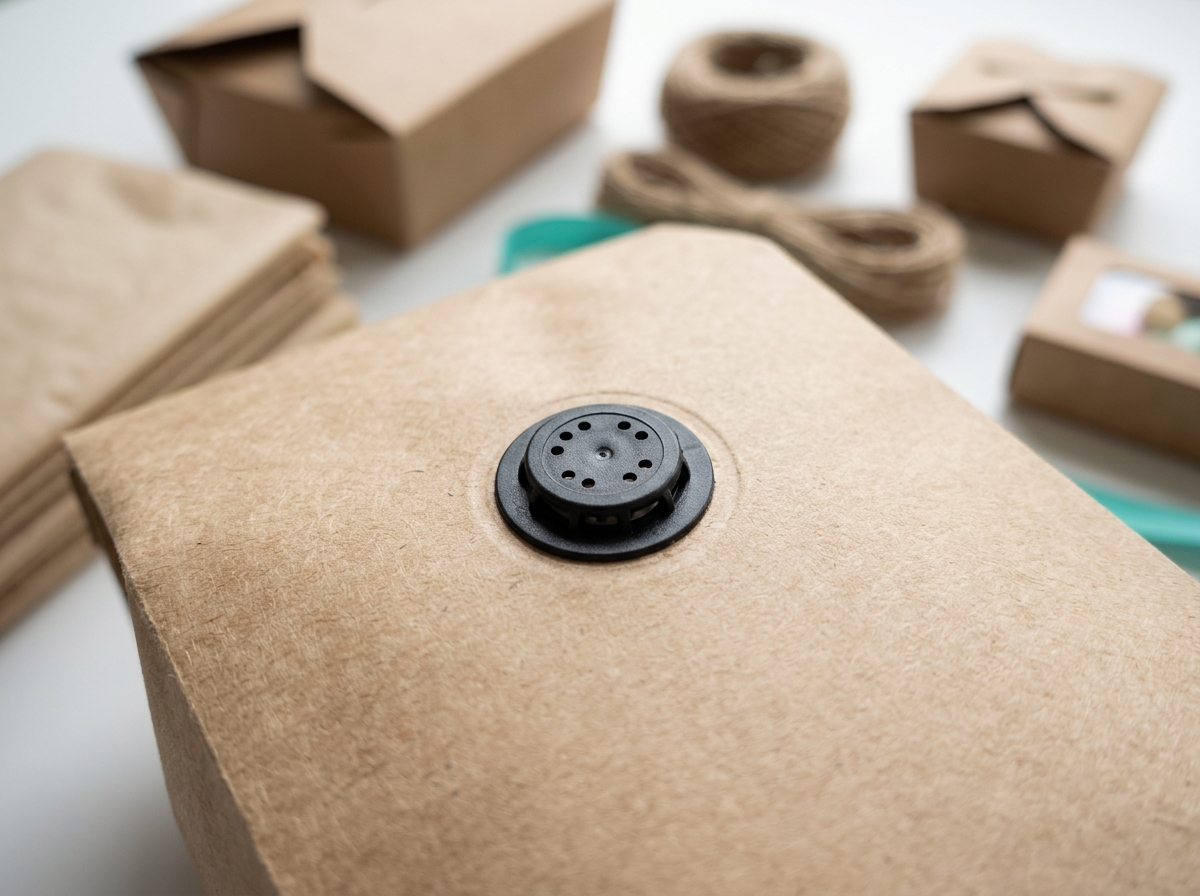
Freshly roasted coffee releases carbon dioxide for days or even weeks after roasting. Without a release mechanism, this gas buildup inflates sealed bags, eventually causing them to burst or leak. Degassing valves solve this problem by allowing CO2 to escape while preventing oxygen from entering the package.
A degassing valve is a one-way vent that allows coffee beans and ground coffee to release carbon dioxide from the bag without coming into contact with outside air. The valve opens when internal pressure reaches a specific threshold, then immediately reseals to block oxygen infiltration. This functionality is critical for preserving coffee freshness, as oxygen exposure accelerates staling and flavor degradation.
Most valves incorporate a small mesh filter to catch coffee particles during pressure release, preventing clogging. Application methods vary: adhesive-backed valves are applied during bag manufacturing, while ultrasonic welding creates a more integrated bond that doesn't interfere with printed graphics. For roasters packaging coffee within 12 to 24 hours of roasting—when degassing is most intense—a valve is essential. Darker roasts degas faster than light roasts due to increased porosity, so roast profile influences valve necessity.
Valve placement affects both function and aesthetics. Center-front placement makes the valve a visible design element and allows customers to press it to smell the coffee—a common retail behavior that drives impulse purchases. Back-panel or side placement keeps the front graphics clean but requires careful orientation during filling to ensure the valve isn't blocked by product.
Not all coffee packaging requires a valve. Instant coffee, which doesn't degas, and pre-ground coffee that has been bulk-degassed for several days before packaging can use valve-free bags. However, for whole bean coffee packaged fresh, skipping the valve risks package failure and product loss.
The two dominant bag styles for retail coffee are tin-tie bags and stand-up pouches. Each offers distinct advantages in closure convenience, shelf presentation, and cost.
Tin-tie bags feature a flat, gusseted construction with a metal wire closure embedded in the top edge. After opening, customers fold the top down and bend the wire tie to reseal the bag. This closure style is simple, requires no additional components, and works well for short-term storage. Tin-tie bags are popular at bakeries, coffee roasteries with on-site retail, and farmers markets where the rustic aesthetic reinforces the handcrafted brand story.
The main limitation of tin-tie closures is air exposure. Unlike zipper seals, the folded closure doesn't create an airtight barrier, so coffee freshness degrades faster once opened. For this reason, tin-tie bags suit smaller package sizes—typically 8 oz to 1 lb—that customers consume within a week or two. Kraft tin-tie bags lined with glassine are a classic choice for artisan roasters prioritizing sustainability and visual warmth over maximum shelf life.
Stand-up pouches incorporate a gusseted bottom that allows the bag to stand upright on shelves, maximizing visibility and brand impact. These pouches typically feature resealable zipper closures that maintain freshness after opening, making them ideal for larger sizes (1 lb to 5 lb) and longer consumption periods. The flat front and back panels provide ample space for branding, origin information, and regulatory labels.
Stand-up pouches dominate grocery and specialty retail because they command shelf presence and communicate premium positioning. Foil-laminate stand-up pouches with degassing valves and zipper closures represent the current retail standard for whole bean coffee. However, they carry higher per-unit costs than tin-tie bags due to additional components and more complex manufacturing.
A hybrid option gaining traction is the flat-bottom pouch, which combines the upright stability of a stand-up pouch with a box-like bottom that increases fill volume and creates a distinctive shelf silhouette. Flat-bottom bags work particularly well for larger formats and premium product lines where differentiation matters.
Clear windows allow customers to see the coffee beans before purchase, building trust and enabling quality assessment. Windows are die-cut openings covered with a transparent film—typically oriented polypropylene or PET—that maintains the bag's barrier properties while providing visibility.
Window placement varies by bag style. On tin-tie bags, windows are usually centered on the front panel, showcasing the beans while leaving space above and below for branding. On stand-up pouches, windows can run vertically along one side or occupy a large portion of the back panel, depending on whether the brand prioritizes logo visibility or product transparency.
The trade-off with windows is barrier performance. Every window introduces a potential weak point in the moisture and oxygen barrier, particularly if the transparent film's barrier properties don't match the surrounding material. For this reason, windowed bags work best for coffee with moderate shelf life requirements—typically two to three months—rather than extended grocery distribution.
Windows also add cost. Die-cutting and applying transparent film requires additional manufacturing steps, increasing per-unit pricing by 10 to 20 percent compared to non-windowed bags. However, the conversion lift from visual product confirmation often justifies this investment, especially for premium single-origin beans where appearance signals quality.
An alternative to physical windows is high-quality product photography printed directly on the bag. This approach maintains full barrier protection while still communicating product quality visually. It's particularly effective for ground coffee, where the visual appeal of whole beans doesn't apply.
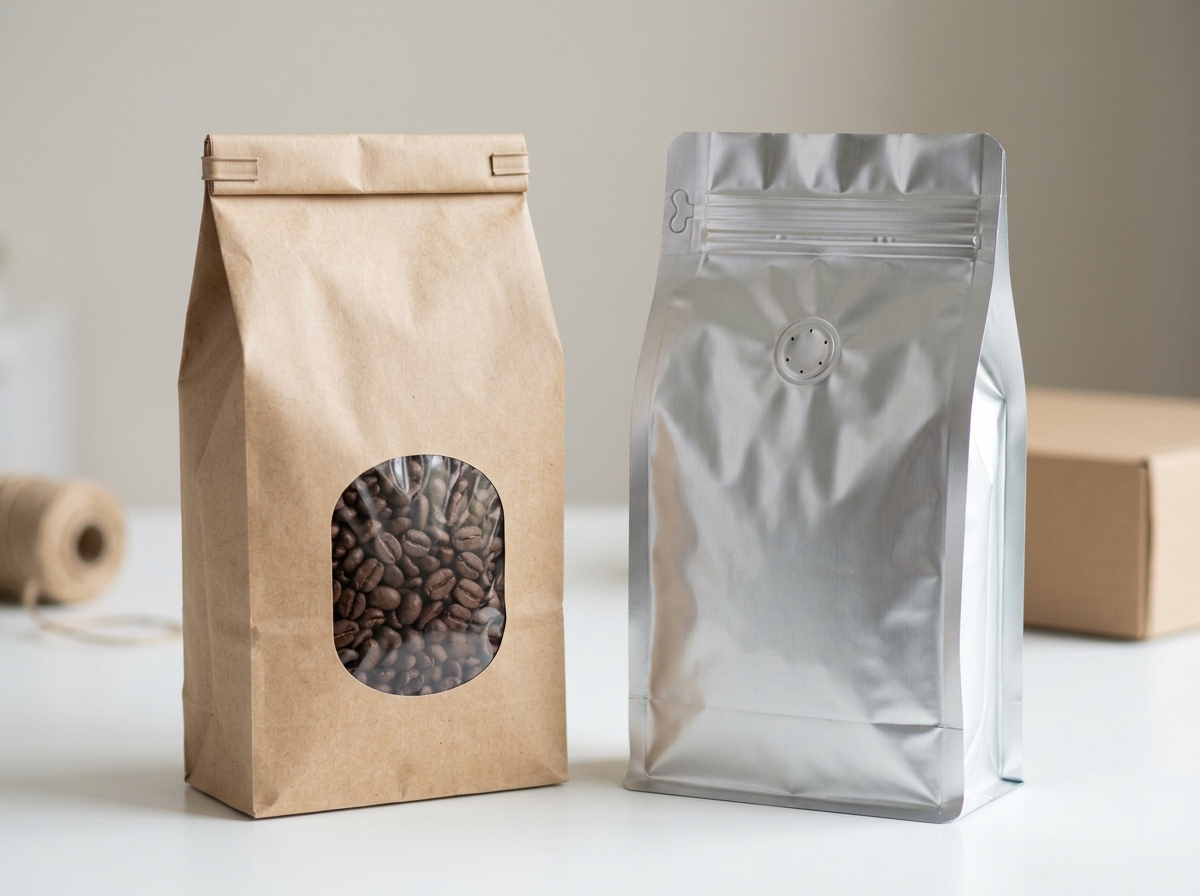
Coffee bag sizes are typically specified by weight capacity rather than dimensions, though understanding both helps with shelf planning and shipping logistics. The most common retail sizes are 8 oz, 12 oz, 1 lb (16 oz), 2 lb, and 5 lb.
Eight-ounce bags suit sampling, subscription boxes, and single-origin offerings where customers want to try multiple varieties without committing to a full pound. These bags typically measure 5 inches wide by 8 inches tall for flat or tin-tie styles, and slightly larger for stand-up pouches to accommodate the gusset. The smaller format encourages trial and works well for premium-priced micro-lots.
One-pound bags represent the retail standard for whole bean coffee. Dimensions vary by style: a typical 1 lb tin-tie bag measures 6.5 inches wide by 10 inches tall, while a 1 lb stand-up pouch might be 5 inches wide by 9 inches tall with a 3-inch gusset. This size balances consumption rate—most households finish a pound within two to three weeks—with packaging cost efficiency.
Two-pound and five-pound bags target bulk buyers, office environments, and café back-of-house use. These larger formats reduce per-ounce packaging costs but require robust sealing and reinforced construction to handle the weight. Five-pound bags, in particular, benefit from side gussets and reinforced bottom seals to prevent bursting during handling.
Capacity planning should account for coffee bean density and roast level. Darker roasts expand more during roasting, reducing density, so a 1 lb bag of dark roast occupies more volume than a 1 lb bag of light roast. Leaving 10 to 15 percent headspace in the bag prevents overfilling and ensures proper sealing, particularly when using automated filling equipment.
Custom sizes outside standard increments are possible but typically require higher minimum order quantities to justify custom tooling. For most roasters, sticking to industry-standard sizes simplifies inventory management and allows for competitive pricing on wholesale orders.
Custom coffee bags wholesale offer a canvas for brand storytelling, but print quality and techniques vary significantly by material and supplier. Understanding these variables helps roasters make informed decisions when designing coffee packaging that builds your brand.
Flexographic printing is the most common method for kraft paper bags, offering good color saturation at moderate costs. This process works well for bold graphics and simple designs but struggles with fine detail and photographic images. Most suppliers offer four to six-color flexo printing, with additional colors increasing per-unit costs.
Rotogravure printing delivers superior image quality and is standard for foil-laminate pouches in grocery retail. This method excels at gradients, photographs, and complex graphics, creating a premium shelf presence. However, rotogravure requires expensive cylinder setup, making it cost-effective only at higher volumes—typically 10,000 units or more.
Digital printing has emerged as a flexible option for short runs and test batches. With no plate or cylinder costs, digital printing allows roasters to order as few as 500 to 1,000 bags economically. Print quality rivals rotogravure for most applications, though per-unit costs remain higher at volume. Digital printing is ideal for seasonal releases, limited editions, and new brands testing market fit before committing to larger print runs.
Matte and soft-touch finishes are trending in specialty coffee, replacing glossy laminates that dominated the previous decade. These finishes convey a premium, tactile experience and align with minimalist design trends. However, matte coatings can reduce barrier performance slightly, so roasters should verify that the finish doesn't compromise shelf life requirements.
Label application offers a lower-cost alternative to full custom printing. Roasters can purchase blank stock bags—kraft or foil—and apply custom labels as needed. This approach reduces minimum order quantities and allows for frequent design changes, though it adds a labor step and may appear less polished than fully printed bags. For small roasters or those with frequently changing product lines, labels provide valuable flexibility.
Custom coffee bags wholesale pricing is heavily influenced by order volume. Understanding typical MOQs and production timelines helps roasters plan inventory and cash flow effectively.
Standard MOQs for custom-printed coffee bags range from 5,000 to 10,000 units for flexographic printing, and 10,000 to 25,000 units for rotogravure printing. Digital printing lowers the barrier to entry, with some suppliers offering MOQs as low as 500 to 1,000 units, though at a higher per-unit cost. Stock bags with label application have no meaningful MOQ beyond case pack quantities, typically 100 to 500 units.
Lead times vary by printing method and supplier capacity. Flexo-printed bags typically require four to six weeks from artwork approval to delivery, accounting for plate creation, production scheduling, and shipping. Rotogravure extends this to six to eight weeks due to cylinder engraving. Digital printing can turn around in two to three weeks, making it suitable for time-sensitive launches or seasonal offerings.
International sourcing—particularly from suppliers in Asia—can reduce per-unit costs by 30 to 50 percent but extends lead times to 8 to 12 weeks and introduces complexity around shipping, customs, and quality control. Domestic suppliers offer faster turnaround and easier communication but at higher unit prices. Most roasters balance these factors by maintaining a base inventory of stock bags for daily production while ordering custom-printed bags in planned batches.
Inventory planning should account for shelf life of the bags themselves. Kraft paper bags can absorb moisture if stored improperly, and adhesive components like degassing valves and zipper seals can degrade over time. Ordering a three- to six-month supply balances volume discounts with storage risks, particularly for roasters without climate-controlled warehouse space.
Consumer demand for eco-friendly packaging continues to reshape the coffee bag market. Roasters face increasing pressure to adopt compostable materials, recyclable structures, and certified sustainable sourcing—but these options come with trade-offs in cost, performance, and availability.
Compostable coffee bags made from plant-based materials like cornstarch, cellulose, and polylactic acid (PLA) decompose naturally without leaving harmful residues. However, most compostable bags require industrial composting facilities to break down properly; they won't decompose in a backyard compost bin or landfill. Roasters using compostable packaging should clearly communicate disposal instructions to avoid customer confusion and potential greenwashing accusations.
Recyclable mono-material structures—such as all-polyethylene pouches—are gaining traction as an alternative to multi-layer laminates that can't be separated for recycling. These bags sacrifice some barrier performance compared to foil laminates but can be recycled through store drop-off programs alongside plastic grocery bags. Some suppliers now offer How2Recycle-certified coffee bags that provide clear disposal instructions directly on the package.
Post-consumer recycled (PCR) content is another sustainability lever. Bags incorporating 30 to 50 percent PCR materials reduce virgin plastic consumption while maintaining most performance characteristics. PCR content typically adds 10 to 15 percent to bag costs but allows roasters to make credible sustainability claims without sacrificing product protection.
Forest Stewardship Council (FSC) certification applies to kraft paper bags, verifying that the paper pulp comes from responsibly managed forests. FSC-certified bags appeal to environmentally conscious consumers and align with broader corporate sustainability commitments. Certification adds minimal cost—typically 2 to 5 percent—but requires supply chain documentation to maintain chain-of-custody.
The sustainability landscape is evolving rapidly, with new materials and certifications emerging regularly. Roasters should balance environmental goals with practical considerations around product protection, cost, and customer expectations. A compostable bag that allows coffee to stale prematurely creates more waste than a conventional bag that preserves freshness through the product's intended shelf life.
Understanding the cost structure of custom coffee bags wholesale helps roasters budget accurately and identify opportunities for savings without sacrificing quality.
Per-unit costs vary widely based on material, size, printing method, and order volume. As a rough benchmark, expect to pay $0.15 to $0.30 per bag for basic kraft tin-tie bags at 5,000-unit volumes, $0.30 to $0.60 per bag for foil-laminate stand-up pouches with degassing valves and zippers, and $0.60 to $1.20 per bag for premium structures with rotogravure printing and specialty finishes.
Digital printing increases per-unit costs but eliminates plate fees, making it cost-effective at lower volumes. A 1,000-unit order of digitally printed kraft bags might cost $0.50 to $0.80 per bag, while the same bag in flexo at 5,000 units drops to $0.25 to $0.40 per bag once plate costs are amortized.
Optional features add incrementally to base costs: degassing valves add $0.03 to $0.08 per bag, resealable zippers add $0.05 to $0.12 per bag, and windows add $0.02 to $0.05 per bag. These costs compound, so a fully featured bag with valve, zipper, and window can easily double the price of a basic structure.
Shipping represents a significant portion of total cost, particularly for domestic orders of moderate volume. A pallet of 10,000 bags might incur $200 to $500 in freight charges, adding $0.02 to $0.05 per bag. International shipping is cheaper per unit at high volumes but introduces longer lead times and potential customs delays.
Roasters should calculate packaging cost as a percentage of retail price to ensure margins remain healthy. Industry benchmarks suggest keeping packaging costs below 5 to 8 percent of the retail price for commodity coffee, and 3 to 5 percent for premium single-origin offerings. A $15 retail bag should target $0.45 to $0.75 in packaging costs, leaving room for coffee, labor, overhead, and profit.
Tin-tie bags use a metal wire closure embedded in the top edge for resealing, while stand-up pouches feature a gusseted bottom and typically include a resealable zipper. Tin-tie bags work well for short-term storage and smaller sizes (8 oz to 1 lb), offering a rustic aesthetic at lower cost. Stand-up pouches provide better shelf presence, airtight zipper seals for extended freshness, and are standard for grocery retail. Pouches cost more due to additional components but deliver superior performance for larger sizes and longer shelf life requirements.
A degassing valve is essential if you package whole bean coffee within a few days of roasting. Freshly roasted coffee releases carbon dioxide for up to two weeks, and without a valve, this gas inflates sealed bags and can cause them to burst. The valve allows CO2 to escape while blocking oxygen from entering, preserving freshness. Darker roasts degas faster than light roasts due to increased porosity. If you bulk-degas coffee for several days before packaging, or if you're packaging instant coffee (which doesn't degas), you can skip the valve.
Minimum order quantities vary by printing method. Flexographic printing typically requires 5,000 to 10,000 bags, rotogravure printing requires 10,000 to 25,000 bags, and digital printing can go as low as 500 to 1,000 bags. Stock bags with applied labels have no meaningful MOQ beyond case pack quantities of 100 to 500 units. Higher volumes reduce per-unit costs significantly, but smaller roasters can start with digital printing or stock bags to minimize upfront investment while testing designs and market fit.
Choose kraft paper bags if you prioritize eco-friendly aesthetics, sell coffee with two- to four-week turnover, and target customers who value sustainability. Kraft bags lined with glassine or PLA offer moderate barrier protection and recyclable or compostable disposal. Choose foil laminate bags if you need extended shelf life (three to six months), distribute through grocery retail, or require maximum protection against oxygen and light. Foil laminates cost more but prevent staling in longer distribution channels. Metallized film offers a middle ground with better barrier performance than kraft at lower cost than full foil.
Compostable coffee bags appeal to environmentally conscious customers and align with sustainability goals, but they come with trade-offs. They typically cost 20 to 40 percent more than conventional bags, require industrial composting facilities to break down properly, and may offer slightly reduced barrier performance. If your brand positioning emphasizes sustainability and your customers have access to commercial composting, the investment can strengthen brand loyalty. However, if compostable bags compromise coffee freshness or customers lack proper disposal options, conventional recyclable bags may deliver better overall value. Clearly communicate disposal instructions to avoid greenwashing concerns.
Selecting the right custom coffee bags wholesale requires balancing freshness protection, brand presentation, sustainability goals, and budget constraints. By understanding the functional differences between materials, closure types, and optional features, roasters can make informed decisions that protect product quality while building shelf appeal. Start with clear priorities—shelf life requirements, target retail channels, and brand positioning—then work with suppliers to identify the bag structure that delivers the best value for your specific needs.