Cart
0
You may also like

Book a call with our development team to get started.



Apply online and access wholesale pricing.

Gift box inserts corporate programs depend on aren't just protective filler—they're structural tools that prevent damage during shipping and create the kind of organized, intentional presentation that reinforces brand credibility. When a client opens a corporate gift and finds items neatly compartmentalized rather than tumbling loose, the insert has already done half the work of making that gift memorable.
Inserts and dividers serve two distinct but equally important functions: they immobilize contents to reduce transit damage, and they control the visual sequence of the unboxing experience. For mixed gift sets that combine fragile items like glassware with heavier products like books or gourmet foods, the right insert configuration is the difference between a gift that arrives intact and one that generates a replacement request.
This guide covers the four most common insert types used in corporate holiday gift packaging, how to match insert materials to product weight and fragility, and when custom-fit inserts justify their higher per-unit cost.
Standard gift boxes without inserts rely entirely on outer cushioning and careful packing to protect contents. That approach works for single-item gifts or uniform products like apparel, but corporate gift programs typically involve curated multi-item sets: a wine bottle paired with glasses and a corkscrew, a coffee sampler with a branded mug, or a desk accessory kit with varying shapes and weights.
Without compartmentalization, heavier items shift during transit and collide with fragile ones. A 750ml wine bottle weighs roughly 2.65 pounds; if it slides against a ceramic mug during a drop or rough handling event, the mug rarely survives. Inserts prevent that movement by creating dedicated cavities or barriers that keep each item in its designated position throughout the shipping journey.
The second function—presentation control—matters just as much in corporate contexts. When a recipient lifts the lid and sees a structured layout rather than a jumble of products and crumpled tissue, the perceived value of the gift increases. Research from the Fibre Box Association has long emphasized that packaging structure contributes to product protection and customer satisfaction, principles that apply equally to commercial shipping and corporate gifting.
Inserts also enable tiered reveals. A top-layer insert can hold a branded card and smaller items like chocolates, while a second layer beneath it conceals a larger anchor gift. That layered discovery process extends the unboxing moment and creates a more engaging experience than presenting everything at once.
Foam inserts—typically made from ethylene-vinyl acetate (EVA) or polyethylene—offer the highest level of impact protection. They're die-cut or CNC-routed to match exact product dimensions, creating snug cavities that cradle each item and absorb shock during drops or rough handling.
EVA foam is the more common choice for corporate gift applications. It's lightweight, cost-effective at moderate volumes, and available in multiple densities. A softer EVA (shore hardness around 20-30) works well for lightweight items like cosmetics or tech accessories, while a firmer EVA (shore 40-50) better supports heavier products like bottles or ceramic items.
Polyethylene foam, denser and more rigid than EVA, is reserved for high-value or highly fragile gifts. Electronics, glassware, or premium spirits that require maximum cushioning justify the higher material cost. Polyethylene also resists moisture and chemical exposure better than EVA, making it suitable for food-adjacent gifts where condensation or oil contact is possible.
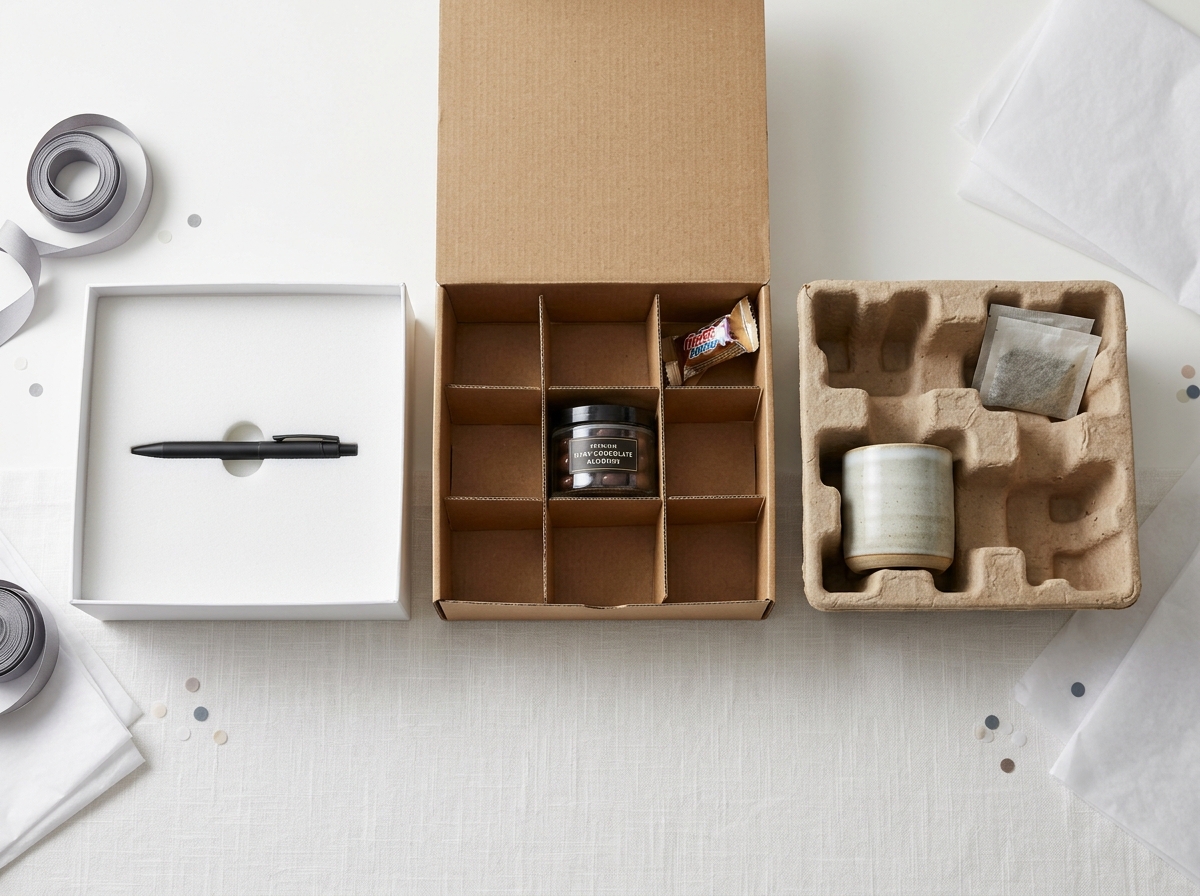
The main drawback of foam inserts is sustainability perception. While both EVA and polyethylene are technically recyclable, municipal programs rarely accept them, and most foam inserts end up in landfills. For corporate programs with explicit sustainability commitments, that's a brand-risk consideration. Some companies address this by using biodegradable foam alternatives made from cornstarch or other plant-based polymers, though these remain more expensive and less widely available than conventional foams.
Foam inserts make the most sense when product value or fragility justifies the cost, when order volumes support custom die-cutting (typically 500+ units), and when the recipient audience won't penalize the use of synthetic materials. A structured kraft gift box with a precision-cut foam insert signals that the sender invested in protecting the gift, which reinforces the gesture's significance.
Cardboard dividers—also called partitions or grids—are the most widely used insert type in corporate gift packaging. They're made from the same paperboard or corrugated material as the outer box, scored and slotted to interlock into a grid pattern that divides the interior into multiple compartments.
The primary advantage is cost. Cardboard dividers are inexpensive to produce, especially when cut from the same material stock as the box itself. They add minimal weight, which keeps shipping costs down, and they're fully recyclable alongside the outer packaging. For programs sending hundreds or thousands of gifts, the per-unit savings compared to foam can be substantial.
Dividers work best for items with relatively uniform dimensions and moderate fragility. A four-compartment grid can separate a set of jars, bottles, or boxed goods, preventing them from knocking together while still allowing some minor movement. They don't provide the same shock absorption as foam, so they're less suitable for truly fragile items like thin glassware or delicate ceramics.
Structural integrity depends on material thickness and the number of interlocking slots. A simple two-slot divider (creating four quadrants) made from single-wall corrugated board will support lightweight items but may buckle under heavier loads. For bottles or other dense products, double-wall corrugated or a more complex multi-slot design distributes weight more effectively.
Cardboard dividers also serve a branding function. The exposed edges and interior surfaces can be printed with logos, patterns, or messaging, extending brand visibility beyond the outer box. A kraft divider with a subtle debossed logo maintains the understated aesthetic that many corporate programs favor, as discussed in our guide to quiet branding versus logo-heavy packaging.
For mixed gift sets that include both heavy and light items—say, a wine bottle alongside a box of crackers and a small cutting board—a hybrid approach works well: use a cardboard divider to separate the bottle into its own compartment, then fill the remaining space with crumpled tissue or shredded paper to cushion the lighter items.
Tissue paper and crinkle-cut paper fill aren't structural inserts in the same sense as foam or dividers, but they play a critical supporting role in corporate gift presentation. They fill negative space, add color and texture, and create layers that slow down the unboxing process.
Tissue paper works in two ways. First, as a top layer that conceals the contents until the recipient lifts it away, building anticipation. Second, as cushioning around individual items when wrapped loosely. A bottle wrapped in two or three sheets of tissue before being placed in a compartment gains an extra buffer layer and arrives looking intentional rather than hastily packed.
Crinkle-cut paper—also called shred or excelsior—fills voids around products. It's particularly useful in boxes where the items don't perfectly fill the available space. A cube-shaped gift box holding a round canister and a rectangular box will have gaps; crinkle fill prevents those items from shifting while adding visual texture.
Color choice matters. White or kraft tissue maintains a neutral, professional tone suitable for most corporate contexts. Metallic or colored tissue can align with brand colors or seasonal themes, but it should feel deliberate rather than arbitrary. A financial services firm sending year-end client gifts might use navy tissue to match their brand palette; a wellness company might choose sage green to reinforce their positioning.
One practical consideration: tissue and crinkle fill add bulk, which affects box size and shipping costs. A gift that fits comfortably in a 10x10x4 box with just a foam insert might require a 12x12x5 box once tissue layers and fill are added. For high-volume programs, that dimensional difference can push shipments into a higher rate tier. The presentation benefit needs to justify the incremental cost.
Custom-fit inserts—whether foam, molded pulp, or die-cut paperboard—are engineered to match the exact dimensions and shapes of the products they'll hold. They offer the highest level of protection and the most polished presentation, but they come with higher tooling costs and longer lead times.
Tooling for a custom foam insert typically requires a one-time die or CNC programming fee, which can range from a few hundred to several thousand dollars depending on complexity. That cost is amortized across the total order quantity, so it becomes negligible at high volumes (5,000+ units) but remains a significant per-unit expense for smaller runs (under 1,000 units).
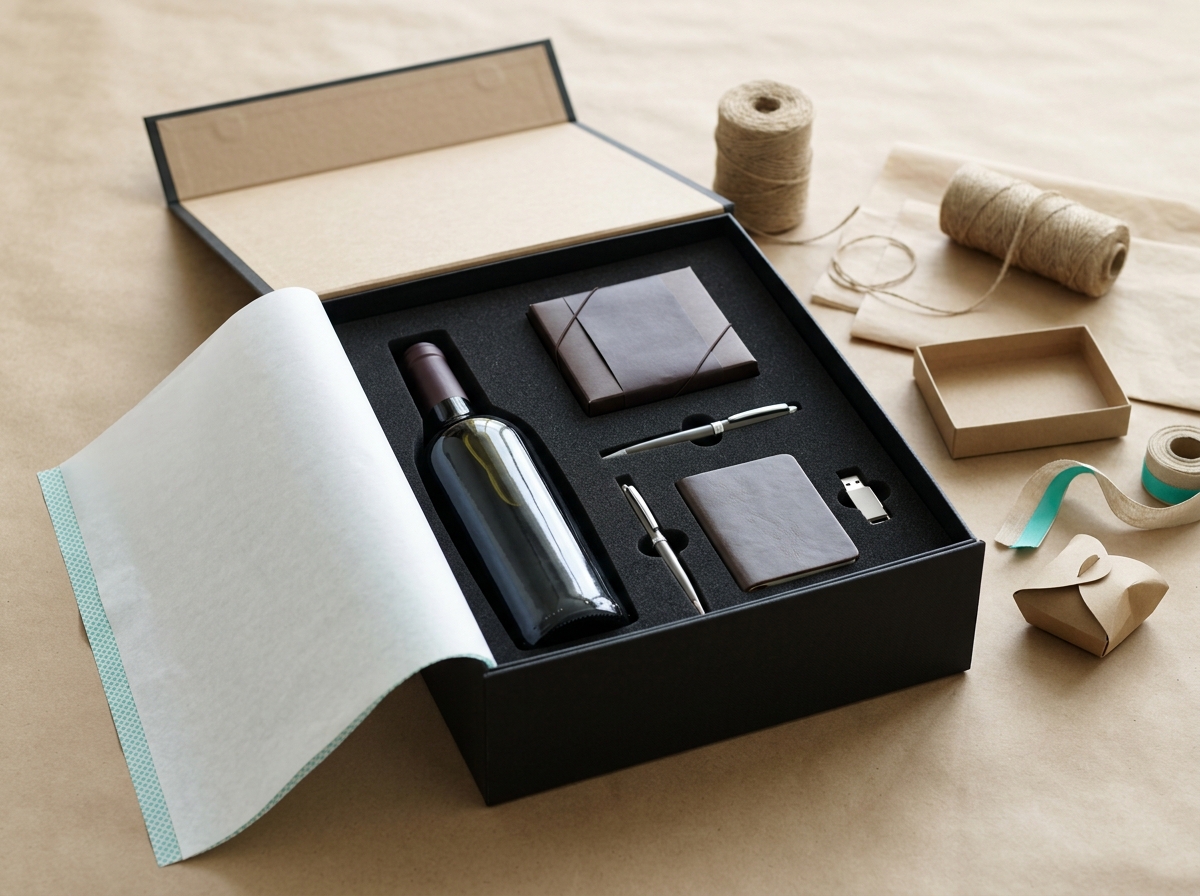
Molded pulp inserts—made from recycled paper fibers formed into three-dimensional shapes—have emerged as a sustainable alternative to foam. They offer comparable protection, are fully recyclable, and project an eco-conscious brand image. However, molded pulp requires expensive molds and higher minimum order quantities (often 10,000+ units), making it viable primarily for large corporate programs or products with multi-year lifecycles.
Standard dividers, by contrast, use off-the-shelf configurations or simple modifications to existing templates. A four-compartment grid or a bottle divider with standard neck openings can be ordered in small quantities with no tooling cost. The trade-off is less precise fit—products may have a bit of wiggle room, and the presentation won't look as tailored.
The decision framework is straightforward: custom inserts make sense when product value is high, when order volume supports tooling amortization, when brand positioning emphasizes premium quality, or when product fragility demands precision fit. Standard dividers work well for moderate-value gifts, smaller order quantities, or programs where speed to market outweighs perfect presentation.
For corporate programs that send different gift configurations throughout the year—client gifts in December, employee milestones quarterly, event thank-yous sporadically—investing in a modular insert system can offer flexibility. A base grid design with removable sections can accommodate different product combinations without requiring new tooling for each variation.
Corporate gifts that include food, beverages, or consumables require insert materials that meet food-safety standards. Not all foams and paperboards are suitable for direct contact with edible products, and using the wrong material can introduce contamination risks or off-flavors.
For wine, spirits, or bottled beverages, the insert typically doesn't contact the liquid directly—it holds the sealed bottle. In these cases, standard EVA foam or corrugated dividers are acceptable. However, if the insert will touch food items (chocolates, baked goods, loose candies), it must be made from food-grade materials.
Food-grade paperboard is coated or treated to resist grease and moisture and is manufactured in facilities that meet FDA standards for indirect food contact. It's widely available and adds minimal cost compared to non-food-grade stock. Foam inserts for food contact are less common; when required, they're typically made from polyethylene specifically certified for food use.
An alternative approach is to individually wrap food items in food-safe cellophane or wax paper before placing them in standard inserts. This creates a barrier that allows the use of non-food-grade structural materials while still protecting the edible contents. It also adds a layer of visual presentation—wrapped items feel more gift-like than loose products.
For corporate gift programs that regularly include food or beverage items, establishing a relationship with a packaging supplier that stocks food-safe materials streamlines sourcing and ensures compliance. It's one less variable to manage when planning corporate holiday gift timelines and coordinating multiple vendors.
The most common corporate gift configuration is the mixed set: three to six items of varying sizes, weights, and fragility levels, all presented together. Designing an effective insert layout requires balancing protection, aesthetics, and cost.
Start by mapping the physical dimensions and weights of all items. A typical mixed set might include a 750ml wine bottle (2.65 lbs), a 12 oz candle (0.75 lbs), a 4 oz chocolate bar (0.25 lbs), and a branded notebook (0.5 lbs). The wine bottle is both the heaviest and most fragile; it dictates the insert's structural requirements.
Place the heaviest item in a corner or along an edge, where the box walls provide additional bracing. The bottle goes in a dedicated compartment with minimal clearance—ideally no more than 1/8 inch on each side—to prevent shifting. If using a foam insert, the cavity should extend at least halfway up the bottle's height to provide lateral support.
Lighter, more durable items can share compartments or sit in less-constrained spaces. The notebook and chocolate bar can be placed side by side with just a thin divider between them, or stacked with a sheet of tissue separating them. The candle, being moderately fragile, benefits from its own compartment but doesn't require foam—a cardboard divider suffices.
Consider the unboxing sequence. If the gift includes a branded card or message, position it on top where it's the first thing the recipient sees. Smaller, high-value items (jewelry, tech accessories, premium chocolates) can be placed in upper layers or compartments that are revealed first, while larger anchor items sit below.
For sets with significantly different item heights, a stepped insert works well. The wine bottle sits in a deep cavity that reaches nearly to the box bottom, while shallower compartments alongside it hold shorter items. This maximizes space efficiency and reduces box size, which lowers shipping costs.
Corporate gift programs increasingly face pressure to align packaging choices with sustainability commitments. Inserts are a frequent point of scrutiny because foam and plastic options, while effective, conflict with waste-reduction goals.
The most sustainable insert materials are those that integrate into existing recycling streams. Corrugated cardboard dividers can be recycled alongside the outer box with no separation required. Molded pulp inserts, made from recycled paper fibers, are also widely recyclable and often compostable, though recipients need clear guidance on disposal.
Foam inserts present a challenge. EVA and polyethylene foams are technically recyclable, but few municipal programs accept them. Some packaging suppliers offer take-back programs where used inserts are returned and reprocessed, but this requires recipient participation and reverse logistics that most corporate gift programs can't practically coordinate.
Biodegradable foam alternatives—made from materials like cornstarch, mushroom mycelium, or seaweed-based polymers—address the end-of-life issue but remain more expensive and less readily available than conventional foams. They're viable for high-profile programs where sustainability messaging is a core brand attribute, but they're not yet cost-competitive for general use.
A middle-ground approach is to use paper-based inserts wherever possible and reserve foam for only the most fragile items within a set. A wine bottle might get a molded pulp insert, while the accompanying items are separated with cardboard dividers. This hybrid strategy reduces foam usage without sacrificing protection for high-risk products.
Transparency matters. If a corporate gift program uses foam inserts, including a note that explains why ("We've chosen this material to ensure your gift arrives intact") and provides disposal guidance can mitigate negative perception. Recipients are generally more forgiving when they understand the trade-offs.
Different product categories have established insert conventions that balance protection, cost, and presentation. Understanding these norms helps avoid over-engineering (and overspending) while ensuring adequate protection.
Wine and spirits: Bottles require vertical support to prevent neck breakage and lateral bracing to prevent rolling. Molded pulp or corrugated dividers with circular cutouts are standard. For premium programs, foam inserts with bottle-shaped cavities offer maximum protection and a more refined look. When pairing bottles with glassware, separate compartments are essential—never nest glasses inside the bottle cavity, as any impact will break both.
Gourmet food sets: Jars, tins, and boxed items are moderately durable and can typically be separated with cardboard dividers. The main risk is impact damage to lids or corners. A four- or six-compartment grid keeps items from colliding, and crinkle fill in the top layer adds cushioning. For sets that include both heavy (large jars) and light (small packets) items, place heavier products in bottom compartments to lower the center of gravity.
Tech accessories: Chargers, cables, earbuds, and similar items are lightweight but can tangle or shift. Foam inserts with precision-cut cavities keep each item in place and create a high-end presentation that matches the product category's expectations. Alternatively, small cube tuck-top boxes can nest inside a larger gift box, with each accessory in its own mini-box—this adds structure without requiring custom foam.
Apparel and soft goods: Clothing, towels, and similar items don't require protective inserts, but presentation inserts add perceived value. A simple platform insert—a flat piece of scored paperboard that folds into a shallow tray—elevates folded items above the box bottom and creates a cleaner reveal. Tissue wrapping around each piece adds another layer of refinement.
Mixed office/desk sets: Notebooks, pens, mugs, and desk accessories vary widely in size and fragility. A combination approach works well: use a cardboard divider to separate the mug (most fragile) from other items, then use tissue or crinkle fill to cushion lighter products. If the set includes a particularly premium item (a leather portfolio, a high-end pen), a small foam or pulp insert for just that item signals its importance.
Custom inserts require longer lead times than off-the-shelf packaging components. Understanding the production timeline helps avoid delays in corporate gift programs, especially for time-sensitive campaigns like holiday gifting.
Standard cardboard dividers with simple modifications (adjusting slot positions or compartment sizes) typically have lead times of one to two weeks once the design is finalized. These are often produced on-demand using digital die-cutting equipment that doesn't require dedicated tooling.
Custom foam inserts require tooling creation (die or CNC programming), material sourcing, cutting, and quality checks. Total lead time from approved design to delivered product is typically four to six weeks. Rush production is possible but adds cost—expect a 20-30% premium for expedited timelines under three weeks.
Molded pulp inserts have the longest lead times due to mold creation and the multi-step forming process. Initial orders often require eight to twelve weeks, though reorders from existing molds can ship in four to six weeks. Minimum order quantities are high (10,000+ units is common), making molded pulp practical only for large programs or products with long production runs.
For corporate gift programs with annual or recurring campaigns, ordering inserts well in advance of the gifting date is critical. A holiday program that ships in early December should have insert design finalized by late September and production completed by early November to allow time for assembly, packing, and shipping. More details on this planning timeline are available in our guide to corporate holiday gift ordering schedules.
Sample approval is a non-negotiable step for custom inserts. Request a physical sample with actual products placed in the insert to verify fit, protection, and presentation before committing to full production. Dimensional errors or poor fit aren't always obvious in digital proofs but become immediately apparent with a physical prototype.
Insert costs vary widely based on material, customization level, and order quantity, but general benchmarks help with budget planning.
Standard cardboard dividers for boxes in the 8x8x4 to 12x12x6 range typically cost $0.15 to $0.50 per unit at quantities of 500 to 1,000. Prices drop to $0.10 to $0.30 per unit at 5,000+ quantities. These are simple grid configurations with minimal customization.
Custom die-cut paperboard inserts with more complex shapes or multiple layers run $0.40 to $1.00 per unit at moderate volumes (1,000 to 2,500 units), including tooling amortization. At higher volumes (10,000+), per-unit costs drop to $0.25 to $0.60.
EVA foam inserts with custom-cut cavities cost $1.00 to $3.00 per unit depending on size, foam thickness, and cavity complexity. A simple two-cavity insert for a wine-and-glasses set might be $1.50 per unit at 1,000 quantity, while a six-cavity insert for a mixed tech accessory set could reach $2.50 to $3.00 per unit.
Molded pulp inserts are difficult to generalize because pricing depends heavily on mold complexity and order volume, but expect $0.50 to $1.50 per unit at volumes above 10,000. Initial mold costs can range from $2,000 to $10,000 depending on the number of cavities and detail level.
These costs are in addition to the outer box, tissue, fill, and any printed materials. For a complete corporate gift package, inserts typically represent 10-20% of total packaging cost for mid-tier programs and can reach 30-40% for high-end programs using custom foam or molded pulp.
Inserts add a step to the gift assembly process, and that labor cost needs to be factored into program budgets, especially for high-volume campaigns.
Pre-scored or pre-folded inserts minimize assembly time. A cardboard divider that arrives flat but has clearly marked fold lines can be assembled in seconds. More complex multi-piece inserts that require interlocking or gluing add time and increase the chance of assembly errors.
For programs assembled in-house, create a packing guide with photos showing the correct insert orientation and product placement sequence. This is especially important when multiple people are assembling gifts—consistency in presentation matters, and a visual guide reduces variability.
For programs using a fulfillment partner or contract packer, confirm that they have experience with the specific insert type. Foam inserts are straightforward—products simply drop into cavities—but complex cardboard dividers or multi-layer configurations require training to ensure correct assembly.
Pack a test batch first. Before committing to full production, assemble 10-20 complete gifts, pack them, and subject a few to drop tests (literally drop the sealed box from waist height onto a hard surface). This reveals any design flaws or inadequate protection before hundreds or thousands of gifts are packed and shipped.
Cardboard dividers are the most cost-effective insert option for most corporate gift programs, typically costing $0.15 to $0.50 per unit at moderate volumes. They're fully recyclable, add minimal weight to shipping costs, and work well for items with moderate fragility like jars, bottles, or boxed goods. For programs with tight budgets or high unit counts, cardboard dividers offer adequate protection and clean presentation without the tooling costs associated with custom foam or molded pulp inserts.
Foam inserts are warranted when product fragility or value justifies the higher cost—typically for glassware, ceramics, electronics, or premium spirits. If a broken item would require expensive replacement or damage the sender's reputation, foam's superior shock absorption is worth the investment. Foam also makes sense when brand positioning emphasizes premium quality and the unboxing experience needs to feel exceptionally polished. Order volumes above 500 units help amortize custom tooling costs.
Custom insert costs vary by material and complexity. Standard cardboard dividers run $0.15 to $0.50 per unit at 500-1,000 quantity. Custom die-cut paperboard inserts cost $0.40 to $1.00 per unit at 1,000-2,500 units. EVA foam inserts with custom cavities range from $1.00 to $3.00 per unit depending on size and cavity count. Molded pulp inserts cost $0.50 to $1.50 per unit but require minimum orders of 10,000+ units and initial mold costs of $2,000 to $10,000.
Molded pulp inserts are made from recycled paper fibers and are widely recyclable and often compostable, making them significantly more sustainable than conventional EVA or polyethylene foam inserts. While foam is technically recyclable, few municipal programs accept it, so most foam inserts end up in landfills. Molded pulp integrates into existing paper recycling streams. The trade-off is higher minimum order quantities (typically 10,000+ units) and longer lead times, which limits their practicality for smaller corporate gift programs.
Custom foam inserts typically require four to six weeks from approved design to delivery. This includes tooling creation (die or CNC programming), material sourcing, cutting, and quality control. Rush production under three weeks is possible but usually carries a 20-30% cost premium. For corporate holiday programs, finalize insert design by late September for December delivery to allow adequate production time plus assembly and shipping.
Inserts and dividers are often the unseen elements of corporate gift packaging, but their impact on both product protection and recipient perception is substantial. The right insert configuration ensures gifts arrive intact, controls the unboxing sequence, and signals that the sender invested in presentation details. Whether that means a simple cardboard divider or a precision-cut foam cavity depends on product requirements, budget constraints, and brand positioning—but the decision deserves deliberate attention rather than being treated as an afterthought.