Cart
0
You may also like


Book a call with our development team to get started.



Apply online and access wholesale pricing.

Corporate holiday gift packaging in 2026 serves a different purpose than it did five years ago. The question is no longer how prominently your logo appears on the box, but whether the recipient keeps the packaging after the gift is opened. Companies ordering holiday gift boxes for clients between September and November face a strategic choice: invest in packaging that functions as a relationship touchpoint, or default to promotional materials that get discarded within minutes of arrival.
The procurement decision matters because packaging communicates intent. A rigid gift box with subtle branding signals that you selected something worth presenting well. A logo-heavy mailer suggests the gift serves a marketing function first. Clients and employees recognize the difference immediately, and what they choose to keep reveals which approach builds lasting relationships.
This guide addresses the practical decisions corporate buyers face when ordering holiday gift packaging: box selection based on gift contents, minimum order quantity planning, delivery timelines for November and December shipments, and the cost-per-impression analysis that justifies keepsake packaging over disposable options. The shift toward quiet branding reflects a broader move away from promotional clutter during the holidays—corporate gifting now prioritizes genuine appreciation over brand visibility.
The corporate gifting landscape has moved decisively toward what recipients actually value and keep. Research consistently shows that personal relevance, design quality, and everyday utility determine whether branded items remain in use or end up donated. The same principle applies to packaging: boxes that serve a purpose beyond delivery earn shelf space in recipients' homes and offices, extending brand presence far longer than a shipping container ever could.
The premium gifting market in 2026 emphasizes refined, curated presentation over ostentation. Quality materials, thoughtful composition, and minimalistic design have replaced flashy finishes and oversized packaging. This shift aligns with data showing that recipients prefer fewer, better products over larger quantities of lower-quality items. When packaging reflects that same philosophy—durable construction, versatile design, reusable format—it reinforces the message that the gift itself was chosen with care.
Sustainability considerations have accelerated this transition. Flexible Packaging Association research indicates that businesses increasingly select packaging with recyclable or minimal materials, favoring paper, bamboo, and compostable options over plastics. But environmental responsibility extends beyond material choice—packaging designed for reuse eliminates waste at the source by giving recipients a reason to keep the box rather than discard it.
The practical implication for corporate buyers: holiday gift packaging should be evaluated not just on upfront cost, but on how long it remains visible in the recipient's environment. A rigid gift box that holds office supplies for two years delivers more brand impressions than a decorative mailer that gets recycled the day it arrives. Keepsake packaging transforms a single gift into an ongoing relationship touchpoint.
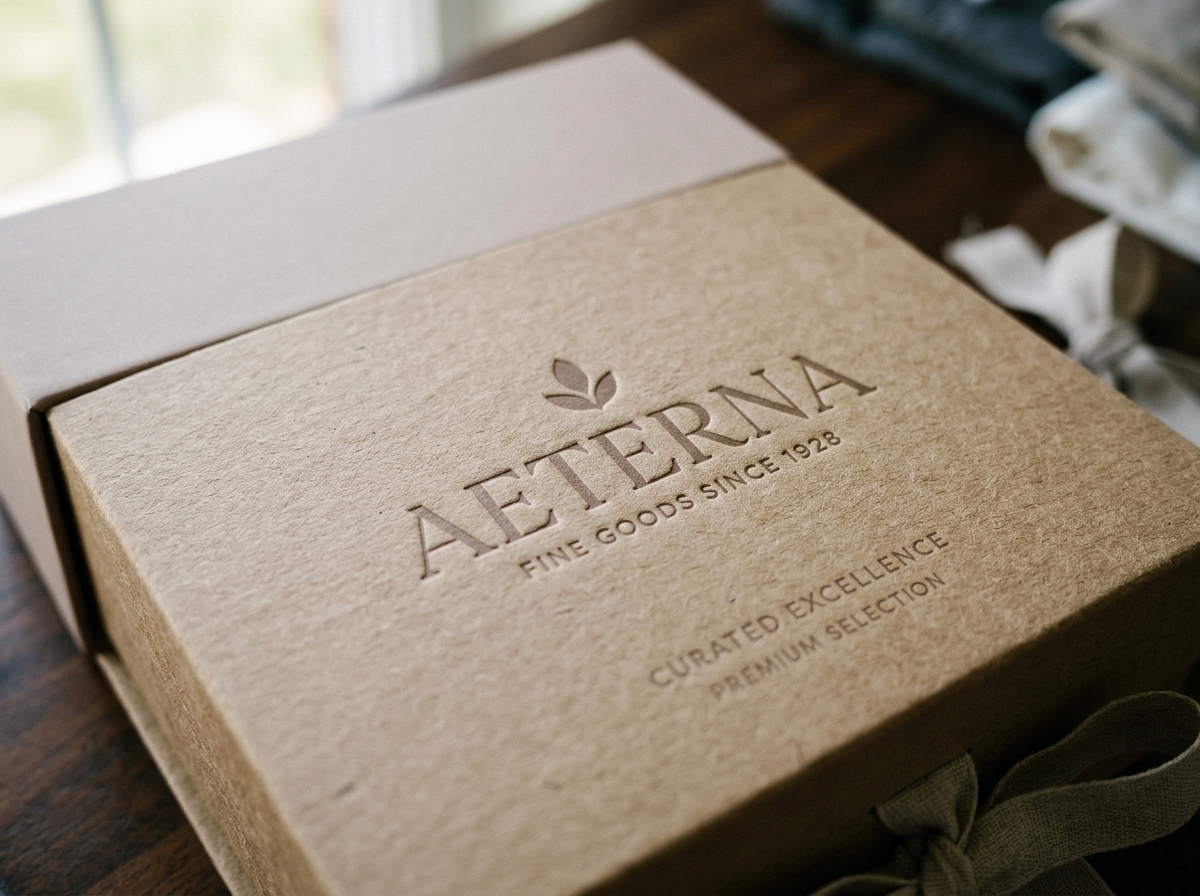
Quiet branding in corporate gift packaging refers to tonal, color-on-color marks that read as premium rather than promotional. Instead of a full-color logo dominating the box lid, quiet branding uses embossing, debossing, foil stamping in subtle metallics, or tone-on-tone printing that reveals itself only upon close inspection. The technique signals quality and intentionality without announcing the sender's identity from across the room.
This approach has become the dominant aesthetic in corporate holiday gifting for 2026. Industry observers note that branding is getting quieter, with subdued packaging and small embossed logos preferred over loud graphics. The shift reflects a broader corporate trend toward understated luxury—recipients want items they genuinely enjoy using, not walking advertisements. When packaging adopts the same restraint, it communicates that the gift serves the recipient's needs rather than the sender's marketing objectives.
The execution details matter. A small logo embossed into textured kraft paper conveys craftsmanship. The same logo printed in bright colors across every surface reads as promotional overreach. Quiet branding works because it respects the recipient's space—the packaging integrates into their environment rather than demanding attention. For corporate buyers, this means specifying finishing techniques (emboss, spot UV, matte foil) rather than maximizing logo size.
Timing plays a role in when quiet branding makes sense versus traditional logo-heavy approaches. Client appreciation gifts, thank-you packages, and relationship-building touchpoints benefit from subtle branding that prioritizes the recipient's experience. Prospect outreach, event giveaways, and awareness campaigns may justify more prominent branding where visibility serves a strategic purpose. Understanding which approach fits your gifting objective prevents packaging from undermining the gift's intent.
Box selection for corporate holiday gifts should start with the contents, not the aesthetic. A wine bottle requires structural support and cushioning that a cookie assortment does not. Mixed-item gifts need dividers or inserts to prevent contents from shifting during shipping. Choosing packaging that protects what's inside while presenting it well requires matching box construction to gift weight, fragility, and dimensions.
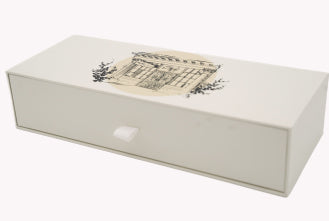
Rigid setup boxes with magnetic closures work well for premium mixed-item gifts where presentation matters as much as protection. The two-piece construction (separate lid and base) creates a reveal moment when opened, and the sturdy chipboard construction supports reuse as storage. These boxes suit corporate gifts in the higher price tiers—key client appreciation packages, executive gifts, and milestone recognition—where the unboxing experience reinforces the gift's significance.
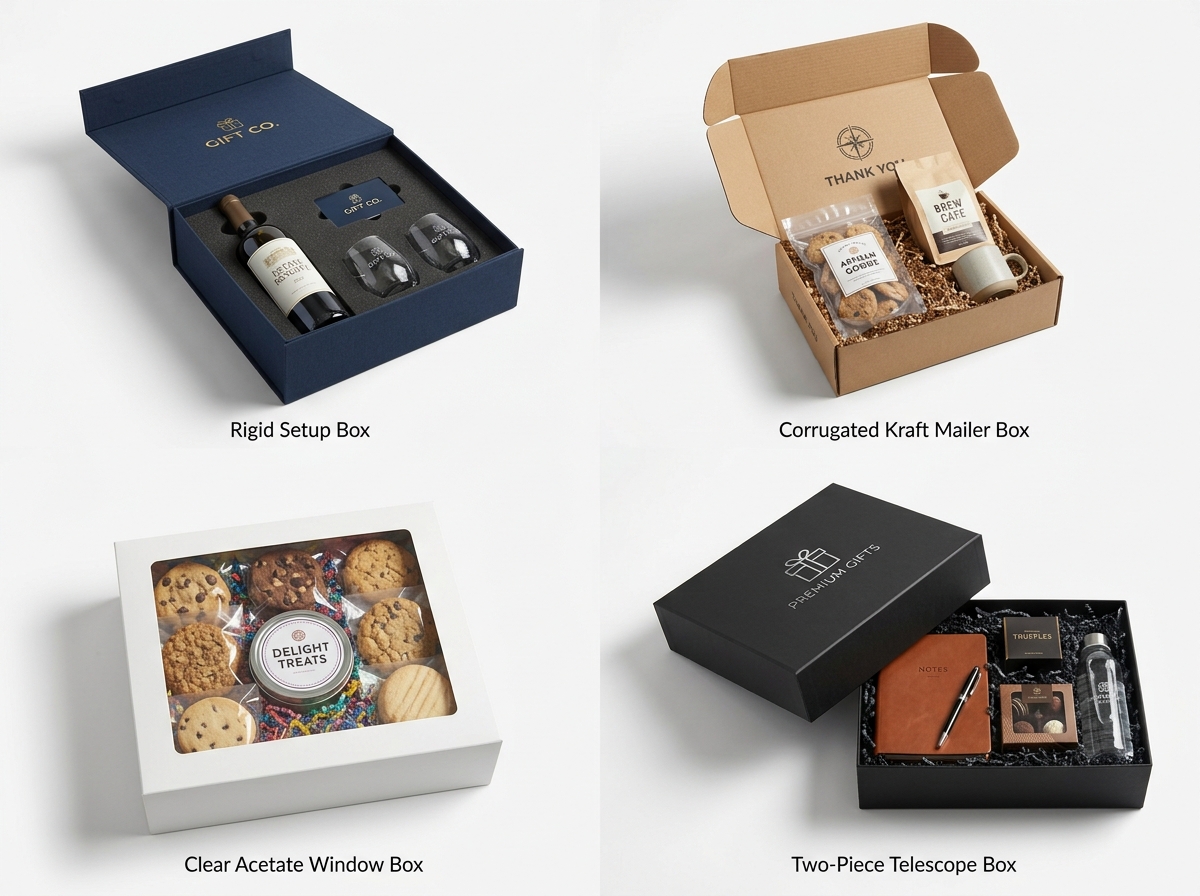
Corrugated kraft boxes offer durability at a lower price point, making them practical for employee gift programs and larger recipient lists. The material ships flat and assembles quickly, reducing storage and fulfillment costs. Corrugated construction provides adequate protection for most non-fragile items (apparel, packaged food, office accessories) while maintaining a clean, professional appearance. For companies coordinating tiered gift programs across multiple recipient segments, corrugated boxes can serve mid-tier gifts while rigid boxes handle top-tier packages.
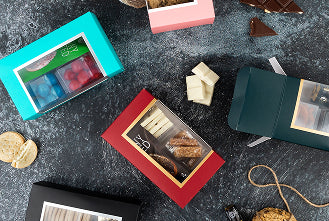
Clear-lid boxes and window boxes serve a specific strategic purpose: they show the gift before the box is opened. This transparency works when the contents themselves are visually appealing—decorated cookies, artisan food assortments, curated product collections—and when revealing the gift enhances anticipation rather than spoiling a surprise. The decision to show or conceal contents affects recipient perception, with opaque packaging creating mystery and clear packaging building immediate excitement.
Wine and bottle packaging requires structural inserts or dividers to prevent breakage during shipping. Purpose-built wine gift boxes include molded pulp inserts, corrugated dividers, or foam cushioning that holds bottles securely while maintaining an elegant presentation. Bottle packaging for corporate clients must balance protection with premium appearance, since damage during transit undermines both the gift and the sender's reputation.
Bakery items and cookies present different challenges—they're fragile but lightweight, and they benefit from visibility. Food-safe boxes with grease-resistant coatings prevent oil stains from migrating through the packaging. Cookie boxes for corporate gifting require both protection and presentation, with window panels or clear lids allowing recipients to see the contents while keeping them secure during shipping.
Minimum order quantities (MOQs) for corporate gift boxes vary by box type, customization level, and supplier. Stock boxes with no custom printing typically have low or no minimums—you can order exactly the quantity you need. Custom-printed boxes trigger MOQs that range from 100 units for digital printing to 500-1,000 units for offset printing, with costs per unit decreasing as quantities increase.
The practical challenge for corporate buyers is forecasting recipient counts across multiple gift tiers. Employee gifts, client appreciation packages, prospect outreach, and vendor thank-you gifts each require different packaging, and ordering too few boxes creates fulfillment delays while ordering too many ties up budget in unused inventory. Understanding MOQ structures helps corporate buyers plan quantities that balance cost efficiency with flexibility.
For companies running tiered gift programs, the math gets more complex. A 200-person company might send premium gifts to 30 key clients, mid-tier gifts to 150 employees, and standard gifts to 50 vendors. If each tier uses custom-printed packaging, you're managing three separate MOQs. One solution: use stock packaging for lower tiers and reserve custom printing for the top tier where presentation has the greatest impact. Another approach: design a single box that works across multiple tiers, varying only the contents and any inserted cards or tissue paper.
Timing affects MOQ planning because custom printing adds lead time. Stock boxes ship within days; custom-printed boxes require 2-4 weeks for printing plus shipping time. Companies that finalize recipient lists late in the season may need to accept higher per-unit costs on stock packaging rather than risk missing delivery deadlines waiting for custom orders. Procurement timelines for holiday packaging require working backward from delivery dates to determine when orders must be placed.
Corporate holiday gift packaging orders for December delivery should be placed in September or early October at the latest. This timeline accounts for custom printing lead times (2-4 weeks), gift assembly and fulfillment (1-2 weeks), and shipping to recipients (1-2 weeks depending on destination). Companies that wait until November face compressed timelines, limited inventory availability, and higher shipping costs as carriers implement peak-season surcharges.
The procurement calendar for corporate holiday gifting starts earlier than most buyers expect. September is when companies finalize gift budgets, approve recipient lists, and select packaging suppliers. October is for placing orders, receiving inventory, and beginning fulfillment. November is for shipping gifts to ensure December arrival. December is too late for anything beyond rush orders with expedited shipping, and even then, carrier capacity constraints make on-time delivery uncertain.
Custom printing extends lead times because it requires design approval, proof review, and production scheduling. A stock box can ship the same week you order it. A custom-printed box requires submitting artwork, reviewing a digital or physical proof, approving the proof, scheduling the print run, completing production, and shipping the finished boxes—a process that typically spans 3-4 weeks. For companies ordering custom packaging, September is the realistic deadline for initiating the process if you want boxes in hand by early November.
Shipping timelines vary by destination and service level. Ground shipping within the continental United States takes 3-7 business days depending on distance. International shipments require 1-3 weeks and may face customs delays. Companies shipping gifts directly to recipients' homes should account for residential delivery schedules and the possibility that recipients may be traveling during the holidays. A detailed procurement timeline prevents last-minute scrambling and ensures gifts arrive when intended.
Most corporate holiday gift programs include multiple recipient tiers: key clients, general clients, employees, prospects, and vendors. Each tier typically receives a different gift value, but packaging should maintain visual consistency across tiers to preserve brand coherence. The challenge is creating differentiation without making lower-tier recipients feel like they received the "cheap version" of someone else's gift.
One effective approach uses a consistent packaging style—same material, same color palette, same branding treatment—with size and construction quality creating the differentiation. Top-tier clients receive a large rigid box with magnetic closure, mid-tier clients receive a medium two-piece telescope box, employees receive a corrugated kraft box, and vendors receive a structured gift bag. All use the same kraft material and embossed logo treatment, so the packaging family is visually cohesive even as the construction quality varies.
Another strategy varies contents rather than packaging. Everyone receives the same high-quality box, but the items inside differ by tier. This approach simplifies procurement (one box type, one MOQ) and eliminates the risk that recipients compare packaging and feel slighted. The trade-off is that you lose the ability to signal gift value through presentation—a premium rigid box telegraphs "important client" before it's opened, which may be desirable in some contexts and problematic in others.
Color coding can differentiate tiers while maintaining brand consistency. A company might use charcoal boxes for clients, kraft boxes for employees, and white boxes for vendors, all with the same logo treatment and ribbon accent. The color immediately identifies the tier during fulfillment (reducing packing errors) while ensuring that each recipient receives packaging that feels intentional rather than generic. Coordinating packaging across recipient segments requires balancing differentiation with brand coherence.
Material choice for corporate holiday gift packaging affects both environmental impact and recipient perception. Paper-based packaging (kraft, chipboard, corrugated) is widely recyclable and biodegradable, making it the default choice for companies with sustainability commitments. Plastic packaging (PET, acetate, polypropylene) offers clarity and moisture resistance but faces increasing scrutiny from environmentally conscious recipients and regulatory frameworks.
Forest Stewardship Council certification provides third-party verification that paper-based packaging originates from responsibly managed forests. FSC-certified packaging supports documented chain-of-custody tracking from forest to finished product, giving corporate buyers a credible sustainability claim that general "eco-friendly" messaging cannot match. For companies where environmental responsibility is part of the corporate brand, FSC certification on gift packaging reinforces that commitment in a tangible, verifiable way.
Recyclability depends on material purity. A box made entirely of kraft paper recycles easily in standard municipal systems. A box with plastic windows, foam inserts, or metallic coatings may not be recyclable and requires special disposal. Corporate buyers should ask suppliers about end-of-life disposal for any packaging components, particularly when combining materials (paper boxes with plastic windows, corrugated boxes with foam inserts). Packaging that appears sustainable but isn't actually recyclable creates a credibility problem when recipients discover the limitation.
Reusable packaging offers an alternative to recyclability by eliminating disposal altogether. A rigid gift box sturdy enough to hold office supplies, store keepsakes, or organize drawers stays in use for years, avoiding the waste stream entirely. This approach aligns with the broader shift toward durable, keepsake packaging that recipients want to keep. From a sustainability perspective, a box used for three years has a far lower environmental impact per use than a box recycled after one day.
The unboxing experience has become a critical factor in corporate gift packaging, driven by the growth of direct-to-recipient shipping and the cultural expectation that premium gifts include layered, thoughtful presentation. Recipients now expect packaging to create a reveal moment—not just protect the contents during transit. The question for corporate buyers is which elements of the unboxing experience justify their cost and which are decorative excess.
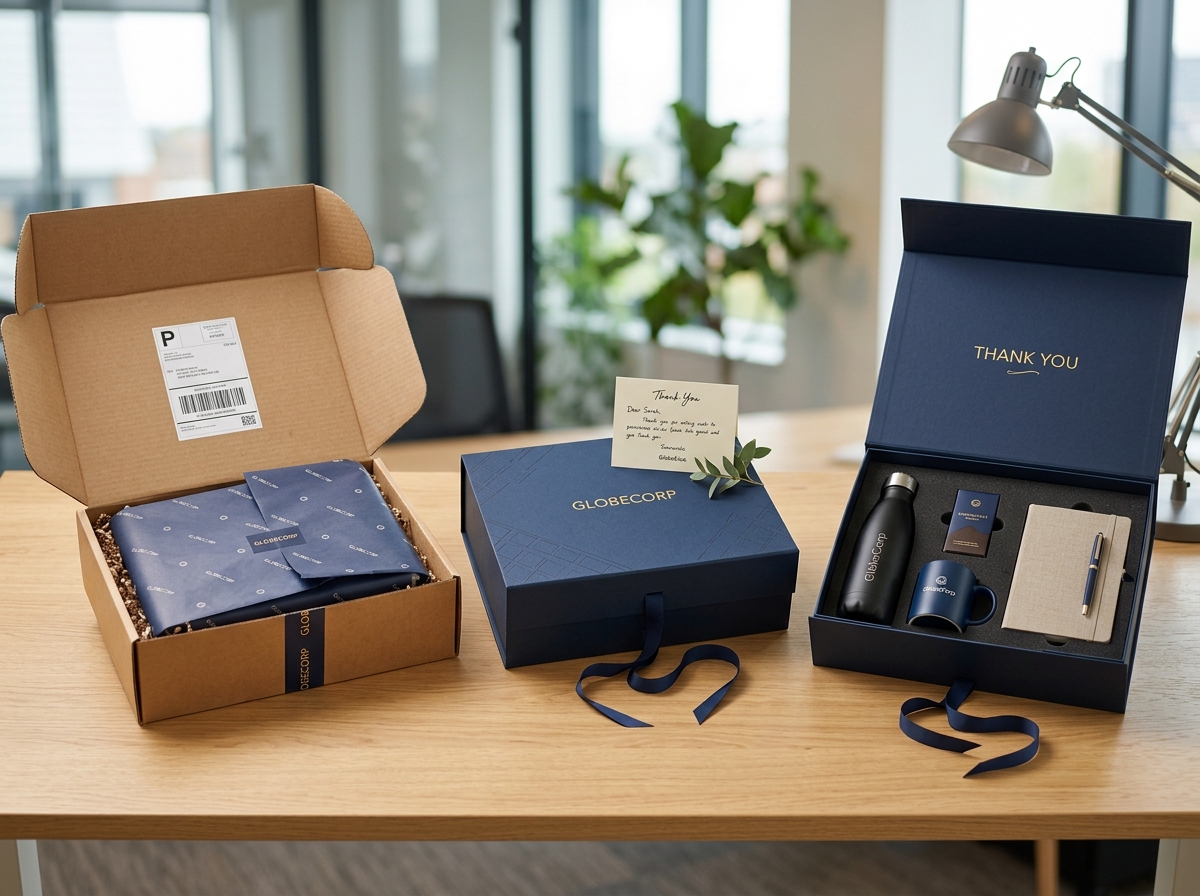
Layered presentation creates anticipation by revealing the gift in stages. An outer shipping box protects the gift during transit. Inside, branded tissue paper or a protective wrap adds a layer of discovery. The gift itself sits in a structured inner box, often with custom inserts that hold items securely and present them at an angle that maximizes visual impact when the lid is lifted. A handwritten card on top personalizes the experience and explains the occasion.
Each layer serves a function beyond aesthetics. The outer box prevents damage. The tissue paper conceals the gift until the recipient is ready to open it. The inner box provides structure and reusability. The insert prevents items from shifting and breaking. The card adds a personal touch that generic packaging cannot provide. Understanding which unboxing elements drive recipient satisfaction helps corporate buyers allocate budget effectively.
Shareability has become a secondary consideration as recipients photograph and post unboxing experiences on social media. Packaging that photographs well—clean lines, interesting textures, thoughtful color palettes—generates organic brand visibility when recipients share their gifts. This outcome is not guaranteed and should not be the primary driver of packaging decisions, but it represents a potential upside when packaging is designed with visual appeal in mind.
The cost-benefit analysis of elaborate unboxing experiences depends on gift tier and recipient relationship. Key client gifts justify investment in premium presentation because the relationship value is high and the recipient count is low. Employee gifts sent to 500 people require more budget-conscious packaging that still feels thoughtful. Inserts and dividers improve presentation while serving a practical function, making them easier to justify than purely decorative elements.
The cost difference between keepsake packaging and disposable options is straightforward: rigid boxes with premium finishes cost more per unit than corrugated mailers or basic folding cartons. A rigid setup box might cost $3-8 per unit depending on size and customization, while a corrugated mailer costs $0.50-2.00. The question is whether the additional cost per unit delivers sufficient value to justify the investment.
Cost-per-impression analysis reframes the comparison by measuring how long packaging remains visible in the recipient's environment. A disposable mailer generates one impression—the moment the recipient opens it—before being discarded. A keepsake box that sits on a shelf for two years generates hundreds of impressions as the recipient sees it daily and visitors to their office or home notice it. If brand visibility is a goal, the keepsake box delivers a lower cost per impression despite the higher upfront cost.
The analysis changes when gifting objectives prioritize relationship building over brand visibility. In that context, keepsake packaging signals that the sender invested in presentation because the recipient matters, not because the sender wants ongoing logo exposure. The packaging becomes a physical reminder of the relationship and the occasion, which has value independent of brand impressions. This outcome is harder to quantify but often more valuable than visibility metrics.
Budget allocation for corporate holiday gifting typically divides between gift contents and packaging, with packaging representing 10-30% of total gift cost depending on the program. A $50 gift might allocate $5-15 to packaging, while a $200 gift might allocate $20-60. The percentage tends to decrease as gift value increases because contents become the primary driver of perceived value. Budget-conscious packaging strategies focus on materials and finishing techniques that signal quality without requiring premium pricing.
Selecting packaging for specific gift types requires matching box characteristics to contents. Wine bottles need structural support and cushioning. Cookies need grease-resistant, food-safe materials. Mixed-item gifts need compartments or inserts. Apparel needs boxes large enough to prevent excessive folding. The selection criteria below address common corporate gift categories and the packaging attributes each requires.
Wine and spirits: Bottle packaging must prevent breakage during shipping, which requires either molded inserts that cradle the bottle or corrugated dividers that isolate it from box walls. Single-bottle boxes typically measure 4" x 4" x 14" for standard 750ml bottles. Two-bottle boxes measure 8" x 4" x 14" or use a side-by-side configuration. Premium wine gifts benefit from rigid boxes with magnetic closures and satin-lined interiors, while budget-conscious programs can use corrugated wine shippers with printed exteriors. Wine packaging for corporate clients balances protection requirements with presentation expectations.
Cookies and baked goods: Bakery packaging requires food-safe materials with grease-resistant coatings to prevent oil migration. Window boxes or clear lids allow visibility while protecting contents. Box depth should accommodate cookie thickness plus a small buffer—1.5" to 2" depth works for most cookies, while decorated or stacked cookies need 3" or more. Inserts or dividers prevent cookies from shifting and breaking during transit. Cookie boxes for corporate gifting must meet food safety standards while maintaining premium appearance.
Mixed-item gifts: Curated gift collections (coffee, chocolates, candles, office accessories) benefit from compartmentalized packaging that displays each item intentionally. Custom inserts made from corrugated board, molded pulp, or foam create dedicated spaces for each item, preventing damage and creating visual organization when the box is opened. Box sizing should minimize empty space—too much void fill makes the gift feel sparse, while too little space requires excessive compression. Inserts and dividers transform mixed-item gifts from jumbled assortments into curated presentations.
Apparel and soft goods: Clothing, blankets, and textile gifts need boxes large enough to minimize folding, which creates creases that detract from presentation. Rigid boxes with tissue paper wrapping work well for premium apparel gifts. Corrugated boxes with printed interiors serve mid-tier programs. Avoid vacuum-sealing or excessive compression, which makes gifts look like they've been stored in a warehouse rather than selected with care.
Tech accessories and office items: Small electronics, USB drives, notebooks, and desk accessories fit well in compact rigid boxes (6" x 6" x 2" to 8" x 8" x 3"). These items are durable enough that protective inserts are optional, but a simple foam or paper insert elevates presentation by positioning items at an angle rather than letting them sit flat in the box. Magnetic-closure boxes work particularly well for tech gifts because the closure mechanism feels premium and the sturdy construction signals that the contents are valuable.
Corporate holiday gift boxes range from $0.50 to $8.00 per unit depending on construction type, size, and customization level. Basic corrugated kraft boxes cost $0.50-2.00, two-piece folding boxes cost $1.00-3.00, and rigid setup boxes with magnetic closures cost $3.00-8.00. Custom printing adds $0.25-1.50 per unit depending on print method and quantity ordered. Stock boxes with no customization offer the lowest per-unit cost but lack branding opportunities, while fully custom boxes maximize brand presentation at higher cost.
Orders for December delivery should be placed in September or early October to account for custom printing lead times, gift assembly, and shipping. Stock boxes ship within days, but custom-printed boxes require 2-4 weeks for production plus shipping time. Companies that finalize orders by mid-September have the greatest flexibility in supplier selection and delivery scheduling. Orders placed in November face compressed timelines, limited inventory, and peak-season shipping surcharges that increase total costs.
Quiet branding refers to subtle logo treatments that prioritize elegance over visibility—embossed logos, tone-on-tone printing, small foil stamps, or debossed marks that reveal themselves on close inspection rather than announcing the sender from across the room. This approach has become the preferred aesthetic for corporate holiday gifting in 2026 because it signals quality and intentionality without making the packaging feel promotional. Quiet branding works best for client appreciation and relationship-building gifts where the recipient's experience matters more than brand visibility.
Clear boxes or boxes with window panels work when the gift contents are visually appealing and revealing them builds anticipation—decorated cookies, artisan food assortments, curated product collections. Opaque boxes work when the contents benefit from mystery or when the unboxing reveal is part of the gift experience. Clear packaging also serves a practical function for food gifts, allowing recipients to verify contents without opening the box. The decision depends on whether showing the gift enhances or diminishes the recipient's experience when they receive it.
Minimum order quantities for custom-printed gift boxes typically range from 100 to 1,000 units depending on printing method and supplier. Digital printing usually requires 100-250 unit minimums with higher per-unit costs. Offset printing requires 500-1,000 unit minimums but offers lower per-unit costs at volume. Stock boxes with no custom printing have low or no minimums, making them practical for small programs or testing. Companies running tiered gift programs can reduce total MOQ exposure by using stock packaging for lower tiers and custom printing only for top-tier recipients where presentation has the greatest impact.
Corporate holiday gift packaging in 2026 rewards strategic thinking over decorative excess. The companies that treat packaging as a relationship tool rather than a branding opportunity create gifts that recipients remember, keep, and associate with genuine appreciation. Box selection, timing, material choice, and branding approach all communicate intent—and recipients notice the difference between a gift chosen for them and a promotional item with their name on it.
The procurement decisions you make in September and October determine whether your holiday gifts arrive on time, fit your budget, and build the relationships you're trying to strengthen. Start with your recipient list, work backward from delivery dates, match packaging to gift contents, and choose materials that align with your company's values. The result is corporate holiday gift packaging that serves its purpose: making the recipient feel valued, not marketed to.