Cart
0
You may also like

Book a call with our development team to get started.



Apply online and access wholesale pricing.

If you're planning corporate holiday gifts for December delivery, the question isn't whether you should order—it's whether you've already missed your window. Companies ordering in September or early October can still secure custom packaging and meet December deadlines, but the timeline narrows quickly. Q4 holiday gifting is the dominant season for corporate gift programs, and getting your packaging to clients before November is the standard, which means Q3 planning and production is required.
The answer to when to order corporate holiday gifts depends on three variables: whether you're ordering stock or custom packaging, your order volume, and your chosen fulfillment method. This guide breaks down the exact lead times, production schedules, and shipping cutoffs you need to plan a December corporate gifting program that arrives on time.
The single biggest factor in your ordering timeline is whether you're using stock packaging or commissioning custom-printed boxes. The difference isn't just a few days—it can be the gap between a November delivery and scrambling for rush fees in mid-December.
Stock packaging—unprinted boxes, bags, and containers available for immediate fulfillment—typically ships within 3-5 business days. If you're assembling gifts in-house and adding branded elements through inserts, stickers, or ribbon, stock packaging gives you the most flexibility. You can order as late as early December and still meet holiday deadlines, though carrier capacity constraints make earlier ordering safer.
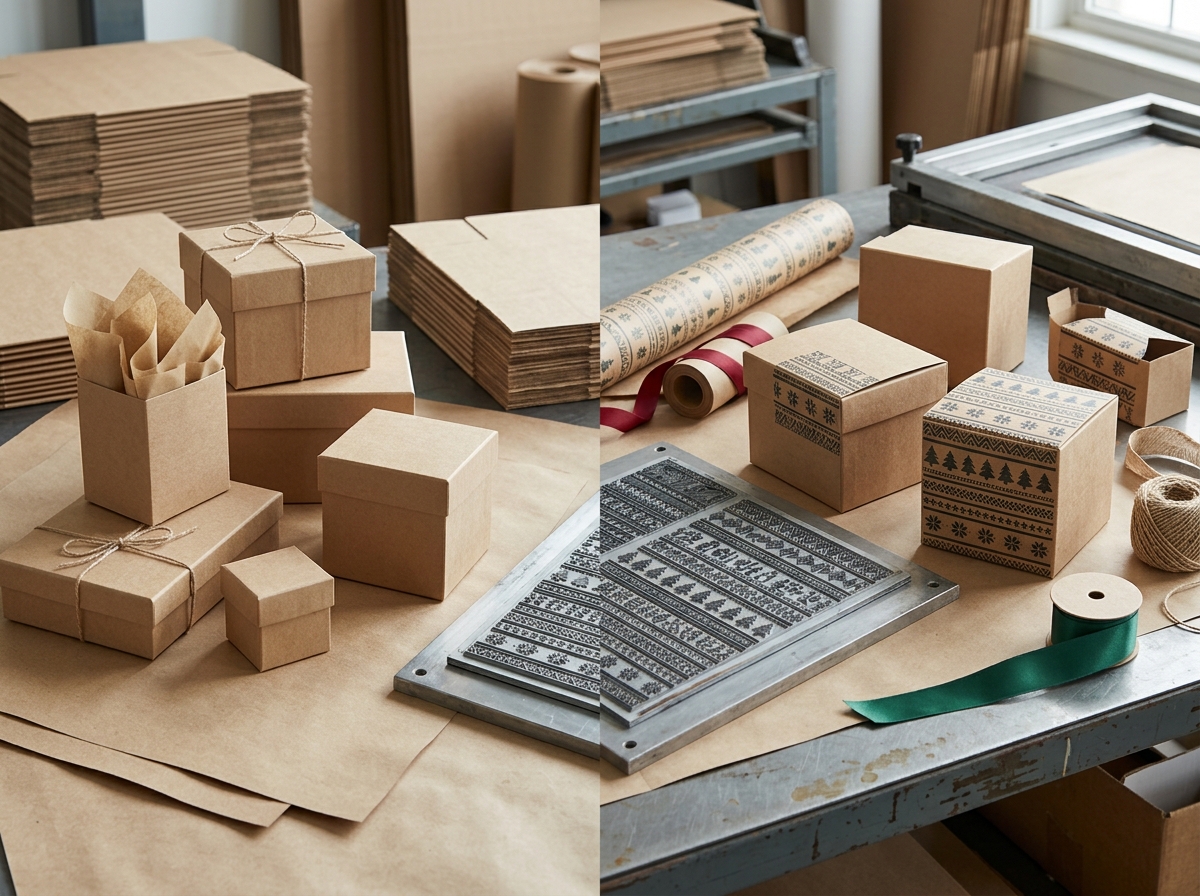
Custom packaging follows a fundamentally different timeline. Digital print allows runs from 50 units upward, with 1–2 week domestic lead times. That's the production window alone—it doesn't include design approval, proofing, or shipping. For a complete custom packaging program, you're looking at a 4-6 week cycle from initial order to delivery.
The complexity of your design also affects production time. Single-color printing on kraft gift boxes moves faster than full-color graphics with specialty finishes. Multi-component packaging—boxes with inserts, magnetic closures, or custom die-cuts—adds assembly time and quality control steps that can extend timelines by another week.
Minimum order quantities don't just determine your unit cost—they directly impact when your order enters the production queue and how long it takes to complete.
Pre-configured sets start at 20 units, while custom-curated programs start at 50. Smaller orders often move through production faster because they require fewer machine setups and shorter press runs. If you're ordering 50-100 custom boxes, a domestic supplier can typically turn the job in 10-14 business days once artwork is approved.
Mid-volume orders—200 to 500 units—sit in a middle ground. They're large enough to justify custom production but small enough to avoid the extended timelines of bulk manufacturing. Expect 3-4 weeks for production, plus shipping time. These orders benefit from domestic production, where communication is faster and adjustments are easier to coordinate.
High-volume programs over 1,000 units introduce different considerations. Overseas production becomes cost-effective at this scale, but for sea freight production from Asia, you need to order by early September for delivery before end of October. If you're reading this in October and need 2,000+ units, domestic production with a rush fee is your only realistic option—or you pivot to stock packaging with branded inserts.

The most reliable way to plan your corporate gifting timeline is to work backward from your target delivery date. If you want gifts in clients' hands by December 15, here's what your calendar needs to look like.
December 15-17: Final carrier cutoffs for ground shipping
Based on recent seasons, plan on ground-service cutoffs around December 17–18 and expedited cutoffs between December 19 and December 23. These are the last days carriers accept packages for pre-Christmas delivery. Miss these dates, and you're paying for expedited service or accepting January delivery.
December 1-10: Final fulfillment and shipping window
Even if your packaging arrives on time, you need 3-7 days for kitting, quality checks, addressing, and carrier pickup. Companies managing large programs often underestimate this stage. Standard lead time is 10 business days, 3 weeks for custom kitting, and 4–6 weeks if custom apparel decoration or custom packaging is involved. If you're assembling multi-item gift sets, build in extra days for this stage.
November 15-30: Packaging delivery window
Your packaging—whether stock or custom—needs to arrive at your fulfillment location by late November to allow time for assembly. For custom orders, this means your production must be complete by mid-November, accounting for 3-5 business days of shipping time.
October 15-November 1: Production window for custom packaging
This is when your custom boxes are actually being printed, die-cut, and assembled. For domestic/regional production, order by mid-October for delivery before end of November. Rush production is available from some suppliers, but express turnaround typically delivers within 6-8 business days at a 25% premium over standard pricing.
October 1-15: Design approval and proofing
Before production begins, you need final artwork approval and physical proofs. This stage often takes longer than expected because it involves multiple stakeholders—your marketing team, your gifting vendor, and sometimes your printer. Budget 7-10 days for this phase, more if you're coordinating across time zones or waiting for executive sign-off.
September: Planning, vendor selection, and initial orders
If you're reading this in September, you're in the ideal window. You have time to compare vendors, request samples, refine your design, and place orders without paying rush fees. Holiday gifting programs should begin preparation 8-12 weeks before intended delivery dates, which allows time for design refinement, proofing, production, and unexpected delays.
Companies that start planning in September can choose between custom and stock options, negotiate better pricing, and build in buffer time for the inevitable delays—artwork revisions, production issues, or carrier slowdowns.
If you're starting your holiday gifting program in late October or November, custom packaging is probably off the table. That doesn't mean your gifts have to look generic. Stock packaging with strategic branding can deliver a professional presentation without the extended lead times.
The most effective approach is to start with high-quality stock boxes and add branded elements that don't require custom manufacturing. A structured kraft gift box paired with custom tissue paper, a printed insert card, and a branded sticker creates a cohesive unboxing experience without the 4-6 week production cycle.
This strategy works particularly well for companies ordering fewer than 100 units. At that volume, the per-unit cost of custom packaging is high, and the flexibility of stock packaging allows you to adjust quantities up or down based on final recipient counts.
Another advantage of stock packaging for late planners: you can order in stages. If your recipient list is still being finalized in early November, you can place an initial order for confirmed addresses and add a second order later without worrying about production minimums or setup fees.
Even perfect planning can fail if you don't account for carrier capacity during peak season. December isn't just busy for corporate gifting—it's the highest-volume shipping period of the year, and carriers prioritize accounts with negotiated contracts and high annual volume.
Ground shipping typically stops accepting packages for pre-Christmas delivery around December 16-18, depending on the carrier and destination zone. Christmas 2026 falls on a Friday, which creates a compressed delivery window, as the weekend before Christmas (December 19-20) limits carrier operations, pushing more volume into the weekdays.
Expedited services extend the window, but at a significant cost premium. Priority Mail and UPS 2nd Day Air typically accept packages through December 19-20, while overnight services may accept packages as late as December 22-23. These extended cutoffs come with peak-season surcharges that can double or triple your per-package shipping cost.
International shipments require substantially more lead time. Earliest international cutoffs start in mid–late November (Africa/LATAM/parts of Asia), with most major lanes closing Dec 5–12 and express options Dec 18–23. If you're shipping to clients outside the United States, your entire timeline shifts forward by 2-4 weeks.
One often-overlooked factor: carrier pickup schedules. Even if you meet the official cutoff date, your packages need to be picked up by the carrier on that date. If your regular pickup is at 2 PM and you finish packing at 4 PM, you've missed the cutoff regardless of what the calendar says. For large corporate programs, arrange dedicated pickup appointments with your carrier to avoid last-minute scrambles.
Minimum order quantities aren't just about cost—they're a timeline factor that many companies overlook when planning corporate gifting programs.
Stock packaging typically has no MOQ beyond the standard pack size. If a box is sold in packs of 18, you can order one pack. This flexibility is valuable for companies with fluctuating recipient lists or those testing different packaging options before committing to a larger program.
Custom packaging MOQs vary by supplier and production method. Digital printing has lowered the barrier significantly—many suppliers now accept orders as small as 50 units. However, these small runs often carry higher per-unit costs and may not receive priority in the production queue during peak season.
The hidden timeline impact of MOQs shows up when you need to reorder. If your initial order was 100 units and you need 25 more, you're either ordering another 100 (and paying for packaging you don't need) or scrambling to find a supplier who will accept a 25-unit reorder, which likely means starting the entire production cycle over.
For companies managing ongoing corporate gifting programs, this is where the corporate holiday gift packaging strategy of maintaining a base stock of branded packaging year-round pays off. You avoid the Q4 rush, eliminate rush fees, and have flexibility to respond to unexpected gifting opportunities throughout the year.
If you're reading this in mid-November and realizing custom packaging isn't feasible, you still have options that don't involve shipping gifts in plain brown boxes.
First, assess whether any suppliers can accommodate rush production. Some manufacturers maintain capacity specifically for emergency orders and can turn custom boxes in 7-10 days, though you'll pay a premium. This works best for simpler designs—single-color printing on standard box sizes.
Second, consider hybrid approaches. Order stock boxes for immediate delivery and add custom printed belly bands, stickers, or hang tags that can be produced on a shorter timeline. A well-designed belly band on a premium stock box can deliver a branded experience that rivals full custom packaging.
Third, shift your delivery timeline. If December 15 isn't a hard deadline, extending to December 20-22 buys you an extra week of production time. Many companies find that gifts arriving the week before Christmas are just as well-received as those arriving in early December—and you avoid the risk of gifts sitting in offices while recipients are traveling for the holidays.
Finally, consider whether your gifting program needs to be a physical delivery at all. Some companies pivot to digital gift cards or experiences for late-cycle programs, then plan a more elaborate physical gifting program for Q1 or mid-year milestones when production capacity is more readily available.
Every corporate gifting timeline should include buffer time—the extra days that absorb inevitable delays without derailing your entire program.
For custom packaging orders, build in a minimum of one week of buffer between when you need the packaging and when production is scheduled to complete. This accounts for production delays, shipping slowdowns, or quality issues that require reprints.
For fulfillment and kitting, add 2-3 days beyond your estimated assembly time. If you think it will take three days to pack 200 gift boxes, schedule five days. The reality of corporate gifting is that recipient lists change, items arrive damaged and need replacement, and the person managing assembly gets pulled into other priorities.
For shipping, the buffer depends on your destination zones and carrier. Domestic ground shipping is generally reliable, but packages to remote areas or during peak season can take an extra 1-2 days beyond the standard transit time. If your cutoff is December 17 and you want guaranteed delivery by December 24, consider treating December 15 as your internal deadline.
Allow at least 12–17 weeks for a fully customised bulk programme, covering 4–8 weeks for sourcing and sampling, 3–6 weeks for production, and 1–3 weeks for fulfilment and shipping. That timeline might seem excessive, but it's the realistic schedule for programs that involve multiple vendors, custom products, and large recipient lists.
For domestic production, mid-October is the latest realistic deadline for custom packaging that will arrive in time for December gifting programs. This assumes a 3-4 week production cycle plus one week for fulfillment and shipping. Some suppliers offer rush production with 7-10 day turnaround, but availability is limited during peak season and comes with a 25-30% cost premium. If you're past mid-October, stock packaging with branded inserts is your most reliable option.
Minimum order quantities directly impact your production schedule because larger orders take longer to complete and may require overseas manufacturing. Orders under 100 units can typically be produced domestically in 2-3 weeks, while orders over 1,000 units may require 6-8 weeks if manufactured overseas. The MOQ also affects your flexibility to reorder—if you underestimate your recipient count and need additional units, you'll need to meet the MOQ again, which restarts the production timeline.
Stock packaging ships within 3-5 business days, while custom packaging requires 4-6 weeks from initial order to delivery. The custom timeline includes design approval (7-10 days), production (2-3 weeks), and shipping (3-5 days). Stock packaging gives you more flexibility for late additions to your recipient list and eliminates the risk of production delays, but custom packaging delivers a more branded presentation that reinforces your company identity.
Ground shipping services typically stop accepting packages around December 16-18 for delivery before December 25. Expedited services extend the window—Priority Mail and 2nd Day Air usually accept packages through December 19-20, while overnight services may accept packages as late as December 22-23. However, these dates vary by carrier, destination zone, and whether service guarantees are in effect. International shipments have much earlier cutoffs, with many lanes closing between December 5-12.
Yes, with stock packaging. You can place multiple orders as your recipient list grows without worrying about MOQs or production delays. With custom packaging, staged ordering is more complicated—you'll need to meet the minimum order quantity for each order, and there's no guarantee your second order will match the first if there are any variations in paper stock, ink batch, or production methods. For programs with uncertain recipient counts, stock packaging with branded inserts offers more flexibility than custom printed boxes.
The companies that execute successful corporate holiday gifting programs share one characteristic: they start planning early. September is the ideal window for custom packaging orders, October is workable with some constraints, and November requires either stock packaging or rush fees.
If you're planning for next year, the lesson is simple: begin conversations with packaging suppliers in August, finalize designs by mid-September, and place orders by early October. This timeline gives you room for the inevitable delays—artwork revisions, stakeholder approvals, production issues—without compromising your delivery schedule.
For this year's program, assess your timeline honestly. If custom packaging is still feasible, move quickly to lock in production slots before peak season capacity fills. If you've missed that window, focus on creating a strong presentation with stock packaging and branded elements that can be produced on a shorter timeline. A well-executed gift in quality stock packaging will always outperform a rushed custom box that arrives late or doesn't meet quality standards.