Cart
0
You may also like



Book a call with our development team to get started.



Apply online and access wholesale pricing.

Retailers planning for Black Friday increasingly face pressure to adopt eco friendly packaging for Black Friday fulfillment—but the perception that sustainable materials require longer lead times often creates hesitation. The reality is more nuanced. With proper planning and an understanding of certification timelines, retailers can meet both ESG commitments and peak-season deadlines without sacrificing either sustainability or speed.
The key is understanding which sustainable packaging options align with compressed Black Friday timelines and which require advance planning. This guide walks through the practical considerations for sourcing Black Friday packaging that meets environmental standards while arriving on time for November fulfillment.
Consumer expectations around packaging sustainability have shifted from preference to baseline requirement. Packaging Digest research shows that sustainability considerations now influence the majority of packaging decisions across the industry, driven by both regulatory pressure and consumer demand. For Black Friday specifically, this creates a dual challenge: retailers must respond to heightened environmental awareness while managing the operational constraints of peak-season fulfillment.
Recent consumer behavior studies reveal that 64% of consumers identify "ease of recycling" as their top priority when choosing a product, and 37% of all consumers have already switched brands specifically due to concerns about packaging, with 54% of 18-29-year-olds reporting switching products because of their packaging. During Black Friday, when purchase volumes spike and unboxing experiences are shared widely on social media, packaging becomes a visible statement of brand values.
The business case extends beyond consumer sentiment. Sustainability pressures are transitioning from a premium differentiator to a baseline expectation, even for single-event packaging, meaning retailers who delay sustainable packaging adoption risk both reputational damage and competitive disadvantage during the year's most visible retail event.
The assumption that all sustainable packaging carries extended lead times is outdated. Lead times vary significantly based on material type, certification requirements, and customization level. Stock sustainable packaging—such as standard kraft boxes or recyclable cellophane bags—typically ships within the same timeframe as conventional materials, often 3-7 days for stock sizes.
The lead time gap widens when certification or customization enters the equation. Compostable stand-up pouches (PLA/PBAT) carry MOQs of 25,000 units and lead times of 12-16 weeks due to raw material allocation and EN 13432 validation cycles, while FSC-certified SBS cartons (die-cut, glued) require MOQs of 10,000 units and lead times of 3-5 weeks if using stock tooling. For retailers ordering in September for late-November fulfillment, these timelines are workable—but they require advance planning.
Material sourcing complexity drives much of the lead time variation. Recycled fiber, bamboo, or compostable resin may not always be in steady supply, and switching a production line from plastic to compostable material takes additional setup. For Black Friday planning, this means retailers should prioritize materials with established supply chains rather than experimental substrates.
A practical benchmark: on average, lead times for standard eco-friendly products are 6-8 weeks, while highly customized runs may extend to 10-12 weeks. Retailers ordering by mid-September can comfortably accommodate most sustainable packaging options for Black Friday delivery.
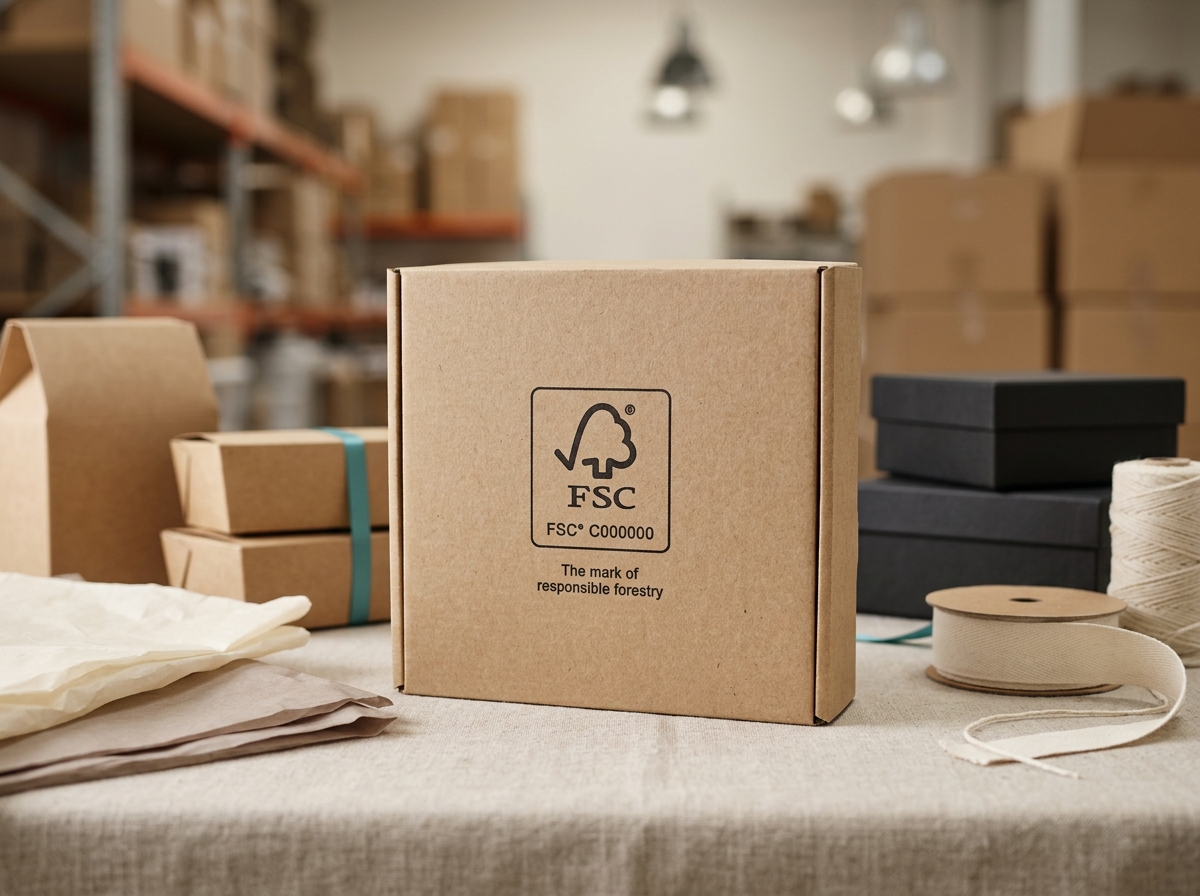
Forest Stewardship Council (FSC) certification remains the most widely recognized standard for paper-based packaging sustainability. FSC verifies that fiber originates from responsibly managed forests and maintains documented chain of custody from forest to finished product. For retailers, understanding FSC label types prevents miscommunication with suppliers and ensures packaging claims align with actual certification.
Three FSC label types appear on packaging: FSC 100% (all virgin fiber from FSC-certified forests), FSC Recycled (100% post-consumer recycled fiber), and FSC Mix (a blend of FSC-certified virgin fiber, recycled content, and controlled wood sources). For Black Friday packaging, FSC Mix typically offers the best balance of availability, cost, and environmental credibility.
The chain-of-custody requirement is critical for lead time planning. Every company handling FSC-certified material—paper mill, converter, packaging manufacturer—must hold valid certification before FSC claims can appear on a product. This adds administrative complexity but not necessarily production time, provided the supplier's certification is current. Retailers should verify supplier FSC chain-of-custody certificates during the RFQ process, ideally in July or August for Black Friday orders.
One common misconception: FSC certification applies to the fiber content, not the finished packaging as a whole. Adhesives, coatings, and closures are not covered by FSC standards, meaning a "FSC-certified box" specifically refers to the paperboard substrate. For comprehensive sustainability claims, retailers should evaluate the entire package construction, not just fiber sourcing.
Retailers who missed early ordering windows or face unexpected volume increases can still source sustainable packaging for Black Friday by focusing on stock items. Standard kraft gift boxes ship quickly and communicate sustainability through material choice alone—no custom printing or certification logos required.
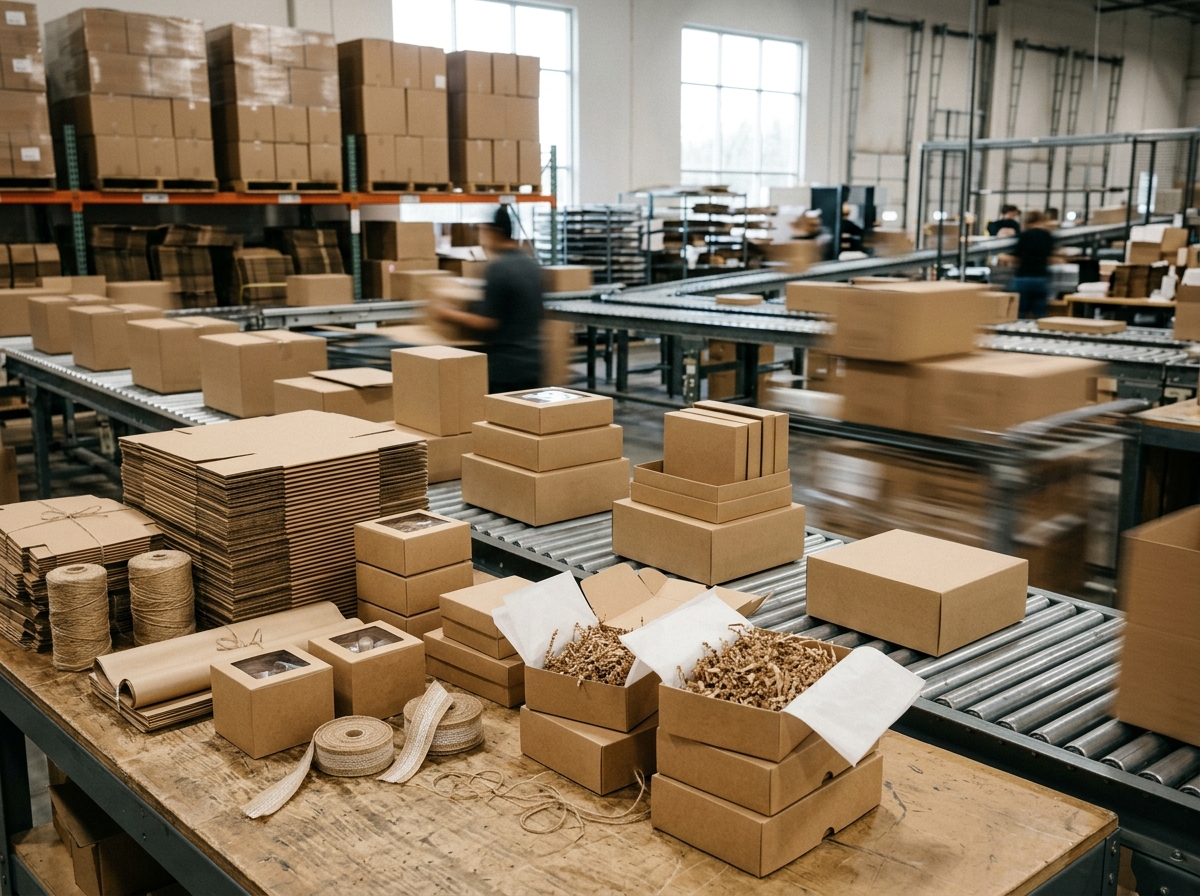
Kraft paperboard offers inherent sustainability advantages: it's typically made with high recycled content, widely recyclable in municipal systems, and visually signals eco-friendliness to consumers without additional messaging. For Black Friday fulfillment, kraft boxes in standard cube sizes (2x2x2, 3x3x3, 4x4x4 inches) provide flexibility across product categories while maintaining fast turnaround.
Clear acrylic boxes represent another stock option that balances sustainability with presentation needs. While not biodegradable, clear acrylic boxes are highly reusable—extending product lifecycle and reducing single-use waste. For premium gift items where product visibility drives purchase decisions, reusable acrylic packaging can support sustainability goals through durability rather than biodegradability.
Cellophane bags, despite the name, are often made from cellulose (a plant-based, biodegradable material) rather than petroleum-based plastic. Standard clear cellophane bags ship within days and provide an eco-friendly alternative to polyethylene for cookies, candies, and small gift items. For retailers managing Black Friday packaging lead times, cellophane represents one of the fastest sustainable pivots available.
Custom printing on sustainable substrates introduces the longest lead time variable in eco-friendly packaging procurement. The challenge isn't the printing itself—it's the plate creation, proof approval cycles, and production scheduling that extend timelines. For Black Friday, retailers must decide whether brand visibility justifies the additional 2-4 weeks custom printing typically adds.
One compromise: order stock sustainable packaging and add sustainability messaging through separate elements like printed tissue paper, recycled content hang tags, or QR codes linking to detailed environmental information. This approach preserves fast lead times while still communicating brand values and environmental commitments.
When custom printing is non-negotiable, prioritize suppliers with existing FSC chain-of-custody certification and in-house printing capabilities. Outsourcing printing to a separate vendor adds handoff time and increases the risk of certification documentation gaps. Integrated suppliers can often compress timelines by running jobs continuously rather than batching across facilities.
Material selection also impacts customization speed. Water-based inks on kraft substrates dry faster and require less specialized equipment than UV-cured inks on coated stocks. For tight Black Friday deadlines, simpler material and ink combinations reduce production complexity and potential delays.
Sustainable packaging inventory planning follows the same principles as conventional materials but requires larger safety stock buffers due to less flexible supply chains. The calculation starts with projected Black Friday order volume, then layers in lead time and variability factors.
A basic formula: monthly packaging usage × 2.5 months of coverage = minimum order quantity for sustainable materials with 8-week lead times. For example, a retailer using 20,000 gift boxes monthly should order at least 50,000 units to cover the period from order placement through peak fulfillment, plus a 15-20% buffer for volume spikes or supply disruptions. This approach aligns with guidance on calculating packaging stock for Black Friday order volume.
The buffer percentage should increase for newer sustainable materials or suppliers without established track records. Compostable films and bio-based polymers, while growing in availability, still face more supply volatility than conventional kraft or recycled paperboard. Retailers betting on emerging materials for Black Friday should order by early August and plan for potential substitution if supply issues arise.
Storage considerations also differ for some sustainable materials. Compostable packaging, particularly PLA-based films, can be sensitive to heat and humidity. Standard warehouse conditions are typically adequate, but retailers in hot climates or facilities without climate control should verify storage requirements with suppliers and factor in any additional logistics costs.
Minimum order quantities for sustainable packaging often exceed conventional material MOQs due to specialized production runs and material sourcing economics. This creates both challenges and opportunities for Black Friday planning. The challenge: smaller retailers may struggle to meet MOQs for certified materials. The opportunity: retailers who can commit to volume unlock significant per-unit cost reductions.
FSC-certified packaging MOQs vary by supplier and product complexity but typically start at 5,000-10,000 units for standard boxes. Custom sizes or printing push minimums higher, often to 25,000+ units. For retailers accustomed to ordering 2,000-3,000 units at a time, this represents a substantial inventory commitment—but one that becomes manageable when viewed across the entire Q4 season rather than Black Friday alone.
Strategic buyers treat Black Friday sustainable packaging orders as the anchor for Q4 inventory, then supplement with smaller conventional material orders for mid-season adjustments. This approach captures volume pricing on the bulk sustainable order while maintaining flexibility for unexpected demand patterns. For more on volume economics, see bulk packaging orders for Black Friday.
Co-op buying represents an emerging solution for smaller retailers unable to meet sustainable packaging MOQs independently. Regional retail associations or buying groups can aggregate demand across members, meeting supplier minimums while distributing inventory proportionally. This model remains underdeveloped in packaging compared to product procurement but offers promise for democratizing access to certified sustainable materials.
Packaging sustainability claims carry legal and reputational risk if not substantiated. The Federal Trade Commission's Green Guides govern environmental marketing claims, requiring that statements be specific, substantiated, and not misleading. For Black Friday packaging, this means retailers must back up sustainability messaging with verifiable facts—not vague terms like "eco-friendly" or "green."
Specific, defensible claims include: "Made with FSC-certified paperboard," "100% recyclable in municipal systems," or "Contains 80% post-consumer recycled content." These statements reference measurable attributes that can be verified through supplier documentation. Vague claims like "better for the environment" or "sustainable choice" lack specificity and invite regulatory scrutiny.
Certification logos provide third-party verification but only when used correctly. FSC logos require that the supplier maintain valid chain-of-custody certification and that the retailer register as an FSC trademark user if making promotional claims. Using certification logos without proper authorization constitutes trademark infringement and undermines the credibility the certification is meant to provide.
Consumer research shows that 70% of consumers prefer packaging with clear sustainability labels, but also that consumers have become more cautious about sustainability claims, and general terms such as 'eco-friendly' or 'green' do not carry much weight. For Black Friday packaging, clear and specific communication builds trust; vague green messaging increasingly triggers skepticism.
Even with careful planning, sustainable packaging supply chains face higher disruption risk than conventional materials due to smaller production volumes and less supply redundancy. Retailers should build contingency plans that preserve sustainability commitments while ensuring fulfillment continuity.
The first contingency layer: identify acceptable substitutes before placing orders. If FSC Mix certified boxes are the primary choice, pre-approve FSC Recycled or high-recycled-content unbleached kraft as backups. Document these alternatives in purchase orders so suppliers can pivot without requiring new approvals if material shortages arise.
The second layer: maintain a small inventory of neutral sustainable packaging that works across product lines. Plain kraft boxes in standard sizes provide universal backup—they may lack custom branding but still communicate sustainability and maintain fulfillment speed. This approach aligns with broader Black Friday packaging contingency planning principles.
The third layer: establish relationships with multiple suppliers for critical sustainable packaging SKUs. Single-source dependency amplifies risk in any supply chain but particularly in sustainable materials where production capacity is more concentrated. Qualifying backup suppliers in August—before peak season demand—provides options if primary suppliers face capacity constraints in October.
Communication protocols matter in contingency planning. Retailers should establish clear escalation paths with suppliers, including direct contacts for production managers who can provide real-time visibility into order status. Weekly check-ins starting 4-6 weeks before required delivery dates catch potential delays early enough to activate backup plans.
Sustainable packaging pricing has narrowed considerably versus conventional materials over the past five years, but gaps remain in specific categories. Retailers planning Black Friday budgets should understand where premium costs persist and where sustainable options have reached price parity.
Kraft paperboard and recycled content boxes now price within 5-15% of virgin fiber equivalents at volume, particularly for standard sizes. The premium reflects material sourcing costs and, in some cases, smaller production runs—but the gap is small enough that many retailers absorb it without passing costs to consumers. FSC certification adds minimal incremental cost (typically under 3%) when suppliers already maintain chain-of-custody systems.
Compostable films and bio-based polymers still carry significant premiums—often 30-50% above conventional plastic equivalents. These materials remain in earlier commercialization stages with less production scale, making them harder to justify for high-volume Black Friday applications unless premium positioning supports higher retail prices.
Total cost of ownership calculations should include disposal and brand value factors beyond unit price. Packaging that consumers can easily recycle reduces waste management costs for retailers with take-back programs. Sustainable packaging that enhances brand perception may support higher product prices or increased customer loyalty, offsetting material cost premiums through revenue lift rather than cost reduction.
Volume discounts on sustainable packaging follow similar tier structures as conventional materials. Retailers ordering 50,000+ units typically access 15-25% lower per-unit costs than those ordering 10,000 units. For Black Friday planning, this creates incentive to consolidate orders and commit to volume early in the procurement cycle.
Sustainable packaging must support the same fulfillment speeds as conventional materials during Black Friday peak periods. Assembly complexity directly impacts labor costs and throughput—making packaging design as important as material sustainability for operational success.
Tuck-top kraft boxes offer the fastest assembly among sustainable rigid packaging options. Workers can fold and load these boxes in seconds without tape, staples, or adhesives—critical when processing hundreds of orders per hour. The design simplicity also reduces training time for seasonal warehouse staff who may be unfamiliar with packaging assembly protocols.
Pre-glued boxes with automatic bottom construction provide even faster assembly but typically require higher MOQs due to specialized die-cutting and gluing equipment. For retailers meeting volume thresholds, this design upgrade can justify the incremental cost through labor savings during peak fulfillment periods. More on assembly efficiency appears in fast-assembly packaging for Black Friday warehouse speed.
Flat storage is another efficiency factor. Sustainable packaging that ships and stores flat maximizes warehouse cube utilization—particularly important when facilities must accommodate both regular inventory and surge packaging stock for Black Friday. Kraft boxes and folding cartons store at 10-15× greater density than pre-assembled rigid boxes, freeing space for product inventory.
Kraft paperboard and recycled content boxes now price within 5-15% of virgin fiber equivalents at volume, with FSC certification adding less than 3% incremental cost. Standard kraft boxes in stock sizes often reach price parity with conventional packaging when ordered in Black Friday volumes (10,000+ units). Compostable films and bio-based polymers remain 30-50% more expensive than plastic equivalents due to smaller production scale. For most retailers, the sustainable packaging premium on paper-based materials is small enough to absorb without significantly impacting margins.
Yes, in most cases. FSC-certified boxes in standard sizes with stock tooling typically require 3-5 weeks lead time, making late September orders viable for November delivery. Custom printing or non-standard sizes extend lead times to 6-8 weeks, requiring August ordering for comfortable Black Friday delivery. The key is verifying that your supplier maintains current FSC chain-of-custody certification—this eliminates delays related to certification documentation. Request certificate verification during the RFQ process, and confirm production slot availability before finalizing orders.
MOQs vary by material and customization level. Stock kraft boxes and recyclable cellophane bags often have MOQs as low as 1,000-2,000 units. FSC-certified packaging with standard printing starts around 5,000-10,000 units. Custom sizes or specialty sustainable materials (compostable films, molded pulp) typically require 25,000+ units. For Black Friday planning, most retailers find that 10,000-unit MOQs align well with Q4 volume needs when the packaging is used across November through December rather than Black Friday weekend alone.
Most paper-based sustainable packaging (kraft boxes, recycled paperboard) stores under the same conditions as conventional packaging—standard warehouse temperature and humidity are adequate. Compostable films made from PLA or PBAT can be sensitive to heat and humidity; suppliers typically recommend storage below 30°C and 40% relative humidity, with use within six months of production. If your facility lacks climate control or operates in a hot, humid climate, verify storage requirements with your supplier and factor in any additional logistics costs for temperature-controlled warehousing.
Use specific, verifiable claims rather than vague terms. State "Made with FSC-certified paperboard" or "100% recyclable in curbside programs" instead of "eco-friendly" or "green packaging." Include certification logos only if your supplier holds valid chain-of-custody certification and you've registered as a trademark user where required. Provide disposal instructions directly on packaging or through easily accessible QR codes. Consumers increasingly scrutinize sustainability claims, so specificity and third-party verification build trust while vague marketing language triggers skepticism.
Retailers who integrate sustainable packaging into Black Friday fulfillment without compromising lead times gain competitive advantage through both operational execution and brand positioning. The key is early planning, realistic material selection, and clear communication—treating sustainability as a procurement requirement rather than an afterthought. With proper timing and supplier partnerships, eco friendly packaging for Black Friday becomes achievable without sacrificing speed, cost efficiency, or customer experience.