Cart
0
You may also like


Book a call with our development team to get started.



Apply online and access wholesale pricing.

Bulk packaging orders for Black Friday require a clear understanding of minimum order quantities, pricing breakpoints, and when volume discounts justify the upfront commitment. Retailers preparing for November 27-30 peak fulfillment face a calculation: order enough to secure better per-unit pricing without tying up working capital in boxes you may not use. This guide walks through the mechanics of MOQ, explains how pricing tiers unlock savings, and provides a framework for deciding when bulk orders make commercial sense.
Most packaging suppliers structure wholesale pricing around volume. Most packaging supplier minimum orders range between 500 and 1,000 units, while true wholesale efficiency typically begins at 2,500–5,000 units. For Black Friday, where order volume can spike 3-5x over baseline, understanding these thresholds determines whether you can negotiate better terms or need to accept higher per-unit costs for smaller runs.
The stakes are straightforward: order too few units and you pay a premium that erodes margin on every sale. Order too many and you lock up cash in inventory that may sit until next year's peak season. The right approach balances cost per unit against storage capacity, demand forecasting accuracy, and the risk of design or branding changes that could render excess stock obsolete. For retailers managing Black Friday packaging across multiple SKUs, this calculation repeats for every box size, bag style, and finishing option in your fulfillment workflow.
Minimum order quantity is the minimum number of units of an item a seller requires for a buyer to purchase. In packaging, MOQ exists because production setup costs remain constant regardless of order size, making small runs unprofitable, and MOQs help maintain efficiency by enabling appropriate-sized production runs.
For Black Friday planning, MOQ matters in three ways. First, it determines your entry point: if a supplier's MOQ is 1,000 units and you only need 400 boxes, you either find a different supplier, pay a premium for below-MOQ production, or commit to the full thousand and manage the overage. Second, MOQ varies by product complexity—standard carton boxes may start from 500 boxes per spec, while multi-color flexo cartons require 2,000 boxes per spec due to higher setup cost. Third, suppliers set MOQs to protect them from orders of small quantities that bring in minimal profit after paying for labor, shipping, and packing supplies, which means negotiating below MOQ typically requires accepting higher per-unit pricing or longer lead times.
Black Friday adds urgency to this equation. If you're ordering in September for late-November delivery, suppliers prioritize orders that meet or exceed MOQ because those runs are more profitable and easier to schedule into production queues already crowded with seasonal demand. Retailers who miss Black Friday packaging lead times and need rush production often face both higher per-unit costs and stricter MOQ enforcement, since expedited runs disrupt normal scheduling.
Understanding why MOQ exists helps frame the negotiation. MOQ exists in almost all custom manufacturing industries, but it is especially important in packaging due to setup costs, printing processes, and material efficiency, and many first-time buyers assume MOQ is just a restriction, but in reality it is directly tied to production economics. Suppliers aren't being arbitrary—they're protecting margin on orders where fixed costs (printing plates, die-cutting tools, machine calibration) must be recovered across the units produced.
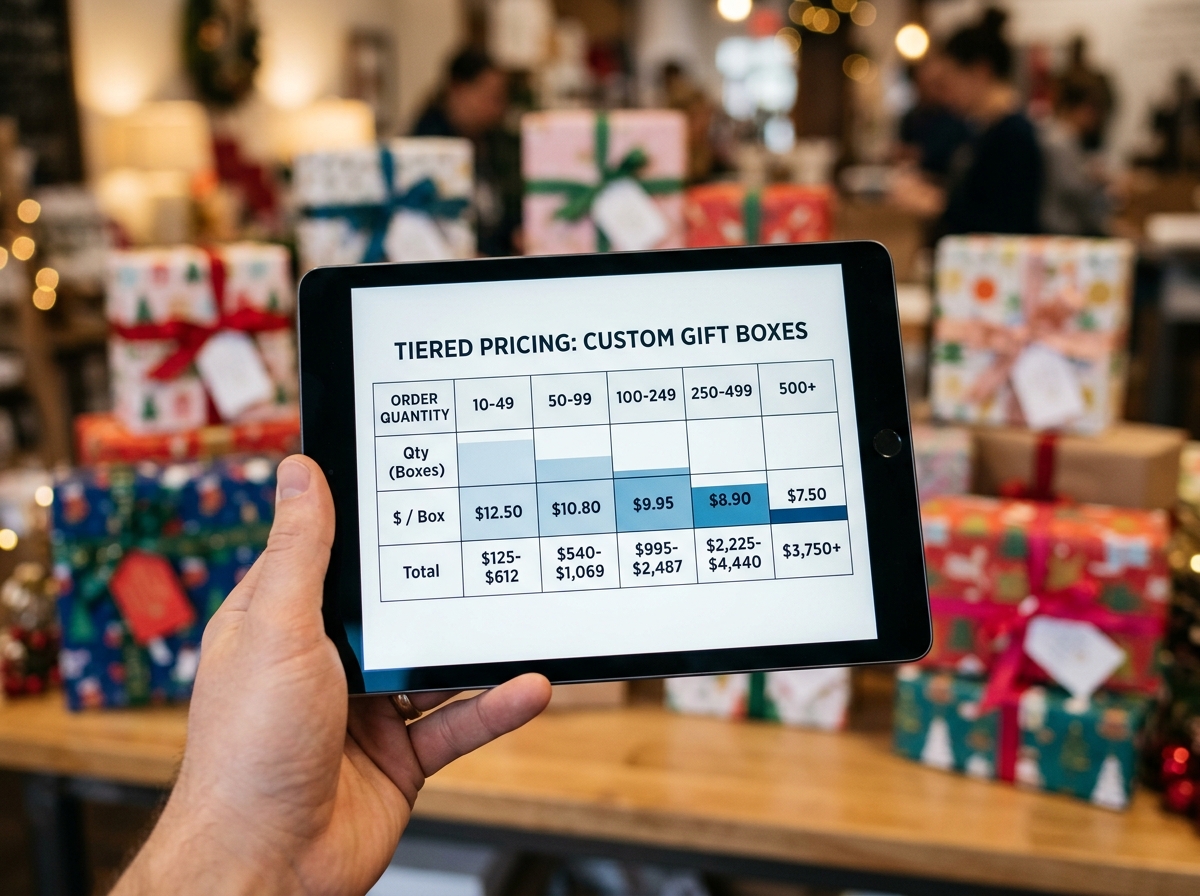
Volume discounts in packaging follow the principle of economies of scale: economies of scale reduces the per unit fixed cost because the fixed cost gets spread across more units the higher the quantity. Price breaks and volume discounts are built into the pricing strategy of wholesale orders and the unit cost is determined by the minimum order quantity.
A typical wholesale pricing structure for gift boxes might look like this: 500-999 units at $1.20 each, 1,000-2,499 units at $0.95 each, 2,500-4,999 units at $0.78 each, and 5,000+ units at $0.65 each. The breakpoints aren't random—they correspond to production efficiencies where setup costs become negligible relative to material and labor. Wholesale suppliers often offer tiered pricing structures, where the cost per item decreases as the order quantity increases.
For Black Friday bulk packaging orders, the decision point is whether the per-unit savings justify the larger upfront spend. If you need 1,200 boxes, ordering exactly 1,200 at $0.95 each costs $1,140. Stepping up to 2,500 units at $0.78 each costs $1,950 total but drops your per-unit cost by 18%. The question becomes: can you use or store the extra 1,300 boxes, and does the $810 additional outlay make sense against your working capital position and storage costs?
Retailers often find the sweet spot at the second or third pricing tier—high enough to capture meaningful savings but not so high that excess inventory becomes a liability. Ordering packaging in larger quantities reduces per-unit costs by spreading fixed expenses, such as tooling, setup, and logistics, over more units. For multi-SKU operations, consolidating orders across product lines can help you reach higher tiers without overcommitting to any single box style.
One practical approach: order your primary fulfillment boxes (the sizes you use for 60-70% of orders) at the higher volume tier to maximize savings, and order specialty sizes or seasonal designs at lower tiers to maintain flexibility. Pairing a structured kraft gift box for your core product line with smaller runs of themed packaging for limited-edition Black Friday bundles lets you balance cost efficiency with creative merchandising.
Cost-per-unit analysis is the foundation of smart bulk ordering. The formula is simple: total order cost divided by number of units. But the decision requires comparing that per-unit cost against storage expense, capital tied up in inventory, and the risk that demand forecasts prove inaccurate.
Start with your Black Friday order volume projection. If historical data or your packaging stock planning model suggests you'll fulfill 3,200 orders during peak weekend, and 80% of those orders use your standard 4x4x4 gift box, you need roughly 2,560 boxes minimum. Adding a 15% buffer for damaged units, packing errors, or higher-than-expected volume brings you to approximately 2,950 boxes.
Now map that quantity against your supplier's pricing tiers. If the 2,500-4,999 tier prices boxes at $0.78 each, ordering 2,950 units costs $2,301. Stepping up to 5,000 units at $0.65 each costs $3,250 but saves $0.13 per box—a 17% reduction in per-unit cost. The 2,050 extra boxes represent $1,333.50 in additional capital outlay. If you have storage space and expect to use those boxes for post-holiday orders or next year's Q1 fulfillment, the savings compound. If you don't, you're paying to warehouse 2,000+ boxes for months, which adds carrying cost that may erase the per-unit savings.
The math shifts when you factor in setup fees. Some suppliers charge separate tooling or plate fees for custom printing, which function as additional fixed costs. If a $200 setup fee applies regardless of order size, that fee adds $0.40 per unit to a 500-box order but only $0.04 per unit to a 5,000-box order. In those scenarios, reaching higher tiers becomes even more compelling because you're amortizing both the supplier's internal setup costs and their external pass-through fees across more units.
Bulk orders lock in pricing and ensure supply, but they sacrifice flexibility. The decision hinges on how predictable your Black Friday demand is, how stable your packaging design remains, and whether you have the capital and storage capacity to carry excess inventory.
Bulk commitments make the most sense when demand is predictable, designs are stable, and per-unit savings are significant. If you've run Black Friday promotions for three consecutive years and order volume has stayed within a 10-15% range, you can forecast with confidence. If your packaging uses a simple one-color logo on kraft stock—no seasonal graphics, no year-specific messaging—you can order in September knowing those boxes will work for December holiday orders and into Q1. And if stepping from 1,000 units to 5,000 units cuts your per-unit cost by 30%, the savings justify the commitment even if you carry some boxes into next quarter.
Flexibility matters more when you're testing new products, running limited-time Black Friday designs, or operating with tight cash flow. If this is your first Black Friday at scale and you're unsure whether you'll fulfill 1,500 orders or 4,000, ordering at the lowest tier that meets your conservative estimate limits downside risk. If you're printing "Black Friday 2026" or "Limited Edition" on the boxes, you can't repurpose leftovers, which makes smaller runs safer even at higher per-unit cost. And if your working capital is constrained—common for small retailers ramping inventory buys in Q3—tying up an extra $2,000 in packaging you won't use for six months may not be viable regardless of the per-unit math.
A middle path: negotiate split shipments. Some suppliers will produce the full volume to capture tier pricing but deliver in two or three shipments spread over weeks or months. You pay the lower per-unit rate, the supplier schedules one efficient production run, and you avoid warehousing the entire order upfront. This works best when you have a strong supplier relationship and can commit to the full order with confidence, but need to manage cash flow and storage more gradually.
Suppliers have more flexibility than their published MOQ and pricing tiers suggest, especially for buyers who can commit to volume, consolidate SKUs, or place orders early in the season. Negotiation starts with understanding what the supplier values: production efficiency, predictable revenue, and long-term relationships.
If you're ordering multiple SKUs, ask about consolidated pricing. A supplier may hold firm on a 1,000-unit MOQ per SKU but offer tier-two pricing if your combined order across three box sizes totals 2,500 units. This lets you reach better pricing without overcommitting to any single format. Similarly, if you can place your order in August rather than October, you give the supplier scheduling flexibility that may unlock lower pricing or waived setup fees, since they can slot your run into production during a slower period rather than competing with the September-October rush.
Long-term commitments also carry weight. If you're confident you'll need packaging year-round—not just for Black Friday—propose an annual agreement with scheduled releases. The supplier books predictable revenue, you lock in pricing for 12 months, and both parties benefit from production efficiency. Standardize components across SKUs, commit to annual volume with scheduled releases, and combine designs in gang runs—sharing accurate forecasts helps suppliers plan efficient runs that justify better pricing while allowing a smaller minimum order on each release.
Finally, be transparent about your constraints. If MOQ is a barrier, explain why and ask what alternatives exist. Some suppliers offer digital printing for short runs, which eliminates plate costs and reduces MOQ to 250-500 units at a higher per-unit price. Others may have overstock of plain boxes in your size that they'll sell below standard pricing to clear inventory. You won't know unless you ask, and suppliers often have more flexibility for buyers who communicate clearly and early.
Ordering in bulk only makes financial sense if you can store the inventory and receive it in time for peak fulfillment. Storage costs vary widely—from a few cents per cubic foot per month in a shared warehouse to significant square footage in your own facility—but they add up quickly when you're holding 5,000+ boxes for weeks or months.
Calculate storage cost as part of your total cost per unit. If you order 5,000 boxes at $0.65 each in September and they occupy 80 cubic feet of warehouse space at $0.50 per cubic foot per month, you're paying $40/month in storage. Over three months (September delivery through November use), that's $120, or $0.024 per box. Small on a per-unit basis, but meaningful when you're comparing a 5,000-unit order against a 2,500-unit order where half the boxes turn immediately and the other half sit in storage.
Lead times compress flexibility. Standard production for custom-printed boxes typically runs 3-4 weeks, plus shipping. For Black Friday, that means ordering by late September or early October to ensure delivery before peak weekend. If you wait until October and need to place a rush order, suppliers may require higher MOQ, charge expedite fees, or simply decline the order because their production schedule is full. The earlier you commit to bulk orders, the more leverage you have to negotiate terms and ensure on-time delivery.
For retailers managing multiple fulfillment channels, consider staging inventory. If you operate both a retail storefront and e-commerce fulfillment, allocate boxes across locations based on projected volume. Store 60% at your primary fulfillment center, 30% at your retail location, and 10% as overflow buffer. This spreads storage cost and ensures you have packaging where you need it without concentrating risk in a single location. A simple compact cube tuck-top box can serve both in-store gift wrapping and e-commerce order fulfillment, reducing SKU complexity and making bulk orders easier to justify.
Custom printing adds setup costs and typically raises MOQ, but it strengthens brand recognition and unboxing experience. Plain stock boxes cost less per unit and carry lower MOQ, but they require secondary branding (stickers, stamps, inserts) to differentiate your packaging. The right choice depends on your brand strategy, budget, and how much of your Black Friday volume comes from repeat customers who already know your brand.
Plain kraft or white boxes with a branded sticker or stamp offer the lowest entry point. You can order plain boxes at 500-1,000 unit MOQ, then apply branding in-house as you pack orders. This approach preserves flexibility—if you rebrand or want to test different messaging, you're only replacing stickers, not discarding printed boxes. For Black Friday, where speed matters and labor is already stretched, the trade-off is packing time: every order requires an extra step to apply the sticker or stamp, which adds seconds per package that compound across hundreds of orders per day.
Custom-printed boxes eliminate the secondary branding step and create a more polished unboxing experience, but they require committing to a design and typically carry 1,000-2,500 unit MOQ depending on print complexity. Folding cartons using offset printing typically have MOQs of 1,000 to 5,000 units, while digital printing for folding cartons can achieve MOQs as low as 50 to 250 units, with higher per-unit cost but no setup charges. For high-volume Black Friday fulfillment, the efficiency gain of pre-printed boxes often justifies the higher MOQ and upfront cost, especially if you plan to use the same design through the holiday season.
A hybrid strategy works well for many retailers: order custom-printed boxes for your core products where volume justifies the MOQ, and use plain boxes with stickers for lower-volume SKUs or limited-time Black Friday bundles. This maximizes efficiency on your highest-volume fulfillment while maintaining flexibility on smaller product lines. Pairing a structured black gift box for premium items with plain kraft boxes for everyday orders lets you segment packaging by product tier without managing a dozen different custom print runs.
Retailers selling multiple product sizes or categories can often reach higher pricing tiers by consolidating orders across SKUs rather than ordering each size separately. This requires coordination—matching box dimensions to products, forecasting volume by SKU, and ensuring your supplier can produce multiple sizes in a single production run—but the per-unit savings can be substantial.
Start by auditing your product catalog and identifying which items ship in similar-sized boxes. If you sell candles, mugs, and small home goods, you might find that 40% of your orders fit in a 4x4x4 box, 30% fit in a 6x6x4 box, and 20% fit in a 3x3x3 box. Rather than ordering 800 units of each size separately (2,400 total across three SKUs, each at tier-one pricing), consolidate into a single 2,400-unit order split across the three sizes. Many suppliers will honor tier-two or tier-three pricing for the combined volume, even though no single SKU reaches that threshold individually.
This approach works best when you're ordering from a single supplier and can standardize materials and finishes across SKUs. If all three box sizes use the same kraft stock, same print method, and same finishing, the supplier can run them consecutively with minimal changeover cost. If you're mixing materials (kraft and white stock) or finishes (matte and gloss), the production efficiency drops and the supplier is less likely to offer consolidated pricing.
For Black Friday, multi-SKU consolidation also simplifies logistics. One delivery date, one freight charge, one receiving process. You're not coordinating three separate shipments from three suppliers or managing three different lead times. This operational simplification has value beyond the per-unit cost savings, especially during a compressed fulfillment window where every day of lead time matters.
Most packaging suppliers set minimum order quantities between 500 and 1,000 units for standard boxes, with wholesale pricing efficiency beginning around 2,500 to 5,000 units. Custom-printed boxes typically require higher MOQs—1,000 to 2,500 units for offset printing—due to setup costs for printing plates and die-cutting tools. Digital printing can reduce MOQ to 250-500 units but at a higher per-unit cost. For Black Friday orders placed in September or October, suppliers may enforce stricter MOQs due to high seasonal demand and limited production capacity.
Volume discounts typically reduce per-unit costs by 15-30% as you move from entry-level MOQ to mid-tier volumes. For example, boxes priced at $1.20 each for 500-999 units might drop to $0.78 each at 2,500-4,999 units—a 35% reduction. The savings come from spreading fixed costs (setup, tooling, plates) across more units. However, the marginal benefit decreases at very high volumes; moving from 10,000 to 15,000 units may only save an additional 2-3% per unit as you approach the point where fixed costs become negligible relative to material and labor.
It depends on whether you can use or store the extra units and how significant the per-unit savings are. If stepping from 1,200 to 2,500 units saves $0.17 per box and you have storage space and confidence you'll use the extras within 6-12 months, the savings justify the commitment. But if the extra units tie up working capital you need for inventory, or if you're ordering seasonal designs you can't repurpose, stay at the lower tier. Calculate total cost including storage and the opportunity cost of capital to make the decision.
Yes, especially if you order early, consolidate multiple SKUs, or commit to future volume. Suppliers have more flexibility in August and early September before the seasonal rush peaks. Ask about consolidated pricing across multiple box sizes, split shipments that let you pay for full volume but take delivery in stages, or digital printing options that eliminate plate costs and reduce MOQ. Long-term relationships and transparent communication about your constraints also help—suppliers often accommodate buyers who plan ahead and communicate clearly.
Standard production for custom-printed packaging runs 3-4 weeks, plus 3-7 days for shipping depending on your location and the supplier's facility. For Black Friday fulfillment starting November 27, order by late September to ensure delivery in time for peak weekend. Rush production is possible but typically requires expedite fees, may have stricter MOQ requirements, and isn't guaranteed if the supplier's production schedule is full. Plain stock boxes often have shorter lead times—1-2 weeks—since they don't require custom printing setup.
Bulk packaging orders for Black Friday come down to balancing cost efficiency against flexibility and risk. Order at higher volume tiers and you capture significant per-unit savings that improve margin on every sale. Order conservatively and you maintain flexibility to adjust if demand shifts or designs change, but you pay more per box and risk running short during peak fulfillment.
The framework is straightforward: calculate your minimum need based on conservative demand forecasts, map that quantity against supplier pricing tiers, and assess whether stepping up to the next tier makes financial sense when you factor in storage costs, capital tied up in inventory, and the likelihood you'll use excess units. For stable, high-volume products, bulk orders almost always pay off. For new products, seasonal designs, or uncertain demand, smaller runs at higher per-unit cost preserve flexibility that may be worth more than the savings.
Start planning now. Black Friday packaging lead times compress quickly in September and October as suppliers fill production schedules. The earlier you commit to bulk orders, the more leverage you have to negotiate terms, ensure on-time delivery, and lock in pricing before seasonal demand drives costs higher. Whether you're ordering cube white gift boxes for retail fulfillment or consolidating multiple SKUs to reach better pricing tiers, the decisions you make in late summer determine your margin and operational efficiency during the year's busiest shopping weekend.