Cart
0
You may also like


Book a call with our development team to get started.



Apply online and access wholesale pricing.

For small business owners, the fourth quarter represents both the biggest revenue opportunity and the highest operational risk of the year. Getting your seasonal packaging planning right means capturing holiday demand without tying up cash in excess inventory that sits unused in February. The challenge is real: order too little and you miss peak sales days with no time to reorder; order too much and you're stuck with snowflake-printed boxes in spring.
This guide walks through practical forecasting methods, optimal order timing, and flexible strategies that help small businesses prepare for Q4 without gambling on quantities. Whether you're planning your first holiday season with custom packaging for small businesses or refining an existing approach, these techniques are designed to balance opportunity with inventory risk.
The most common mistake in seasonal packaging planning for small business operations is waiting until autumn to think about holiday inventory. By September, production timelines have compressed and your options narrow significantly. Standard lead times that run 8-10 business days during most of the year can stretch to 3-4 weeks in October as supplier capacity fills.
Brands that finalize packaging decisions by June avoid pre-season surprises and secure better production slots. Early commitment matters especially for custom or specialty formats that require tooling, color matching, or finishing techniques like foil stamping. The window for complex customization closes months before the first holiday order ships.
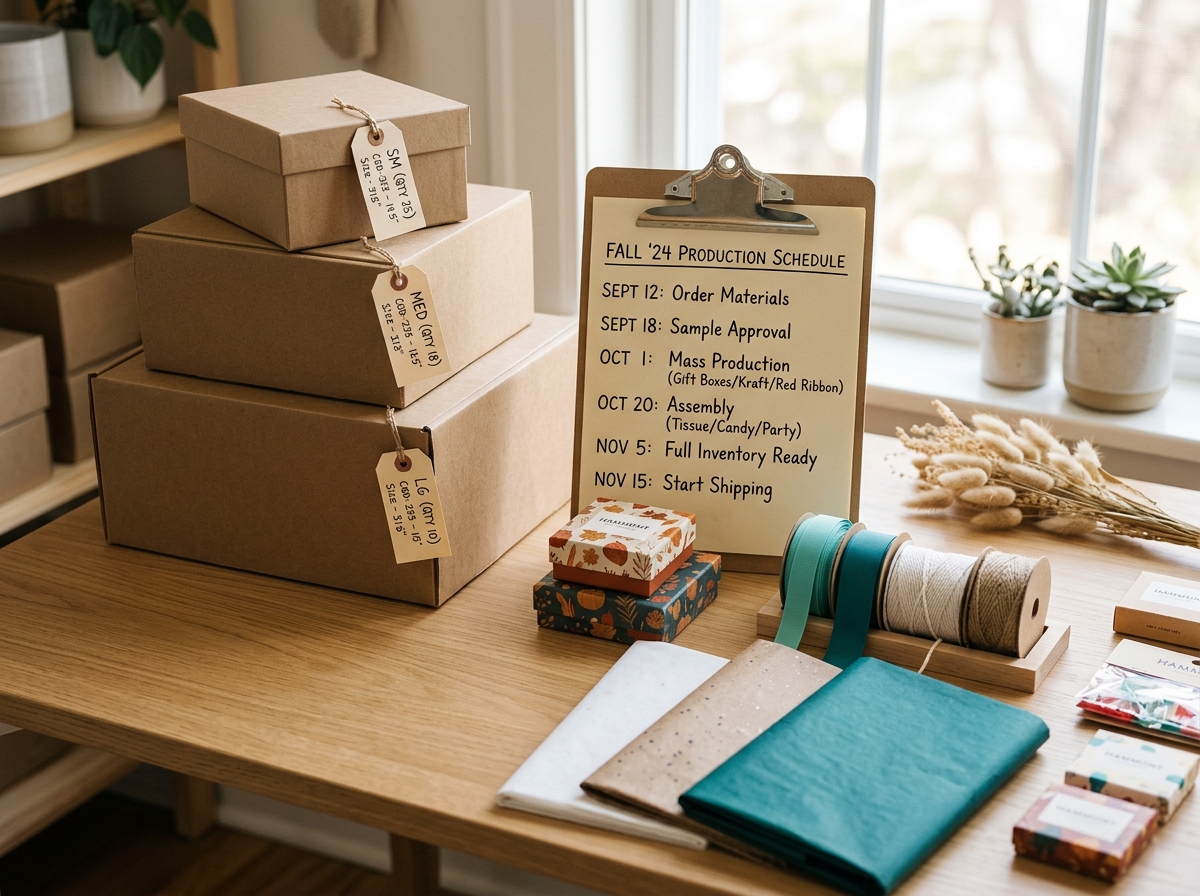
A practical timeline for seasonal packaging planning looks like this: finalize SKU lists and material specs by the end of June, approve design and mockups by the end of July, sign off on physical samples by late August, and issue purchase orders by mid-September. This sequence ensures finished goods arrive at your facility by early November, leaving a buffer for the Thanksgiving through New Year peak.
If you're reading this after July, contact suppliers immediately to understand what formats remain available on compressed timelines. Many suppliers maintain express production lines for late-arriving orders, though options and customization depth will be more limited than spring planning would allow.
Established businesses can pull 8-12 weeks of order history from the previous year's Q4 and use that as a baseline. New businesses or those launching branded packaging for the first time face a different challenge: forecasting without historical sales to reference.
When you lack past performance data, qualitative forecasting methods become essential. These approaches rely on market research, customer feedback, and industry benchmarks rather than your own sales history. Start by analyzing current market trends in your category, surveying existing customers about their holiday purchasing intentions, and studying competitors' seasonal product launches.
A scenario-based approach works well for first-time holiday planners. Instead of trying to predict an exact number, define three scenarios: conservative (matching your average monthly volume), moderate (30-50% increase over baseline), and optimistic (doubling baseline volume). Then tie your packaging order quantity to the scenario that matches your committed inventory and marketing spend.
For businesses with some sales history but no seasonal data, trend forecasting offers a middle path. Examine your sales patterns over the past three to six months, calculate the average monthly growth rate, and project forward while adding a seasonal multiplier. Industry data suggests that consumer-facing businesses typically see demand spikes of 3-5× during the final quarter, though your specific multiplier depends on product category and sales channel.
The key principle for any forecasting method: order packaging for the inventory you have committed to fulfill, plus a 15-20% buffer for unexpected demand. Resist the temptation to order packaging for aspirational sales volumes unless you're prepared to carry the excess into the next year.
Packaging suppliers and industry consultants consistently recommend placing Q4 orders 8-12 weeks before you need the finished goods in your facility. This window accounts for production time, quality checks, shipping, and a small buffer for unexpected delays.
The timing is not arbitrary. Paper mills reserve Q4 production runs months in advance, with high-volume orders claiming capacity first. Custom work that requires die-cutting, special finishes, or color matching creates even tighter windows. A structured gift box tower with ribbon and custom printing needs more lead time than stock kraft boxes with a label.
Breaking down the 8-12 week window: expect 2-3 weeks for production itself, 1-2 weeks for quality control and packing, 1-2 weeks for domestic shipping (longer for international), and 1-2 weeks of safety buffer. Rush orders are possible but usually come with premium pricing and reduced customization options.
For small businesses working with minimum order quantities, understanding lead times helps you balance the MOQ commitment with actual demand timing. If your supplier's MOQ is 1,000 units but you only need 600 by Thanksgiving, the 8-12 week planning window lets you split delivery: 600 units by early November and 400 units by mid-December.
Phased ordering splits your total seasonal packaging needs into two or three separate purchase orders with staggered delivery dates. This approach reduces the risk of overordering while maintaining enough inventory to serve peak demand.
A typical phased structure for Q4 might look like this: place 60% of your forecasted need in early September for delivery by early November, then place 40% in late September for delivery by early December. The first batch covers Thanksgiving through early December demand, while the second batch supports the final pre-Christmas rush and any post-holiday sales.
The cost of phased ordering is slightly higher per-unit pricing on the second order and the administrative overhead of managing two purchase orders instead of one. The benefit is flexibility: if your early November sales come in below forecast, you can adjust the December order downward. If sales exceed expectations, you can increase the second order or add a third emergency order with rush production.
Phased ordering works best when you have an established relationship with your packaging supplier and clear communication about lead times for repeat orders. Confirm upfront that your supplier can accommodate a second order on a compressed timeline, and lock in pricing for both phases when you place the first order to avoid mid-season price increases.
This strategy pairs well with businesses that use both eco-friendly kraft boxes for standard orders and premium options for gift sets. Order your high-volume everyday packaging in the first phase and specialty formats in the second phase once you have better visibility into gift vs. standard order mix.
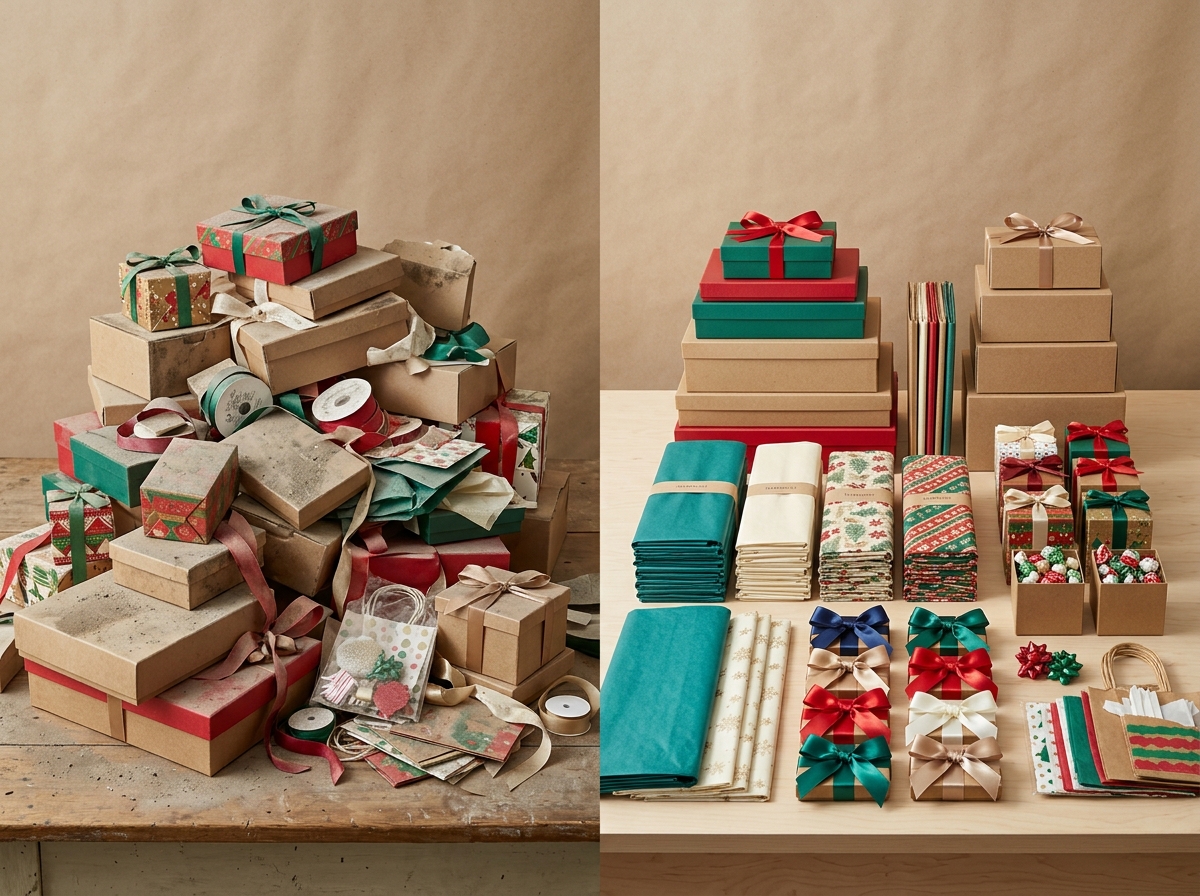
Not every piece of holiday packaging needs to be custom. A hybrid approach combines stock packaging with seasonal customization elements, giving you holiday appeal without the full cost and lead time of custom manufacturing.
The stock-plus-custom method works like this: order high-quality stock boxes, bags, or mailers in larger quantities (often at better per-unit pricing and with shorter lead times), then add seasonal customization through labels, stickers, tissue paper, or ribbon. A resealable treat bag in a neutral color becomes holiday packaging with a custom printed label and seasonal tissue.
This approach offers several advantages for seasonal packaging planning. Stock packaging can often be ordered with 2-4 week lead times instead of 8-12 weeks, giving you more time to finalize your forecast. Excess stock packaging carries over to Q1 without looking dated, while seasonal elements like printed labels can be ordered in smaller quantities that match actual demand more closely.
The trade-off is brand impact. Fully custom packaging creates a stronger unboxing experience and brand impression than stock boxes with labels. For businesses where unboxing experience drives word-of-mouth and social sharing, investing in custom seasonal packaging may deliver better ROI despite the higher inventory risk.
A practical middle ground: use custom packaging for your hero products or gift sets that represent your brand in holiday marketing, and use stock-plus-custom for everyday orders. This tiered approach concentrates your custom packaging investment where it has the most impact while keeping flexibility for volume orders.
Even with careful planning, most businesses end up with some seasonal packaging inventory in January. How you handle this surplus affects both your cash flow and your planning for the next year.
Leftover seasonal packaging after January is a planning signal, not necessarily a waste problem. If you have 10-15% of your order remaining, your forecast was accurate and that small buffer protected you against stockouts. If you have 30-40% remaining, your forecast was too aggressive and you should adjust next year's quantities downward.
For packaging with subtle seasonal elements—a simple snowflake pattern, winter colors, or generic holiday messaging—consider using it through January and into early February for clearance sales or thank-you shipments. Many customers appreciate receiving a post-holiday order in festive packaging as a small unexpected touch.
For packaging with explicit holiday messaging (Merry Christmas, Happy Hanukkah, specific year references), you have three options: store it carefully for next year if the design is evergreen, repurpose it for internal use or shipping supplies, or donate it to local nonprofits that can use it for fundraising or community events. Storage only makes sense if the design will still feel current next year and you have climate-controlled space that won't damage the materials.
The right response to seasonal overstock is not ordering less overall next year, but rather ordering less seasonal-specific packaging and more evergreen packaging that can flex between holiday and regular use. A kraft box with your logo and a seasonal belly band or sticker gives you holiday presence without locking all your inventory into December-only use.
Minimum order quantities create a particular challenge for seasonal packaging planning because supplier MOQs rarely align perfectly with your actual Q4 demand forecast. Understanding how to work within MOQ constraints without overcommitting is essential.
When your forecast falls below the supplier's MOQ, you have several options. First, check if the supplier offers split delivery at no additional cost—you meet their MOQ but take delivery in two shipments, one in November and one in January. Second, ask if they'll reduce the MOQ for a slight price premium; many suppliers will negotiate on MOQ for established customers or for orders placed well in advance. Third, consider whether you can use the full MOQ by extending the seasonal packaging into January clearance sales or early Valentine's Day orders.
If none of these options work, compare the cost of meeting the MOQ against the cost of using stock packaging with seasonal elements. Sometimes paying for 1,000 custom boxes when you only need 600 is still more cost-effective than you expect, especially if the per-unit price drops significantly at the MOQ threshold.
For businesses planning their first custom order, reviewing how to order custom packaging helps clarify the MOQ conversation with suppliers and sets realistic expectations about quantities and pricing tiers.
The most flexible seasonal packaging planning strategy might be avoiding overtly seasonal designs altogether. Evergreen packaging with premium materials and thoughtful details can serve holiday demand without becoming obsolete in January.
Evergreen holiday packaging relies on elevated presentation rather than seasonal graphics. Think premium kraft paper, elegant ribbon, quality tissue, and your brand's standard design executed in holiday-appropriate colors. A well-designed kraft box in deep green or burgundy feels seasonal in December but remains usable year-round.
This approach works particularly well for businesses with strong year-round gift demand—specialty foods, personal care, artisan goods—where the packaging needs to function for both holiday gift orders and regular retail or corporate gifting. The trade-off is reduced holiday distinctiveness; your December packages won't look dramatically different from your June packages.
For businesses that need clear seasonal differentiation, consider a modular approach: invest in high-quality evergreen packaging as your base, then add seasonal touches through low-MOQ elements like custom tissue paper, stickers, or printed cellophane bags that can be swapped out by season. This gives you holiday presence without locking your entire packaging budget into December-specific inventory.
Material choice matters here. Comparing packaging materials helps you understand which substrates and constructions feel premium enough to serve as gift packaging without seasonal graphics.
Place orders 8-12 weeks before you need finished goods in your facility. For delivery by early November, order by mid-September at the latest. Custom or complex formats may require even longer lead times, so confirm production schedules with your supplier by June.
Use qualitative forecasting based on market research, customer surveys, and competitor analysis. Define three scenarios (conservative, moderate, optimistic) and order packaging for the scenario that matches your committed inventory. Add a 15-20% buffer for unexpected demand.
Subtle seasonal designs can be used through January and February. Explicit holiday packaging can be stored for next year if the design remains current, repurposed for internal use, or donated. The better solution is ordering less seasonal-specific packaging and more evergreen designs with seasonal accents.
Yes, phased ordering splits your total need into 2-3 purchase orders with staggered delivery dates. This reduces overstock risk and gives you flexibility to adjust later orders based on early-season performance. Confirm your supplier can accommodate this approach and lock in pricing upfront.
Ask about split delivery (meet MOQ but take shipments in November and January), negotiate MOQ reduction for a slight price premium, or evaluate whether you can use the full MOQ by extending seasonal packaging into January sales. Compare the cost of meeting MOQ against using stock packaging with seasonal elements.