Cart
0
You may also like

Book a call with our development team to get started.



Apply online and access wholesale pricing.

Choosing the right packaging material affects everything from your shipping costs to how customers perceive your brand the moment they receive their order. The custom packaging materials comparison between kraft, corrugated, and rigid boxes comes down to three factors: what you're packaging, where it's going, and what impression you need to make. Kraft boxes offer an eco-conscious, budget-friendly option for lightweight products. Corrugated boxes provide superior cushioning and stacking strength for shipping. Rigid boxes deliver the premium unboxing experience that justifies higher price points. This guide breaks down the durability, cost, printability, and ideal applications for each material so you can match your packaging to your product and business model.
Most small businesses don't need to pick just one material—your packaging strategy should align with your custom packaging for small businesses approach and adapt to different product lines, sales channels, and customer expectations.
Before comparing performance metrics, it helps to understand what each material actually is and how it's constructed. These structural differences drive everything from cost to crush resistance.
Kraft paperboard is made from unbleached wood pulp through the kraft process, which preserves the natural brown color and long cellulose fibers that give the material its strength. The paperboard is typically a single layer or laminated sheet, with thickness measured in points (1 point = 0.001 inch). Most gift boxes use 18–24 point kraft board. The natural aesthetic has become synonymous with sustainable, artisan, and small-batch brands.
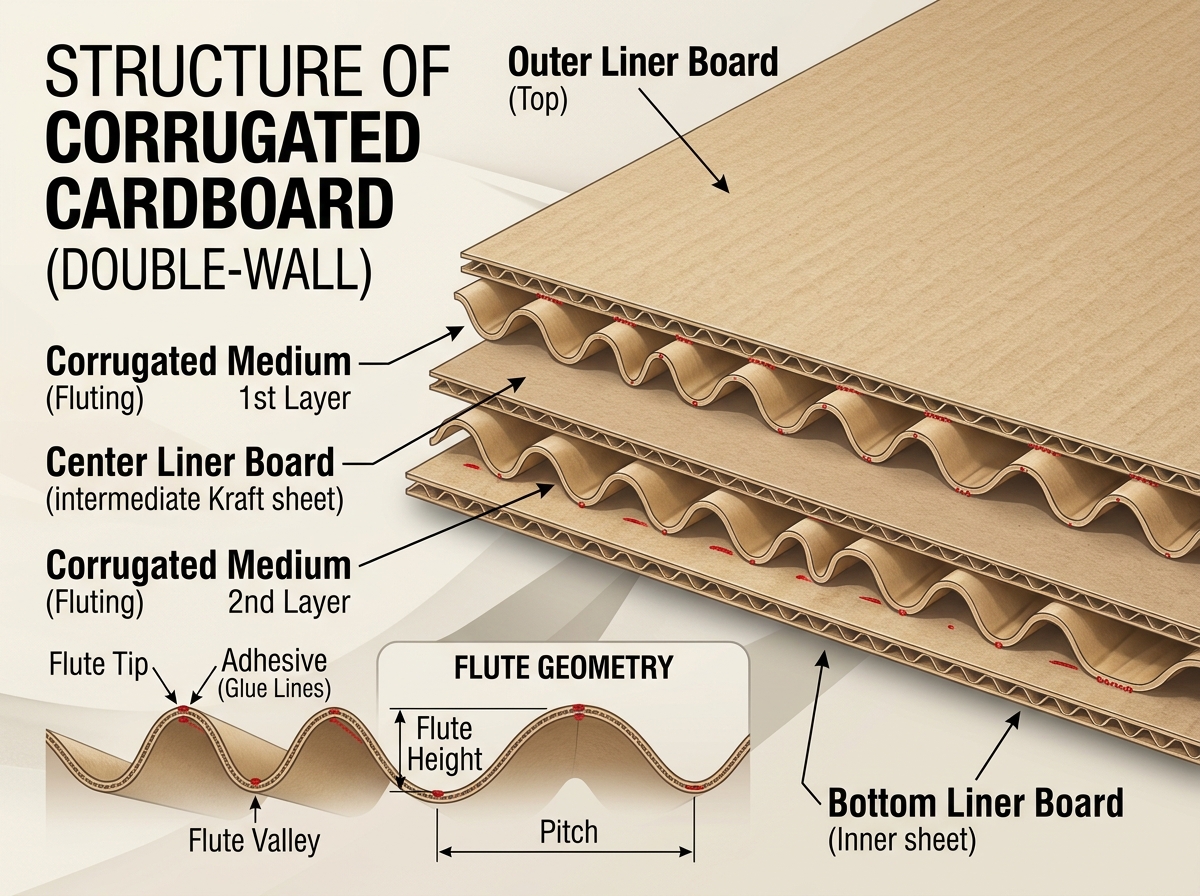
Corrugated cardboard is an engineered sandwich: two flat linerboards with a fluted (wavy) sheet glued between them. This architecture creates air pockets that absorb impact and distribute weight. Corrugated is graded by flute size—E-flute (1/16" thick) for retail packaging, B-flute (1/8") for standard shipping boxes, and C-flute (3/16") for heavy-duty applications. According to the Fibre Box Association, corrugated containers protect products through an average of 17 handling points in the distribution chain.
Rigid boxes (also called set-up boxes) are made from highly condensed paperboard—typically 36 point or thicker—wrapped in printed paper, fabric, or specialty finishes. Unlike folding cartons, rigid boxes arrive fully assembled and hold their shape without contents. They're the material of choice for luxury goods, electronics, and premium gifting. The two-piece construction (separate base and lid) creates the signature slow-reveal unboxing moment.
Durability in packaging isn't a single attribute—it's a combination of crush resistance, puncture resistance, and edge protection. Each material excels in different scenarios.
Kraft paperboard performs well for products under one pound that don't require cushioning. An 18-point kraft box can support moderate stacking in a retail environment but will compress under sustained weight. It offers minimal shock absorption, making it suitable for non-fragile items like apparel, candles, soaps, or cookies in protective sleeves. The material resists tearing better than it resists crushing, so it's ideal when the primary risk is handling rather than impact.
Corrugated cardboard is engineered specifically for distribution stress. The fluted layer acts as a spring, absorbing impacts that would otherwise transfer directly to contents. B-flute and C-flute corrugated can handle stacking weights of 40–60 pounds depending on box dimensions and edge crush test (ECT) ratings. According to Packaging Digest, corrugated performs best when box dimensions are optimized—oversized boxes allow contents to shift, while undersized boxes stress the walls. If you're shipping glass, ceramics, or electronics, corrugated is non-negotiable unless you're adding substantial internal cushioning to a rigid box.
Rigid boxes prioritize structural integrity over shock absorption. The thick chipboard maintains crisp corners and flat surfaces even after repeated handling, which is why they're used for products where presentation matters as much as protection—jewelry, cosmetics, high-end confections. However, rigid boxes don't flex or compress to absorb energy, so fragile contents still need internal padding like molded inserts or tissue wrapping. For small businesses using kraft boxes for small business applications, rigid construction can elevate perceived value without requiring custom printing.
All three materials are cellulose-based and vulnerable to moisture, but they respond differently. Kraft and corrugated will weaken if stored in humid environments or exposed to rain during delivery—corrugated especially, since moisture compromises the adhesive bonding the layers. Rigid boxes fare slightly better due to their density and frequent use of coated wrapping papers, but none of these materials should be considered waterproof without additional treatment like wax coating or poly lining.
Temperature extremes matter less than humidity, but freeze-thaw cycles can cause warping in any paperboard product. If your products ship year-round to varied climates, corrugated with a higher bursting strength rating provides the most consistent performance.
Price per unit is only part of the equation. Total packaging cost includes material, printing, assembly labor, storage space, and shipping weight.
Kraft boxes typically cost $0.15–$0.75 per unit for standard sizes in moderate quantities, depending on dimensions, board thickness, and whether they ship flat or pre-glued. They're the most economical option for businesses that need branded packaging on a limited budget. Kraft also stores efficiently—flat boxes take up minimal warehouse space and can be assembled in seconds. Many small businesses start here because the material cost is low enough to absorb while testing product-market fit.
Corrugated boxes range from $0.30–$2.00+ per unit. E-flute (thin corrugated used for retail packaging) sits at the lower end; heavy-duty C-flute shipping boxes with custom printing push toward the higher end. The cost advantage of corrugated becomes clear when you factor in product damage rates. A $0.50 box that prevents a $20 product return pays for itself immediately. Corrugated also ships flat and stores compactly, though the thicker material takes up more space than equivalent kraft.
Rigid boxes are the premium tier, typically $1.50–$8.00+ per unit depending on size, wrapping material, and interior features like ribbon pulls or magnetic closures. They cannot ship flat—rigid boxes are delivered fully assembled, which increases both storage requirements and inbound freight costs. However, for products with retail prices above $40, the perceived value increase often justifies the expense. Customers frequently reuse rigid boxes for storage, extending your brand presence in their homes.
Understanding what is MOQ in packaging becomes critical here, because minimum order quantities scale with material complexity. Kraft boxes might have MOQs as low as 100–250 units for stock sizes. Corrugated typically starts at 250–500 units for custom sizes, higher if you're adding print. Rigid boxes often require 500–1,000 unit minimums due to the labor-intensive manufacturing process, though some suppliers offer lower MOQs at higher per-unit costs.
Your packaging is a marketing asset. The material you choose determines what's possible in terms of color accuracy, finish options, and fine detail.
Kraft paperboard accepts print well but has limitations. The natural brown surface mutes colors—vibrant reds and blues shift toward earth tones, and pastels can look muddy. Many brands lean into this constraint by using one- or two-color designs that complement rather than fight the substrate. Black, white, and metallic inks (especially gold and copper) create striking contrast on kraft. The material works beautifully for screen printing, flexography, and digital printing. Expect slightly less detail resolution than white coatings, but the organic aesthetic aligns with brands emphasizing sustainability and authenticity.
Corrugated presents more challenges for high-quality print. The fluted structure creates a slightly uneven surface, and the linerboard (outer layer) is usually a coarser kraft paper. Flexographic printing is the industry standard for corrugated—it's fast and economical but limited to simpler designs and spot colors. If you need photographic images or fine gradients on corrugated, you'll want to spec a white-top linerboard and potentially add a litho-laminate (a pre-printed sheet laminated to the corrugated), which increases cost significantly. For many shipping applications, a simple one-color logo is sufficient and keeps costs down.
Rigid boxes offer the highest print fidelity because you're printing on the wrapping paper before it's mounted to the chipboard. This allows for offset lithography, digital printing, or specialty techniques like foil stamping, embossing, debossing, and spot UV. You can achieve full-color photographic reproduction, fine typography, and intricate patterns. The smooth surface also accommodates textured papers, linen wraps, and even fabric coverings. If your brand identity relies on precise color matching and tactile details, rigid boxes provide the canvas to execute it.
One practical consideration: kraft and corrugated boxes can often be customized with stamps, stickers, or labels as a lower-cost alternative to full custom printing, especially useful when testing new designs or running limited seasonal promotions. Rigid boxes, due to their wrapped construction, are harder to customize post-production without compromising the premium look.
The right material depends on what you're selling, where it's going, and who's buying it.
Kraft boxes are ideal for:
A resealable treat bag inside a kraft box works well for cookie assortments or small confections, combining the structure of the box with the freshness-preserving function of the bag.
Corrugated boxes are ideal for:
If you're shipping bottles or canned goods, pairing corrugated with interior dividers prevents breakage. A windowed wine box demonstrates how corrugated can incorporate display features while maintaining protective function.
Rigid boxes are ideal for:
Rigid boxes work especially well when the unboxing experience is shared on social media—the slow-reveal lid lift and crisp construction photograph better than folding cartons.
Many successful packaging programs use different materials for different contexts. A skincare brand might use rigid boxes for retail and gift sets, kraft boxes for limited-edition seasonal releases, and corrugated mailers for e-commerce fulfillment. This tiered approach lets you optimize cost and presentation for each channel without compromising brand consistency.
Another common hybrid: a printed kraft or rigid inner box nested inside an unprinted corrugated shipper. The outer layer protects during transit; the inner layer delivers the branded experience. This is especially effective for direct-to-consumer brands that want to control the unboxing moment without paying for full-color corrugated printing.
Some businesses also vary materials by product line. A bakery might use kraft for everyday cookies and rigid boxes for wedding favors or corporate gifts. The material choice reinforces the product's positioning and price tier.
All three materials are recyclable and biodegradable, but their environmental profiles differ in sourcing, manufacturing energy, and end-of-life processing.
Kraft paperboard is often made from recycled content or sustainably managed forests certified by the Forest Stewardship Council. The unbleached process uses fewer chemicals than white paperboard production. Kraft's single-layer structure also means less material by weight compared to corrugated, which can reduce transportation emissions when shipping empty boxes to your facility.
Corrugated cardboard has the highest recycling rate of any packaging material in North America—around 96% according to industry data. The material is designed for repeated recycling, with fibers that can be reprocessed multiple times before degrading. However, corrugated production is energy-intensive due to the lamination process, and the material is heavier than kraft, increasing freight impact.
Rigid boxes use the densest chipboard, which often contains high percentages of post-consumer recycled content. The wrapping paper, however, may include coatings, foils, or laminates that complicate recycling. Customers are more likely to reuse rigid boxes than discard them immediately, which extends the product's useful life but also means the material stays out of the recycling stream longer.
If sustainability is a core brand value, communicate your material choices clearly. Customers appreciate transparency about recycled content percentages, certifications, and disposal instructions printed directly on the packaging.
Start by answering these questions:
What is your product's weight and fragility? Under 1 lb and non-fragile: kraft or thin corrugated. Over 1 lb or fragile: corrugated with appropriate cushioning. High-value and compact: rigid with interior padding.
What is your sales channel? Retail shelf: kraft or rigid for visual appeal. E-commerce: corrugated for shipping protection. Both: consider a dual-layer approach.
What is your price point? Under $20: kraft keeps packaging costs proportional. $20–$50: corrugated or entry-level rigid. Over $50: rigid boxes reinforce premium positioning.
What is your brand aesthetic? Natural, eco-conscious, artisan: kraft. Bold, graphic, modern: printed corrugated or rigid with coated wrap. Luxury, tactile, gift-focused: rigid.
What is your order volume? Check MOQs against your sales velocity. Ordering a six-month supply of kraft boxes is manageable; a six-month supply of rigid boxes might overwhelm your storage.
What is your timeline? Stock kraft and corrugated boxes can ship in days. Custom printing adds 2–4 weeks. Rigid boxes often require 4–8 weeks for production, especially for first-time orders with new tooling.
Test before committing to large orders. Order samples of each material in your target size, pack your actual product, and evaluate the fit, protection, and presentation. Ship a few test packages to yourself or friends in different locations to assess real-world durability.
Kraft boxes can work for shipping lightweight, non-fragile items if they're placed inside a padded mailer or outer corrugated box. Shipping kraft boxes alone risks crushing and moisture damage during transit. For anything over one pound or remotely fragile, corrugated is the safer choice.
Rigid boxes make sense when packaging is a key part of your value proposition and your product price point can absorb the cost—typically $40 and up. If you're just starting out, consider using rigid boxes for a hero product or gift set while using kraft or corrugated for your everyday line. You can always upgrade as revenue grows.
E-flute (1/16" thick) works for lightweight retail packaging and mailers. B-flute (1/8") is the standard for most e-commerce shipping boxes. C-flute (3/16") is for heavier products or boxes that will be stacked on pallets. Your packaging supplier can recommend the right flute based on your product weight and distribution method.
Yes, but the natural brown substrate will shift your colors toward warmer, earthier tones. Vibrant blues and bright whites won't reproduce accurately. Many brands design specifically for kraft, using black, white, or metallic inks that contrast beautifully with the brown background. If you need precise color matching, consider printing on white-coated kraft or switching to rigid boxes with white wrapping paper.
All three materials are recyclable and compostable, so "most sustainable" depends on your priorities. Kraft uses less material by weight and fewer chemicals in production. Corrugated has the highest recycling rate and often contains recycled content. Rigid boxes are frequently reused by customers, extending their lifecycle. The most sustainable choice is the one that's appropriately sized for your product, minimizes waste, and aligns with your customers' disposal habits.