Cart
0
You may also like


Book a call with our development team to get started.



Apply online and access wholesale pricing.

Most companies gift to multiple audiences during the holiday season—all employees receive something, top performers get an upgrade, key clients expect premium treatment, and prospects receive introductory touches. The challenge isn't just selecting different gifts for each group. It's creating a tiered corporate gift packaging system that looks intentional, maintains brand consistency, and signals appropriate value at every level without appearing arbitrary or tone-deaf.
A well-designed tiered packaging strategy uses visual consistency as the foundation—the same color palette, similar materials, recognizable branding—while varying perceived value through box size, construction quality, and finishing details. Done well, it allows you to allocate budget strategically while ensuring every recipient feels acknowledged. Done poorly, it creates visible inequity that undermines the gesture entirely.
This guide covers how to build a coordinated corporate holiday gift packaging system across multiple recipient tiers, from selecting anchor design elements that unify the program to choosing specific box styles and finishes that differentiate value levels without breaking visual coherence.
Corporate gifting is no longer a one-size-fits-all function. Tiered programs that scale gift quality with relationship level ensure everyone feels acknowledged without breaking the budget. The packaging itself becomes a visible signal of how the company values different relationships—and recipients notice.
When an entire company receives identical gifts regardless of tenure, performance, or role, high performers often feel undervalued. When there's no visual connection between what employees receive and what clients get, the program feels fragmented rather than strategic. Tiered packaging solves both problems by creating a spectrum of presentation options that share a common design language but vary in material quality, size, and finishing.
The business case is straightforward. Tiered programs that scale gift value to account value prevent overspending while maintaining meaningful impact at every level of the relationship. You're not giving everyone a premium magnetic-closure box when a well-designed tuck-top would communicate the same appreciation. You're reserving the premium finishes for the relationships where they'll generate the highest return—renewals, referrals, long-term loyalty.
Budget allocation becomes more defensible when the packaging itself reflects strategic prioritization. A $30 gift in a structured kraft gift box with a branded belly band reads as more thoughtful than a $50 gift in generic packaging, and the cost difference can be redirected toward higher-tier recipients.
Before selecting boxes, map your recipient segments and assign each a clear objective. Most corporate programs include three to five tiers, each with different relationship goals and corresponding budget ranges.
A practical framework starts with broad employee recognition—everyone who's been with the company for at least 90 days. The goal here is acknowledgment, not differentiation. Packaging should be clean, branded, and appropriately sized for the contents, but doesn't need premium finishes. A simple cube or rectangular tuck-top box in kraft or white works well, especially when paired with a branded sticker or printed belly band.
The next tier typically covers top performers, long-tenure employees, or department leads. Here the objective shifts from acknowledgment to reinforcement—you're signaling that exceptional work is noticed and valued. Packaging at this level benefits from an upgrade in finish (a ribbon closure instead of a sticker, slightly heavier cardstock) or size (a larger box that accommodates layered contents). The visual connection to the base tier should remain clear, but the presentation feels elevated.
Client and partner tiers require more nuance. Prospects and newer clients fall into a mid-tier category where the goal is relationship building without overcommitment. Packaging should look professional and on-brand but not so lavish that it creates discomfort or obligation. A well-constructed rectangular box with a clean finish and subtle logo treatment typically lands in the right range.
Key accounts, long-term clients, and strategic partners occupy the premium tier. The objective is retention and deepening the relationship. Packaging at this level justifies premium finishes—magnetic closures, embossed logos, foil accents, grosgrain ribbon. The box itself becomes part of the gift, something recipients might repurpose rather than discard. When planning corporate holiday gift timelines, remember that custom finishes for premium tiers often require longer lead times.
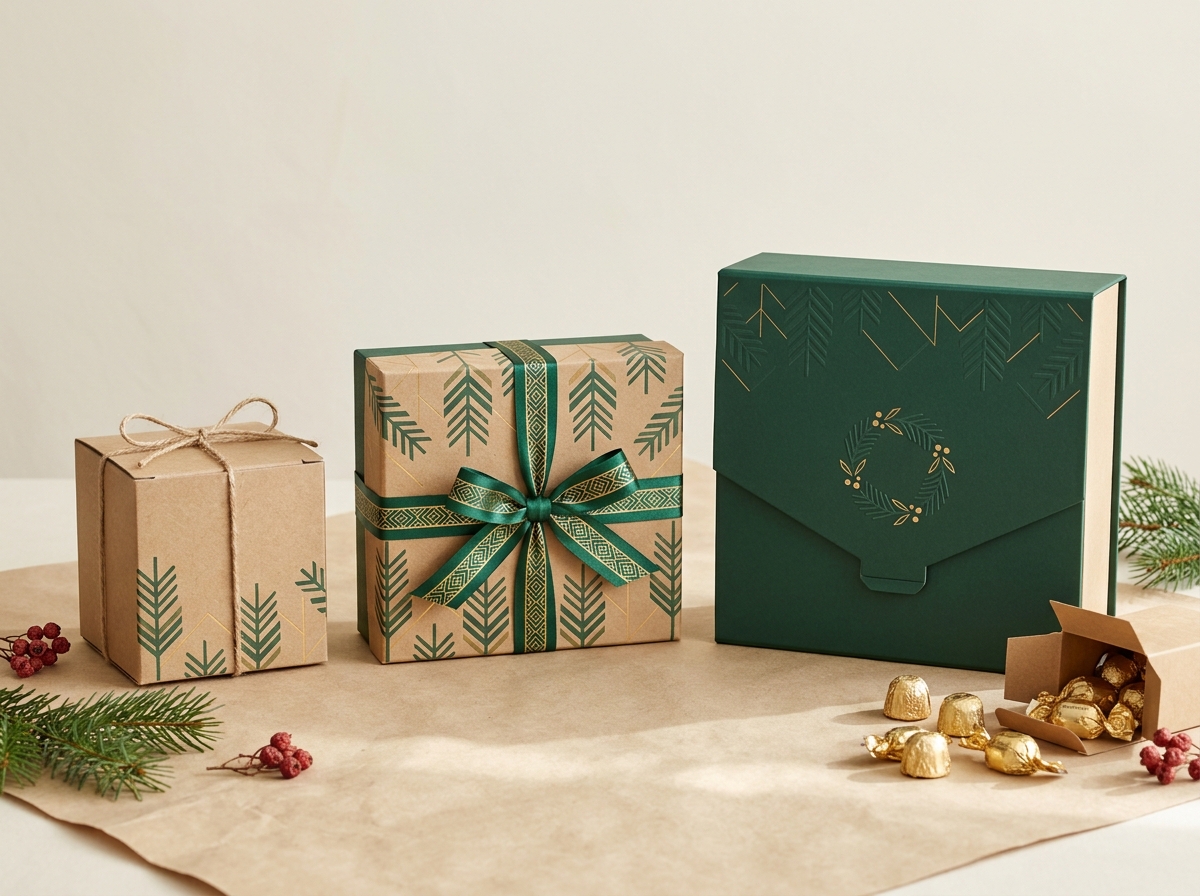
The anchor elements that unify a tiered packaging program are color palette, material family, and branding treatment. These stay consistent across every tier, creating immediate visual recognition while allowing variation in quality and detail.
Start with a primary packaging color that aligns with your brand but doesn't require custom printing. Kraft, white, and black are the most versatile—they're available across a wide range of box styles and sizes, they photograph well, and they accept both printed and applied branding. If your brand colors are strongly associated with your identity (a recognizable blue, green, or red), consider using them as accent elements—ribbon, tissue paper, stickers—rather than requiring custom box printing, which often comes with high minimums and long lead times.
Material consistency matters more than most companies expect. If your base tier uses a matte kraft paperboard, your premium tier should use a heavier-weight matte kraft or a textured natural fiber, not a glossy coated stock. The materials should feel like an evolution of the same design language, not a departure into a different aesthetic. This is where quiet branding strategies become especially valuable—subtle, high-quality finishes communicate premium positioning without requiring loud logos.
Branding treatment should scale in sophistication, not size. A small embossed logo on a premium box reads as more refined than a large printed logo on the same box. For base tiers, a printed kraft sticker or a simple one-color belly band provides brand presence without adding significant cost. Mid-tier packaging benefits from printed ribbon or a two-color band. Premium tiers justify embossing, foil stamping, or custom-printed interiors.
Avoid the temptation to use completely different packaging families for different tiers. A cube box for employees and a cylinder for clients breaks visual coherence. Instead, vary the dimensions and finishes within the same box family—small cubes for base tier, larger rectangles for mid-tier, oversized or specialty shapes for premium.
Box construction and dimensions are the most visible differentiators between tiers. The goal is to create a clear hierarchy of presentation quality without requiring custom manufacturing for every level.
For base-tier employee gifts, cube tuck-top boxes offer the best combination of cost, availability, and perceived quality. They're sturdier than folding cartons, they accommodate a range of contents (small items, treats, a few pieces of branded merchandise), and they stack efficiently for storage and distribution. A 3x3x3 kraft cube works well for compact gifts, while a 4x4x4 provides room for layered presentation with tissue or shred.
Mid-tier packaging benefits from a shift to rectangular boxes, which naturally accommodate more contents and create a more substantial unboxing experience. A 6x6x3 or 8x5x5 rectangular tuck-top provides enough interior volume for multiple items or a feature gift with supporting elements. The larger footprint also offers more surface area for branding—a belly band or ribbon wrap becomes more prominent and visually impactful.
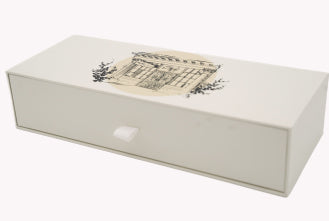
Premium-tier boxes justify an upgrade in closure mechanism. Magnetic-closure rigid boxes, drawer-style boxes, or hinged-lid constructions all signal higher perceived value than tuck-tops, even when the exterior dimensions are similar. These styles also encourage reuse—recipients are more likely to keep and repurpose a well-constructed magnetic box than a disposable folding carton, which extends brand visibility beyond the initial gift moment.
For client gifts that include bottles—wine, spirits, gourmet oils—wine bottle gift boxes provide a natural tier differentiation. A single-bottle kraft box with a tuck-top closure works for mid-tier clients, while a two-bottle rigid box with a magnetic closure and custom insert elevates the presentation for key accounts.
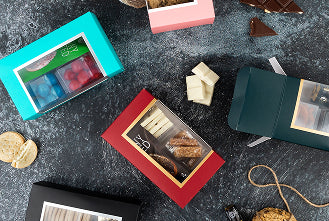
When contents are edible—cookies, chocolates, baked goods—consider how the box construction affects product protection and presentation. Bakery box packaging with window panels works well for mid-tier gifts where product visibility adds appeal, while solid-wall boxes with interior inserts create a more premium reveal for top-tier recipients.
Once box style and size establish the basic hierarchy, finishing details refine the perceived value at each tier. These are the elements recipients notice immediately—closures, interior treatments, protective layers, and decorative accents.
Closure methods create an instant visual cue about gift tier. Base-tier boxes typically use tuck-top or simple lift-off lids. Mid-tier benefits from ribbon ties, elastic bands, or branded stickers that require a deliberate opening action. Premium-tier closures—magnetic snaps, grosgrain ribbon with a bow, custom belly bands with a tear strip—add a sense of ceremony to the unboxing.
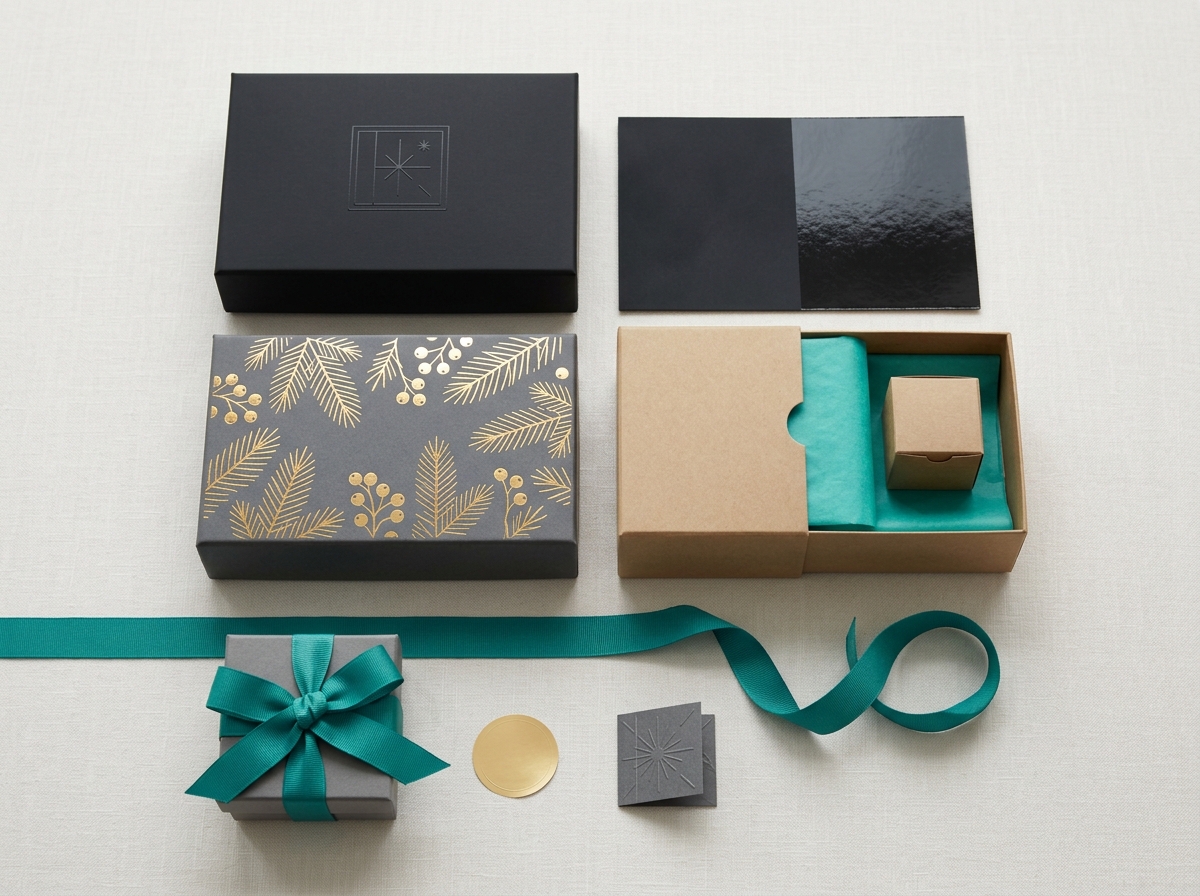
Interior treatments are often overlooked but highly effective at differentiating tiers. Base-tier boxes can use simple white tissue paper or kraft crinkle shred for cushioning. Mid-tier upgrades to colored tissue that coordinates with brand colors or printed tissue with a subtle logo pattern. Premium-tier interiors justify custom inserts, printed box liners, or layered tissue in complementary colors that create a reveal effect when the box is opened.
Surface finishes on the box exterior also ladder in cost and impact. Uncoated kraft or white paperboard is the most economical and works well for base tiers. A matte coating adds a subtle refinement for mid-tier without a dramatic cost increase. Soft-touch coatings, spot UV, or metallic foils are premium finishes that justify the investment only for top-tier recipients where the packaging itself contributes to long-term brand recall.
Protective elements like tissue wrapping, ribbon, or custom sleeves serve dual purposes—they protect contents during shipping and add layers to the unboxing experience. For base tiers, a single sheet of tissue is sufficient. Mid-tier can add a coordinating ribbon or a printed band. Premium tiers benefit from multiple tissue layers, ribbon with a hand-tied bow, or a custom-printed sleeve that slides over the box and reinforces branding before the box is even opened.
The most effective tiered packaging programs align box selection with both the contents and the allocated budget for each recipient segment. Mismatches—premium packaging with a low-value gift, or expensive contents in flimsy packaging—undermine the entire gesture.
Start by defining the total budget per recipient for each tier, then allocate a percentage to packaging. A common framework is 15-25% of the total gift value for base and mid-tiers, and up to 30-35% for premium tiers where the packaging itself contributes to perceived value and long-term brand presence. If the total budget for a base-tier employee gift is $20, allocating $3-4 to packaging leaves $16-17 for contents—enough for a small branded item, treats, or a gift card with a thoughtful presentation.
Contents should justify the packaging tier. A $10 gift card in a premium magnetic box feels mismatched—the packaging overpromises and the contents underdeliver. The same gift card in a well-designed small white cube box with a branded sticker and a handwritten note reads as appropriately scaled and thoughtful.
For food gifts, packaging must also meet functional requirements. Cookies, chocolates, and baked goods need grease-resistant interiors and enough structural integrity to prevent crushing during shipping. If you're coordinating a tiered program that includes edible items across multiple recipient groups, select box styles that offer the same material and construction quality across sizes—this maintains visual consistency while ensuring all food items arrive in good condition.
Volume purchasing creates opportunities to reduce per-unit packaging costs, especially for base and mid-tiers where you're likely ordering hundreds of units. Understanding minimum order quantities for different box styles helps you plan orders that hit volume discounts without over-purchasing. Premium-tier packaging often requires smaller quantities, so those boxes may not benefit from the same economies of scale—but the higher per-unit cost is justified by the smaller recipient pool and the strategic importance of those relationships.
Once the packaging tiers are defined, execution requires coordination across sourcing, assembly, and distribution. The larger the program, the more critical it becomes to standardize processes and create clear guidelines for who receives which tier.
Sourcing should happen as early as possible, especially for premium-tier boxes with custom finishes. Standard kraft and white boxes are typically available with short lead times, but embossed logos, custom printing, or specialty closures can require 6-8 weeks or more. Ordering all tiers simultaneously, even if assembly happens in phases, prevents delays and ensures inventory is available when you need it.
Create a clear recipient matrix that maps individuals or accounts to specific tiers based on objective criteria—tenure, role, account value, contract size. This removes ambiguity during assembly and prevents the awkward situation where two people in the same department receive visibly different gift tiers without a clear rationale. Transparency isn't always possible, but internal consistency is non-negotiable.
Assembly workflows benefit from staging by tier. Set up separate packing stations for each tier with the corresponding boxes, contents, and finishing materials. This reduces errors and speeds up the process, especially when you're working with volunteers or temporary staff who may not be familiar with the full program structure. Label each station clearly and provide a visual reference (a fully assembled sample box) so packers can match the intended presentation.
Shipping and delivery logistics should also account for tier differentiation. Premium-tier gifts to key clients often justify individual shipments with tracking and signature confirmation. Mid-tier client gifts can often be batched by region or account. Base-tier employee gifts are typically distributed internally, either through department managers or at a company event, which eliminates shipping costs entirely and allows for a personal handoff that reinforces the gesture.
Even well-intentioned tiered programs can backfire when execution doesn't align with strategy. The most common mistakes are visible inequity, inconsistent branding, and mismatched packaging-to-contents ratios.
Visible inequity happens when recipients in the same physical space receive dramatically different packaging without a clear reason. If two employees sitting next to each other get the same gift in completely different boxes, the one with the simpler packaging feels slighted, even if the contents are identical. Avoid this by ensuring that tier differentiation is tied to transparent criteria (role, tenure, performance tier) and that base-tier packaging still looks intentional and on-brand, not like an afterthought.
Inconsistent branding across tiers creates confusion rather than cohesion. If your base-tier boxes are kraft with a white logo sticker, your mid-tier boxes are black with a gold foil logo, and your premium boxes are white with an embossed logo, the program doesn't read as coordinated—it reads as three separate initiatives. Maintain a consistent color palette and logo treatment style across all tiers, varying only the application method (printed, foil, embossed) and the prominence of the branding.
Mismatched packaging-to-contents ratios undermine perceived value in both directions. Over-packaging a modest gift creates disappointment when the box is opened. Under-packaging a premium gift makes the contents feel less valuable than they are. The packaging should set appropriate expectations—a substantial box should contain a substantial gift, and a compact box should feel complete and well-curated, not sparse.
Waiting too long to order is the most preventable mistake and one of the most common. Premium finishes, custom printing, and specialty closures all extend lead times. If you're planning a December delivery and you haven't ordered packaging by early October, you're likely too late for anything beyond stock boxes with applied branding. Build in buffer time, especially for first-time programs where you're still refining quantities and specifications.
The effectiveness of a tiered packaging program isn't just about aesthetics—it should produce measurable outcomes aligned with the objectives you defined for each recipient segment.
For employee-facing tiers, track engagement and retention metrics. Well-planned gifting programs have been linked to higher employee satisfaction, stronger client relationships, improved customer retention, and measurable business results. Post-gift surveys can capture immediate reactions (did the gift feel appropriate, did it make you feel valued), while longer-term metrics like voluntary turnover and internal referrals indicate whether the program is contributing to retention and culture.
For client and partner tiers, measure relationship outcomes rather than just delivery confirmation. Did the gift prompt a thank-you call or email that opened a conversation? Did accounts that received premium-tier gifts show higher renewal rates or contract expansions in the following quarter? According to Coresight Research, 80% of companies say corporate gifting has improved relationships with employees and clients, while 43% identify customer loyalty as one of the top benefits of their gifting program.
Budget efficiency is also a valid metric. Compare the total cost per recipient across tiers and evaluate whether the incremental investment in premium packaging for top-tier recipients generated proportional returns. If a $15 upgrade in packaging for a key account contributed to a $50,000 contract renewal, the ROI is clear. If the same upgrade for a prospect didn't move the relationship forward, the allocation may need adjustment.
Qualitative feedback matters too. Pay attention to how recipients talk about the gift—do they mention the packaging, the presentation, the unboxing experience? When clients or employees share photos on social media or in internal channels, note what they're highlighting. If the packaging consistently gets called out as thoughtful or impressive, it's working. If no one mentions it, it may be too subtle or generic to make an impact.
Most effective programs include three to four tiers: a base tier for broad employee recognition, a mid-tier for top performers or valued clients, a premium tier for key accounts and strategic partners, and optionally a prospect or introductory tier for relationship-building touches. More than five tiers creates unnecessary complexity and dilutes the visual coherence of the program. Fewer than three limits your ability to allocate budget strategically and differentiate value appropriately.
Allocate 15-25% of the total per-recipient budget to packaging for base and mid-tiers, and up to 30-35% for premium tiers where the packaging itself contributes to long-term brand presence and reuse. If the total budget for a mid-tier client gift is $75, spending $15-20 on a well-constructed box with branded finishing is appropriate. For a $200 premium gift, allocating $60-70 to a magnetic-closure rigid box with custom interior and embossed branding is justified by the relationship value.
Yes, and this is often the most effective approach for maintaining visual consistency. Using the same box family—such as kraft tuck-top cubes—across all tiers and varying only the dimensions and finishing details (ribbon, tissue color, closure type) creates a cohesive program that's immediately recognizable as part of the same initiative. Size differentiation naturally signals value hierarchy without requiring completely different packaging styles.
Tie tier differentiation to transparent, objective criteria such as role, tenure, performance level, or account responsibility. When employees understand that top performers or long-tenure colleagues receive an upgraded gift as recognition for specific contributions, the differentiation feels earned rather than arbitrary. Ensure that base-tier packaging still looks intentional and on-brand—if it appears generic or careless, recipients will feel undervalued regardless of the tier structure.
Minimum order quantities vary by customization level. Stock boxes with applied branding (stickers, printed bands) often have no minimum or minimums as low as 25-50 units. Custom-printed boxes typically require 250-500 units per design. Premium finishes like embossing or foil stamping may require 500-1,000 units to justify setup costs. For tiered programs, many companies use stock boxes with applied branding for base and mid-tiers, reserving custom printing for premium tiers where the higher per-unit cost is justified by the smaller, high-value recipient pool.
A well-designed tiered corporate gift packaging program does more than organize logistics—it creates a visual system that reinforces how your company values different relationships. When every tier looks intentional, when the design language is consistent across recipient groups, and when the packaging quality aligns with the strategic importance of each relationship, the program becomes a tool for relationship building rather than just a seasonal obligation.
The most effective programs start with clear objectives for each recipient segment, establish a unified visual identity across all tiers, and use box style, size, and finishing to create a natural value hierarchy. They allocate budget strategically, reserving premium finishes for the relationships where they'll generate the highest return, while ensuring that even base-tier packaging communicates care and brand alignment.
Execution requires early planning, especially for premium tiers with custom finishes and longer lead times. It requires clear internal guidelines for who receives which tier, and it requires packaging that sets appropriate expectations—substantial enough to signal value, but not so elaborate that it overpromises what's inside.
When tiered packaging is done well, recipients at every level feel acknowledged in a way that's appropriate to the relationship. Employees see that their contributions are recognized. Clients understand that the company invests in relationships proportionally. And the packaging itself becomes a tangible representation of how your company approaches partnership—thoughtfully, strategically, and with attention to the details that make people feel valued.