Cart
0
You may also like


Book a call with our development team to get started.



Apply online and access wholesale pricing.

Sustainable packaging for small business isn't just a trend—it's a customer expectation that directly impacts purchasing decisions. According to a 2020 Business Wire report, 74% of consumers are willing to pay more for sustainable packaging, and that number continues to climb. For small businesses navigating custom packaging for small businesses, the challenge lies in balancing environmental responsibility with budget constraints, material performance, and transparent communication. This guide breaks down the materials, certifications, and messaging strategies that help you meet customer expectations without sacrificing quality or profitability.
Customer demand for eco-friendly options has shifted from niche to mainstream. Small businesses that adopt sustainable packaging gain competitive advantages beyond environmental impact: stronger brand loyalty, higher perceived value, and access to retail partnerships that require sustainability standards. A McKinsey survey found that 60% of consumers consider sustainability when making purchases, with younger demographics weighting it even more heavily.
For small businesses, sustainable packaging also addresses practical concerns. Many eco-friendly materials—particularly kraft and corrugated options—offer durability and cost-effectiveness that rival conventional packaging. The key is understanding which materials align with your product needs, shipping requirements, and brand positioning. When evaluating options, consider both the material's environmental footprint and its functional performance during storage, transit, and unboxing.
Not all sustainable packaging materials perform the same way or suit every business model. The three most accessible categories for small businesses are recycled content packaging, renewable materials, and compostable or biodegradable options. Each brings distinct advantages and trade-offs in cost, durability, and end-of-life disposal.
Recycled kraft and corrugated boxes represent the most widely adopted sustainable option for small businesses. These materials use post-consumer or post-industrial waste fiber, reducing demand for virgin pulp. Recycled kraft maintains structural integrity for gift boxes, mailers, and retail packaging while offering a natural aesthetic that communicates eco-consciousness without additional printing. Many suppliers offer boxes with 80-100% recycled content at price points comparable to virgin materials, especially when ordering at moderate volumes. If you're exploring material options, our guide on choosing custom packaging materials compares performance characteristics across kraft, corrugated, and rigid options.
Recycled materials work particularly well for businesses shipping non-fragile products or creating gift sets where the unboxing experience matters. A rectangle gift box tower with ribbon made from recycled kraft delivers visual impact while supporting sustainability claims. The natural brown tone of kraft also reduces the need for heavy ink coverage, further lowering environmental impact.
Forest Stewardship Council (FSC) certification guarantees that paper and wood fiber come from responsibly managed forests. For small businesses, FSC certification provides third-party verification that strengthens sustainability messaging and meets requirements for many retail partnerships. FSC-certified materials are available across most paper-based packaging categories, from gift boxes to tissue paper, often with minimal price premiums over non-certified alternatives.
When sourcing FSC materials, look for the FSC Mix label, which indicates a blend of FSC-certified and recycled content—this typically offers the best balance of cost and environmental benefit for small businesses. FSC Pure (100% certified virgin fiber) and FSC Recycled are also available but may carry higher costs or limited availability depending on your supplier and order volume.
Compostable packaging breaks down into organic matter under specific conditions, while biodegradable materials decompose naturally over time. For small businesses, compostable cellophane bags and plant-based films offer alternatives to traditional plastic for product protection and gift presentation. However, these materials require customer education: most compostable packaging needs industrial composting facilities to break down properly and won't decompose in landfills or home compost bins.
Compostable options work best for businesses whose customers have access to municipal composting programs or who are willing to invest in customer education. They're particularly effective for food-related businesses, beauty products, and gift items where the packaging's brief functional life makes rapid decomposition valuable. When considering volume requirements, understanding minimum order quantities for packaging helps you evaluate whether specialty materials like compostable films fit your budget and storage capacity.
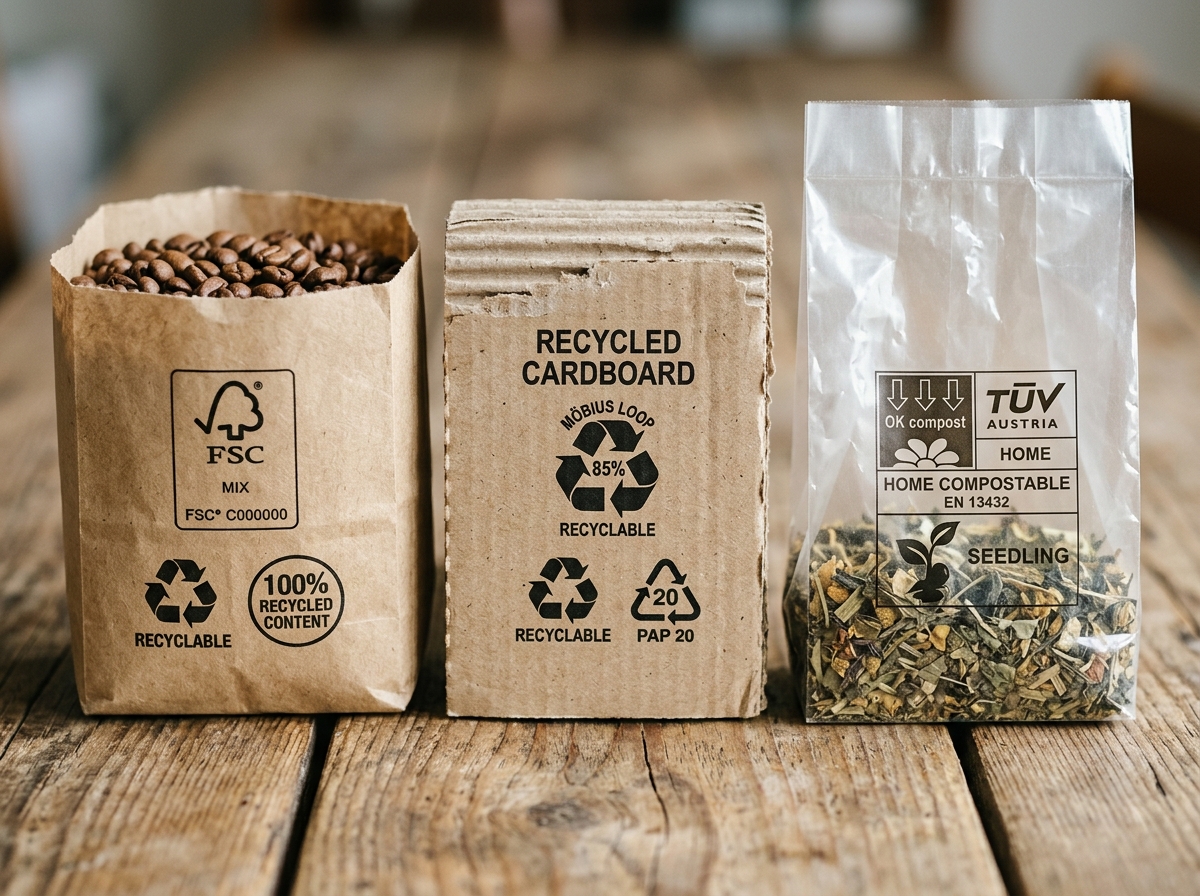
The recyclable versus compostable debate centers on infrastructure and customer behavior. Recyclable packaging—particularly paper and cardboard—benefits from established municipal recycling systems that most customers can access. Compostable packaging, while appealing in theory, faces significant barriers: limited industrial composting availability, customer confusion about disposal, and contamination risks when compostable materials enter recycling streams.
For most small businesses, recyclable materials offer the clearest path to measurable environmental impact. Paper-based packaging enjoys high recycling rates when kept clean and dry, and customers understand how to dispose of it properly. Mono-material designs—packaging made from a single material type—maximize recyclability by eliminating the need to separate components. A kraft gift box with paper-based ribbon and minimal adhesive recycles more easily than a box with plastic windows, foam inserts, or laminated coatings.
Compostable packaging makes strategic sense when your product or brand story specifically emphasizes zero-waste principles, when you serve customers in regions with robust composting infrastructure, or when you're packaging items that may contaminate traditional recycling (food residue, oils, or organic materials). If you choose compostable materials, invest in clear disposal instructions printed directly on the packaging or included as inserts—customer confusion is the primary barrier to proper composting.
Sustainability certifications provide third-party validation, but not all carry equal weight or relevance for small business packaging. Focus on certifications that are widely recognized, independently verified, and directly tied to measurable environmental standards.
FSC (Forest Stewardship Council): The gold standard for paper and wood products. FSC certification verifies responsible forest management, chain of custody tracking, and social responsibility standards. Look for FSC Mix or FSC Recycled labels on kraft boxes, tissue paper, and cardboard.
SFI (Sustainable Forestry Initiative): Another forest certification program, more common in North America. While less stringent than FSC in some areas, SFI certification still indicates responsible sourcing and is accepted by many retailers.
BPI (Biodegradable Products Institute): Certifies compostable packaging meets ASTM D6400 standards for industrial composting. Essential if you're making compostability claims—without BPI or equivalent certification, you risk greenwashing accusations.
How2Recycle Label: Not a certification but a standardized labeling system that clarifies disposal instructions. This label helps customers understand whether packaging is widely recyclable, recyclable in limited locations, or not recyclable, reducing contamination and improving actual recycling rates.
Avoid vague or self-created "eco-friendly" badges without third-party verification. Customers and regulators increasingly scrutinize unsubstantiated environmental claims, and the reputational risk of greenwashing far outweighs any short-term marketing benefit.
Greenwashing—making misleading or exaggerated environmental claims—damages customer trust and invites regulatory scrutiny. Small businesses should communicate sustainability efforts with specificity, transparency, and humility. Instead of broad claims like "eco-friendly packaging," describe exactly what makes your packaging sustainable: "Our gift boxes use 90% post-consumer recycled kraft and are fully recyclable in curbside programs."
Effective sustainability messaging includes three elements: what the material is, why it matters, and how customers should dispose of it. A product insert or website page that explains your packaging choices builds credibility and educates customers. For example: "We chose FSC-certified kraft for these boxes because it supports responsible forest management. After enjoying your gift, please recycle this box with your paper products."
Acknowledge limitations honestly. If your packaging includes a small plastic window for product visibility, explain that choice: "This box features a small PET window so you can see the product inside. The box body is fully recyclable; please remove the window before recycling if your local facility requires it." Transparency about trade-offs demonstrates integrity and helps customers make informed disposal decisions.
When designing packaging that creates a memorable unboxing experience on a small business budget, sustainable materials can enhance rather than compromise the presentation. Natural kraft textures, minimalist designs, and paper-based ribbons communicate quality and environmental consciousness simultaneously.
Sustainable packaging must still protect products during shipping and create positive customer experiences. Material selection depends on product fragility, shipping distance, and brand positioning. Kraft and corrugated materials offer excellent crush resistance and cushioning for most products, while maintaining recyclability. For businesses shipping delicate items, consider recycled corrugate with paper-based cushioning or molded pulp inserts rather than foam or plastic bubble wrap.
Presentation quality matters, especially for gift-focused businesses. Sustainable materials don't require sacrificing aesthetics—many brands have built strong visual identities around natural kraft, recycled textures, and minimal printing. A well-designed hexagon gift box tower with ribbon in natural kraft creates visual interest through structure and form rather than heavy printing or synthetic materials.
For businesses requiring moisture or grease barriers, look for paper-based coatings rather than plastic lamination. Water-based coatings and natural wax treatments provide functional barriers while maintaining recyclability or compostability. These solutions typically cost more than conventional plastic coatings but offer meaningful environmental advantages without compromising product protection.
Sustainable packaging often carries a price premium, but the gap has narrowed significantly as demand has increased and production has scaled. Recycled kraft boxes typically cost 5-15% more than virgin material equivalents, while FSC-certified options may add 3-10% depending on the supplier and order volume. Compostable films and specialty materials generally carry higher premiums, often 20-40% above conventional plastic alternatives.
Small businesses can manage these costs through strategic choices. Ordering at higher volumes reduces per-unit costs, making minimum order quantities an important consideration. Stock sizes cost less than fully custom dimensions, and limiting color printing to one or two ink colors on natural kraft reduces both cost and environmental impact. Many businesses find that customers willingly accept slightly higher prices when sustainability is clearly communicated—the same consumer research showing willingness to pay more for sustainable packaging demonstrates that transparency about environmental efforts builds brand value.
Consider the total cost of packaging beyond material price. Lightweight sustainable materials may reduce shipping costs, and simplified designs with fewer components lower assembly time and labor. Some businesses offset higher packaging costs by reducing other marketing expenses—sustainable packaging itself becomes a marketing tool that communicates brand values without additional advertising spend.
When evaluating packaging suppliers for sustainable options, ask specific questions about materials, certifications, and supply chain transparency. Request documentation for any environmental claims: FSC chain-of-custody certificates, recycled content verification, or compostability test results. Reputable suppliers provide this documentation readily and can explain their sourcing practices in detail.
Key questions to ask include: What percentage of recycled content does this material contain? Is the material certified by FSC, SFI, or another recognized body? Can you provide chain-of-custody documentation? What disposal method do you recommend for end customers? Are inks and adhesives compatible with recycling or composting? What are the minimum order quantities for sustainable options versus conventional materials?
Understanding supplier capabilities helps you make informed decisions that balance sustainability goals with practical constraints. Some suppliers offer smaller minimum orders for stock sustainable packaging, making it easier for small businesses to test materials before committing to large custom orders. Our resource on custom kraft boxes for small business explores budget-friendly eco-friendly options in detail.
Transitioning to sustainable packaging doesn't require an overnight overhaul. Most small businesses benefit from a phased approach that allows testing, customer feedback, and budget management. Start by auditing current packaging: identify which components have the highest environmental impact and which have readily available sustainable alternatives.
Phase one typically focuses on primary packaging—the boxes, bags, or mailers that contain products. Switching to recycled kraft boxes or FSC-certified materials often provides the biggest impact with minimal operational disruption. Phase two addresses secondary components: tissue paper, ribbons, void fill, and protective materials. Replace plastic bubble wrap with recycled paper crinkle, swap synthetic ribbons for paper or cotton alternatives, and choose recycled tissue.
Phase three refines details: eliminating plastic tape in favor of paper tape, removing plastic windows from boxes, or transitioning to soy-based or water-based inks. Each phase allows you to communicate progress to customers, gather feedback, and adjust based on real-world performance. This incremental approach also spreads costs over time and allows you to deplete existing inventory rather than creating waste by discarding conventional packaging.
Recycled kraft boxes and bags offer the best balance of cost, availability, and environmental benefit for most small businesses. They typically cost 5-15% more than virgin materials, are widely recyclable, and communicate sustainability visually without additional printing. Stock sizes in recycled kraft often match or nearly match conventional packaging prices, especially when ordering at moderate volumes.
While not legally required in all cases, third-party certifications like FSC, SFI, or BPI provide credibility and protect against greenwashing accusations. If you make specific environmental claims—"compostable," "from responsibly managed forests," or "X% recycled content"—you should have documentation to support those claims. Vague terms like "eco-friendly" without substantiation risk customer distrust and potential regulatory issues.
Check municipal waste management websites for the regions where most of your customers live. Industrial composting availability varies widely by location—it's common in many West Coast cities and select urban areas but limited in rural regions. If you're unsure, recyclable packaging offers broader accessibility. You can also survey customers or include questions about composting access in post-purchase communications to inform future packaging decisions.
Yes. Recycled kraft and corrugated materials offer crush resistance and cushioning comparable to virgin materials. For most products, sustainable options perform identically to conventional packaging. Highly fragile items may require additional protective materials—choose recycled paper crinkle, molded pulp inserts, or corrugate cushioning rather than foam or plastic bubble wrap to maintain sustainability standards while ensuring product safety.
Be specific and transparent. Explain what materials you're using, why you chose them, and how customers should dispose of them. Include this information on your website, in product inserts, or printed directly on packaging. Avoid vague claims and acknowledge any limitations. For example: "Our boxes use FSC-certified kraft from responsibly managed forests and are fully recyclable. Please recycle with your paper products." Customers appreciate honesty and education over marketing hyperbole.