Cart
0
You may also like


Book a call with our development team to get started.



Apply online and access wholesale pricing.

Choosing the right gift box materials determines whether your handmade package looks polished or falls apart before it reaches the recipient. The difference between a flimsy box and a sturdy one often comes down to paper weight, while the choice between kraft and white cardstock affects both aesthetic and structural integrity. This guide breaks down the material specifications that matter—GSM measurements, finish types, and embellishment options—so you can select supplies that match your project's functional and visual requirements.
Whether you're assembling DIY gift boxes for a special occasion or packaging products for a small business, understanding material properties helps you make informed purchasing decisions and avoid common construction failures.
Paper weight directly affects how well a gift box holds its shape. GSM (grams per square meter) measures the weight of one square meter of paper, providing a universal standard that eliminates regional measurement confusion. In the United States, paper is also measured in pounds and points, but GSM offers the most consistent reference across suppliers.
Standard copy paper sits at 80 GSM—far too light for any structural application. Light cardstock begins around 170 GSM, suitable for flat cards but inadequate for three-dimensional boxes. For gift box construction, you need material in the 200-350 GSM range. At 200 GSM, cardstock has enough rigidity to stand when folded but may flex under moderate weight. The 250-300 GSM range represents the functional sweet spot for most DIY projects: thick enough to maintain box structure, yet manageable to score and fold without specialized equipment.
Premium boxes and business card stock typically use 300-350 GSM material. This weight feels substantial in hand and resists crushing during transport. Beyond 350 GSM, you enter territory that requires industrial die-cutting equipment—practical for commercial production but unnecessary for home crafters.
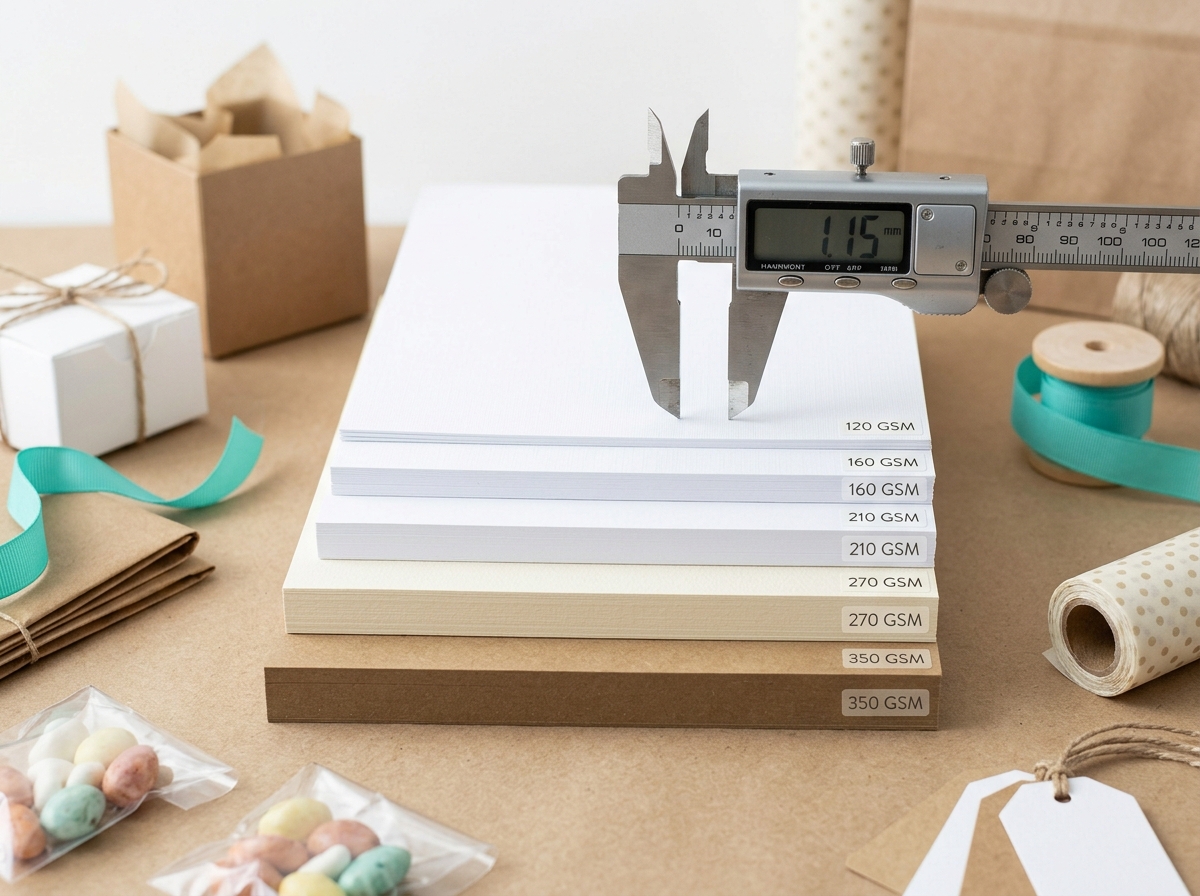
Point measurement (pt) indicates thickness in thousandths of an inch. A 12-point cardstock measures approximately 0.30mm thick and corresponds to roughly 300 GSM. The conversion isn't exact because paper density varies by composition, but as a general reference: 200 GSM = 8pt, 250 GSM = 10pt, 300 GSM = 12pt, and 350 GSM = 14pt.
When selecting cardstock for step-by-step gift box construction, consider the box dimensions. Smaller boxes under 4 inches per side function well with 250 GSM cardstock. Larger boxes—particularly those exceeding 6 inches or holding heavier contents—benefit from 300 GSM or above to prevent sidewall collapse.
Kraft paper derives its strength from long wood fibers processed with minimal chemical treatment. The natural brown color comes from unbleached pulp, and the material's coarse texture provides excellent adhesive grip. Kraft cardstock in the 250-300 GSM range offers superior tear resistance compared to bleached alternatives at the same weight, making it a practical choice for boxes that will be handled frequently or shipped.
The rustic appearance of kraft material suits casual gifting contexts—farmers market packaging, artisan goods, eco-conscious branding, and informal celebrations. It pairs naturally with twine, burlap ribbon, and minimal embellishment. Ink and paint adhere well to kraft surfaces, though darker colors may require multiple coats for opacity.
White cardstock presents a clean canvas for decoration and creates a more formal presentation. Bleached cardstock typically uses shorter fibers than kraft, resulting in a smoother surface ideal for detailed printing, stamping, or fine-line illustration. The bright white finish makes colors appear more vibrant, which matters when you're adding printed designs or colorful embellishments.
White cardstock shows smudges and fingerprints more readily than kraft, so handle it with clean hands during assembly. It also costs slightly more per sheet due to the additional bleaching process. For wedding favors, formal events, or luxury gift presentation, the premium appearance justifies the price difference.
Both materials are available in cube kraft gift boxes and white versions, offering a ready-made option when time constraints or volume needs make DIY construction impractical.
Uncoated cardstock has a natural, porous surface that absorbs ink and allows paper fibers to remain visible. This finish works well for rubber stamps, markers, and matte paint. The texture provides tactile interest and a handmade quality that aligns with artisan aesthetics. Uncoated surfaces accept adhesives readily—important when you're gluing flaps or attaching decorative elements.
Coated cardstock receives a clay or polymer layer that creates a smooth, semi-glossy or glossy surface. This coating prevents ink absorption, allowing colors to sit on top of the paper where they appear more saturated and vibrant. Coated stock produces sharper printed images and photographs, making it the preferred choice when you're printing high-resolution graphics or product photography directly onto box surfaces.
The coating also adds a slight moisture barrier, useful for boxes containing baked goods or products that might introduce humidity. However, standard adhesives may not bond as effectively to coated surfaces—you'll need glues specifically formulated for non-porous materials, or you'll need to sand the coating at glue points.
Matte-coated cardstock splits the difference: it has a subtle coating that enhances color without the reflective shine of gloss. This finish resists fingerprints better than uncoated stock while maintaining a sophisticated, understated appearance.
FSC (Forest Stewardship Council) certification verifies that paper materials come from responsibly managed forests. Forest Stewardship Council standards require traceability through the entire supply chain, ensuring that wood sources meet environmental and social criteria. For businesses building brand reputation around sustainability, FSC-certified cardstock provides third-party validation of responsible sourcing.
FSC 100% means all fibers come from certified forests. FSC Mixed indicates a blend of certified and controlled sources. FSC Recycled specifies post-consumer recycled content. The label appears as a small logo on certified paper products, and reputable suppliers will provide certification documentation upon request.
Recycled content cardstock reduces demand for virgin pulp but may have slightly different working properties. Paper made from 100% post-consumer recycled fibers often has a softer hand and may be more prone to tearing along score lines. Blended recycled content (30-50% recycled fiber mixed with virgin fiber) balances environmental benefit with structural performance.
When sourcing materials for small business gift box packaging, certifications communicate values to customers who prioritize environmental responsibility. The cost premium for certified materials has decreased significantly as demand has grown—often adding only 5-10% to material costs.
Metallic cardstock incorporates reflective particles or foil layers that catch light. Available in gold, silver, copper, and iridescent finishes, metallic stock adds visual impact for celebration packaging. The foil layer makes scoring more difficult—you'll need a bone folder and firm pressure to create clean fold lines without cracking the metallic surface.
Textured cardstock includes linen, canvas, and laid finishes that add dimensional interest. Linen texture mimics woven fabric and provides an upscale tactile experience. These specialty finishes work well for wedding gift boxes and formal occasions where presentation quality matters as much as the gift itself.
Corrugated cardboard consists of a fluted inner layer sandwiched between flat linerboard sheets. This structure provides exceptional strength-to-weight ratio, making it suitable for shipping boxes and protective packaging. Single-wall corrugated board (one fluted layer) handles most gift box applications when you need serious durability. The visible corrugation edges give boxes an industrial or eco-conscious aesthetic.
Chipboard, made from compressed recycled paper fibers, offers an economical rigid substrate. It's too thick to fold but serves as an excellent structural base for covered boxes—you can wrap chipboard forms with decorative paper to create professional-looking rigid gift boxes without the cost of custom manufacturing.

Ribbon transforms a plain box into a finished gift. Satin ribbon provides a smooth, glossy surface that ties into elegant bows and resists fraying at cut edges. Grosgrain ribbon has a ribbed texture and matte finish that holds knots securely—useful for boxes that will be handled or transported. Organza ribbon offers sheer, lightweight decoration suitable for layering multiple colors.
Wire-edged ribbon contains thin wires along both edges, allowing you to shape and hold elaborate bow configurations. This type works well for display pieces but adds cost and may be impractical for high-volume production. For business applications, pre-made bows with adhesive backing save assembly time while maintaining consistent appearance.
Tissue paper serves both functional and decorative purposes. Placed inside a box, it cushions contents and conceals them until opening. Tissue weights range from 17-25 GSM—substantially lighter than cardstock. Acid-free tissue prevents chemical transfer to sensitive items like textiles or archival materials. Colored tissue adds a layer of visual interest; white tissue provides neutral elegance.
Decorative edge tissue, with scalloped or deckled borders, elevates basic tissue paper into a design element. When lining small white gift boxes, allow decorative edges to extend above the box rim for a professional finishing touch.
Additional embellishments include adhesive labels, wax seals, twine, dried botanicals, and small ornamental charms. The key is restraint—one or two well-chosen details create more impact than multiple competing elements. Consider the unboxing experience: will embellishments interfere with opening the package, or do they enhance the reveal?
White craft glue (PVA) works reliably for most cardstock assembly. It dries clear, remains flexible, and bonds paper fibers effectively. Apply thin, even coats to prevent warping—excess moisture causes cardstock to buckle. Drying time runs 15-30 minutes for initial set, with full cure in 24 hours.
Glue sticks offer convenience for light-duty applications like attaching decorative paper to box exteriors. They contain less moisture than liquid glue, reducing warping risk, but create weaker bonds unsuitable for structural seams.
Double-sided tape provides instant adhesion without moisture. Foam tape adds dimensional spacing, useful when layering decorative elements. For boxes that need to be assembled flat and then popped into shape, tape allows for easier repositioning than glue during the learning curve.
Hot glue bonds quickly and strongly but can look messy if not applied carefully. It works well for attaching ribbon, bows, and three-dimensional embellishments where a strong immediate bond matters more than invisible seams.
For origami gift boxes that use folding techniques without adhesive, paper weight becomes even more critical—you need enough stiffness to hold folds but not so much thickness that multiple layers become bulky at corners.
Craft stores stock cardstock in standard letter and tabloid sizes (8.5x11" and 11x17"), convenient for small projects but limiting for larger box construction. Per-sheet costs run high—typically $0.50-$2.00 per sheet depending on weight and finish. Selection includes a wide variety of colors and specialty finishes.
Paper wholesalers and packaging suppliers offer bulk quantities at significantly lower per-unit costs. A ream (500 sheets) of 300 GSM cardstock might cost $80-120, bringing per-sheet cost to $0.16-$0.24. Minimum order quantities vary; some suppliers require case purchases while others accommodate smaller volumes for small businesses.
Online specialty paper retailers bridge the gap, offering smaller quantities than wholesale minimums but larger sheets and better pricing than craft stores. Standard sheet sizes include 12x12", 8.5x14", and 12x18"—dimensions that yield efficient cuts for common box sizes.
When calculating material costs, account for waste. A printable gift box template might fit efficiently on a 12x12" sheet with minimal scrap, while an irregular template could waste 30-40% of material. Test your template layout before committing to large material purchases.
For businesses producing gift boxes regularly, establishing relationships with packaging suppliers provides access to custom printing, die-cutting services, and consistent material specifications. Ready-made options like kraft paper gift boxes eliminate material sourcing and assembly labor when production volume or time constraints make DIY construction impractical.
Small jewelry boxes and favor boxes (2-3 inches) work well with 250 GSM cardstock. The compact size means sidewalls are short enough to maintain rigidity even with lighter-weight material. White cardstock suits formal events; kraft works for casual celebrations.
Medium gift boxes (4-6 inches) for clothing items, books, or moderate-weight gifts require 300 GSM cardstock minimum. This is the most common DIY gift box size range, and material availability is best in this weight class. Consider coated stock if you're printing directly onto boxes.
Large boxes (over 6 inches) or boxes containing heavy items need 350 GSM cardstock or corrugated material. The structural demands increase significantly with size—a 10-inch cube box made from 250 GSM cardstock will collapse under its own weight when filled.
Specialty applications like explosion gift boxes use lighter weight cardstock (200-250 GSM) because multiple layers stack inside the outer box. Too much thickness creates bulk that prevents proper closure.
Seasonal projects like Christmas gift boxes might incorporate metallic or textured specialty papers that align with holiday aesthetics, while birthday gift boxes offer more flexibility for creative material combinations and bold colors.
Before committing to a full production run, test your material choices with a prototype. Construct one complete box using your selected cardstock weight, adhesive, and embellishments. Fill it with representative contents and handle it as the recipient would—this reveals structural weaknesses, adhesive failures, or design flaws before you've invested in bulk materials.
Score lines deserve particular attention. Use a bone folder or scoring tool with a straight edge to create clean fold lines. Insufficient pressure produces weak folds that don't hold shape; excessive pressure cuts through the cardstock. The correct score creates a compressed line that folds crisply without fiber damage.
Test adhesive bonds by allowing full cure time, then attempting to pull seams apart. Proper bonding should result in paper tearing before the glue joint fails. If seams separate cleanly, you need stronger adhesive, better surface preparation, or more clamping pressure during drying.
For printed boxes, run test prints to verify color accuracy and ink adhesion. Some cardstock finishes cause inkjet ink to smudge or bleed. If you're using a home printer, remember that most consumer models can't handle cardstock heavier than 250 GSM—you'll need to print on lighter stock and adhere it to heavier structural cardstock, or use commercial printing services.
For most DIY gift box projects, 250-300 GSM cardstock provides the optimal balance of structural integrity and workability. Boxes under 4 inches per side can use 250 GSM successfully, while larger boxes or those containing heavier items should use 300 GSM or higher. This weight range is thick enough to hold shape without collapsing but remains manageable to score, fold, and cut with standard craft tools. Lighter weights (200 GSM) work for small favor boxes or nested designs, while weights above 350 GSM typically require professional die-cutting equipment.
At equivalent weights, kraft cardstock typically offers superior tear resistance compared to bleached white cardstock due to its longer, less-processed wood fibers. The natural kraft pulping process preserves fiber length and strength, making it a practical choice for boxes that will be handled frequently or need to support moderate weight. However, the strength difference is modest—both materials at 300 GSM will perform similarly for typical gift box applications. Choose based on aesthetic preference and project requirements rather than assuming kraft is always structurally superior.
Home inkjet and laser printers can handle cardstock up to approximately 250 GSM, though maximum thickness varies by printer model. Check your printer specifications before attempting to print on thick cardstock. For heavier weights (300+ GSM), print your design on lighter paper stock and adhere it to the structural cardstock, or use commercial printing services equipped to handle heavy substrates. Coated cardstock produces sharper, more vibrant printed images than uncoated stock, but verify that your printer ink is compatible with coated surfaces to prevent smudging.
FSC certification is not required for gift box construction, but it provides verification of responsible forest management if environmental sustainability matters to you or your customers. For personal gift-giving, certification is a values-based choice. For small businesses, FSC-certified materials can support brand positioning around sustainability and meet customer expectations in eco-conscious market segments. The cost premium for certified paper has decreased significantly and typically adds only 5-10% to material costs, making it an accessible option for most applications.
Satin ribbon offers the most versatile option for gift boxes—it ties into neat bows, resists fraying, and provides an elegant finish suitable for most occasions. Grosgrain ribbon works well when you need bows to hold their shape securely or want a matte, textured appearance. Wire-edged ribbon allows for elaborate bow shaping but adds cost and bulk. For high-volume production or business applications, pre-made bows with adhesive backing save assembly time while maintaining consistent quality. Choose ribbon width proportional to box size: 1/4-inch for small boxes under 3 inches, 3/8 to 5/8-inch for medium boxes, and 7/8-inch or wider for large presentation boxes.
The materials you select for gift box construction directly affect both the structural performance and visual impact of your finished package. By understanding paper weights, finish types, and material properties, you can make informed choices that match your project requirements and skill level. Start with quality materials in the appropriate weight range, test your designs before full production, and don't hesitate to use ready-made boxes when time or volume needs make DIY construction impractical.