Cart
0
You may also like



Book a call with our development team to get started.



Apply online and access wholesale pricing.

The window between Black Friday and Cyber Monday represents one of the most challenging inventory management periods for retailers. While Black Friday packaging demands peak preparation, Cyber Monday packaging planning requires real-time stock assessment, rapid reorder decisions, and the flexibility to extend promotional fulfillment through the entire weekend. Retailers who treat the Nov 27-30 period as four distinct days—rather than one continuous event—often find themselves scrambling for packaging supplies by Sunday afternoon.
This guide walks through the inventory management strategies that bridge Black Friday fulfillment and Cyber Monday demand, including stock assessment protocols, emergency reorder triggers, and planning frameworks for extended promotional windows that stretch beyond the traditional Monday cutoff.
The days between Black Friday and Cyber Monday create a unique packaging inventory challenge. Most retailers experience a sharp spike in order volume on Black Friday, followed by sustained demand through Small Business Saturday and Sunday, then another surge on Cyber Monday itself. Cyber Monday sales hit $12.8 billion in the U.S. in 2024, demonstrating the scale of the Monday peak that follows an already intense weekend.
The problem: packaging stock levels that seemed adequate on Thursday morning may be critically depleted by Saturday evening, leaving insufficient inventory for the Monday rush. Unlike product inventory—where stockouts can sometimes be managed with backorders—packaging shortages halt fulfillment entirely. A retailer can't ship orders without boxes, bags, or protective materials, regardless of product availability.
Effective cyber monday packaging planning means establishing checkpoint inventory counts at specific intervals: Friday evening after the first wave, Saturday mid-day, Sunday morning, and Monday pre-opening. These checkpoints reveal consumption rates and trigger reorder decisions before stock reaches critical levels.
Static inventory counts taken before Black Friday become obsolete within hours once order volume begins. Real-time assessment requires both automated tracking systems and manual verification checkpoints to catch discrepancies before they disrupt fulfillment.
Set up a dedicated inventory station in your warehouse where one team member updates packaging counts every four hours during peak periods. Track consumption by SKU category—kraft gift boxes, cellophane bags, tissue paper, ribbon—rather than aggregate "packaging supplies." This granularity reveals which specific items are depleting fastest and need immediate attention.
Compare actual consumption rates against your pre-event forecasts. If you projected 1,000 gift boxes would last through Sunday but you've used 600 by Friday evening, your Monday inventory will fall short. Adjust reorder quantities based on observed burn rates, not original estimates. Inventory systems must stay in sync across all fulfillment channels to prevent allocation errors that promise packaging materials already committed to other orders.

Even with careful planning, unexpected demand spikes can exhaust packaging inventory faster than anticipated. Establishing emergency reorder triggers—specific stock levels that automatically initiate backup orders—prevents complete depletion.
For high-velocity items like cellophane rolls or standard shipping boxes, set your trigger at 30% remaining inventory. When stock drops to this level on Saturday, initiate an emergency order for Monday delivery. Many wholesale packaging suppliers offer weekend emergency services during the Black Friday period, though often at premium rates.
Your packaging contingency plan should include pre-negotiated backup suppliers who can fulfill rush orders within 24-48 hours. Contact these suppliers before Thanksgiving to confirm weekend availability and pricing. Some distributors maintain dedicated Black Friday inventory reserves specifically for emergency reorders, but access requires advance arrangement.
Consider maintaining a small buffer stock of universal packaging items—plain kraft boxes in common sizes, clear bags, neutral tissue—that can substitute for branded or specialized packaging if primary inventory runs out. These generic options keep fulfillment moving even when preferred materials are unavailable.
Black Friday order data provides the most accurate foundation for Cyber Monday inventory projections. Rather than relying on pre-event forecasts, use actual Friday and Saturday performance to refine Monday stock requirements.
If Black Friday generated 2,000 orders and you used 2,400 pieces of packaging (accounting for multi-item orders and protective materials), calculate your per-order packaging ratio: 1.2 pieces per order. Apply this ratio to your projected Cyber Monday order volume. If you expect 2,500 Monday orders based on historical patterns, you'll need approximately 3,000 packaging units.
Layer in category-specific data. Categories with strong demand included personal care (online sales up 530%), jewelry (up 478%), appliances (up 464%), electronics (up 452%), and apparel (up 392%) during Cyber Monday 2024. If your Black Friday sales skewed toward one of these high-growth categories, expect similar or higher Monday demand in the same segments—and stock the packaging types those products require.
Review your packaging stock planning calculations against actual consumption. If your original forecast assumed a 20% buffer but you're burning through stock 30% faster than expected, increase your Cyber Monday buffer to 40% to accommodate the higher-than-projected rate.
Many retailers now extend Black Friday promotions through the entire Thanksgiving weekend and into the following week, creating "Cyber Week" rather than discrete Friday and Monday events. This extended window complicates inventory management because demand doesn't follow the traditional two-peak pattern.
For extended promotions, shift from event-based inventory allocation to daily consumption tracking. Instead of "Black Friday stock" and "Cyber Monday stock," maintain a rolling 72-hour inventory target. Each evening, calculate how much packaging you'll need to fulfill the next three days of projected orders, and ensure stock meets or exceeds that threshold.
This approach accommodates the unpredictable demand curves that characterize extended promotional windows. A Tuesday flash sale or a viral social media post on Sunday can create unexpected order surges that wouldn't appear in traditional Friday/Monday planning models.
Communicate your extended timeline to packaging suppliers when placing pre-event orders. If your promotion runs through December 2, your supplier needs to know you may require mid-week emergency replenishment, not just weekend support. Some suppliers offer "Cyber Week" service packages that include scheduled delivery checkpoints throughout the extended period.
Retailers operating both e-commerce and physical locations face additional complexity during the Black Friday to Cyber Monday period. Packaging inventory must be allocated across warehouses, retail stores, and fulfillment centers, with the flexibility to reallocate as demand patterns emerge.
Establish a centralized inventory visibility system that shows real-time packaging stock levels at all locations. When your downtown store depletes its supply of white gift boxes on Saturday, you need to know immediately whether your warehouse has excess inventory that can be transferred overnight.
According to the National Retail Federation, omnichannel fulfillment capabilities have become essential for meeting customer expectations during peak periods. Pre-arrange inter-location transfer protocols before Black Friday. Which locations can send inventory to which others? Who authorizes transfers? What's the fastest transfer method—courier service, company vehicle, or asking customers to pick up from an alternate location?
Some retailers maintain a small "float" inventory at a central hub that doesn't get allocated to any specific location until demand patterns become clear. On Saturday morning, when data shows your e-commerce warehouse is burning through packaging faster than retail stores, you can direct the float inventory to the warehouse rather than splitting it evenly across all locations.
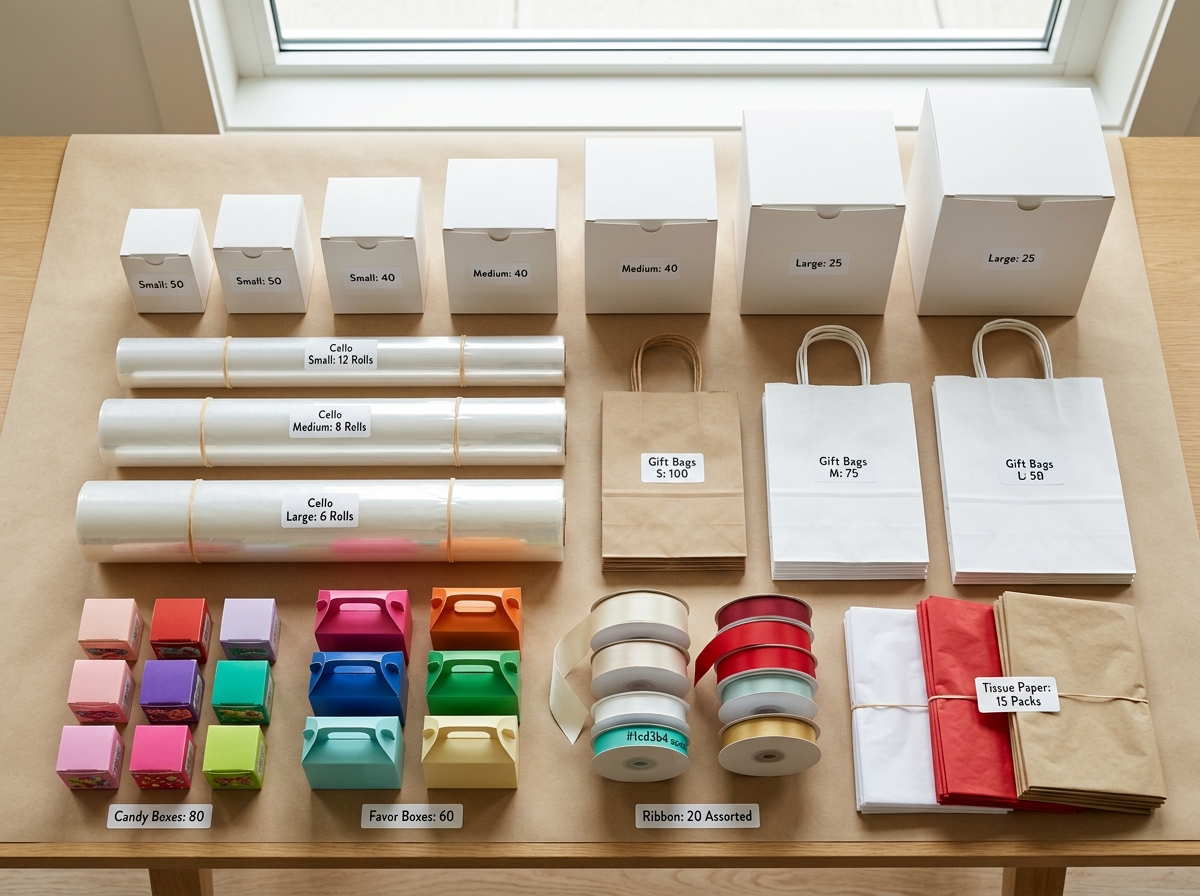
Inventory management isn't just about having enough packaging—it's about accessing the right materials quickly during high-volume fulfillment periods. Poor warehouse organization creates bottlenecks that slow fulfillment even when adequate stock exists.
Reorganize your packaging storage before Black Friday to prioritize the fastest-moving items. Place your most-used boxes, bags, and materials in the most accessible locations—ideally within arm's reach of packing stations. Less common items can be stored in secondary locations that require a brief walk to retrieve.
Group packaging by fulfillment workflow rather than product category. If most orders require a box, tissue paper, and a shipping label, store these items together so packers can grab all three in one motion. This workflow-based organization reduces the steps required to complete each package, increasing throughput during peak periods.
Consider your fast-assembly packaging options for the Cyber Monday rush. Tuck-top boxes that require no tape, pre-sized cellophane bags, and self-adhesive shipping labels eliminate assembly steps that consume time during high-volume periods. Stock these quick-assembly options near packing stations for easy access when Monday order volume peaks.
Not all packaging materials deplete at the same rate. Product mix—which items customers actually buy—determines which packaging you'll need most during the Cyber Monday period.
Analyze your Black Friday order composition by Saturday morning. If 40% of Friday orders contained bakery items, you'll need a heavy stock of bakery boxes for Monday. If jewelry and small accessories dominated, focus on small cube gift boxes and protective padding materials.
Track packaging usage by product category, not just total volume. Your inventory system should show that you used 300 small boxes for jewelry, 450 medium boxes for apparel, and 200 large boxes for home goods on Black Friday. Apply these category-specific ratios to your Cyber Monday product mix forecast to determine exactly which box sizes you'll need most.
This granular approach prevents the common mistake of ordering "more boxes" without specifying sizes. You might have adequate total box inventory but run out of the specific 4x4x4 size that your best-selling product requires, while sitting on excess 8x8x8 boxes that don't fit anything you're shipping.
Cyber Monday increasingly extends beyond Monday itself, with many retailers offering "Cyber Week" promotions that run through the first week of December. This extension shifts packaging planning from a four-day sprint to a two-week marathon.
When promotions extend beyond the traditional Monday cutoff, your packaging inventory must support sustained elevated volume rather than two discrete peaks. Calculate your average daily consumption during the Black Friday weekend, then project that rate forward through your promotion end date. Add a 25% buffer to accommodate unexpected surges or delivery delays.
Coordinate with your packaging supplier to establish scheduled replenishment deliveries throughout the extended period. Rather than one large pre-event order, arrange for weekly deliveries that maintain consistent stock levels without requiring massive upfront storage space. This approach reduces warehouse congestion and preserves capital that would otherwise be tied up in excess inventory.
Monitor your packaging lead times throughout the promotional period. Suppliers' production capacity may be strained by industry-wide demand, extending normal lead times from days to weeks. Place replenishment orders earlier than you typically would to accommodate these extended timelines.
The period immediately after Cyber Monday offers critical learning opportunities for future planning. Conduct a comprehensive packaging inventory assessment by Tuesday evening, while the weekend's events are still fresh.
Document actual consumption rates for every packaging category. How many boxes did you use per day? Which items ran out first? Where did you maintain excess inventory that could have been reduced? These data points become the foundation for next year's planning models.
Calculate your actual packaging cost per order for the Black Friday through Cyber Monday period. Divide your total packaging expenditure by the number of orders fulfilled. If this per-order cost exceeds your budget projections, identify which materials drove the overage—was it emergency rush orders, premium materials, or simply higher-than-expected volume?
Review your backup supplier performance. Did emergency orders arrive on time? Were quantities accurate? Was quality consistent with your primary supplier? These assessments determine whether your contingency plans functioned as intended or need refinement for future peak periods.
Update your master planning documents with actual performance data. Replace forecasts with reality: "We used 3,200 medium gift boxes" is more valuable than "We estimated 2,500 boxes" for next year's planning. Build your future models on what actually happened, not what you thought would happen.
Maintain a minimum 40% buffer above your projected Cyber Monday needs when conducting your Saturday evening inventory check. This buffer accommodates unexpected demand spikes and prevents stockouts if your consumption rate increases. For high-velocity items like standard shipping boxes or cellophane bags, increase the buffer to 50-60% to ensure you can fulfill Monday's peak volume without emergency reorders.
Yes, but it requires advance planning with your supplier. Many wholesale packaging distributors offer weekend emergency services during the Black Friday period, though typically at premium rates of 15-30% above standard pricing. Contact your supplier before Thanksgiving to confirm their weekend availability, delivery windows, and minimum order quantities for rush service. Some suppliers require 48-hour notice even for emergency orders, so place your Saturday reorder by Thursday if you anticipate potential shortages.
Implement checkpoint inventory counts every four hours during peak fulfillment periods. Assign one team member to physically count packaging stock at your busiest packing stations and update your tracking system immediately. Compare these counts against your starting inventory and the number of orders fulfilled to calculate your per-order consumption rate. This rate reveals whether you're using packaging faster or slower than projected, allowing you to adjust Cyber Monday stock levels before it's too late.
Yes. Extended promotions require rolling inventory management rather than event-based planning. Instead of allocating specific quantities to "Black Friday" and "Cyber Monday," maintain a 72-hour inventory target throughout the promotional period. Each evening, calculate how much packaging you need for the next three days of projected orders and ensure stock meets this threshold. This approach accommodates unpredictable demand surges that occur outside the traditional Friday and Monday peaks.
Track packaging consumption by SKU and product category, not just total volume. Your inventory system should show which specific box sizes, bag dimensions, and material types are depleting fastest based on your actual product mix. Analyze Black Friday order composition by Saturday to identify which packaging SKUs your customers' purchases require most, then prioritize restocking those specific items rather than ordering generic "more packaging." This granular approach prevents the common problem of having adequate total inventory but lacking the specific sizes your fulfillment process needs most.
While the Black Friday to Cyber Monday period demands intensive short-term inventory management, the most successful retailers use these peak events to refine year-round packaging systems. The consumption data, supplier performance metrics, and workflow insights you gather during this four-day window inform smarter purchasing decisions, better supplier relationships, and more efficient fulfillment processes throughout the year.
Treat cyber monday packaging planning as a continuous improvement process rather than an annual scramble. Each year's performance data should make the next year's planning more accurate, your inventory buffers more precise, and your emergency protocols more reliable. The retailers who master this cycle transform the Thanksgiving weekend from a chaotic inventory challenge into a predictable, manageable component of their annual fulfillment calendar.
Start your planning early, track your consumption carefully, maintain strong supplier relationships, and build your models on actual performance data rather than optimistic projections. These fundamentals create packaging inventory systems that support not just Black Friday and Cyber Monday, but every peak period your retail operation encounters.