Cart
0
You may also like

Book a call with our development team to get started.



Apply online and access wholesale pricing.

Seasonal packaging isn't just about slapping a snowflake on your box in December. For small businesses, it's a revenue strategy that spans twelve months—one that can capture purchase intent during high-traffic shopping windows, justify premium pricing on limited-edition runs, and create urgency that drives conversions. The National Retail Federation forecasts holiday retail sales alone will exceed $1 trillion, but Valentine's Day, Mother's Day, back-to-school, and summer gifting windows each carry their own sales spikes. The businesses that plan packaging around these cycles—rather than treating seasonality as a last-minute aesthetic choice—consistently outperform competitors who use generic boxes year-round.
This guide walks through how to build a year-round seasonal packaging calendar, manage inventory without over-ordering, and use limited-edition packaging to create scarcity that converts browsers into buyers. Whether you sell bakery goods, handmade products, or retail items, the principles remain the same: align your packaging with the emotional context of the season, plan lead times around supplier schedules, and treat seasonal packaging as a measurable marketing investment rather than a decorative expense. For foundational strategies on differentiating your brand through packaging, see our guide to custom packaging ideas for small businesses.
Most small businesses approach seasonal packaging as a design problem: what colors, patterns, or icons match the holiday. But the real opportunity lies in behavioral economics. Seasonal packaging demand reaches maximum levels during Christmas, Halloween, and Valentine's Day, with U.S. holiday retail sales hitting $936.3 billion in 2023, and seasonal packaging creates three revenue-driving effects that generic packaging cannot replicate.
First, it signals limited availability. When a customer sees autumn-themed packaging in October, they understand the product won't be available in November—scarcity drives immediate purchase decisions rather than "I'll come back later" browsing. Second, seasonal packaging elevates perceived value. A cookie in a Valentine's Day box with heart-themed cellophane commands a higher price than the same cookie in a plain kraft box, because the packaging communicates gift-readiness and occasion-appropriateness. Third, it reduces decision fatigue for gift buyers. During peak seasons, shoppers are overwhelmed by choice; packaging that clearly signals "this is a Mother's Day gift" shortens the path from consideration to checkout.
The market data supports this. Seasonal food products alone generated $12.8 billion in sales during 2023, and much of that revenue stems from packaging that communicates temporal relevance. For small businesses, the implication is clear: seasonal packaging isn't an optional brand flourish—it's a conversion tool that directly impacts average order value and purchase frequency during high-traffic periods.
The most effective seasonal packaging strategies don't start in November. They start in January, with a full-year calendar that maps packaging needs to cultural shopping moments. Here's how to structure your planning around the major revenue seasons, with lead times that account for supplier schedules and internal prep work.
Q1: Valentine's Day and Spring Gifting (January-March)
Valentine's Day drives bakery, confection, and gift product sales from late January through February 14. Plan for red, pink, and heart-themed packaging—cube kraft gift boxes work well for cookies and small treats when paired with red tissue paper or ribbon. Order packaging by early January to allow time for any custom printing or sticker application. Spring (March-April) carries lighter demand but captures Easter, Mother's Day pre-orders, and spring wedding favor orders. Pastel cellophane bags and floral-patterned boxes perform well here.
Q2: Mother's Day and Graduation (April-June)
Mother's Day is the second-largest gifting holiday in the U.S. after Christmas. Packaging should emphasize elegance and gift-readiness—think structured boxes with lids, satin ribbons, or window boxes that showcase product quality without requiring unwrapping. Graduation season (late May through June) overlaps and benefits from similar packaging: sophisticated, congratulatory, often in school colors if you're serving a local market. Order by late March to avoid supplier backlog as other businesses rush orders.
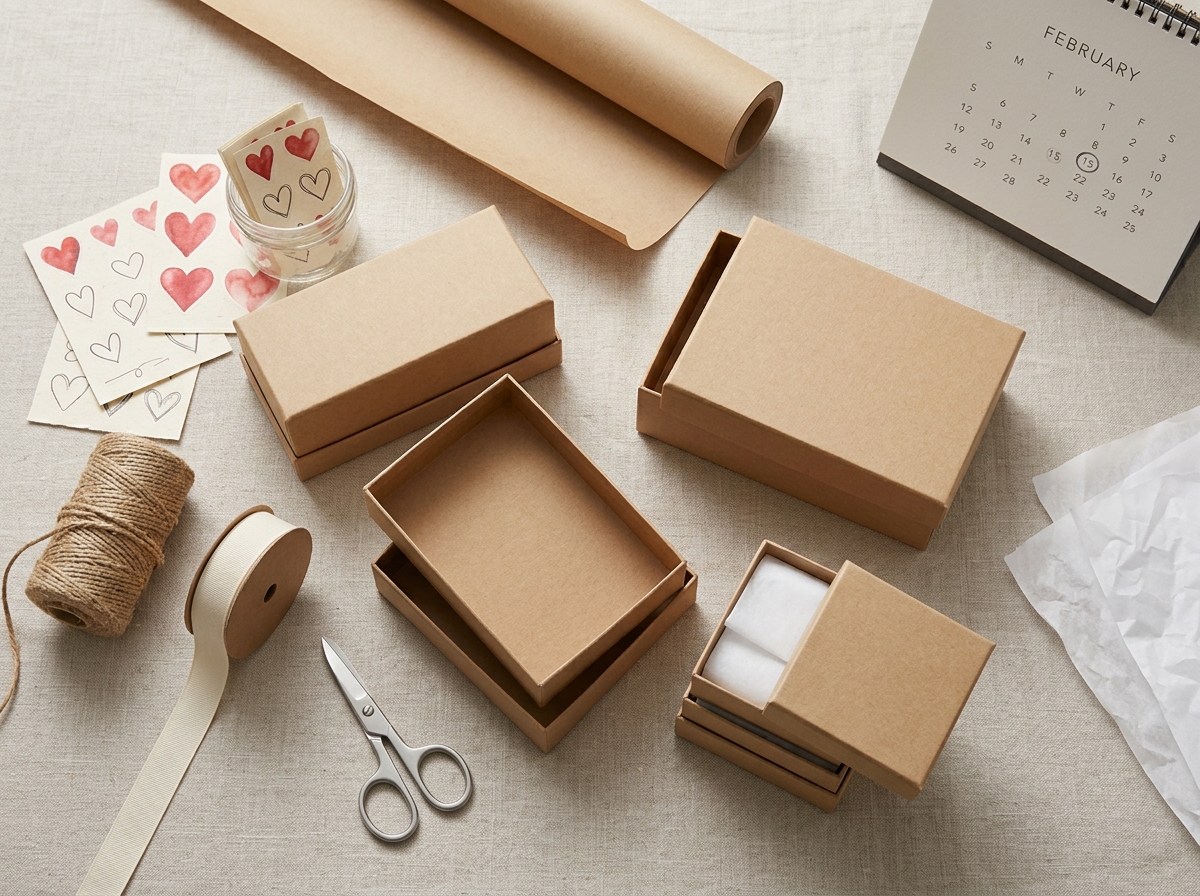
Q3: Summer Events and Back-to-School (July-September)
Summer is often treated as a slow season, but it's prime time for picnic supplies, party favors, and outdoor event packaging. Bright, casual packaging—like white gift tuck-top boxes or zipper treat bags—aligns with informal summer gatherings. Back-to-school (mid-August through September) is a sleeper revenue opportunity for businesses selling teacher gifts, classroom party supplies, or bulk snack packaging. Order packaging by late June; many suppliers experience a July slowdown followed by a late-summer rush.
Q4: Halloween, Thanksgiving, and Holiday Season (October-December)
This is the highest-volume packaging quarter for most small businesses. Halloween (October) demands bold, playful packaging—black boxes, orange cellophane, or themed treat bags. Thanksgiving (November) is bakery-heavy: pie boxes, dessert carriers, and hostess gift packaging. The December holiday season requires the earliest planning of any season; many suppliers impose order cutoffs in late September or early October to manage capacity. If you're ordering custom-printed holiday boxes, initiate design conversations in July and finalize orders by mid-September. Stock packaging (non-custom) can often be ordered through October, but popular sizes and colors sell out quickly.
For businesses balancing seasonal inventory against budget constraints, consider reading our guide on understanding MOQ for small businesses to navigate minimum order quantities without over-committing capital.
One of the most underutilized seasonal packaging tactics is the limited-edition pre-order. Instead of ordering large quantities of seasonal packaging and hoping inventory sells through, small businesses can use seasonal packaging as a pre-order incentive: announce a limited run of Valentine's Day boxes or holiday gift sets, take orders for two to three weeks, then order packaging based on actual demand. This approach flips the traditional inventory risk model—you're not guessing at demand; you're fulfilling confirmed orders.
Here's how to structure it. Four to six weeks before the target holiday, announce a limited-edition product or packaging option available only via pre-order. Emphasize the limited nature: "Only 100 Valentine's Day gift boxes available—pre-order by February 5 for February 12 delivery." Collect orders and payment upfront (or at least a deposit), then place your packaging order based on the actual pre-order count plus a small buffer (typically 10-15% over orders to account for walk-in demand or last-minute additions). This minimizes waste, reduces upfront capital requirements, and creates urgency that drives faster purchase decisions.
The packaging itself becomes part of the value proposition. Customers aren't just buying your product; they're buying access to packaging that won't be available again until next year. For bakeries, this might mean a dozen cookies in a limited-edition Valentine's box. For handmade goods, it could be a spring collection in pastel packaging available only in March. The key is to make the packaging feel exclusive and time-bound, not just seasonally themed.
The biggest mistake small businesses make with seasonal packaging is ordering based on optimism rather than data. You don't want to be stuck with 500 Halloween boxes in November, but you also don't want to run out of holiday packaging on December 10. The solution is a tiered ordering strategy based on your sales history and growth projections.
Start with last year's sales data for the same season. If you sold 200 units during last year's Valentine's Day window, that's your baseline. Apply a conservative growth factor—10-20% is reasonable for an established business; 30-50% if you're in a growth phase or expanding marketing. That gives you a target order quantity. Now split that quantity into two orders if your supplier allows it: place 60-70% of your total packaging order six to eight weeks before the season, then place a second order for the remaining 30-40% four weeks out, once you have early sales data or pre-order numbers to validate demand.
This two-order approach costs slightly more per unit (you lose some volume discount on the first order), but it dramatically reduces the risk of over-ordering. If your first batch sells faster than expected, you have time to increase the second order. If it sells slower, you can reduce the second order or skip it entirely. For businesses working with tight cash flow, this strategy is far safer than committing 100% of your seasonal packaging budget in a single August order and hoping December demand materializes.
One important note on supplier lead times: most packaging suppliers experience seasonal bottlenecks. Custom-printed boxes for the December holidays often require 8-10 week lead times if ordered after September. Stock (non-custom) packaging is more flexible, but popular items—like window cookie boxes or red gift bags—can sell out by mid-November. Plan conservatively. If you're unsure about quantities, our guide on choosing the right packaging material can help you select versatile options that work across multiple seasons.
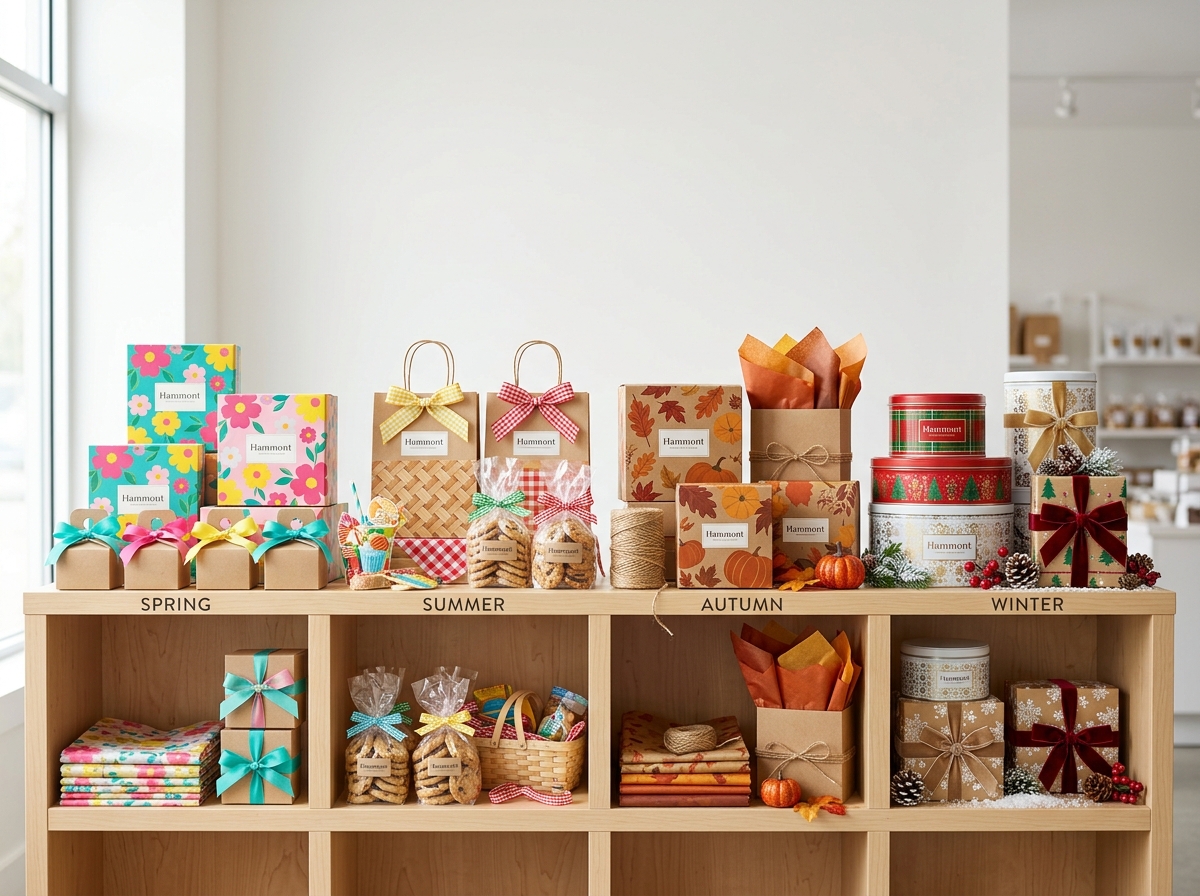
Not every business can afford to order unique packaging for every holiday. The alternative is cross-seasonal packaging—neutral base designs that can be customized with low-cost seasonal accents. A kraft gift box, for example, works year-round. Pair it with red ribbon and a heart sticker in February, pastel tissue paper in April, a "Happy Holidays" stamp in December. The base packaging stays the same; the seasonal signal comes from inexpensive add-ons that you can order in smaller quantities.
This approach works especially well for businesses with unpredictable seasonal demand or limited storage space. Instead of stocking five different seasonal box designs, you stock one versatile box and five sets of seasonal accessories (ribbons, stickers, stamps, tissue paper). The per-unit cost is often comparable to ordering custom seasonal boxes, but your inventory risk is much lower—if you over-order kraft boxes, you use them next season; if you over-order Valentine's stickers, they sit unused for a year.
The trade-off is visual impact. A fully custom seasonal box—printed with holiday graphics, colored paperboard, themed windows—creates a stronger first impression than a neutral box with a sticker. But for many small businesses, especially those just starting to experiment with seasonal packaging, the cross-seasonal model is a safer entry point. You can test customer response to seasonal packaging without committing to large custom print runs, then scale up to fully custom designs once you have sales data to support the investment.
If you're exploring budget-conscious customization, see our post on branded packaging on a budget using stickers and stamps.
Different product types benefit from different seasonal packaging strategies. Here's how to adapt seasonal packaging to the most common small business product categories.
Bakery and Food Products
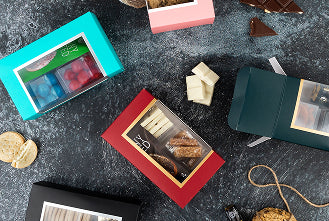
Food businesses have the highest seasonal packaging turnover because products are consumable and purchase frequency is high. Cookies, brownies, and confections sell year-round but see massive spikes around Valentine's Day, Easter, Halloween, and Christmas. Use window boxes to showcase product quality—customers want to see what they're buying, especially for gift orders. For holiday cookie assortments, consider tiered packaging: a base box for everyday sales, and a premium holiday box with a clear lid and decorative insert for gift buyers willing to pay more. Timing is critical; many bakeries take holiday pre-orders in November for December pickup, which means packaging must be ordered by late September.
Handmade and Artisan Goods
Handmade product sellers (candles, soaps, jewelry, textiles—note: Hammont does not sell candles or home fragrance, but does serve makers who package such products) benefit from seasonal packaging that elevates perceived value. A bar of handmade soap in a plain kraft box is a $6 product; the same soap in a spring-themed box with a botanical label is a $10 gift. Seasonal packaging justifies premium pricing because it communicates occasion-appropriateness. For these businesses, limited-edition seasonal packaging works especially well—announce a "Spring Collection" available only in March and April, packaged in exclusive floral boxes. Scarcity drives urgency, and the packaging itself becomes part of the product story.
Retail and E-Commerce Products
Retail businesses selling physical goods (apparel, accessories, home goods) use seasonal packaging primarily for gift orders and promotional campaigns. The packaging doesn't need to be product-specific; it needs to be gift-ready. A customer buying a scarf for themselves accepts a plain mailer; a customer buying a scarf as a Mother's Day gift expects a box, tissue paper, and a ribbon. Offer seasonal gift packaging as an optional add-on at checkout—many customers will pay $3-5 extra for gift-ready packaging, which covers your packaging cost and adds margin. For e-commerce, this is especially effective because it reduces the customer's friction: they don't have to wrap the gift themselves or buy separate wrapping supplies.
Seasonal packaging creates a storage problem that generic packaging doesn't: you can't use Halloween boxes in December, so unsold inventory sits idle for eleven months. For small businesses with limited storage space, this is a real constraint. The solution is a combination of accurate demand forecasting, modular packaging systems, and post-season clearance strategies.
First, order conservatively. It's better to sell out of seasonal packaging three days before the holiday than to have 200 leftover boxes. If you do sell out early, you can often pivot to neutral packaging with seasonal ribbons or stickers—it's not ideal, but it's better than over-ordering. Second, use modular packaging where possible. Instead of ordering boxes pre-printed with "Happy Halloween," order neutral orange or black boxes and add Halloween stickers or stamps. The base boxes can be used for other purposes if demand falls short; only the low-cost stickers go to waste.
Third, plan a post-season clearance strategy. If you have leftover seasonal packaging, discount it heavily in the week after the holiday. Sell "Valentine's Day cookies, 50% off" on February 15 in leftover Valentine's boxes—customers buying for themselves (not as gifts) don't care about the packaging date, and you clear inventory before it becomes dead stock. Some businesses even market this as an annual tradition: "Day-After-Valentine's Sale, limited quantities." It turns excess inventory into a revenue event rather than a loss.
Custom seasonal packaging—boxes printed with your logo, holiday graphics, and brand colors—creates a stronger brand impression than stock packaging, but it requires higher minimum order quantities (often 500-1,000 units) and longer lead times (8-12 weeks for printing). Stock seasonal packaging—pre-designed holiday boxes available from suppliers in smaller quantities—offers flexibility and lower upfront cost but less differentiation.
The decision comes down to volume and brand maturity. If you're selling fewer than 300 units per season, stock packaging almost always makes more sense. The per-unit cost difference between custom and stock narrows as volume increases, but at low volumes, the MOQ for custom packaging forces you to order far more than you need. If you're selling 500+ units per season and have a strong brand identity, custom packaging becomes worth the investment—it reinforces brand recognition and creates a premium unboxing experience that generic stock packaging cannot match.
One middle-ground option: order custom base packaging (boxes with your logo but no seasonal graphics) and add seasonal elements with stickers, stamps, or inserts. This gives you brand consistency year-round while keeping seasonal customization costs low. You're not re-ordering fully custom packaging for every holiday; you're ordering one set of branded boxes and swapping out the seasonal accents.
Seasonal packaging is a marketing expense, which means it should be measured like any other marketing investment: cost per acquisition, incremental revenue, and customer lifetime value. Here's how to track whether your seasonal packaging is paying off.
Start with incremental revenue. Compare sales during the seasonal window this year (with seasonal packaging) to the same window last year (with generic packaging, if applicable). If you sold $5,000 worth of product during last year's Valentine's season and $7,500 this year with Valentine's packaging, the incremental revenue is $2,500. Subtract your seasonal packaging cost (let's say $400 for boxes, ribbons, and stickers) and your incremental product cost (if you sold more units, you incurred more ingredient or material costs). If your net incremental profit is positive, the seasonal packaging paid for itself.
Next, track customer acquisition. Did seasonal packaging attract new customers, or did it just increase spend from existing customers? Both are valuable, but they have different long-term implications. If seasonal packaging brings in new customers who return for non-seasonal purchases, the lifetime value of those customers far exceeds the initial packaging cost. Use discount codes or post-purchase surveys to identify first-time buyers during seasonal campaigns, then track their repeat purchase rate over the following six months.
Finally, measure qualitative impact: social shares, word-of-mouth referrals, and brand perception. Seasonal packaging often generates social media content that generic packaging does not—customers photograph and share gift boxes, especially during high-visibility holidays like Christmas and Valentine's Day. Monitor branded hashtags and tagged posts during seasonal campaigns to gauge this effect. While harder to quantify, this organic reach has real value in building brand awareness and customer loyalty.
Even experienced small business owners make predictable mistakes with seasonal packaging. Here are the most common pitfalls and how to avoid them.
Ordering Too Late
Suppliers experience seasonal bottlenecks. If you order holiday packaging in November, you're competing with every other business that waited until the last minute. Lead times stretch, popular items sell out, and rush fees inflate costs. Order seasonal packaging 8-10 weeks before you need it—earlier for custom printing.
Ignoring Storage Constraints
Seasonal packaging takes up space. If you're working out of a home kitchen or small studio, 500 holiday boxes can overwhelm your workspace. Before placing a large order, confirm you have physical space to store it. If not, consider smaller orders placed closer to the season, even if per-unit costs are slightly higher.
Treating Seasonal Packaging as Pure Aesthetics
Seasonal packaging should drive behavior, not just look festive. If your Halloween packaging doesn't create urgency ("available only through October 31") or elevate perceived value (justifying a higher price), it's not earning its cost. Every seasonal packaging decision should answer: how does this increase revenue?
Skipping the Test Season
If you've never used seasonal packaging before, don't launch with a massive holiday campaign. Test the concept during a smaller season—Valentine's Day or Mother's Day—where order quantities are lower and financial risk is manageable. Learn what works, refine your process, then scale up for the holiday season.
For custom-printed holiday packaging, place orders 8-10 weeks before you need it—ideally by late September for December holidays. Stock (non-custom) seasonal packaging can often be ordered 4-6 weeks out, but popular sizes and colors sell out by mid-November. If you're working with a new supplier, add two weeks to these timelines to account for potential delays or revisions.
Stock seasonal packaging typically has low MOQs—often 25-100 units depending on the supplier and product type. Custom-printed seasonal packaging usually requires 500-1,000 units minimum, though some suppliers offer lower MOQs at higher per-unit costs. If you're unsure about demand, start with stock packaging and graduate to custom once you have sales data to support larger orders.
Yes, if the packaging is still in good condition and the design is evergreen (e.g., "Happy Holidays" rather than "Holiday 2025"). Generic seasonal themes—snowflakes, hearts, autumn leaves—work year after year. Avoid date-specific or trend-specific designs that will feel stale. Store leftover packaging in a cool, dry place away from direct sunlight to prevent fading or moisture damage.
If you're selling fewer than 300 units per season, stock packaging is usually more cost-effective. Custom packaging makes sense when you're moving 500+ units per season and want to reinforce brand identity. A middle-ground option: use branded base packaging year-round and add seasonal stickers or inserts, which keeps costs low while maintaining brand consistency.
Store seasonal packaging flat (if possible) in a climate-controlled space away from moisture, direct sunlight, and temperature extremes. Cardboard boxes can warp or fade if exposed to humidity or heat. Label storage containers by season and year so you can quickly locate packaging when needed. If storage space is limited, consider ordering smaller quantities closer to each season rather than storing large volumes year-round.
Seasonal packaging is one of the few marketing investments that pays for itself within a single sales cycle. When planned strategically—with lead times that account for supplier schedules, inventory levels based on actual demand data, and packaging designs that create urgency and elevate perceived value—it transforms occasional buyers into repeat customers and turns high-traffic shopping windows into predictable revenue events.
The businesses that succeed with seasonal packaging treat it as a revenue strategy, not a design project. They plan twelve months ahead, test concepts during smaller seasons before scaling to major holidays, and measure results in incremental profit rather than aesthetic appeal. Whether you're a bakery planning Valentine's cookie boxes, a maker launching a spring collection, or a retailer offering gift-ready packaging at checkout, the principles remain the same: align packaging with customer intent, order conservatively, and make scarcity work in your favor.
Start small, measure results, and refine your approach each season. Within a year, you'll have a seasonal packaging system that drives revenue every quarter—not just in December.