Cart
0
You may also like

Book a call with our development team to get started.



Apply online and access wholesale pricing.

For gift shops, specialty retailers, and food businesses targeting the Lunar New Year market, timing your lunar new year gift boxes order correctly can mean the difference between a profitable season and missed opportunities. The 2027 Year of the Goat begins on February 6, and if you're sourcing lunar new year packaging wholesale, your order window opens much earlier than you might expect.
B2B buyers planning inventory for the 2027 celebration should place orders between November 21 and December 5, 2026—a full 8 to 10 weeks before the holiday. This timeline accounts for production lead times, overseas shipping delays, and the internal staging period retailers need to prepare displays and fill orders. Miss this window, and you risk stockouts during the busiest gifting weeks of the year.
The critical order window for lunar new year packaging wholesale isn't arbitrary. It's built backward from February 6, 2027, the start of the Year of the Goat, accounting for every stage in the supply chain that stands between your purchase order and your shelf-ready inventory.
Retailers typically need 8 to 10 weeks of lead time for seasonal packaging programs. This breaks down into several distinct phases: production scheduling, manufacturing, quality control, international shipping, customs clearance, domestic freight, and warehouse receiving. Each phase has its own timeline, and delays in any one stage cascade through the rest of the chain.
Production scheduling alone can consume 1 to 2 weeks during peak season, when packaging manufacturers are managing high order volumes from multiple retailers preparing for the same holiday. Once your order enters production, manufacturing times for standard gift boxes and bags range from 7 to 25 working days depending on order quantity and customization requirements.
International shipping introduces the longest variable in the timeline. Ocean freight from Asia—where many packaging suppliers operate—typically requires 30 to 45 days port-to-port, with additional time for customs clearance and inland transit. Air freight reduces transit to 5 to 10 days but significantly increases per-unit costs, making it viable only for rush orders or high-margin products.
By ordering between November 21 and December 5, you create buffer time for the unexpected: port congestion, weather delays, customs inspections, or material shortages. This buffer is what separates retailers who are fully stocked by mid-January from those scrambling to fill gaps in early February.
Lunar New Year 2027 falls on Saturday, February 6, marking the beginning of the Fire Goat year. The 15-day Spring Festival period runs through February 20, when the Lantern Festival concludes the official celebration. For retail and food businesses, however, the commercial window extends well beyond these dates.
Consumer shopping for Lunar New Year gifts typically begins 3 to 4 weeks before the holiday itself, meaning your inventory needs to be shelf-ready by mid-January at the latest. Gift shops and specialty food retailers see peak sales in the final two weeks of January, as customers purchase traditional sweets, candies, and symbolic gifts to exchange with family and friends.
The Year of the Goat carries specific cultural symbolism that influences packaging design and product selection. The goat represents kindness, peace, and inner strength in the Chinese zodiac, and the 2027 Fire Goat element adds associations with creativity and warmth. Retailers who incorporate these themes into their kraft gift boxes and display messaging can create stronger cultural resonance with shoppers.
Planning your packaging order around these dates requires working backward from your in-store readiness deadline. If you need inventory available for customer orders by January 10, and your internal receiving and staging process takes one week, your packaging must arrive at your facility by January 3. Add 8 to 10 weeks of supply chain lead time, and you arrive at the November 21–December 5 order window.

Understanding where time disappears in the packaging supply chain helps B2B buyers plan more accurately and identify opportunities to compress timelines when necessary. The total lead time from purchase order to shelf-ready inventory typically spans 8 to 12 weeks, distributed across six major phases.
Order confirmation and artwork approval (3-7 days): Even for stock packaging without custom printing, this phase includes order processing, payment terms confirmation, and specification review. Custom designs add time for artwork proofs and revision cycles.
Production scheduling (7-14 days): During peak season—which for Lunar New Year packaging runs from November through early January—manufacturers queue orders based on capacity and material availability. Placing orders early in the window improves your position in the production schedule.
Manufacturing (7-25 working days): Production timelines vary by packaging type and order volume. Simple folding cartons at lower quantities move faster than rigid boxes or high-volume runs that require dedicated press time. Standard red and gold gift boxes typically fall in the middle of this range at 10 to 15 working days.
International shipping (30-45 days ocean, 5-10 days air): Ocean freight from major Asian manufacturing hubs to North American ports averages 30 to 35 days under normal conditions, with additional time possible during peak shipping season or adverse weather. Air freight compresses this to under two weeks but increases landed cost substantially.
Customs clearance and domestic freight (5-10 days): Once your shipment reaches port, customs processing, drayage to domestic carriers, and final-mile delivery add another week to ten days. LTL (less-than-truckload) shipments may experience additional delays compared to full truckload orders.
Receiving and internal staging (3-7 days): After packaging arrives at your facility, your team needs time to receive the shipment, inspect for damage or discrepancies, integrate inventory into your system, and stage products for order fulfillment or retail display.
These phases don't always run sequentially—some overlap is possible—but delays in early stages compound through the rest of the timeline. A two-week delay in production scheduling becomes a two-week delay in your shelf-ready date unless you pay premium rates for expedited shipping.
The choice between domestic U.S. packaging suppliers and overseas manufacturers fundamentally alters your lead time planning and order window. Each approach carries distinct advantages and trade-offs that B2B buyers must weigh against their specific needs.
Domestic suppliers typically offer lead times of 3 to 5 weeks from order to delivery, significantly shorter than the 8 to 12 weeks required for imported packaging. This compressed timeline provides more flexibility for retailers who are still finalizing their Lunar New Year assortment in late December or early January. Domestic sourcing also reduces exposure to international shipping disruptions, port delays, and customs complications.
However, domestic packaging often carries higher per-unit costs, particularly for specialized items like red and gold gift boxes with custom printing or traditional design motifs. The trade-off is speed and reliability versus price, and the right choice depends on your margin structure and the risk tolerance in your inventory planning.
Import sourcing from Asian manufacturers—where much of the world's gift packaging is produced—offers lower unit costs and access to specialized designs that may not be available domestically. For retailers running high-volume Lunar New Year programs, the cost savings can be substantial enough to justify the longer lead times and added complexity.
The key to successful import sourcing is building extra buffer time into your planning. If domestic sourcing requires a December order for January delivery, import programs should be initiated in November to achieve the same in-stock date. This earlier commitment requires more confident demand forecasting, as you're locking in quantities before you have late-season sales data to inform your projections.
Some B2B buyers split their sourcing strategy, using imports for core, high-volume SKUs where cost efficiency matters most, and domestic suppliers for fill-in orders, specialty items, or late-season replenishment. This hybrid approach balances cost control with supply chain flexibility.
Successful Lunar New Year packaging programs don't begin with an order—they begin with a planning calendar that maps demand forecasting, supplier coordination, and inventory staging against fixed holiday dates. Retail buyers who treat seasonal packaging as a distinct planning discipline consistently outperform those who approach it reactively.
The planning cycle for Lunar New Year 2027 should begin in September or October 2026, when retailers analyze historical sales data from previous years to establish baseline demand projections. Look at sell-through rates for red and gold packaging, traditional candy boxes, and specialty gift items during the 2024, 2025, and 2026 celebrations. Identify which SKUs sold out early, which carried excess inventory past the holiday, and which price points drove the strongest margins.
This historical analysis informs your initial order quantities, but it should be adjusted for market factors specific to 2027. Is your customer base growing? Are you expanding your Lunar New Year assortment or adding new product categories? Have competitors entered or exited the market in your area? These variables layer on top of historical data to create a more accurate forecast.
Once you've established target quantities, map them against supplier lead times to determine your order deadline. For lunar new year packaging wholesale sourced internationally, this typically means placing orders in late November. Domestic orders can wait until mid-December, but earlier is always safer.
Build contingency plans for both demand surges and supply disruptions. Identify which SKUs you could reorder domestically if imports are delayed, and establish relationships with backup suppliers before you need them. Determine which products could be substituted if your first-choice black gift boxes or specialty items are unavailable.
Finally, coordinate your packaging arrival with your broader merchandising calendar. Packaging that arrives in early January gives you time to stage displays, train staff on product features, and begin marketing campaigns before peak shopping begins in mid-January. Packaging that arrives in late January leaves you scrambling to get products on shelves while customers are already shopping.
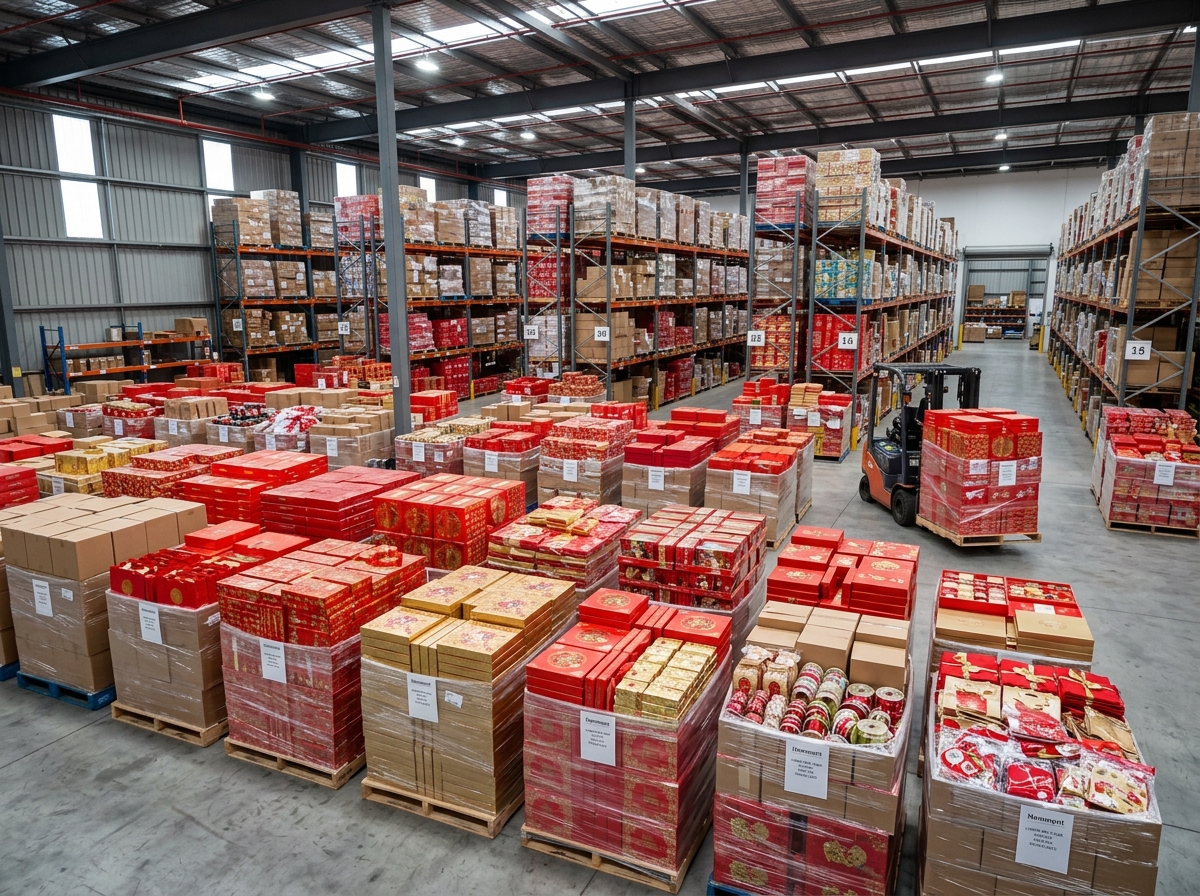
Even with careful planning, international packaging orders face risks that domestic sourcing avoids. Port congestion, customs delays, and shipping disruptions can extend lead times by days or weeks, and B2B buyers need strategies to mitigate these risks without resorting to expensive air freight.
Port delays have become increasingly common in recent years, with congestion at major West Coast and East Coast ports adding unpredictable time to ocean freight schedules. During peak shipping season—which overlaps with Lunar New Year packaging orders—container ships may wait days for berth availability, and inland drayage can be delayed by chassis shortages or warehouse appointment backlogs.
Customs clearance introduces another variable. Most packaging shipments clear customs within 24 to 48 hours, but inspections, documentation issues, or classification questions can extend this to a week or more. Working with experienced freight forwarders who understand packaging HS codes and FDA requirements (for food-contact packaging) reduces but doesn't eliminate this risk.
To manage these risks, build buffer time into your order window. If normal lead time is 8 weeks, plan for 10. If your absolute latest in-stock date is January 10, target January 3 as your planning date. This two-week cushion absorbs most routine delays without triggering emergency measures.
Maintain visibility into your shipment status throughout the supply chain. Request regular updates from your supplier on production completion, container loading, vessel departure, and estimated arrival. Once the shipment reaches port, track customs clearance status and inland transit. Early warning of delays gives you time to adjust merchandising plans, communicate with customers, or arrange partial air shipments of critical SKUs.
Consider splitting large orders across multiple shipments with staggered delivery dates. An initial shipment arriving in early January covers your opening inventory needs, while a second shipment in mid-January provides replenishment stock for peak selling days. This approach reduces the risk of total stockout if one shipment is delayed, though it may increase per-unit shipping costs.
For retailers running Lunar New Year programs for the first time, the safest approach is often a hybrid strategy: order core items from import suppliers with maximum lead time, and supplement with domestic sourcing for specialty items and safety stock. As you gain experience with demand patterns and supplier reliability, you can optimize the mix in future years.
The packaging you select for Lunar New Year programs should balance cultural authenticity with practical considerations like size, format, and price point. B2B buyers need to think beyond aesthetics to how packaging performs in retail environments and supports customer purchasing behavior.
Red and gold remain the dominant color scheme for Lunar New Year packaging, symbolizing luck, prosperity, and celebration. While some suppliers offer Year of the Goat-specific designs with zodiac imagery, many retailers find that generic red and gold packaging performs just as well and offers more flexibility for multi-year inventory planning.
Size selection should match your product assortment. Small 2x2x2 gift boxes work well for individual candies, chocolates, or small jewelry items. Medium 3x3x3 or 4x4x4 boxes accommodate bakery items, tea samplers, or gift sets. Larger formats suit premium gift baskets or multi-item assortments.
Format diversity gives customers options and increases average transaction value. Stock both rigid gift boxes for premium presentation and cellophane bags for casual gifting or party favors. Offer boxes with windows for products where visibility drives purchase decisions, and opaque boxes for items where the packaging itself creates anticipation.
Price point strategy matters in B2B packaging selection. Your packaging cost should align with your product margin and target customer. Premium gift shops can support higher-cost rigid boxes with custom printing, while high-volume candy retailers need economical folding cartons that maintain acceptable presentation at lower cost.
Don't overlook complementary packaging items that support the primary gift boxes. Tissue paper, ribbon, gift tags, and bags all contribute to the complete gifting experience and represent additional revenue opportunities. Customers who purchase a gift box often need these accessories, and bundling them increases basket size.
Lunar new year packaging wholesale pricing varies significantly based on order volume, customization level, sourcing origin, and timing. Understanding the cost structure helps B2B buyers make informed decisions about when and how much to order.
Most packaging suppliers set minimum order quantities (MOQs) that increase efficiency for both manufacturer and buyer. Stock items like standard kraft or white gift boxes typically carry lower MOQs—often 100 to 500 units per SKU—while custom-printed packaging may require 1,000 to 5,000 units to justify setup costs.
Volume discounts create strong incentives to consolidate orders rather than placing multiple small orders throughout the season. A single 5,000-unit order typically costs 15% to 25% less per unit than five separate 1,000-unit orders, even before accounting for reduced shipping and handling costs.
However, volume commitments increase inventory risk, particularly for first-year programs or untested SKUs. Conservative buyers can balance cost efficiency with risk management by ordering core items at volume and specialty items at minimum quantities, then using sell-through data from the first few weeks to inform reorders.
Timing affects pricing in ways beyond simple supply and demand. Orders placed in the November window—before peak season pressure—sometimes receive better pricing than December orders when manufacturers are at capacity. Early orders also avoid rush fees and expedited shipping charges that can add 20% to 50% to total landed cost.
Import sourcing generally offers lower per-unit costs but higher minimum order quantities and longer payment terms. Domestic suppliers often accept smaller orders with shorter payment cycles, providing more flexibility for retailers with limited working capital or uncertain demand forecasts.
Calculate total landed cost, not just unit price, when comparing suppliers. An imported gift box that costs $0.40 per unit may have a landed cost of $0.55 after ocean freight, customs duties, and domestic delivery. A domestic box priced at $0.50 with minimal shipping charges may actually be more economical, especially when you factor in reduced lead time risk.
Packaging availability must align with product production schedules, particularly for food businesses creating Lunar New Year-specific items. A mismatch between when products are ready and when packaging arrives creates costly delays or forces compromises in presentation quality.
Bakeries and confectioners producing Lunar New Year specialties—traditional cookies, candies, or pastries—typically begin production in early to mid-January to ensure freshness during peak selling days. Your packaging needs to be on-site and ready before the first batch comes out of production, which means targeting a January 5–10 delivery window for most food applications.
Gift shops and retailers selling pre-packaged goods have more flexibility, as they're typically receiving finished products from suppliers rather than packaging items in-house. However, you still need packaging available for display building, gift wrapping services, or custom gift basket assembly before customers begin shopping in mid-January.
For businesses offering both standard inventory and custom gift services, consider staging your packaging deliveries. Core display packaging can arrive in early January, while specialty items or custom-printed boxes scheduled for later in the season can arrive in mid-January. This staged approach reduces warehouse congestion and aligns cash outflows with revenue more closely.
Communication between your purchasing, production, and merchandising teams prevents costly misalignments. The buyer ordering packaging should know exactly when production or merchandising needs materials on-site, and production teams should understand the lead times required for packaging procurement. Regular check-ins during the November-to-January planning period keep everyone aligned.
Lunar New Year 2027 begins on Saturday, February 6, marking the start of the Year of the Goat. This date matters for packaging orders because B2B buyers need to work backward from it to account for 8 to 10 weeks of supply chain lead time. Orders placed between November 21 and December 5, 2026 ensure packaging arrives in early January, giving retailers time to stage inventory before peak shopping begins in mid-January.
Wholesale pricing for Lunar New Year gift boxes and bags varies widely based on size, material, customization, and order volume. Standard kraft or white gift boxes in small sizes (2x2x2 to 3x3x3) typically range from $0.30 to $0.75 per unit at wholesale volumes. Red and gold specialty packaging or custom-printed designs cost $0.50 to $1.50 per unit depending on complexity. Volume discounts of 15% to 25% apply to orders above 5,000 units, and import sourcing generally offers lower per-unit costs than domestic suppliers, though total landed cost should be compared.
December orders for Lunar New Year 2027 packaging are possible but risky. Domestic suppliers with 3 to 5 week lead times can fulfill December orders for January delivery, though you'll have less selection as popular items sell out. Import orders placed in December face significant risk of missing the holiday entirely, as 8 to 12 week lead times push delivery into late January or February. If you must order in December, work with domestic suppliers, expect to pay rush fees, and have backup plans for potential stockouts.
The most critical factors are lead time reliability, minimum order quantities, quality consistency, and total landed cost. Verify that suppliers can meet your required delivery date with buffer time for delays, and confirm MOQs align with your volume needs without forcing excess inventory. Request samples to assess quality before placing large orders, and calculate total cost including shipping, duties, and handling—not just unit price. Also consider the supplier's experience with seasonal programs and their capacity to handle rush reorders if you sell through inventory faster than expected.
Start by estimating total customer traffic during the 4-week selling window from mid-January through early February. Multiply traffic by your expected attachment rate (the percentage of customers who will purchase Lunar New Year items), then by average units per transaction. Add 20% to 30% safety stock to cover demand variability and potential reorder delays. For example, if you expect 1,000 customers, a 30% attachment rate, and 2 units per transaction, you'd need 600 units base plus 120-180 units safety stock, totaling 720-780 units. First-year programs should err on the conservative side, as unsold seasonal packaging has limited value after the holiday.
Planning your lunar new year packaging wholesale order for 2027 Year of the Goat requires balancing lead time realities with demand uncertainty, but the November 21–December 5 order window gives B2B buyers the best chance of success. By understanding the supply chain timeline, building in buffer for delays, and coordinating packaging arrival with product and merchandising schedules, retailers can ensure they're fully stocked when customers begin shopping in mid-January. The investment in early planning pays dividends in sell-through rates, reduced stockout risk, and the ability to capture the full revenue potential of this important cultural celebration.