Cart
0
You may also like


Book a call with our development team to get started.



Apply online and access wholesale pricing.

If you're selling handmade candles at weekend markets and shipping the same products via Shopify, you've probably noticed that your packaging needs are pulling in two directions. Retail packaging prioritizes shelf appeal and instant visual impact, while ecommerce packaging must protect products through handling, transit, and doorstep delivery. Understanding the difference between retail vs ecommerce packaging helps you allocate your budget strategically and avoid over-investing in features your customers will never see.
The good news: many small businesses don't need entirely separate packaging systems. With thoughtful planning, you can identify versatile solutions that serve both channels—or pinpoint exactly when a dual approach makes financial sense. This guide walks through the functional and aesthetic distinctions, cost considerations, and decision frameworks for hybrid sellers.
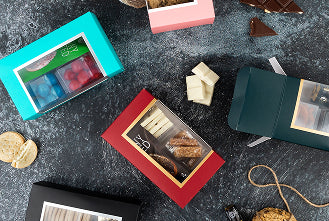
Retail packaging and ecommerce packaging serve fundamentally different moments in the customer journey. Retail packaging competes for attention in a physical space—on a shelf, in a display case, or at a checkout counter. It needs to communicate brand identity, product details, and value proposition within seconds. Window cutouts, bold graphics, and structural design all play a role. The package itself often doubles as the display fixture.
Ecommerce packaging, by contrast, must survive the supply chain. According to the Packaging Digest industry reports, packages shipped via parcel carriers experience an average of 17 touch points between warehouse and doorstep. That means your packaging must withstand stacking weight, vibration, temperature fluctuations, and occasional rough handling. Protection is the baseline requirement—everything else is secondary.
For small businesses navigating custom packaging for small businesses, these differences shape material selection, structural design, and cost per unit. A beautiful windowed gift box that sells well at a craft fair may arrive crushed if shipped without additional outer protection. Conversely, a plain corrugated mailer that keeps your product safe in transit does nothing to attract a browser's eye in a retail environment.
Some products and business models allow you to use retail-focused packaging for ecommerce orders with minimal modification. This approach works best when your product is relatively durable, your retail packaging already includes some structural integrity, and your brand aesthetic benefits from a premium unboxing experience.
Consider a small bakery selling decorated cookies. A sturdy kraft window box designed for farmers' market display can ship successfully if you add a layer of tissue paper inside for cushioning and place the box inside a slightly larger corrugated mailer. The customer still gets the visual appeal of the windowed box when they open the outer mailer, and you avoid maintaining two separate SKUs.
This strategy works particularly well for:
The trade-off is material cost. You'll pay for the aesthetic features of retail packaging (windows, coatings, custom printing) plus the protective features of ecommerce packaging (outer mailers, void fill, cushioning). For high-margin products or small batch operations, this premium is often worthwhile. For commodity products or high-volume shippers, the math changes quickly.
Dedicated ecommerce packaging makes sense when shipping volume justifies the inventory complexity, when products are fragile or oddly shaped, or when retail packaging simply can't survive transit without excessive additional protection.
A ceramics studio selling mugs at art fairs and through Etsy offers a clear example. The retail version might use an open display box or simple sleeve that lets customers see and touch the glaze. The ecommerce version needs corrugated inserts, corner protectors, and a rigid outer box—none of which add value in a face-to-face retail setting. Forcing the retail packaging to do double duty would mean either over-packaging for in-person sales or under-protecting online orders.
Channel-specific packaging also makes sense when order volumes allow you to hit minimum order quantities for custom printing on both packaging types. If you're shipping 500+ ecommerce orders per month and attending 12+ retail events per year, you can likely justify separate packaging runs optimized for each channel's requirements.
Key indicators you need separate systems:
Most small businesses fall somewhere between the extremes—not quite ready for fully separate systems, but aware that a one-size-fits-all approach has limitations. Hybrid strategies offer a middle path.
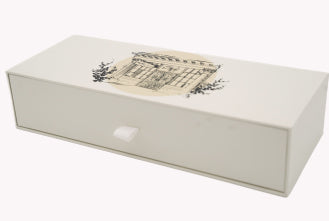
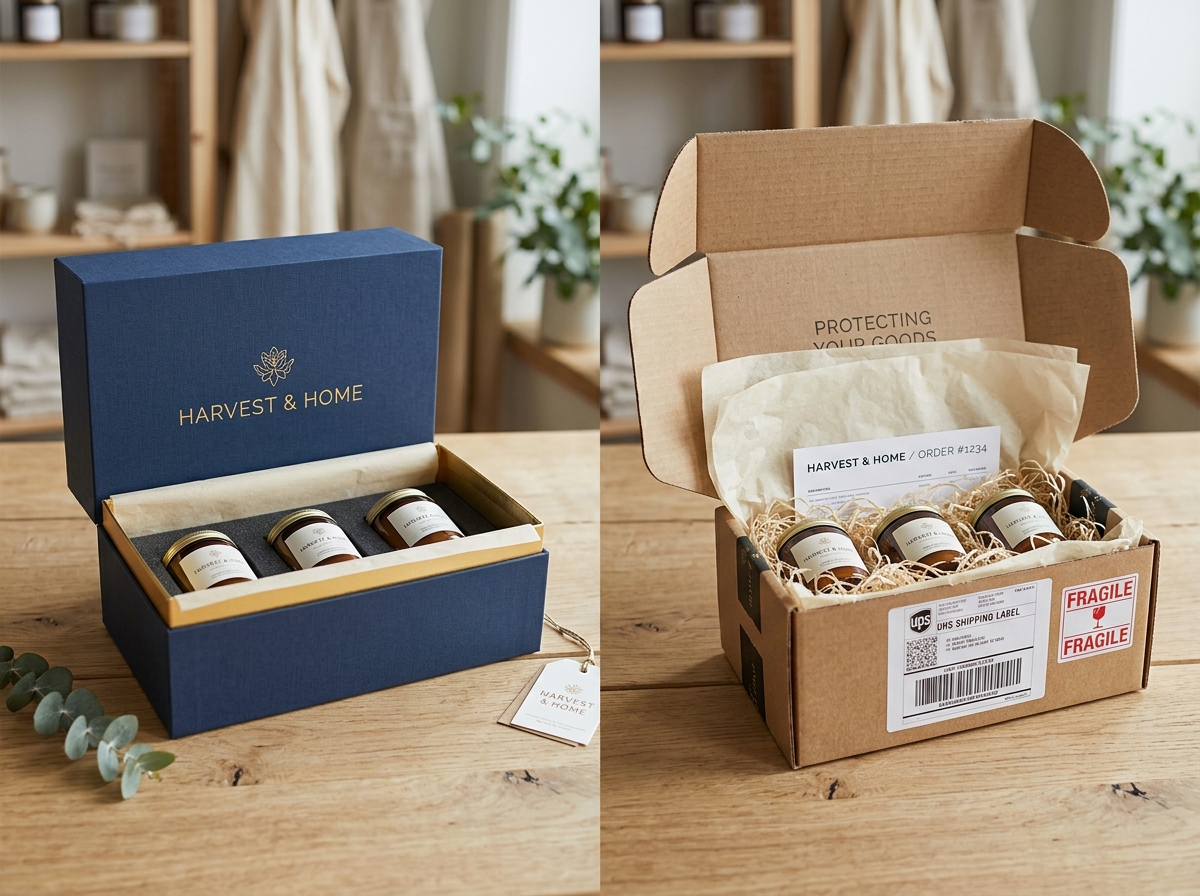
One effective approach is the modular system: design a core package that works for both channels, then add channel-specific components. For example, a structured gift box serves as your base unit. For retail, you add a belly band with product information and display it open or with a clear lid. For ecommerce, you nest the same box inside a plain corrugated mailer with minimal tissue paper.
Another strategy focuses on the unboxing moment. Ship products in plain, protective outer packaging, but include a branded insert, tissue paper, or small gift box inside that recreates the retail presentation. This approach is detailed in our guide to creating an unboxing experience on a small business budget. The customer still gets a memorable reveal when they open the shipping box, but you're not paying to protect decorative features during transit.
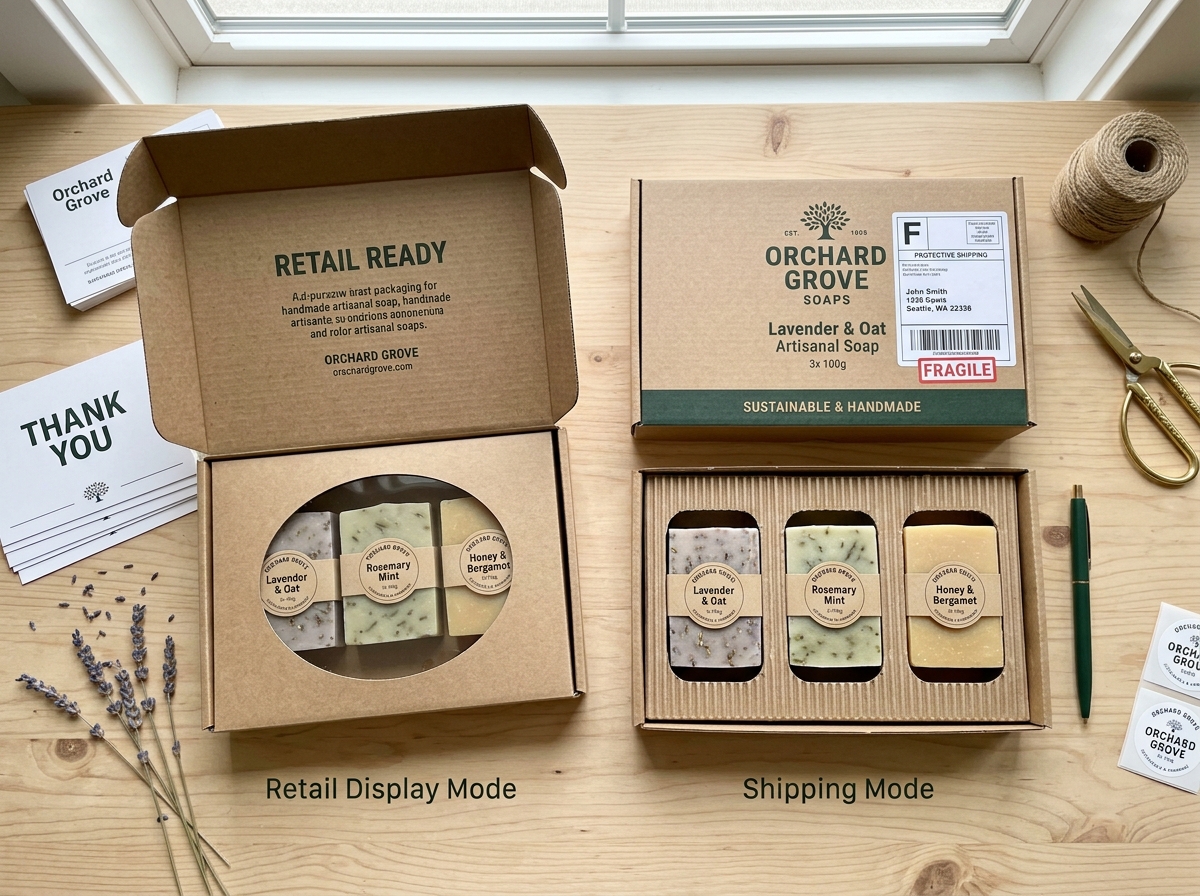
Material selection plays a crucial role in hybrid strategies. Kraft paperboard offers a sweet spot: it's sturdy enough to ship with moderate protection, eco-friendly enough to appeal to conscious consumers, and affordable enough to use across channels. A well-designed kraft box can display on a shelf and survive parcel shipping if you choose the right caliper and construction. The trade-off is aesthetic flexibility—kraft has a distinct look that won't suit every brand.
The financial case for separate packaging systems hinges on three variables: order volume, product margin, and damage rates. A simple framework helps clarify the decision.
Calculate your current packaging cost per order for each channel. Include the package itself, any inserts or void fill, labor time for packing, and an estimated cost for damages and returns. If your retail packaging costs $2.50 per unit and requires an additional $1.75 in shipping materials and labor when used for ecommerce, your blended ecommerce cost is $4.25.
Now price out channel-specific ecommerce packaging. A plain mailer with minimal branding might cost $1.20, with another $0.60 in labor and materials. Your new ecommerce cost is $1.80—a savings of $2.45 per order. If you ship 300 orders per month, that's $735 in monthly savings, or $8,820 annually.
The catch is upfront investment. Custom ecommerce packaging often requires minimum order quantities of 250-1,000 units depending on printing and structural complexity. Understanding MOQ requirements helps you forecast cash flow and storage needs. If your MOQ investment is $800 and you're saving $735 per month, payback happens in just over one month—a clear win.
But if your shipping volume is only 50 orders per month, that same $2.45 savings yields just $122.50 monthly, stretching payback to six months. You'll also need to store 250-1,000 units of packaging, which may exceed your available space. In lower-volume scenarios, a hybrid approach or universal packaging often makes more sense.
The materials you choose dramatically affect whether a single packaging solution can serve both retail and ecommerce needs. Rigid setup boxes offer excellent protection and premium presentation but add significant weight and cost to shipping. Folding cartons in heavier calipers strike a better balance—they can be designed with tuck closures and windows for retail appeal, while still offering enough rigidity to ship safely with minimal outer packaging.
Corrugated boxes are the workhorse of ecommerce but can feel industrial for retail settings. However, printed corrugated with high-quality graphics is increasingly accepted in artisan retail environments, particularly for brands emphasizing sustainability. A well-designed corrugated box with a natural kraft exterior and bold one-color printing can work on a farmers' market table and ship reliably.
For businesses selling products in containers—beverages, candles in tins, or cosmetics in jars—protective sleeves and holders offer flexibility. A protective can holder can nest inside a decorative outer box for retail, or ship alone in a poly mailer for ecommerce. This modular approach lets you scale protection up or down based on channel needs.
The Packaging School notes that material choice should align with your product's fragility rating and typical shipping distance. Products shipping across the country via ground service face more stress than local deliveries. If most of your ecommerce orders are regional, you may be able to use lighter-weight packaging than a business shipping coast-to-coast.
Your packaging is a brand touchpoint, but the role it plays differs by channel. In retail, packaging must work harder to establish credibility and communicate value—the customer has no prior relationship with your brand and is evaluating you against adjacent products on the same shelf. Bold logos, clear product descriptions, and material cues (soft-touch coatings, metallic foils, embossing) all signal quality and justify price points.
In ecommerce, the customer has already made a purchase decision, often based on your website, product photography, and reviews. The packaging still matters—it's the first physical interaction with your brand—but its job is to confirm the customer's choice and encourage repeat purchases, not to make the initial sale. This means ecommerce packaging can be more understated, focusing on protection and a pleasant unboxing moment rather than shelf competition.
For hybrid sellers, this creates an opportunity to differentiate your packaging investment. Allocate more budget to custom printing and structural features for retail packaging, where it directly influences conversion. Use simpler, more cost-effective solutions for ecommerce, investing instead in inserts, thank-you cards, or small samples that build customer loyalty.
That said, brand consistency still matters. Even if your ecommerce packaging is simpler, it should use the same color palette, logo treatment, and tone of voice as your retail packaging. A customer who discovers you at a craft fair and later orders online should recognize your brand immediately when the package arrives.
Few businesses get their packaging strategy perfect on the first try. The most successful multi-channel sellers treat packaging as an ongoing experiment, tracking metrics and adjusting based on real-world performance.
Start by monitoring damage rates by channel. If your ecommerce damage rate exceeds 2-3%, your packaging isn't providing adequate protection—even if it looks great. Conversely, if you're seeing zero damages but spending significantly more on packaging than competitors, you may be over-engineering the solution.
Customer feedback offers qualitative insight. Pay attention to unboxing photos customers share on social media, and note any comments about packaging in reviews. Phrases like "arrived safely," "beautiful presentation," or "easy to open" are positive signals. Complaints about excessive packaging, difficulty opening, or damaged goods point to areas for improvement.
Run small tests before committing to large orders. Order sample quantities of 25-50 units in different configurations and use them for a month of orders or a few retail events. Track the time required to pack each order, customer reactions, and any issues that arise. This low-risk testing helps you identify problems before you're sitting on 1,000 units of packaging that doesn't quite work.
As your business grows and channel mix shifts, revisit your packaging strategy annually. A business that starts with 80% retail and 20% ecommerce may find those ratios flip within two years. What worked as a scrappy startup may no longer serve you at higher volumes, and packaging solutions that seemed too expensive at 50 orders per month become cost-effective at 500.
Beyond aesthetics and protection, certain products face channel-specific packaging requirements. Food products shipping via ecommerce must meet FDA guidelines for sealed, tamper-evident packaging, while the same products sold at farmers' markets may have more flexibility under cottage food laws. Cosmetics and personal care items face similar distinctions between retail and direct-to-consumer regulations.
Shipping carriers also impose requirements that don't apply to retail packaging. Dimensional weight pricing penalizes oversized packages relative to their actual weight, making bulky retail packaging expensive to ship. Packages over certain dimensions may incur additional handling fees. Check your primary carrier's guidelines—UPS, FedEx, and USPS each have slightly different thresholds.
Sustainability considerations increasingly influence packaging decisions across both channels. According to McKinsey research, more than 60% of consumers consider sustainability when making purchase decisions, and packaging is a highly visible element of that assessment. Retail packaging that sits on a shelf allows customers to evaluate recyclability and material choices before purchase. Ecommerce packaging arrives as a fait accompli—customers can't opt out of excessive packaging, which makes restraint especially important for brand perception.
Practical storage and fulfillment logistics also matter. If you're packing orders from a spare bedroom or small studio, maintaining inventory of multiple packaging types, void fill materials, and branded inserts quickly becomes unwieldy. Simpler systems with fewer SKUs reduce errors and speed up fulfillment. As you scale, you may gain access to warehouse space or third-party fulfillment that makes complexity more manageable, but early-stage businesses benefit from streamlined packaging systems.
To determine whether you need separate retail and ecommerce packaging, work through this decision framework:
Step 1: Assess product fragility. Can your product survive parcel shipping in retail packaging with minimal additional protection? If yes, a universal or hybrid approach is viable. If no, you need channel-specific solutions.
Step 2: Calculate volume by channel. If either channel represents fewer than 100 units per quarter, the complexity of separate systems likely outweighs the benefits. Focus on a hybrid solution or accept slightly higher per-unit costs in the lower-volume channel.
Step 3: Evaluate margin and price sensitivity. High-margin products (jewelry, artisan goods, specialty foods) can absorb higher packaging costs. Commodity or price-sensitive products need leaner solutions. If your retail customers expect premium presentation but your ecommerce customers are price-shopping, separate packaging may be justified.
Step 4: Consider brand positioning. If your brand emphasizes sustainability, unboxing experience, or luxury positioning, packaging plays an outsized role in customer perception. Invest accordingly, potentially using a premium retail package and a simplified but still branded ecommerce solution.
Step 5: Project 12-month growth. Your packaging needs six months from now may differ significantly from today. If you're scaling rapidly, design systems that can grow with you—even if that means slightly over-investing in flexibility today.
For many small businesses, the answer lands on a hybrid system: a well-designed core package that works for both channels, supplemented with minimal channel-specific components. A versatile gift box that can display on a shelf or nest inside a mailer offers exactly this kind of flexibility, allowing you to serve both channels without maintaining entirely separate inventory.
Yes, this hybrid approach works well for durable products and low to moderate shipping volumes. Use your retail packaging as the inner package and add a plain outer mailer, corrugated box, or bubble mailer for transit protection. The trade-off is slightly higher material costs per ecommerce order, but you gain inventory simplicity and maintain brand consistency across channels.
Monitor your damage rate—if more than 2-3% of orders arrive damaged, your packaging needs improvement. Conduct drop tests by sealing a package and dropping it from waist height onto concrete several times. If the product inside shifts or shows damage, add more cushioning or use a sturdier outer container. Consider the shipping distance and carrier handling in your area, as regional variations exist.
Custom printing on ecommerce packaging serves brand recognition and encourages social sharing, but it's not essential for product protection. If budget is tight, prioritize custom printing for retail packaging where it influences purchase decisions, and use stock packaging with branded inserts or stickers for ecommerce. As volume grows and per-unit costs drop, you can add custom printing to ecommerce packaging.
Most businesses see positive ROI on separate packaging systems when shipping 200+ ecommerce orders per month and maintaining steady retail presence. Below that threshold, the inventory complexity and upfront MOQ investment typically outweigh per-unit savings. However, the calculation depends on your product margin, damage rates, and available storage space—run the numbers for your specific situation.
Protection is non-negotiable—damaged products create waste, returns, and customer dissatisfaction that outweigh any sustainability benefit of lighter packaging. Within the constraint of adequate protection, choose recyclable or compostable materials, right-size your packaging to minimize void fill, and avoid mixed materials that complicate recycling. Many sustainable options like kraft corrugated and molded pulp offer excellent protection alongside environmental benefits.