Cart
0
You may also like

Book a call with our development team to get started.



Apply online and access wholesale pricing.

When planning Lunar New Year gifts for customers, employees, or loved ones, one of the first decisions you'll face is whether to use gift bags or gift boxes. Both formats work well for traditional treats like candies, cookies, tea, and red envelopes, but each offers distinct advantages depending on your gift type, presentation goals, and volume needs.
This guide walks through the practical differences between lunar new year gift boxes and lunar new year gift bags, helping you choose the right packaging for candy assortments, baked goods, and ceremonial items while respecting the cultural importance of red, gold, and auspicious presentation.
The choice between gift bags and gift boxes isn't purely aesthetic. Each format serves different functional needs, and understanding these differences helps you match packaging to the specific gift and occasion.
Gift boxes—whether rigid two-piece styles or folding tuck-top cartons—provide structure, protection, and a formal presentation. They're ideal for fragile items, stacked cookies, or gifts that need to maintain their shape during transport. Gift bags, on the other hand, offer flexibility, convenience, and portability. They accommodate irregular shapes, simplify high-volume packing, and include built-in handles for easy carrying.
For Lunar New Year specifically, both formats can incorporate the essential red and gold color palette that Packaging Insights notes as central to festive packaging across Asian markets. The question becomes which structure best serves your gift's contents and the recipient's experience.
Gift boxes excel in situations where presentation, protection, and reusability matter most. If your Lunar New Year gift includes delicate items—such as thin almond cookies, chocolate truffles, or layered candies—a structured box prevents crushing and maintains product integrity during handling and transport.
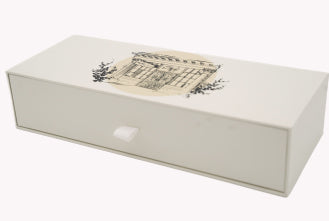
Rigid boxes and tuck-top cartons also create a more formal unboxing experience. The recipient lifts a lid or unfolds a closure, revealing the contents in a controlled, ceremonial way that aligns with the reverence of Lunar New Year gift-giving traditions. This format works especially well for corporate gifts, premium tea sets, or multi-item assortments where visual presentation reinforces the gift's value.
From a storage perspective, boxes stack cleanly and can be reused for organizing small items long after the holiday. A cube kraft gift box in a 3x3x3-inch format, for example, holds a generous portion of wrapped candies or fortune cookies while remaining compact enough for desktop display or drawer storage.
Boxes provide superior protection for items that can't tolerate compression. If you're packaging thin butter cookies, sesame crisps, or delicate pineapple cakes, the rigid walls of a gift box shield contents from external pressure. This is particularly important when gifts are stacked, shipped, or transported in bulk.
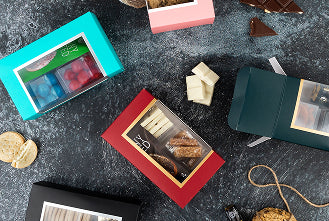
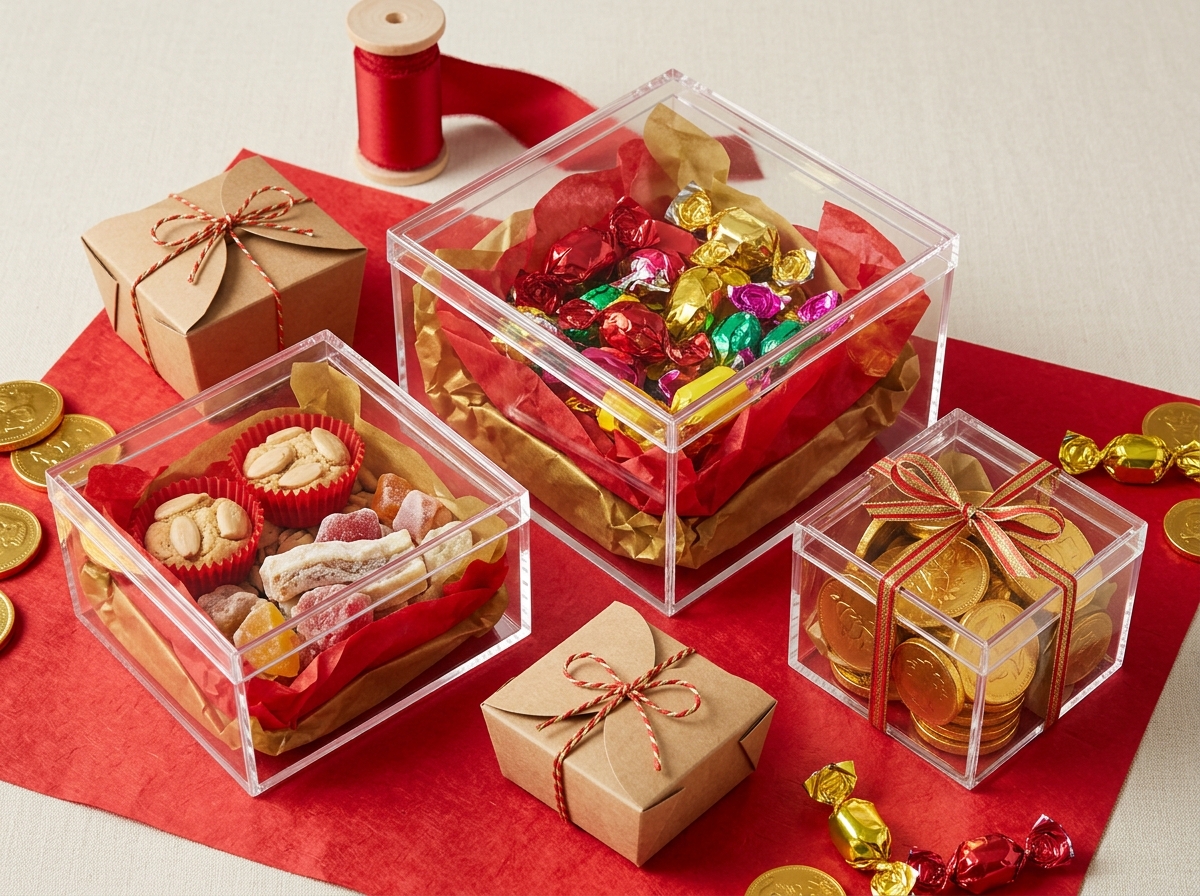
For bakery items, windowed boxes offer the additional benefit of product visibility without sacrificing structural support. A clear acetate or PET window lets recipients see the treats inside while the box frame keeps everything secure. This transparency can be especially appealing for branded or custom-decorated cookies where the visual appeal is part of the gift.
In B2B contexts—employee appreciation, client gifts, or vendor thank-yous—boxes convey a higher perceived value than bags. The structure itself signals thoughtfulness and investment, reinforcing the cultural importance of prosperity and good fortune that Lunar New Year represents.
Black or kraft cube boxes in particular offer a modern, elegant alternative to traditional red packaging while still pairing well with gold foil accents, red tissue paper, or metallic ribbon. A 4x4x4-inch black cube box can hold a substantial candy assortment or a wrapped tin of premium tea, creating a sophisticated presentation that works across cultural contexts.
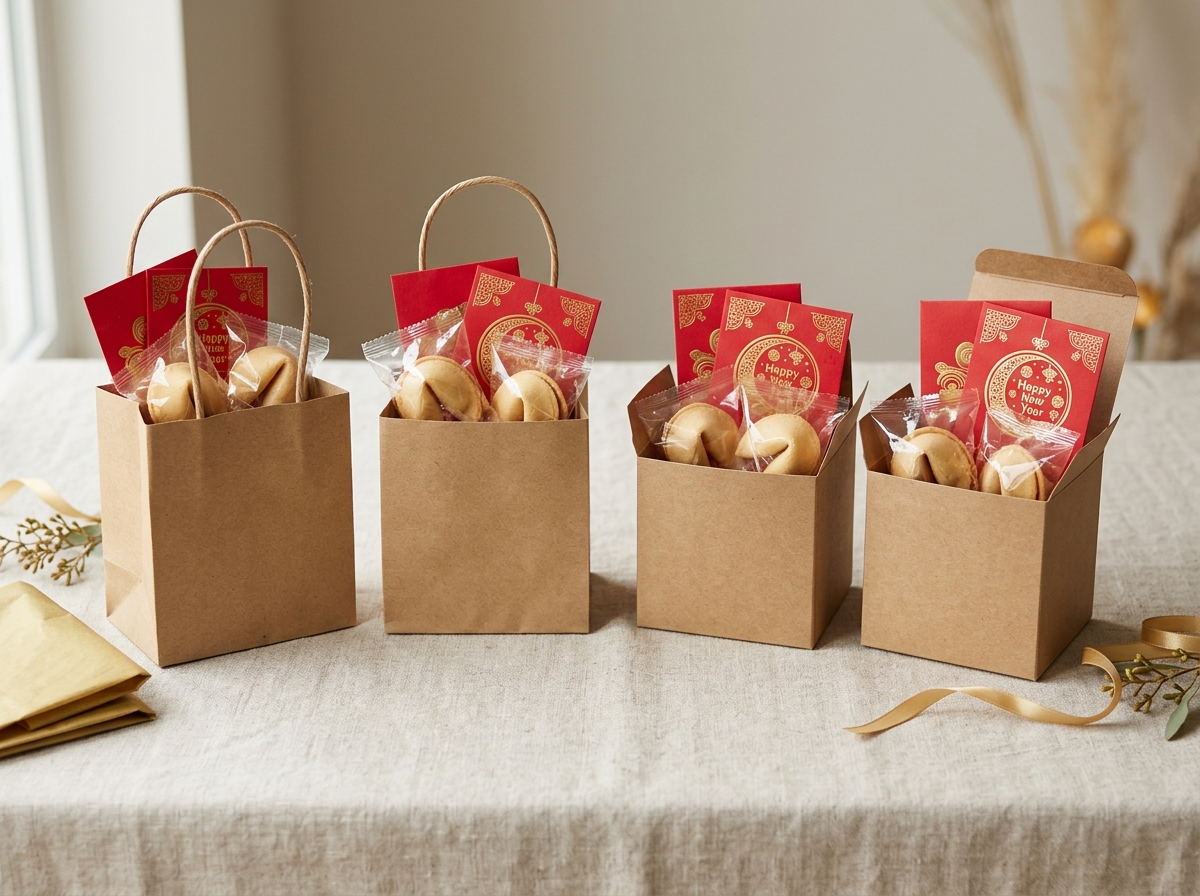
Gift bags shine in high-volume scenarios, last-minute packing situations, and when portability matters more than rigid structure. If you're assembling dozens or hundreds of Lunar New Year gifts—for a retail promotion, employee distribution, or community event—bags streamline the packing process significantly.
Unlike boxes, which require assembly (even tuck-top styles need folding and tucking), gift bags arrive ready to use. You simply insert the gift, add tissue paper, and you're done. This speed advantage becomes critical when you're working against tight timelines, such as the weeks leading up to Lunar New Year when demand peaks and labor is stretched.
Bags also accommodate irregular shapes more gracefully than boxes. If your gift includes a mix of items—red envelopes, a small jar of candied ginger, a packet of tea, and a decorative ornament—a bag conforms to the contents rather than requiring you to fit everything into a fixed cube or rectangle.
One of the most practical advantages of gift bags is the built-in handle. Recipients can carry multiple bags at once, freeing their hands for other items. This is especially useful at events, office distributions, or family gatherings where guests may be juggling coats, purses, and other belongings.
Handles also reduce the risk of dropping or mishandling the gift. A bag hangs securely from the hand or wrist, while a box must be cradled or balanced, increasing the chance of accidental drops—particularly problematic if the contents are fragile.
From a budget and logistics standpoint, gift bags typically cost less per unit than rigid boxes and occupy less storage space when empty. Bags nest flat, allowing you to store hundreds in a small footprint. Boxes, even collapsible tuck-top styles, require more cubic volume and careful stacking to prevent crushing.
For small businesses operating with limited warehouse space or tight seasonal budgets, this efficiency can be decisive. You can stock a larger variety of bag sizes and designs without committing significant floor space or capital.
The ideal packaging choice often depends on what you're putting inside. Here's how different Lunar New Year gift categories align with bags versus boxes.
For individually wrapped candies—chocolate coins, fruit gels, or hard candies in traditional red and gold foil—both bags and boxes work well. The decision comes down to presentation preference and quantity.
Small cube boxes in the 2x2x2-inch or 3x3x3-inch range create a tidy, uniform presentation for candy assortments. A 2x2x2-inch white cube box holds approximately 6-8 individually wrapped candies, making it ideal for small thank-you gifts or party favors.
Gift bags, on the other hand, allow for more generous portions and easier visibility. If you want recipients to see the variety of candies at a glance, a clear cellophane bag or a paper bag with a transparent front panel showcases the contents while still incorporating festive colors through tissue paper or printed designs.
Cookies present a packaging challenge because they're both fragile and often irregularly shaped. Boxes generally provide better protection, especially for thin, crisp cookies that can shatter under pressure.
For standard-sized cookies (3-4 inches in diameter), a 4x4x4-inch cube box accommodates a stack of 4-6 cookies with minimal shifting. If you're packaging larger or thicker cookies, consider a slightly larger format or a rectangular box that better matches the cookie dimensions.
Bags can work for cookies if you provide adequate cushioning—crinkle paper, tissue puffs, or bubble wrap—to prevent movement. However, the lack of rigid walls means cookies may still break if the bag is compressed or dropped. For retail or gifting scenarios where product integrity is non-negotiable, boxes remain the safer choice.
Traditional Lunar New Year gifts often include non-edible items like red envelopes (lai see or hongbao), tea tins, or small decorative ornaments. These items typically don't require the same level of protection as fragile cookies, making bags a practical and culturally appropriate choice.
A medium-sized gift bag (approximately 5x7 inches or 8x10 inches) easily holds a tea tin, a bundle of red envelopes, and a small decorative item without excessive empty space. The flexibility of the bag conforms to the contents, creating a neat, finished look without the rigid geometry of a box.
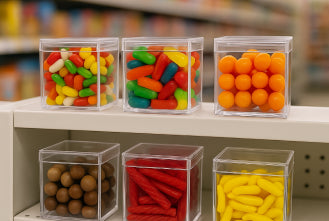
If you prefer a box for these items, consider using a clear acrylic option that showcases the red envelopes and gold accents inside. Transparent packaging honors the visual importance of red and gold in Lunar New Year traditions while providing structure and reusability.
One key consideration in the bag-versus-box decision is whether you want the contents visible or concealed. This choice affects both aesthetic appeal and practical merchandising.
Clear packaging—whether a cellophane bag, a windowed box, or a fully transparent acrylic container—allows the gift's colors, shapes, and variety to speak for themselves. This is particularly effective for Lunar New Year gifts because the red and gold hues of candies, cookies, and envelopes are themselves symbolic and visually appealing.
Opaque packaging, conversely, creates anticipation and allows you to control the reveal. A solid red or gold bag with tissue paper conceals the contents until the recipient opens it, adding an element of surprise. This approach works well when the gift itself may not be visually striking (such as a plain tea tin or a simple red envelope) but the gesture and symbolism are what matter.
For more guidance on when to show versus conceal gifts, see our related post on clear versus opaque gift boxes, which explores this decision in a corporate gifting context.
Lunar New Year packaging carries cultural weight beyond simple aesthetics. Red symbolizes luck, happiness, and prosperity, while gold represents wealth and good fortune. These colors aren't optional decorative elements—they're foundational to the holiday's meaning and are expected in gift packaging across Chinese, Vietnamese, Korean, and other Asian communities celebrating the lunar calendar.
Both bags and boxes can incorporate these colors, but the execution differs. Bags often feature printed designs—zodiac animals, floral motifs, or calligraphic blessings—directly on the paper surface. Boxes, particularly plain kraft or white options, typically rely on added elements like tissue paper, ribbon, or stickers to introduce red and gold accents.
If you're sourcing neutral-colored boxes or bags, plan to supplement with culturally appropriate embellishments. Red tissue paper, gold metallic ribbon, or adhesive decals featuring the year's zodiac animal (such as the Snake for 2025 or the Horse for 2026) transform a generic package into a culturally resonant gift. For detailed guidance on color symbolism and traditional motifs, see our post on traditional Lunar New Year gift packaging.
Regardless of whether you choose bags or boxes, timing your packaging order is critical. Lunar New Year falls on a different date each year (based on the lunar calendar), and the weeks leading up to the holiday see intense demand for packaging materials, particularly in red and gold colorways.
For B2B buyers—bakeries, candy shops, corporate gifting companies—placing orders 8-12 weeks in advance is standard practice. This lead time accounts for manufacturing, shipping, and potential delays during the peak holiday season. Retail buyers or individuals planning smaller-scale gifts can often work with shorter timelines, but availability of specific colors and sizes may be limited closer to the holiday.
For specific guidance on ordering timelines and minimum order quantities for Lunar New Year packaging, see our post on when to order Lunar New Year packaging for 2027, which includes planning benchmarks for both small businesses and high-volume buyers.
In some cases, the most effective approach isn't choosing between a bag and a box—it's using both. A layered presentation combines the structural benefits of a box with the portability and visual appeal of a bag.
For example, you might package delicate cookies in a small tuck-top box, then place that box inside a larger gift bag along with red envelopes and a decorative ornament. This approach protects the fragile items while creating a multi-element gift that feels generous and thoughtfully assembled.
This strategy is particularly effective for corporate gifts where you want to include both edible and non-edible items. The box holds the food component (ensuring freshness and preventing crushing), while the bag serves as the outer carrier and provides space for branded tissue paper, a greeting card, or additional small items.
Choosing the right size is just as important as choosing the right format. Packaging that's too large creates excess void space and requires additional filler; packaging that's too small risks crushing contents or looking cramped.
For candy assortments, a 3x3x3-inch cube box holds approximately 10-12 individually wrapped candies with minimal air space. If you're packaging larger quantities, step up to a 4x4x4-inch box, which accommodates 20-25 candies comfortably.
For cookies, match the box or bag dimensions to the cookie diameter plus about an inch of clearance on each side. A 4-inch cookie fits well in a 5x5-inch box or a bag with a 5-inch base width. If you're stacking multiple cookies, add height accordingly—plan for roughly 0.5 inches per cookie layer.
For more detailed sizing recommendations specific to Lunar New Year candy and sweets, see our post on red and gold gift box sizes for Lunar New Year candy, which includes dimension charts for common treat types.
Beyond format and size, the material and finish of your packaging influence both aesthetics and functionality. Kraft paper offers a natural, eco-friendly look that pairs well with red and gold accents. White provides a clean, modern canvas for custom printing or embellishments. Black creates a sophisticated, high-contrast backdrop for metallic details.
For Lunar New Year specifically, kraft and white are the most versatile neutral bases. They don't compete with the symbolic red and gold colors and allow those hues to dominate the visual presentation. Black can work well for contemporary or minimalist interpretations of the holiday, particularly in urban or design-forward contexts, but may feel less traditional to some recipients.
Specialty finishes—such as foil stamping, embossing, or metallic inks—add a premium touch but typically require custom printing and longer lead times. For small businesses or individuals, adding gold foil stickers or pre-printed red tissue paper to plain boxes or bags achieves a similar effect without the cost and complexity of custom manufacturing.
If you're packaging gifts in volume—whether for a corporate distribution, a retail promotion, or a community event—the assembly workflow differs significantly between bags and boxes.
Gift bags require minimal setup. You open the bag, insert the gift, add tissue paper or filler, and optionally attach a tag or seal the top with a sticker or ribbon. A single person can assemble 50-100 bags per hour depending on the complexity of the contents and embellishments.
Boxes, particularly tuck-top styles, require folding and tucking before you can insert the gift. Rigid two-piece boxes need lid placement and alignment. These steps add time—expect to assemble 30-50 boxes per hour for simple configurations. However, boxes often require less filler material because their structure itself provides cushioning and shape, potentially offsetting some of the time difference.
For high-volume scenarios, consider setting up an assembly line with multiple stations: one person folds boxes, another inserts gifts, a third adds tissue and closes lids, and a fourth applies labels or ribbons. This division of labor can significantly increase throughput compared to having each person complete one package at a time.
Sustainability considerations are increasingly important to both B2B buyers and end consumers. Both bags and boxes can be eco-friendly depending on material choices and post-use behavior.
Paper bags and kraft boxes are widely recyclable in municipal recycling programs, provided they're not heavily contaminated with food residue or non-paper embellishments like plastic windows or metallic coatings. Encourage recipients to reuse packaging before recycling by designing for durability and providing multiple use cases (storage, regifting, organization).
Clear acrylic boxes, while not biodegradable, offer exceptional reusability. A well-made acrylic box can be used dozens of times for storage, display, or future gifting, potentially offsetting its higher initial environmental footprint through extended lifecycle use.
If sustainability is a priority for your brand or recipient base, communicate your packaging choices clearly. A small insert card explaining that the kraft box is recyclable or that the acrylic container is designed for long-term reuse reinforces your environmental values and encourages responsible disposal.
Cost is often a deciding factor, particularly for small businesses operating on tight margins or individuals assembling large quantities of gifts.
In general, paper gift bags cost less per unit than rigid boxes of comparable size. A basic kraft or white gift bag in a 5x7-inch format typically costs 20-40% less than a 4x4x4-inch cube box. This difference scales significantly when you're ordering hundreds or thousands of units.
However, total cost includes more than just the packaging itself. Boxes often require less filler material (tissue paper, crinkle paper, bubble wrap) because their structure provides inherent cushioning. Bags, conversely, usually need generous amounts of tissue or other filler to prevent contents from shifting and to create a polished presentation when the bag is opened.
Factor in labor costs as well. If bags save you two hours of assembly time compared to boxes on a 200-unit order, that labor savings may offset the higher per-unit cost of boxes—or vice versa, depending on your specific workflow and wage rates.
Neither format is inherently more traditional than the other. What matters most is the incorporation of red and gold colors and culturally appropriate symbols like zodiac animals, floral motifs, or calligraphic blessings. Both bags and boxes can be decorated to honor Lunar New Year traditions. Historically, gifts were often wrapped in red paper or fabric, which evolved into modern bags and boxes. Choose the format that best protects and presents your specific gift contents.
Clear window boxes work best when the candy itself is visually appealing—individually wrapped in red or gold foil, or featuring colorful traditional designs. The visibility showcases the variety and quality of the assortment. Opaque bags are better when you want to conceal the contents for surprise, or when the candy packaging itself isn't particularly decorative. Consider your audience: retail customers often prefer to see what they're buying, while gift recipients may appreciate the anticipation of an opaque package.
For 10-15 individually wrapped candies, a 3x3x3-inch cube box provides a snug fit with minimal void space. For 20-30 candies, step up to a 4x4x4-inch box. If you're including larger items like chocolate bars or candy tins along with loose candies, consider a rectangular box in the 6x4x2-inch range. Always leave about 0.5 inches of clearance on all sides to allow for tissue paper or other cushioning materials.
Yes, neutral colors like kraft, white, or black can serve as a base for Lunar New Year packaging, provided you add red and gold accents through tissue paper, ribbon, stickers, or printed inserts. This approach offers a modern, sophisticated look while still honoring the cultural importance of auspicious colors. However, avoid using predominantly black packaging without red or gold elements, as black can carry negative connotations in some cultural contexts and may be seen as inappropriate for a celebration focused on prosperity and good fortune.
For B2B buyers placing bulk orders (500+ units) or requiring custom printing, order 8-12 weeks before Lunar New Year. This timeline accounts for manufacturing, shipping, and potential delays during the peak holiday season. Small businesses ordering stock packaging in standard sizes can often work with 4-6 week lead times. Individual buyers purchasing small quantities from retail suppliers may find inventory available closer to the holiday, but selection of specific colors and sizes may be limited. Always check supplier lead times and plan for contingencies.
The decision between gift bags and gift boxes for Lunar New Year ultimately depends on your specific needs: the type of gift, your presentation goals, your budget, and your volume requirements. Boxes offer structure, protection, and a premium feel ideal for fragile items and formal gifting. Bags provide convenience, flexibility, and cost efficiency perfect for high-volume distributions and mixed-item gifts.
Both formats can honor the cultural significance of Lunar New Year when thoughtfully executed with red and gold colors, appropriate symbols, and attention to presentation. By matching packaging format to gift contents and recipient expectations, you create a complete gifting experience that respects tradition while meeting practical needs.
Whether you choose bags, boxes, or a combination of both, plan ahead to ensure availability of your preferred styles and colors during the peak holiday season. With the right packaging and proper timing, your Lunar New Year gifts will convey prosperity, good fortune, and thoughtful attention to detail.