Cart
0
You may also like


Book a call with our development team to get started.



Apply online and access wholesale pricing.

Chocolate-covered strawberries are a Valentine's Day staple, but getting them from your kitchen to your customer's door without smudged chocolate or toppled berries requires more than a pretty box. Height clearance matters. Insert trays matter. And if you're selling a dozen berries in a single-layer format, the box footprint changes dramatically compared to a four-count gift box.
This guide walks through the most common valentine's day candy packaging dimensions for chocolate covered strawberry boxes, the role of insert trays in preventing berry-to-berry contact, and how to choose between windowed rigid boxes and clear acrylic formats when presentation drives your sales.
Unlike truffles or bark, chocolate-covered strawberries are tall, fragile, and perishable. The berry stem adds height, the chocolate coating is prone to smudging, and any moisture from the fruit can cause condensation inside the box. Standard candy boxes designed for flat confections don't provide adequate vertical clearance, and boxes without compartments allow berries to shift and collide during transport.
The packaging must accomplish three things: keep each berry upright, prevent the chocolate surface from touching anything, and provide enough airflow to avoid condensation buildup. Insert trays solve the first two problems by creating individual cavities that cradle each berry. Box height solves the third by ensuring the lid doesn't press down on the tallest berry, and material choice—particularly food-safe paperboard or clear rigid acrylic—ensures the package meets FDA food contact standards for direct contact with chocolate-coated fruit.
Most small bakeries and chocolatiers sell chocolate-covered strawberries in three counts: four-packs for individual gifts, six-packs for couples or small gatherings, and dozen boxes for Valentine's Day centerpiece orders. Each format has a preferred box footprint and height range.
A four-count chocolate covered strawberry box typically measures 6 x 6 x 3 inches or 4 x 4 x 2.5 inches, depending on berry size. The square footprint allows for a 2x2 grid of berries, with each cavity measuring roughly 2 x 2 inches. Height clearance of 2.5 to 3 inches accommodates medium to large strawberries with stems intact, though bakers working with jumbo berries may need to trim stems or opt for a taller box.
These dimensions work well for clear rigid acrylic boxes that showcase the berries through all sides, or for windowed kraft boxes that balance visibility with a more traditional gift-box aesthetic.
Six-count boxes often use a 2x3 grid layout, with overall dimensions around 9 x 6 x 2.5 inches or 8 x 5.5 x 2.5 inches. The longer footprint creates a rectangular box that fits neatly into gift bags or can be tied with a ribbon for hand delivery. Cavity size remains consistent at roughly 2 x 2 inches per berry, though some bakers prefer slightly larger cavities (2.25 x 2.25 inches) to accommodate berries dipped in toppings like crushed nuts or sprinkles that add diameter.
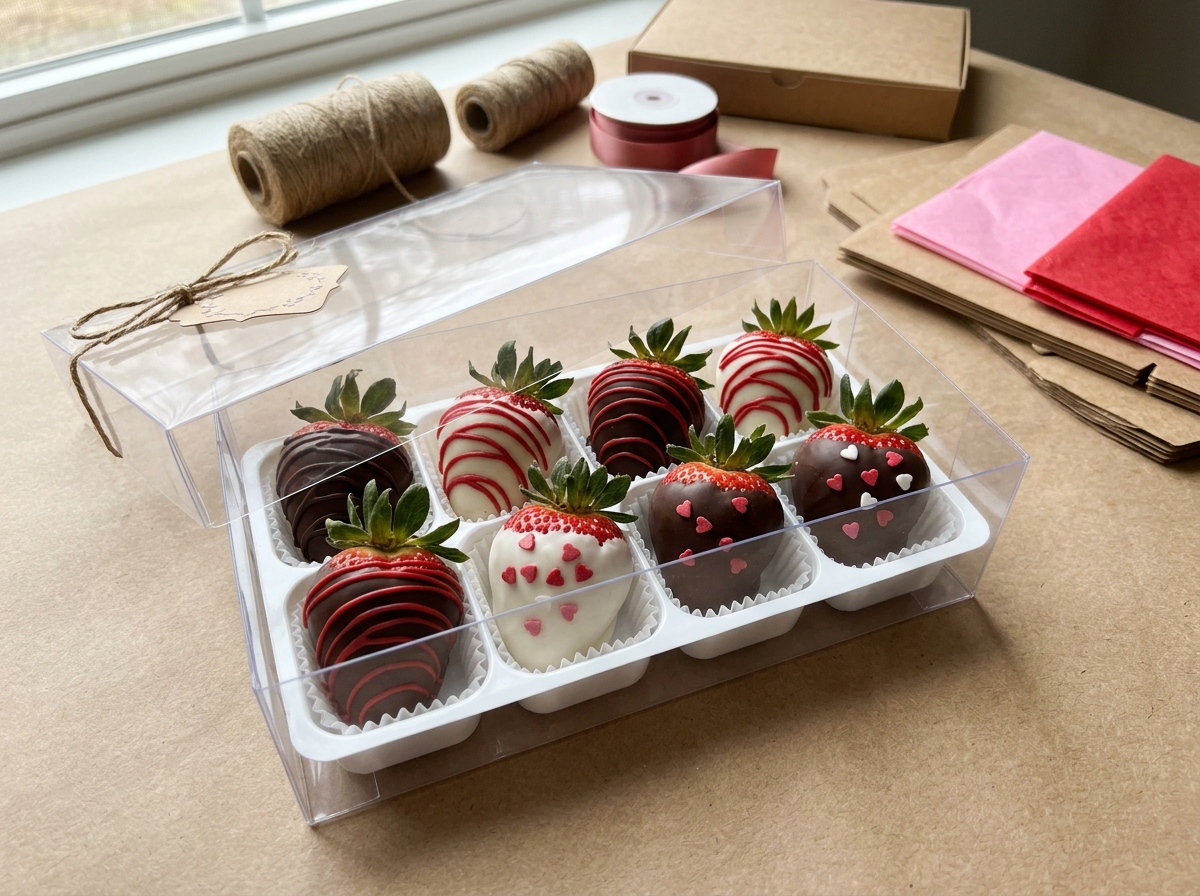
A dozen chocolate-covered strawberries is the most requested Valentine's format, and the standard box dimensions reflect that demand. Most twelve-count boxes measure 12 x 4.8 x 2 inches or 11.5 x 8.5 x 2 inches, depending on whether the baker arranges berries in a single row (12 x 1 grid) or a 3 x 4 grid.
The single-row format—12 inches long, roughly 5 inches wide, and 2 inches tall—creates a dramatic presentation that works well for charcuterie-style boxes with clear lids. Each berry sits in its own compartment, and the narrow profile makes the box easy to carry. The 3 x 4 grid format offers a more compact footprint (around 11.5 x 8.5 inches) and works better for stacking multiple orders in a delivery vehicle, though it requires a slightly taller box (2.5 inches) to prevent the lid from compressing the berries in the back rows.
When planning lead times for Valentine's Day orders, remember that twelve-count boxes often require higher minimum order quantities from suppliers, and custom insert trays may need to be ordered separately if your box supplier doesn't offer a matched set.
Insert trays are the unsung hero of chocolate-covered strawberry packaging. Without them, berries slide, tips, and collide, smearing chocolate across the box interior and ruining the presentation. A well-designed insert tray holds each berry in place, prevents surface contact, and makes it easy for customers to remove individual berries without disturbing the rest.
The standard cavity size for chocolate-covered strawberries is 2 x 2 x 1.5 inches, which accommodates a medium to large berry with a moderate chocolate coating. Bakers who dip berries in thick chocolate or add toppings (coconut flakes, crushed cookies, drizzled white chocolate) should opt for 2.25 x 2.25-inch cavities to prevent the toppings from scraping against the cavity walls.
Spacing between cavities—the wall thickness of the insert tray—should be at least 0.25 inches to provide structural integrity. Thinner walls (0.125 inches) can collapse under the weight of the berries, especially in humid conditions when the paperboard absorbs moisture from the fruit. A 0.75-inch minimum spacing between berry surfaces prevents chocolate transfer if a berry shifts slightly during transport.
Insert trays come in two primary materials: clear PET plastic and food-safe paperboard. Clear PET inserts are rigid, reusable, and showcase the berries from all angles, making them ideal for clear acrylic boxes where visibility is the selling point. They're also easy to clean and can be reused by customers for storage, which adds perceived value to the purchase.
Paperboard inserts are less expensive, fully recyclable, and better suited for kraft or windowed boxes where the insert is hidden beneath the berries. Food-grade paperboard must meet FDA food contact standards, particularly when the chocolate-coated berries sit directly in the cavities without individual wrappers. Suppliers should confirm that the paperboard is coated with a food-safe barrier that prevents grease migration and doesn't impart any odor or flavor to the chocolate.
One of the most common packaging failures with chocolate-covered strawberries is insufficient height clearance. If the box lid presses down on the tallest berry, it smears the chocolate, flattens any decorative drizzle, and can even cause the berry to detach from its stem. The result is a box that looks damaged before the customer even opens it.
As a rule, the interior height of the box should be at least 0.5 inches taller than the tallest berry when seated in the insert tray. For most medium to large strawberries, this means a box height of 2 to 2.5 inches. Jumbo berries—those over 2 inches tall from base to tip—require a 3-inch box, and berries with long stems left intact may need up to 3.5 inches of clearance.
Bakers who trim stems to a uniform length can use shorter boxes, which reduces packaging costs and makes the boxes easier to stack. However, many customers prefer the visual appeal of intact stems, particularly for Valentine's Day gifts where presentation is paramount. The trade-off is worth considering when selecting box dimensions and discussing expectations with customers at the point of sale.
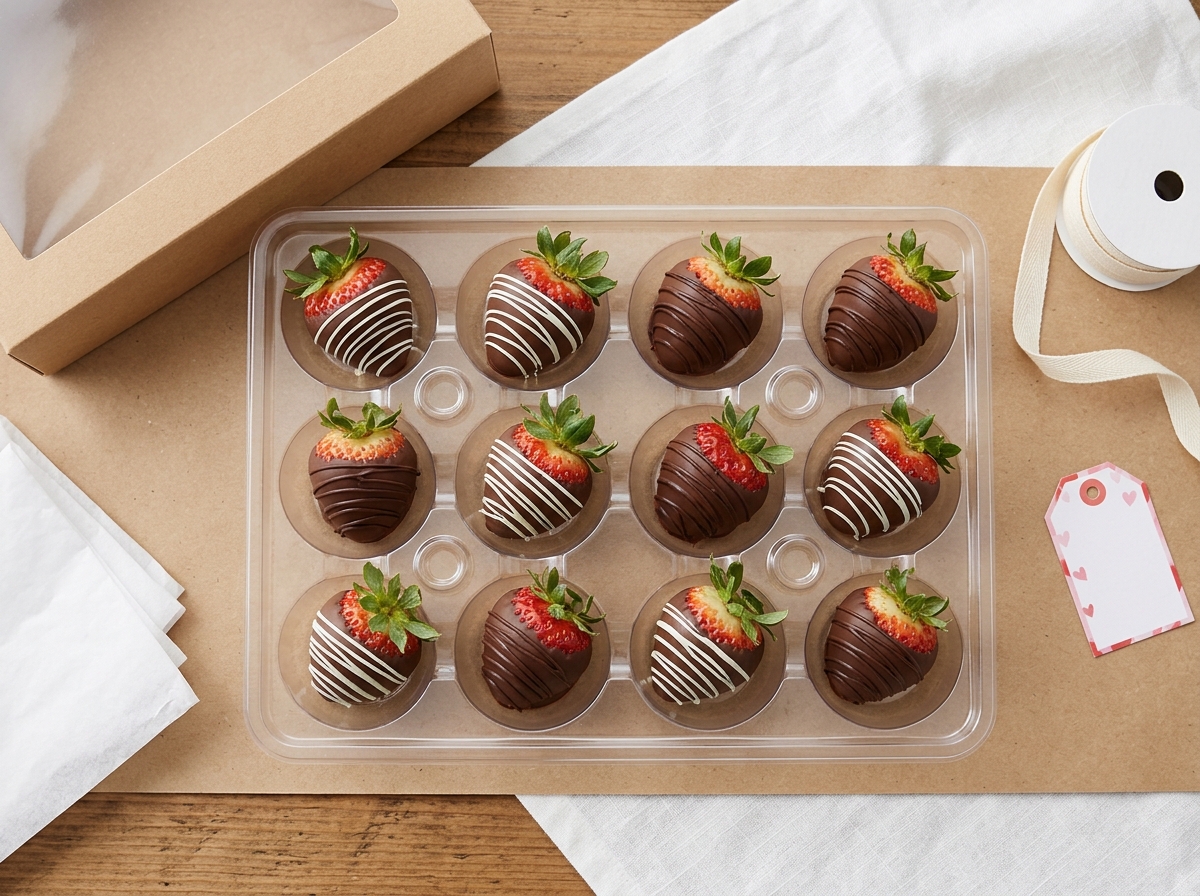
The choice between a windowed paperboard box and a full-clear acrylic box often comes down to price point, brand positioning, and customer preference. Both formats have distinct advantages, and many bakeries offer both to serve different segments of their Valentine's Day customer base.
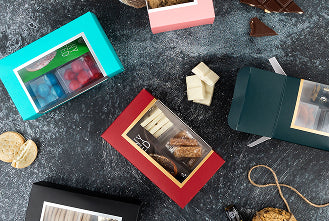
Windowed boxes—typically kraft or white paperboard with a clear PET window on the lid—offer a balance of visibility and traditional gift-box appeal. The window allows customers to see the berries without opening the box, which is critical for impulse purchases in retail settings, while the paperboard base provides a sturdy structure that protects the berries during transport.
These boxes are also easier to label, either with a printed brand logo on the paperboard or a sticker applied to the lid. For bakeries that want to include care instructions (e.g., "Refrigerate upon arrival" or "Consume within 48 hours"), the paperboard surface provides a natural place for that messaging. Windowed boxes are generally less expensive than full-clear acrylic, making them a better choice for high-volume Valentine's orders where margins are tight.
For more on how different candy box formats perform in Valentine's sales, see our comparison of heart-shaped candy boxes vs. clear acrylic.
Clear acrylic boxes showcase chocolate-covered strawberries from every angle, creating a premium presentation that justifies a higher price point. These boxes work particularly well for berries with elaborate decorations—drizzled chocolate, edible gold leaf, or hand-piped designs—where the craftsmanship is part of the product's value.
Acrylic boxes are also reusable, which appeals to eco-conscious customers who appreciate packaging that doesn't end up in the trash after a single use. The rigid structure provides excellent protection during delivery, and the clear material eliminates any concern about color coordination with Valentine's Day themes. However, acrylic boxes are heavier and more expensive to ship, and they require careful handling to avoid scratches that can make the box look worn before it reaches the customer.
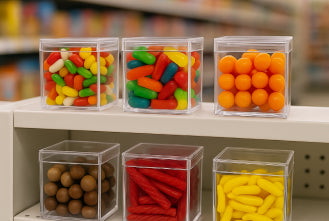
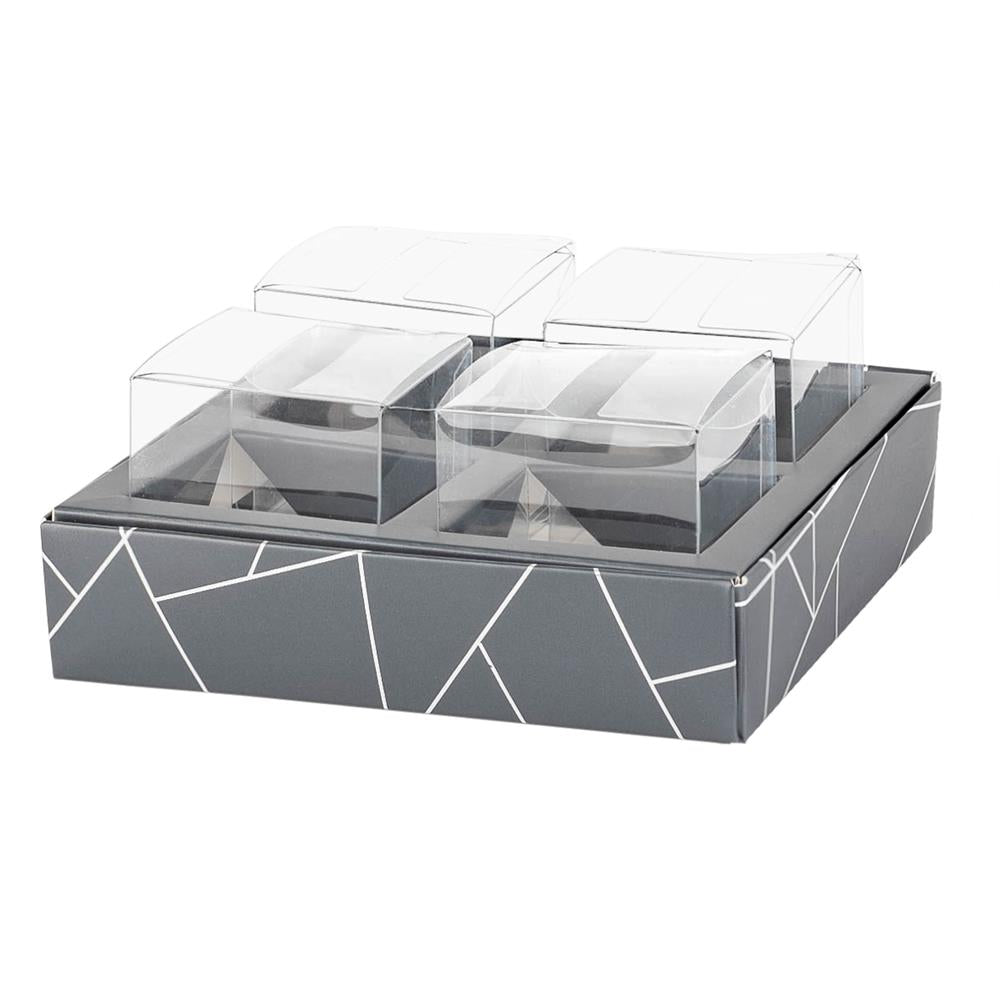
Hammont's clear acrylic boxes are designed for storage, display, or gifting, and their square profile works well for four-count strawberry arrangements when paired with a custom insert tray.
Charcuterie-style boxes—long, shallow boxes with a single row of compartments—have become a popular format for chocolate-covered strawberries, particularly for Valentine's Day orders that emphasize visual impact over compact portability. These boxes typically measure 12 to 14 inches long, 4 to 5 inches wide, and 2 inches tall, creating a horizontal display that mimics the aesthetic of a charcuterie board.
The single-layer format eliminates the risk of berries in back rows being obscured by those in front, and the wide footprint allows for creative arrangements that alternate berry sizes or colors (e.g., white chocolate, milk chocolate, and dark chocolate). The shallow depth also reduces the risk of lid compression, since there's less vertical distance for the box to flex during transport.
However, charcuterie-style boxes are harder to stack, which can be a logistical challenge for bakeries fulfilling dozens of Valentine's orders in a single day. They also require more shelf space in retail displays, and the long profile makes them awkward to carry without a handle or ribbon tie. For these reasons, many bakeries reserve charcuterie-style boxes for premium orders or custom requests, while using more compact 3 x 4 grid boxes for standard dozen orders.
Any packaging that comes into direct contact with food must meet FDA food contact standards, and chocolate-covered strawberries are no exception. The chocolate coating, the fruit, and any toppings all interact with the box interior and insert tray, so every material in the packaging assembly must be certified food-safe.
For paperboard boxes, this means using virgin fiber board (such as SBS, or solid bleached sulfate) with a food-safe coating that prevents grease migration and doesn't leach chemicals into the chocolate. Recycled paperboard is generally not recommended for direct food contact unless the supplier can provide documentation that the material has been processed to remove contaminants.
For clear boxes, the PET or acrylic material must meet FDA standards for food contact, and any adhesives or coatings used in the box assembly must also be food-safe. Window films—the clear PET panels in windowed boxes—must be explicitly certified for food contact, not just general-purpose transparency film. Suppliers should be able to provide a Letter of Guarantee or Certificate of Compliance upon request, confirming that all materials meet 21 CFR Parts 174-186 for the intended use case.
Bakeries operating under cottage food laws or selling through farmers markets should verify that their local health department doesn't have additional packaging requirements beyond federal FDA standards. Some states require tamper-evident seals or specific labeling on food packaging, even for products sold directly to consumers.
Not all strawberries are created equal, and berry size variation is one of the most common causes of packaging mismatch. A box designed for medium berries will leave large berries cramped and small berries rattling around in oversized cavities. To avoid this, many bakeries sort berries by size before dipping and assign each size category to a specific box format.
Small berries (under 1.5 inches tall) work well in 4 x 4 x 2.5-inch boxes with 1.75 x 1.75-inch cavities. Medium berries (1.5 to 2 inches tall) fit comfortably in the standard 2 x 2-inch cavities found in most six- and twelve-count boxes. Large berries (2 to 2.5 inches tall) require 2.25 x 2.25-inch cavities and a box height of at least 2.5 inches. Jumbo berries (over 2.5 inches tall) are best packaged individually or in small counts (two or four per box) using 3 x 3-inch cavities and a 3-inch box height.
Bakeries that don't want to stock multiple box sizes can trim berry stems to a uniform height, which allows for more consistent packaging across a wider range of berry sizes. However, this approach sacrifices some of the visual appeal of intact stems, which many customers associate with freshness and artisanal quality.
Many bakeries offer combination boxes that pair chocolate-covered strawberries with other Valentine treats—truffles, cookies, or chocolate bark—to create a more substantial gift. These boxes require careful planning to ensure that each item has adequate space and that flavors and textures don't cross-contaminate.
A common format is an 8 x 8 x 3-inch box divided into sections: four chocolate-covered strawberries in one quadrant, a selection of truffles in another, and a few decorated cookies in the remaining space. Dividers or sectional inserts keep the items separated, and the larger footprint allows for more creative arrangements. For guidance on sizing boxes for truffles and bark, see our guide to clear window gift boxes for Valentine candy.
Combination boxes also benefit from clear cellophane wrap over the top, which holds the lid in place during transport and adds a finished, gift-ready appearance. The cellophane also provides a light moisture barrier, which is helpful when the box contains both chocolate-covered strawberries (which release moisture) and dry items like cookies (which absorb moisture).
For bakeries that prioritize cost over presentation, cellophane bags offer a budget-friendly alternative to rigid boxes. Individual chocolate-covered strawberries can be placed in small clear bags (4 x 6 inches or 5 x 7 inches), tied with a ribbon, and sold as single-serving treats or bundled into larger gift sets.
This approach works well for Valentine's Day classroom exchanges, where parents need to purchase 20 to 30 individual treats, or for bakeries selling at farmers markets where customers prefer to buy a few berries at a time rather than committing to a full dozen. However, cellophane bags don't provide the same level of protection as rigid boxes, and berries are more prone to shifting and smudging during transport.
For more on when to use bags versus boxes for Valentine candy, see our cost and presentation comparison of cellophane bags vs. rigid boxes.
Because chocolate-covered strawberries are perishable, clear labeling is essential to manage customer expectations and reduce the risk of complaints about spoilage. At minimum, the box should include a "consume within" date (typically 48 to 72 hours from the time of dipping) and storage instructions ("refrigerate upon arrival" or "store at 40°F or below").
Many bakeries also include a small card or sticker with handling tips: "Allow berries to come to room temperature for 10 minutes before serving for best flavor" or "Store uncovered in the refrigerator to prevent condensation." These instructions help customers understand that chocolate-covered strawberries are a fresh product, not a shelf-stable candy, and that proper handling is necessary to preserve quality.
For bakeries that offer allergen-free or vegan options (e.g., dairy-free chocolate, gluten-free toppings), the label should clearly state the ingredients and any relevant certifications. This is particularly important for Valentine's Day orders, when many customers are purchasing gifts for people whose dietary restrictions they may not know in detail.
Most bakers use a 12 x 4.8 x 2-inch box for a single-row arrangement or an 11.5 x 8.5 x 2.5-inch box for a 3 x 4 grid layout. The single-row format creates a dramatic presentation, while the grid format is more compact for stacking and delivery. Both require insert trays with 2 x 2-inch cavities to keep berries upright and separated.
Yes. Any packaging that comes into direct contact with chocolate-covered strawberries must meet FDA food contact standards. This includes the box interior, insert tray, and any window film. Look for suppliers who can provide a Letter of Guarantee confirming that materials comply with 21 CFR Parts 174-186 for food contact use.
Interior height should be at least 0.5 inches taller than your tallest berry when seated in the insert tray. For most medium to large strawberries, a 2 to 2.5-inch box height works well. Jumbo berries or berries with long stems intact may require 3 to 3.5 inches of clearance to prevent the lid from compressing the chocolate coating.
Yes. Clear acrylic boxes showcase berries from all angles and create a premium presentation that justifies a higher price point. Make sure the acrylic is food-safe and pair the box with a PET insert tray to hold berries in place. Acrylic boxes are heavier and more expensive to ship than paperboard, but they're reusable, which adds value for customers.
Clear PET plastic inserts are rigid, reusable, and showcase berries from all sides, making them ideal for clear boxes. Food-safe paperboard inserts are less expensive, fully recyclable, and work well for kraft or windowed boxes where the insert is hidden. Both materials must meet FDA food contact standards and provide cavities that prevent berry-to-berry contact during transport.
Packaging chocolate-covered strawberries successfully means matching box dimensions to berry size, using insert trays that prevent surface contact, and selecting materials that meet food safety standards while supporting your brand's presentation goals. Whether you're selling four-count gift boxes in a retail case or fulfilling dozens of twelve-count orders for Valentine's Day delivery, the right combination of box footprint, height clearance, and insert tray design ensures that your berries arrive looking as good as they did when they left your kitchen.
For bakeries planning their Valentine's packaging strategy, remember to order boxes and inserts early—lead times for custom insert trays can extend to four weeks during peak season, and standard box inventory often sells out by mid-January. Stock a range of sizes to accommodate different berry counts and customer budgets, and consider offering both windowed paperboard and clear acrylic formats to serve customers at different price points. With the right packaging in place, your chocolate-covered strawberries become a gift-ready product that sells itself.